
Loading...

Companies now make business decisions faster than ever, driving increased reliance on AI-driven data analytics to stay competitive. According to Gartner's 2024 report, worldwide spending on AI software is projected to reach $297 billion by 2027, with data analytics representing the largest segment of this investment.
Organizations are discovering that AI not only accelerates information processing but fundamentally transforms their approach to business strategy. When companies can predict customer behavior, spot problems before they happen, and uncover opportunities hidden in their data, they're not just keeping up with competitors. They're getting ahead of them.

AI analytics combines artificial intelligence with traditional data analysis methods to enhance business intelligence and improve decision-making processes. Traditional data analysis involves asking specific questions and receiving specific answers. For example, companies run reports to analyze sales data or create queries to track customer demographics.
AI analytics works differently by automatically scanning all available data to find unknown patterns. These systems identify emerging trends and predict future outcomes by analyzing patterns and historical data. Traditional methods show what happened last month, while AI analytics show what is likely to happen next quarter.
The gap between traditional and AI-powered analytics becomes most apparent in how they handle complexity and time.
Traditional analyticsAI-powered analyticsAnalysts create queries manually and explore datasets step by step.Algorithms automatically scan massive datasets to find patterns.Reports are generated on fixed schedules with static information.Insights update in real-time and adapt to changing business conditions.All insights require manual interpretation and explanation.AI-powered systems generate recommendations and explanations automatically.Analysis follows a reactive model, revealing outcomes after events occur.Analysis employs predictive modeling to forecast likely outcomes before they materialize.Best suited for structured data and known questions.Handles both structured and unstructured data with unknown variables.
The shift from reactive to proactive analysis changes everything. Traditional methods tell you what happened, but AI analytics predicts what will happen and suggests what you should do about it.

AI transforms every aspect of data handling, from automated cleaning and predictive modeling to real-time processing and pattern recognition, making advanced analytics accessible to businesses of all sizes.
Data preparation typically consumes the majority of an analyst's time; however, AI can automate these tedious tasks. Machine learning algorithms excel at recognizing data quality issues, standardizing formats, and applying consistent cleaning rules across massive datasets.
Alteryx has built its platform around this concept, enabling data scientists to focus on generating insights rather than performing data preparation tasks.
Businesses use predictive models to anticipate future trends and outcomes before they materialize. These AI-driven forecasting systems analyze historical patterns, seasonal variations, and external factors to generate accurate predictions.
Walmart utilizes AI-powered forecasting to predict demand for millions of products across thousands of stores, reducing inventory costs while maintaining optimal stock levels.
These systems analyze weather patterns, local events, and purchase history to generate accurate demand forecasts.
Traditional analytics tells you what happened last week or last month, but AI gives you insights while events are still happening. These intelligent systems continuously monitor data streams, providing immediate alerts when they detect significant trends, anomalies, or emerging opportunities.
Uber processes millions of ride requests in real-time, using AI to set prices, predict where demand will spike, and match drivers with passengers. This instant analysis prevents service disruptions and maximizes revenue during busy periods.
Automated systems continuously scan data streams to identify unusual patterns that may indicate fraud, equipment failures, or unexpected market opportunities. These AI models establish baseline behavior patterns and identify subtle deviations that may escape human detection.
Mastercard utilizes AI to analyze transaction patterns in milliseconds, flagging potentially fraudulent activities while allowing legitimate purchases to proceed. This methodology improves fraud detection accuracy while minimizing false positive alerts.
Natural Language Processing (NLP) extracts insights from unstructured text data that conventional analytics tools cannot process. This includes customer reviews, social media posts, emails, support tickets, and other unstructured content that contains valuable business intelligence.
Twitter generates terabytes of text data daily. AI-powered sentiment analysis enables brands to monitor public perception, identify emerging issues, and evaluate campaign effectiveness across multiple languages and cultural contexts.
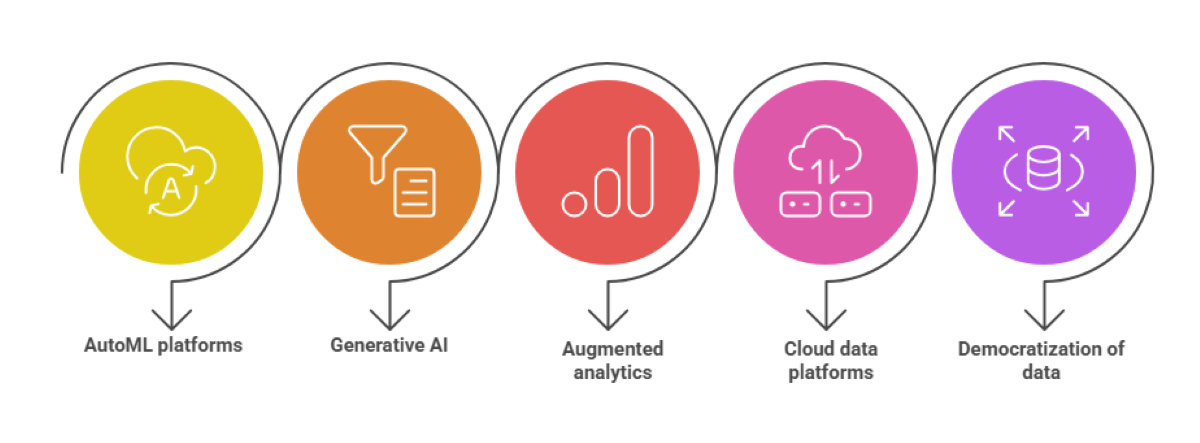
AI analytics is transforming at breakneck speed, with breakthrough technologies democratizing sophisticated data analysis for businesses of all sizes and industries.
Automated Machine Learning (AutoML) democratizes AI analytics by reducing dependency on specialized data science expertise for standard use cases.
Google's AutoML and Microsoft's Azure AutoML enable business analysts to build sophisticated predictive models using drag-and-drop interfaces, streamlining the process. Organizations can deploy AI solutions within weeks rather than months, significantly reducing implementation costs and technical complexity.
Large Language Models (LLMs) are transforming the creation and consumption of organizational reports, enhancing the accessibility and actionable insights.
Tools like ChatGPT and Claude can now generate executive summaries, create visualizations, and even write analysis reports based on dataset inputs. This functionality enables teams to generate comprehensive reports within minutes rather than days.
Language models enhance traditional analytics by providing natural language interfaces and automated insight generation that non-technical users can easily understand.
Tableau and Power BI now integrate conversational interfaces, allowing users to ask questions in plain English and receive instant visualizations and explanations. This approach removes the technical barriers that previously limited the adoption of analytics.
Cloud-native AI analytics platforms offer scalability and integration capabilities that surpass those of traditional on-premises solutions.
Amazon Web Services, Microsoft Azure, and Google Cloud Platform provide integrated analytics ecosystems. These platforms enable seamless collaboration between data storage, processing, and AI modeling while reducing complexity and improving performance.
AI-powered interfaces make complex data analysis accessible to employees across all departments, not just technical specialists.
Companies like ThoughtSpot have built search-driven analytics platforms that enable marketing managers, sales directors, and operations teams to explore data using natural language queries, thereby eliminating their dependence on centralized IT teams.
Businesses often face major challenges when implementing AI analytics solutions, which is why thoughtful planning and the right approach are crucial.
Poor data quality remains the primary obstacle, with inconsistent datasets producing unreliable results that undermine business decisions.
Historical data often contains embedded biases that AI systems inadvertently perpetuate in their recommendations and automated decisions.
Many AI models operate as "black boxes," providing accurate predictions without clearly explaining their decision-making processes.
Existing IT infrastructure often lacks compatibility with modern AI analytics tools, creating expensive technical and integration barriers.
AI analytics requires substantial upfront investment in technology, talent, and infrastructure that many organizations find financially challenging.
Companies can select from various AI-powered solutions tailored to their specific needs, the technical expertise of their team, and budget.
Custom AI models address specific business problems that standard analytics platforms cannot effectively solve. These solutions require development time and expertise, but deliver unique competitive advantages.
AI-powered executive dashboards transform complex data into clear visual insights for leadership teams. These platforms automatically generate reports and highlight significant trends without requiring technical expertise from users.
Natural Language Processing tools analyze text and speech data to understand customer emotions and opinions. These systems monitor social media, customer reviews, and support conversations to identify potential issues early.
Big data AI platforms handle massive amounts of information that would overwhelm traditional analytics systems. These specialized tools use distributed computing to process terabytes of data quickly and efficiently.
Cloud-based AI platforms provide ready-to-use analytics tools, eliminating the need for extensive internal development resources. These services offer integrated environments where data storage, processing, and machine learning work together seamlessly.
Different industries utilize AI analytics to address their specific challenges and identify opportunities that align with their unique business requirements.
Healthcare organizations utilize AI analytics to enhance patient outcomes and lower costs by employing predictive modeling and early intervention strategies that identify issues before they escalate.
Financial institutions utilize AI analytics for risk management, regulatory compliance, and customer service optimization across all their business lines, continually adapting to new threats and market conditions.
Retail companies leverage AI analytics to optimize inventory management, personalize customer experiences, and forecast market demand, taking into account factors such as weather patterns, local events, and seasonal trends.
Manufacturing organizations utilize AI analytics to enhance production efficiency, minimize downtime, and maintain consistent product quality through automated monitoring that anticipates and prevents issues before they arise.
Marketing teams leverage AI analytics to understand customer preferences, optimize campaign performance, and predict customer lifetime value, thereby crafting personalized experiences that enhance engagement and drive revenue.
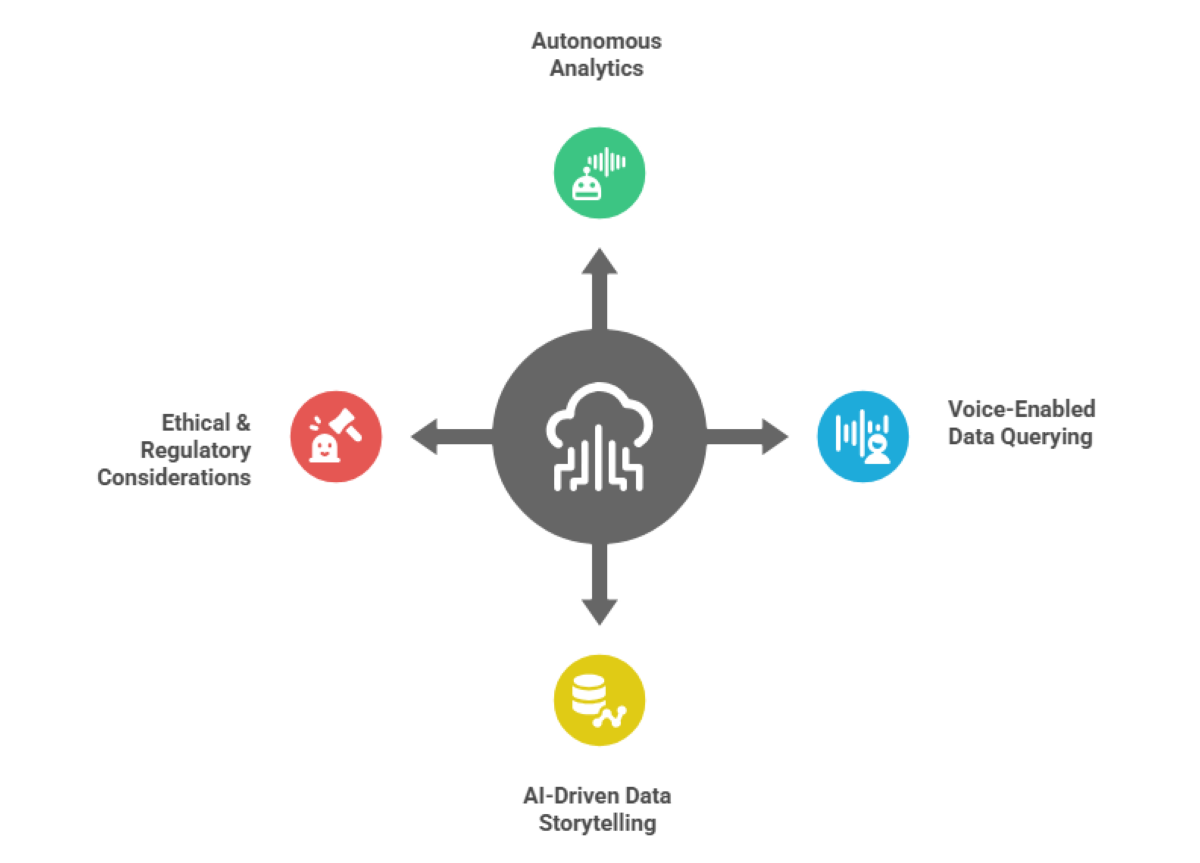
Emerging AI analytics trends indicate a progression toward autonomous, accessible, and ethically responsible systems that will fundamentally alter organizational data interaction.
Future AI systems will operate with minimal human intervention, automatically discovering insights, generating reports, and even implementing recommended actions within predefined parameters.
Organizations are developing AI systems capable of monitoring business metrics, identifying anomalies, investigating root causes, and proposing solutions with minimal human intervention. This autonomous approach will enable real-time optimization of complex business processes.
Natural language interfaces will make data analysis as simple as asking questions aloud, eliminating technical barriers that currently limit analytics adoption.
Voice-activated business intelligence systems will allow executives to query performance data during meetings, sales teams to check customer information while traveling, and operations managers to monitor systems hands-free.
Advanced AI will automatically generate compelling narratives that explain complex data insights in terms that non-technical stakeholders can easily understand and act upon.
Future analytics platforms will create presentation-ready stories that highlight key findings, explain their significance, and recommend specific actions, transforming raw data into persuasive business communications.
Growing awareness of AI's societal impact is driving the development of new regulations and ethical frameworks that will shape how organizations develop and deploy analytics solutions.
The European Union's AI Act and similar regulations worldwide are establishing requirements for transparency, fairness, and accountability in AI. Organizations must build compliance into their AI analytics strategies from the beginning.
Folio3 AI leverages expertise in predictive analytics, edge computing, and business intelligence to build custom AI-driven data analytics solutions tailored to your specific business requirements and industry needs.
Predictive analytics solutions: We develop machine learning models for fraud detection, customer behavior prediction, business forecasting, and risk assessment using historical data patterns to enable informed decision-making and competitive advantages.
Edge analytics & real-time processing: Our team builds intelligent edge computing solutions with interactive dashboards, real-time data processing capabilities, and automated insights generation for IoT devices and sensor-rich environments.
Business intelligence & visualization: We create custom BI systems with advanced data visualization, automated reporting, performance dashboards, and analytics integration to transform raw data into actionable business insights.

AI analytics uses machine learning algorithms and artificial intelligence to automatically analyze large datasets, identify patterns, and generate insights without manual intervention. It combines statistical analysis with predictive modeling to uncover hidden trends and make data-driven recommendations.
AI automates complex data processing tasks, enables real-time analysis of massive datasets, and provides predictive capabilities that traditional analytics cannot match. It reduces the time from data collection to actionable insights from weeks to minutes while improving accuracy.
AI analytics processes data faster than human analysts, identifies subtle patterns that might be missed manually, and provides predictive insights for better decision-making. It also scales automatically to handle growing data volumes without requiring additional human resources.
Popular tools include Python libraries (TensorFlow, scikit-learn), cloud platforms (AWS SageMaker, Google Analytics Intelligence), and business intelligence software (Tableau with AI features, Power BI). Specialized platforms, such as DataRobot and H2O.ai, offer no-code AI analytics solutions.
Businesses use AI analytics for customer segmentation, sales forecasting, fraud detection, and operational optimization. It helps identify market trends, predict customer behavior, and automate reporting processes to improve strategic decision-making.
Data quality issues, lack of skilled personnel, and integration complexity with existing systems are primary challenges. Organizations also face concerns about algorithm bias, data privacy compliance, and the need for significant upfront investment.
Traditional analytics relies on predefined rules and human-driven queries, while AI analytics automatically discovers patterns and adapts to new data. AI can handle unstructured data, provides predictive capabilities, and continuously learns to improve accuracy over time.
Healthcare, finance, retail, and manufacturing lead AI analytics adoption for applications like diagnostic imaging, fraud detection, personalized recommendations, and predictive maintenance. Technology companies and telecommunications also heavily utilize AI for operational optimization.
Edge analytics for real-time processing, automated machine learning (AutoML) for democratizing AI, and explainable AI for transparency are major trends. Integration with natural language processing for conversational analytics is also gaining momentum.
Yes, many platforms offer drag-and-drop interfaces and automated machine learning tools that require no coding knowledge. Tools like Tableau's Ask Data, Microsoft Power BI AI features, and Google Analytics Intelligence provide user-friendly AI analytics capabilities.