
Loading...
Almost all businesses today are working to find the answer to the same important question: how can we make faster, smarter decisions that keep us ahead of the competition? The answer increasingly lies in artificial intelligence, but choosing the right approach has become a make-or-break decision for organizations across every industry.
According to Statista's 2024 report, the global AI market is projected to reach $826 billion by 2030, with real-time processing capabilities driving much of this explosive growth. As companies race to implement AI solutions, they face a critical choice: Edge AI vs. Cloud AI.
Speed, privacy, and deployment strategies have become the defining factors in this decision that will shape your business's future. Understanding the differences between these approaches is essential for strategic intelligence that determines competitive advantage in an AI-driven marketplace.

Edge AI represents a paradigm shift toward localized intelligence, where artificial intelligence algorithms execute directly on devices, collecting data rather than relying on remote processing. This approach enables real-time decision-making at the source of data generation.
Edge AI's architecture consists of three fundamental components that enable autonomous, real-time processing capabilities directly on local devices without external dependencies.
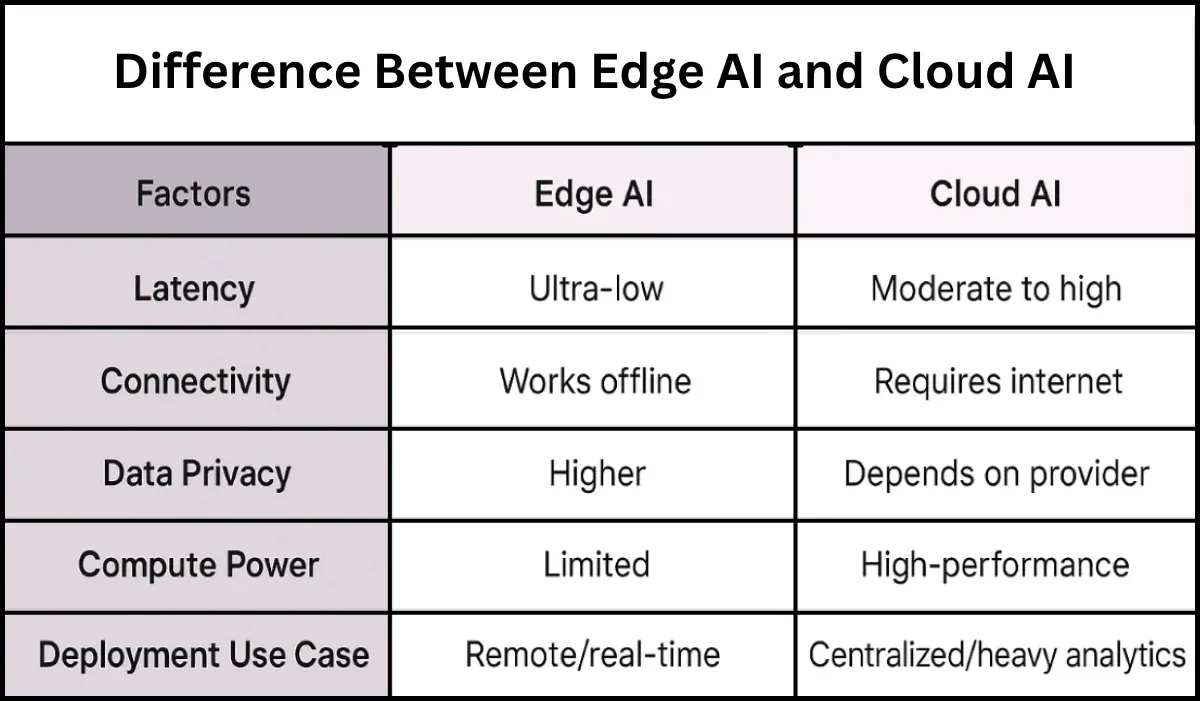
Edge AI achieves processing times measured in milliseconds by eliminating network communication delays. Devices make instantaneous decisions locally, enabling applications like autonomous vehicles and real-time security systems to respond immediately to changing conditions.
Edge AI systems maintain full functionality without internet connectivity, ensuring continuous operation in remote locations or during network failures. This independence proves critical for mission-critical applications that cannot afford downtime due to connectivity issues.
Trained AI models reside directly on hardware where data originates, processing inputs locally rather than transmitting raw information across networks. This approach reduces bandwidth usage while maintaining privacy and enabling immediate responses to local conditions.
Cloud AI harnesses the vast computational resources of remote data centers to deliver powerful artificial intelligence capabilities that exceed individual device limitations. This centralized approach enables complex processing, large-scale analytics, and resource sharing across multiple applications and users.
Cloud AI's infrastructure leverages three core components that provide scalable, powerful, and centralized artificial intelligence services accessible through internet connectivity for diverse applications.
Cloud AI dynamically adjusts computational resources based on demand, handling workloads from single queries to millions of simultaneous requests. This elasticity ensures optimal performance during peak periods while maintaining cost-effectiveness through pay-per-use models.
Cloud AI aggregates information from multiple sources to generate comprehensive insights impossible for isolated devices. This unified approach combines customer data, operational metrics, and external information to enable strategic decision-making and advanced analytics.
Cloud AI utilizes specialized hardware, including GPUs and TPUs, that accelerate complex AI training and inference tasks. These powerful resources enable sophisticated deep learning models requiring significant computational power for accurate, comprehensive results.
Organizations implementing AI solutions encounter specific obstacles that can derail projects and waste resources if not adequately addressed from the start.
Decision-making delays become critical when Cloud AI systems can't respond fast enough for real-time applications. Network latency, server processing queues, and data transmission delays combine to create response times that miss business-critical moments.
Bandwidth costs escalate quickly when constantly sending large amounts of data to cloud services for processing. Video streams, sensor data, and high-resolution images consume expensive network resources, particularly in remote locations where connectivity comes at a premium rate.
Data security and compliance concerns present risks when sensitive information travels across networks to third-party cloud providers. Healthcare records, financial transactions, and proprietary business data face additional exposure risks during transmission and storage outside your direct control.
Scaling edge infrastructure presents unique challenges, as adding processing power requires physical hardware deployment rather than simply upgrading cloud service plans. Each new location needs its own computing resources, maintenance protocols, and technical support capabilities.
Cost comparison between hardware investments and cloud services becomes complex when factoring in long-term operational expenses, maintenance requirements, and the total cost of ownership for different deployment scenarios across your organization.
Understanding where each AI approach excels helps you match technology choices with business requirements and operational constraints.
Edge AI shines in scenarios where immediate response times and local decision-making create competitive advantages or operational necessities.
Autonomous vehicles represent the most demanding Edge AI application, where split-second decisions about steering, braking, and navigation can't wait for cloud processing. Vehicles must respond to obstacles, traffic changes, and road conditions instantly using onboard AI systems that process sensor data in real-time.
Industrial robotics relies on Edge AI for precise manufacturing operations where millisecond timing affects product quality and worker safety. Assembly line robots, welding systems, and quality control cameras need immediate feedback to maintain production standards without network dependency.
Remote monitoring applications in oil rigs, agricultural fields, and mining operations use Edge AI, where internet connectivity is unreliable or expensive. Sensors detect equipment failures, environmental changes, and security threats while operating independently in challenging locations.
Smart cities and traffic management systems deploy Edge AI in traffic lights, surveillance cameras, and environmental sensors to respond immediately to changing conditions. Traffic flow optimization, emergency response coordination, and public safety monitoring all benefit from distributed intelligence that acts locally while contributing to citywide coordination.
Cloud AI excels when computational requirements exceed individual device capabilities or when centralized intelligence provides strategic advantages.
Big data analytics requires the massive processing power and storage capacity that only cloud infrastructure can provide economically. Companies analyze customer behavior patterns, market trends, and operational efficiency metrics using datasets too large for edge devices to handle effectively.
Chatbots and recommendation systems benefit from Cloud AI's ability to access comprehensive user databases, product catalogs, and behavioral models that improve with scale. Netflix's recommendation engine, Amazon's product suggestions, and customer service chatbots all leverage centralized intelligence that gets smarter with more data.
Fraud detection systems use Cloud AI to analyze transaction patterns across entire financial networks, identifying suspicious activities by comparing individual transactions against global fraud databases and behavioral models that require constant updates and massive computational resources.
AI model training at scale demands specialized hardware, extensive datasets, and significant computational time, which makes cloud infrastructure the only practical choice. Training large language models, computer vision systems, and complex neural networks requires resources that far exceed what individual organizations can maintain cost-effectively.
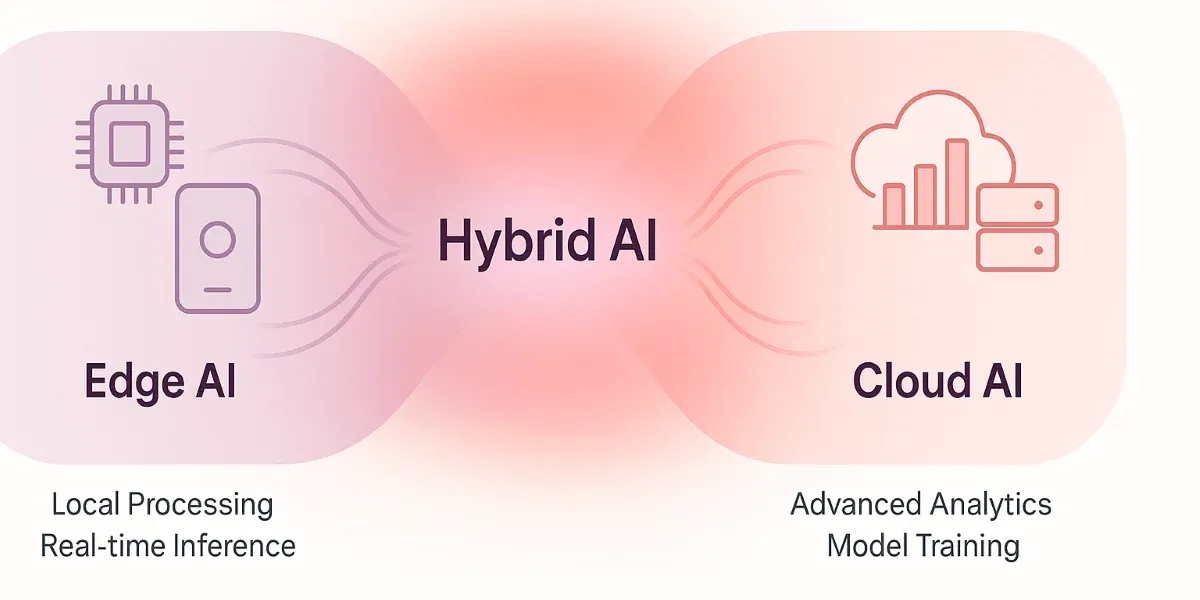
Many enterprises are discovering that combining edge and cloud capabilities creates more effective AI solutions than choosing one approach exclusively.
Smart pipeline architectures perform inference at the edge for immediate responses while using cloud resources for model training, updates, and complex analytics. This combination provides fast local decision-making with the benefits of centralized intelligence and continuous improvement.
Healthcare organizations use hybrid approaches where patient monitoring devices make immediate decisions about critical situations using Edge AI, while sending data to cloud systems for trend analysis, treatment optimization, and medical research that benefits from larger datasets.
Retail companies deploy Edge AI in stores for real-time inventory tracking, customer behavior analysis, and point-of-sale optimization, while using Cloud AI for supply chain management, demand forecasting, and personalized marketing campaigns that require comprehensive customer data analysis.
Manufacturing operations use a hybrid approach that leverages both AI technologies. Edge AI handles real-time quality control, predictive maintenance, and safety monitoring at individual facilities. Meanwhile, Cloud AI manages supply chain optimization, production planning, and performance analysis across multiple locations, providing the centralized coordination and strategic insights that enterprise operations require.
Folio3 helps organizations navigate AI deployment complexities by providing comprehensive solutions that match technology choices with business objectives, leveraging 15+ years of experience and 30+ AWS-certified experts.
We design and implement edge solutions using computer vision, sensor processing, and real-time inference capabilities that operate reliably in challenging environments while maintaining optimal performance standards.
Our team develops scalable systems across AWS, Azure, and Google Cloud platforms that efficiently handle varying workloads while optimizing costs, security, and operational requirements.
We create custom large language models, fine-tune using proprietary data, and seamlessly integrate multi-modal AI solutions that enhance productivity and deliver exceptional user experiences.
We specialize in optimizing AI models for edge deployment through quantization, pruning, and knowledge distillation techniques that significantly reduce computational requirements while preserving accuracy for resource-constrained devices.
Our comprehensive framework ensures edge deployments maintain robust security postures with encrypted data transmission, secure boot processes, and regulatory compliance measures tailored to industry-specific requirements and regional data protection laws.

Edge AI processes artificial intelligence algorithms directly on devices where data is generated, rather than sending information to remote servers. It's used when immediate responses, offline operation, or data privacy requirements make local processing more advantageous than cloud-based alternatives.
Cloud AI processes data in centralized data centers with powerful computing resources, while Edge AI processes data locally on individual devices. Cloud AI offers superior computational power and scalability, while Edge AI provides faster response times and better privacy control.
Yes, Edge AI typically provides faster response times because processing happens locally without network delays. Cloud AI must transmit data back and forth across networks, adding latency that Edge AI avoids through local computation.
Edge AI eliminates network latency, operates without internet connectivity, reduces bandwidth costs, and keeps sensitive data local. These benefits make it ideal for applications requiring swift processing or operating in remote locations with limited connectivity.
Cloud AI faces network latency delays, requires stable internet connectivity, and depends on data transmission speeds that can create bottlenecks. These limitations make it less suitable for applications requiring prompt actions or operating in areas with unreliable networks.
Yes, Edge AI systems operate independently of internet connectivity once AI models are deployed to edge devices. This offline capability makes Edge AI particularly valuable for remote locations, mobile applications, and mission-critical systems that can't rely on network availability.
Autonomous vehicles, smart security cameras, industrial robotics, medical monitoring devices, and smart city infrastructure all use Edge AI. These applications require instant data handling that makes local processing more effective than cloud-based alternatives.
Consider your latency requirements, connectivity constraints, data privacy needs, computational requirements, and cost considerations. Edge AI suits real-time applications with offline requirements, while Cloud AI works better for complex analytics requiring significant computational resources.
Google uses both approaches: Google Assistant uses Edge AI for voice processing on devices while leveraging Cloud AI for complex queries, and Google Photos uses Edge AI for basic image recognition while using Cloud AI for advanced features and storage.
Edge AI requires upfront hardware investments but reduces ongoing bandwidth and cloud service costs, while Cloud AI eliminates hardware expenses but creates ongoing operational costs that scale with usage. Total cost depends on your specific deployment requirements and usage patterns.