Loading...

AI agents are moving from experiments to production systems, and leaders face a familiar tradeoff: go fast with no-code tools or build for scale with custom code. If your goal is rapid validation, business-user ownership, and low lift, no-code wins. If you need deep integration, fine-grained control, or strict compliance, custom development is the safer long game.
In 2026, the smartest path is often hybrid, prototype with a visual AI agent builder, then graduate critical workflows to engineered, governed, and scalable agentic AI. This guide walks you through the practical differences between No‑code vs custom-coded AI agents, costs, timelines, and when each approach delivers the best ROI.
No-code AI platforms let teams build and deploy agents using visual programming, drag-and-drop components, and prebuilt integrations, with no programming required. They are ideal for fast iteration and business-owned automation.
Custom-coded AI agents (pro-code) are engineered by developers, enabling full control over models, logic, integrations, and infrastructure, at the cost of longer timelines and specialized skills. The distinction matters because it determines who owns delivery (business vs. engineering), how fast you can ship, and how far you can scale.
Most organizations also consider low-code AI as a middle ground: visual workflow tools with selective extensibility via code when needed. Across this spectrum, agentic AI refers to systems that can perceive, decide, and act across tools and data to complete multi-step objectives.

The choice comes down to speed and accessibility versus depth and control.
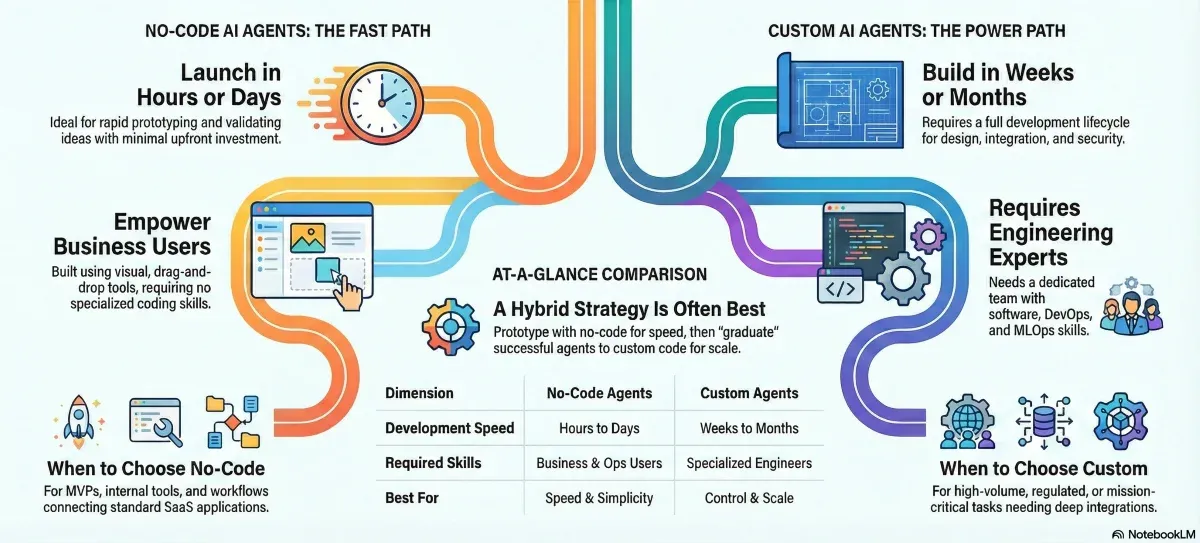
DimensionNo-code (visual workflow tools, drag-and-drop agent builder)Custom (engineered agents)Required skillsetsBusiness ops, product; minimal codingSoftware engineering, DevOps, MLOpsDevelopment speedHours to days for usable prototypesWeeks to months for production-grade systemsCustomizationLimited to platform features and pluginsFull control over logic, models, data, and toolingIntegration depthBroad SaaS connectors; shallow custom APIsDeep legacy/system integrations and bespoke adaptersScalability & performanceGood for modest throughputDesigned for high volume, concurrency, and SLAsGovernance & securityBasic roles/logs; vendor-controlledEnterprise IAM, versioning, auditability, and on-prem optionsOngoing costsSubscription-based; per-seat/usage feesInfra + maintenance; potential lower unit costs at scaleVendor lock-inHigher (platform dependency)Lower with open-source or portable architecturesSupport modelVendor support, communityInternal team, SI/partner, vendor support, where applicable
The speed and accessibility of no-code come from ready-made components, while custom-coded agents trade time for deep functional flexibility and enterprise features, including multi-agent orchestration and advanced policies.
Use this checklist to narrow your path:
Development timeline: Are you targeting a same-week pilot or a quarter-long rollout?
Integration needs: Do you primarily connect SaaS apps, or must you touch legacy, ERP, or custom data services?
Scalability: Expected users, requests per minute, data volumes, and concurrency.
Governance and compliance: Audit trails, data residency, PII handling, model governance, and change control.
Security posture: SSO/IAM, secrets management, network/isolation requirements, and on-prem/virtual private cloud needs.
Cost structure: Budget for licenses vs. engineering; long-term unit economics; vendor lock-in risk.
Ownership and agility: Business-led iteration vs. engineering-led lifecycle and release management.
In practice, no-code excels for proofs-of-concept and fast iteration, while pro-code fits performance-critical or regulated environments.
Rapid prototyping is the fast creation of a functional, testable AI agent using streamlined platforms, typically within a day to a week. No-code tools can often deliver working prototypes the same day, with light UAT in a few days. Custom agents move from discovery and architecture to implementation, integration, and hardening, usually in several weeks to a few months, depending on scope and dependencies.
Typical path comparison:
No-code
Ideation and prompt/workflow design: hours
Configure integrations and test: 1–3 days
Pilot with a team: 3–10 days
Custom
Discovery and system design: 1–3 weeks
Build core agent logic and services: 2–6 weeks
Integrations, security, governance: 3–8 weeks
Performance hardening and rollout: 2–4 weeks
Custom agents support advanced logic, specialized model selection and fine-tuning, vectorized and long-horizon memory, and robust multi-agent orchestration. They are better suited to unique workflows, domain-heavy processes, strict compliance, and high transaction volumes where long-term extensibility matters. No-code platforms typically limit deep configuration, can constrain performance at scale, and may cap multi-agent complexity or extensibility.
Tradeoffs to consider:
No-code: rapid value, constrained depth, higher platform dependency.
Custom: slower start, higher control, better scale, and portability.
Low-code: blend of both—visual workflows with code escape hatches.
No-code platforms shine with out-of-the-box connectors across productivity suites, CRMs, ticketing, and storage. However, versioning, approvals, granular RBAC, and auditability are typically more mature in custom-engineered environments, where you can enforce enterprise IAM, secrets management, and policy-as-code. Pro-code also enables custom security configurations, private networking, and on-prem deployments for sensitive workloads—key for enterprise AI automation.
Data governance means the policies, roles, processes, and controls that ensure secure, compliant, and auditable handling of business data across the AI lifecycle.
For regulated teams, custom approaches provide clearer pathways to meet data residency, encryption, model isolation, and traceability.
Expect different cost curves:
No-code: SaaS/subscription models with per-seat or usage tiers; typical paid plans range roughly $20–$100+/month, with enterprise tiers higher. Tools like n8n, Lindy, Dify, and others are commonly cited in 2026 low-code roundups for their approachable pricing and fast starts.
Custom: Higher upfront engineering costs; potentially lower recurring vendor fees if self-hosted or built on open-source. Infra, monitoring, and maintenance shift to your team.
Open-source code stacks: Minimal license fees, but require skilled developers and sustained ownership.
Illustrative examples:
n8n: ~from $20/mo SaaS; self-hosting available
Zapier: paid plans from about $19.99/mo
Lindy AI: from ~$25/mo
Dify: open-source with managed options
OpenAI Custom GPTs: bundled with ChatGPT plans; limited native integrations
Note: Prices vary by usage and enterprise add-ons; verify current tiers before committing.
Match approach to workload and risk:
Industry/Use CaseRecommended ApproachRationaleInternal operations automationNo-code or low-codeQuick wins with SaaS connectors and visual workflowsCustomer support FAQs/triageNo-code to start; custom at scaleFast iteration; migrate for SLAs, analytics, and integrationsSales ops and CRM enrichmentNo-codeMature connectors; low complexityRegulated healthcare workflowsCustomCompliance, PHI controls, auditabilityManufacturing quality insightsCustomReal-time data, edge/OT integration, reliabilityFinance, underwriting, and riskCustomModel governance, explainability, and data lineageMarketing content opsNo-codeSpeed and business ownershipEnterprise knowledge assistantsHybridStart no-code; scale to RAG, access controls, and telemetry
No-code is well-suited to internal automations, workflow assistants, and modest-throughput bots, while custom code supports high-volume data, real-time analytics, model tuning, and mission-critical SLAs.
Select no-code or low-code tools when:
You need speed for validation and near-term ROI.
Business users will own iteration and day-to-day changes.
Integrations are primarily SaaS with standard connectors.
Workflows are low to medium complexity and throughput.
You are building MVPs, pilots, internal utilities, or FAQ-style assistants.
Decision checklist: tight deadline, limited engineering capacity, modest data volume, low compliance risk, clear off-the-shelf connectors.
Choose custom development when:
You require deep legacy integrations, bespoke APIs, or streaming data.
You need specialized models, retrieval-augmented generation with strict access controls, or long-horizon memory.
You operate under strict compliance, data residency, or audit requirements.
You expect high concurrency, low latency, and contractual SLAs.
You need observability, versioning, rollback, and multi-environment releases.
Red flags you’ve outgrown no-code: frequent workarounds, governance gaps, performance bottlenecks, limited extensibility, and rising vendor costs.
A staged approach minimizes risk and maximizes learning:
Prototype: Build in a no-code builder to validate UX, task coverage, and value metrics.
Harden: Identify bottlenecks, compliance gaps, and custom integration needs.
Migrate: Re-platform critical flows to engineered services and agent orchestration.
Scale: Add monitoring, governance, CI/CD, and cost controls.
Optimize: Continuously tune prompts, tools, and models.
This “prototype-to-scale” path is widely recommended. Start with no-code for speed, then “graduate” workflows to code for robustness and scale.
The 2026 clusters into two groups:
No-code AI agent builders: visual studios with templates, connectors, and hosted runtimes for rapid delivery.
Custom developer frameworks: libraries and runtimes for tool orchestration, memory, RAG, multi-agent systems, and production observability.
Choose based on your bias toward speed (no-code), integration depth and scale (custom), or a deliberate hybrid. Always review the latest platform feature matrices and release notes, as capabilities evolve quickly.
n8n: Open-source visual automation with hundreds of integrations and self-hosting options; strong for orchestration and branching logic.
Zapier: Ubiquitous SaaS automation with thousands of app connections; simple to start, great for business users.
Lindy AI: Low-code workflows and SaaS integrations with templates for common tasks; accessible pricing for teams.
Dify: Open-source agent builder with no-code workflow design and extensibility; attractive for organizations that want portability.
OpenAI Custom GPTs: Fast creation of tailored ChatGPT variants; excellent for conversational tasks, but native integrations are limited.
Feature and pricing snapshot:
PlatformCore strengthHostingPricing (indicative)n8nVisual automation, extensibilityCloud or self-host~from $20/mo; open-source self-hostZapierBroad SaaS integrationsCloudfrom ~$19.99/moLindy AILow-code templates for work appsCloudfrom ~$25/moDifyOpen-source agent studioCloud or self-hostOpen-source; paid managed plansOpenAI Custom GPTsConversational customizationCloudIncluded with ChatGPT plans
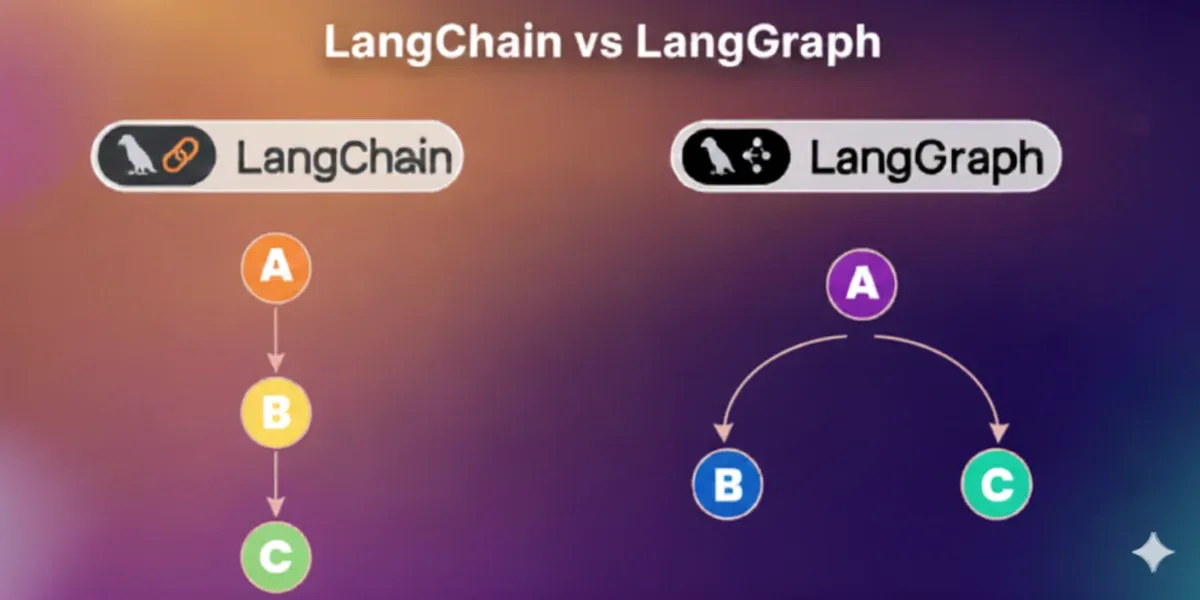
LangChain and AutoGen: Developer-first frameworks for tool orchestration, RAG pipelines, and multi-step agents with rich ecosystem support.
Auto-GPT and MetaGPT: Open-source projects for autonomous agents and complex multi-agent workflows; best for research and advanced prototyping.
Rasa: Open-source, on-prem-ready conversational AI with strong customization, language support, and enterprise deployment patterns.
Comparatively, pro-code frameworks offer maximum flexibility, better observability, and scale-out patterns; support ranges from community-driven to commercial SLAs via vendors and partners.
Do this:
Start small, iterate fast, and validate KPIs early.
Align stakeholders on scope, risk, and governance responsibilities.
Plan integrations up front; document data flows and security boundaries.
Establish telemetry: prompts, tools, latency, cost, and user feedback.
Gate releases with QA, red-teaming, and change controls.
Avoid this:
Underestimating integration and data quality complexity.
Skipping governance for speed-to-market.
Relying solely on vendor defaults for security and observability.
Ignoring scale testing until post-launch.
Quantify value across:
Efficiency: reduced manual hours, cycle time, and handling time.
Experience: CSAT, NPS, self-service rates, first-contact resolution.
Reliability: uptime, latency, SLA adherence, error budgets.
Economics: cost per task, infra spend, license fees, revenue lift.
Track KPIs by approach:
No-code: time-to-deploy, iteration velocity, platform dependency risk, per-run costs.
Custom: throughput and latency under load, integration coverage, governance maturity, and upgrade agility.
Consistent measurement helps justify transitions from no-code pilots to production-grade custom agents and confirms when to sustain a hybrid portfolio.
A no-code AI agent builder uses visual tools and templates so non-developers can ship quickly, while custom-built agents are coded by engineers for maximum flexibility, integration depth, and control.
Choose no-code for rapid prototyping and straightforward workflows; choose custom for advanced integrations, compliance, and scalable performance under SLAs.
No-code agents can often be live in hours or days; custom agents typically take weeks to months to build, integrate, secure, and harden.
They offer fast deployment and easy iteration, but can be limited in deep customization, scalability, and complex multi-agent orchestration.
No-code provides broad SaaS integrations and baseline security; custom agents support advanced security controls, on-prem options, and deeper, bespoke integrations.