
Loading...
Are you weighing speed-to-prototype against production-grade, stateful workflows in 2026? You’re not alone. Pressure to deliver AI impact is surging: generative AI could add $2.6–$4.4 trillion in annual economic value, and controlled studies show developers complete coding tasks up to 55% faster.
AI leaders evaluating agent orchestration in 2026 face a practical trade-off: speed-to-prototype versus production-grade, stateful workflows. LangChain remains excellent for linear AI pipelines like chatbots and RAG, while LangGraph, built on a node-and-edge model with persistent state, dominates complex, multi-agent systems. In short: if you need fast experiments and simple flows, choose LangChain; for robust, cyclic, and recoverable agent orchestration at scale, LangGraph usually wins.
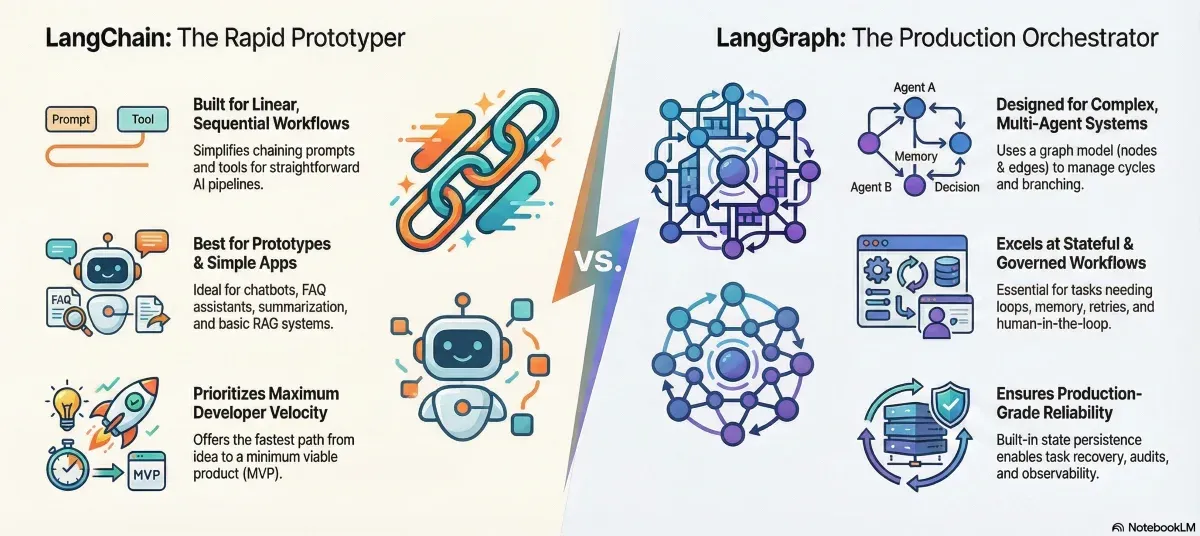
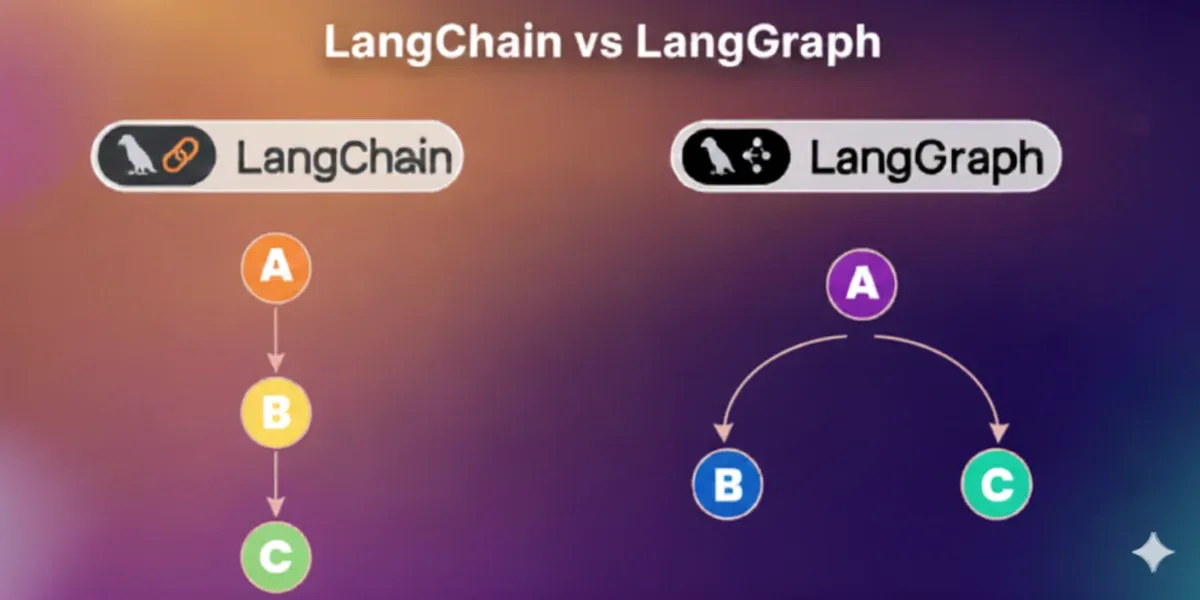
LangChain is a modular framework for building LLM systems with primarily linear workflows. It simplifies chaining prompts, tools, and retrievers for tasks like chatbots, document QA, and summarization, making it ideal for rapid prototyping and straightforward AI pipelines.
LangGraph is a graph-based orchestration framework designed for multi-agent systems, loops, branching, and long-lived, stateful workflows. It treats your application as a directed graph of nodes (steps) and edges (transitions), enabling sophisticated control over agent behavior and reliable execution with persistent state.
For enterprise teams, this distinction matters: agentic AI projects that demand concurrency, retries, memory, and governance will benefit from LangGraph’s stateful workflows and precise agent orchestration, while simpler, stateless tasks often reach value faster with LangChain.
Control flow in LLM frameworks describes how tasks and model calls advance across steps, whether sequentially or with branching, loops, retries, timeouts, and failover. It dictates how your AI pipeline behaves under real-world conditions.
LangChain emphasizes sequential chains and tool-augmented prompts. You typically design a linear pipeline (e.g., query → retrieve → synthesize) with optional conditional logic. This pattern is fast to implement and easy to reason about for deterministic flows.
LangGraph models applications as graphs with explicit nodes, edges, and a shared state object. It natively supports cycles, branching, and asynchronous fan-out/fan-in, enabling complex multi-agent systems and robust recovery strategies. This results in more control over long-running, stateful workflows and fine-grained observability across steps.
In practice, LangChain speeds up initial builds but can become cumbersome as requirements for branching, retries, or multi-agent coordination grow. LangGraph shifts complexity into a formal graph abstraction, trading a steeper learning curve for better maintainability in production-scale agent orchestration.
Choose LangChain when:
You need rapid prototypes or MVPs with linear or lightly branched flows.
Your use case is a chatbot, FAQ assistant, summarization, or straightforward RAG.
You prioritize developer velocity and minimal orchestration overhead.
Choose LangGraph when:
You need multi-agent systems with coordination, memory, and tool use.
Your workflows require loops, backtracking, and explicit state checkpoints.
You expect partial failure recovery, human-in-the-loop, or long-running tasks.
Illustrative enterprise scenarios:
Policy-compliant customer support agent: LangGraph orchestrates multiple agents (retrieval, policy checker, escalation) with auditable state transitions and rollbacks.
Batch document processing with episodic memory: LangGraph’s checkpointing and retries help ensure completeness and traceability across large corpora.
Knowledge assistant MVP for internal teams: LangChain provides a fast, maintainable path to deploy a single-agent RAG system.
State management: LangGraph maintains a shared, persisted state across nodes, enabling deterministic recovery and resume-on-failure, essential for SLAs and auditability. LangChain relies more on external state stores or custom glue code for similar guarantees.
Observability: Graph-level traces, node metrics, and event logs help diagnose bottlenecks and hallucinations. With LangChain, you’ll often assemble observability via third-party logging and tracing, which is effective but less native.
Reliability: LangGraph’s explicit transitions reduce hidden coupling and make retries, timeouts, and circuit breakers first-class. LangChain can implement these, but the complexity tends to spread across custom handlers rather than a central graph runtime.
Learning curve: LangChain is approachable for most Python developers familiar with sequential pipelines. LangGraph requires learning graph modeling patterns, but pays off for complex systems.
Ecosystem: LangChain’s ecosystem of integrations (models, vector stores, tools) remains a strength and is fully usable from LangGraph. Teams can start in LangChain and graduate to LangGraph as complexity rises.
Integration: Both frameworks play well with enterprise systems via APIs, webhooks, message queues, and data platforms. LangGraph’s structured state and nodes simplify mapping to microservices, ETL stages, and governance layers.
Token spend: Graph-based retries, caching, and conditional routing can reduce wasted tokens by preventing full-pipeline re-execution after partial failures. This can lower the total cost of ownership when workflows are non-linear.
Latency: LangChain’s linear flows often minimize overhead in simple tasks. LangGraph introduces orchestration overhead, but can parallelize subflows to meet latency targets.
Throughput: For concurrent, multi-agent workloads, LangGraph’s explicit concurrency and checkpointing better support reliable scaling under load.
Cost trade-off: Simpler MVPs cost less on LangChain. As orchestration needs and compliance grow, LangGraph’s predictability and recoverability reduce hidden engineering and incident costs.
Start with a narrow scope: Prove value with a LangChain prototype for a single task (e.g., RAG on a defined corpus).
Identify orchestration risks: Where do you need loops, retries, or multi-agent collaboration? Where does the state need to persist across steps or sessions?
Migrate critical paths to LangGraph: Encapsulate complex flows as subgraphs. Define a shared state schema and explicit transitions, checkpoints, and failure policies.
Add observability and guardrails: Track node-level metrics, implement content filters, and enforce policy checks before final actions.
Operationalize: Containerize, set autoscaling policies, and integrate CI/CD and model evaluations. Document recovery playbooks based on graph state.
DimensionLangChainLangGraph2026 VerdictDesign modelSequential chains and toolsNode-and-edge graph with shared stateGraph wins for complex systemsControl flowMostly linear with conditional stepsNative loops, branching, subgraphsGraph for orchestration depthStateExternalized or ad hocPersistent, first-class stateGraph for reliability/auditMulti-agentPossible, more manualBuilt for multi-agent coordinationGraphObservabilityAdd-on logging/tracingGraph-native traces and eventsGraphSpeed to MVPVery fastModerateLangChainScaling complex workflowsIncreasing complexityPredictable structureGraphBest fitChatbots, RAG, summariesStateful, governed agentic AIDepends on need
Is your workflow linear, with limited branching? Favor LangChain.
Do you require loops, backtracking, or long-running tasks? Favor LangGraph.
Are multiple agents coordinating with shared memory? Favor LangGraph.
Is speed-to-market for a simple assistant your top priority? Favor LangChain.
Do you need auditability, retries, and deterministic recovery? Favor LangGraph.
Folio3 AI builds custom, enterprise-grade agentic systems that integrate with legacy stacks, comply with governance, and scale reliably, turning LLM potential into measurable business outcomes.
Our offerings:
AI Agent Strategy & Roadmapping: Unlock new efficiencies with a clear AI adoption strategy. We assess your business, recommend the right agents, and define a roadmap for scalable implementation.
Custom AI Agent Development: Build intelligent agents that adapt to your workflows, designed with flexibility, performance, and real-time decision-making in mind.
AI Agent Integration: Seamlessly plug AI agents into your tech stack. We ensure smooth data exchange, compatibility, and security across all platforms.
Maintenance & Optimization: From updates to continuous tuning, we ensure your agents remain high-performing and aligned with your evolving needs.
Human-AI Experience Design: Craft natural, intuitive user experiences with multimodal interfaces that foster trust and adoption.

LangChain is a framework for building LLM applications using linear or lightly branched chains, ideal for rapid prototypes and straightforward RAG or chatbot use cases.
LangGraph is a graph-based orchestration framework enabling loops, branching, multi-agent systems, and persistent state for complex, stateful workflows.
LangGraph is better due to its native support for coordination, shared state, and explicit transitions across agents.
Yes, for simple, stateless assistants; for complex, governed workflows with retries and audits, LangGraph is typically more maintainable.
Absolutely. Many teams prototype in LangChain and move complex paths to LangGraph while reusing models, tools, and data components.