
Loading...

AI agents can drive measurable ROI, but the first question every executive asks is how to introduce AI agents without breaking operations. The answer: treat agents as mission-critical services from day one, wrap them in governance, deploy them with progressive rollouts, and engineer for observability, resilience, and rapid rollback.
This guide distills Folio3 AI’s enterprise playbook into pragmatic steps you can apply now, from architecture decisions to human-in-the-loop safety. If you need a faster path to results, partner with an AI agent development expert experienced in regulated and legacy-heavy environments.
Operational downtime is the period when AI-driven systems fail to deliver expected functionality, interrupting business processes. For enterprises, this can halt order flow, trigger SLA misses, and erode customer trust, often compounding costs through retries, manual rework, or incident response across teams.
Unlike static automation, AI agents encounter unpredictable data, evolving contexts, and long-running states that magnify reliability risks. They orchestrate across APIs and tools, so unexpected inputs or upstream changes can cascade into failures. Real-world examples show agents meeting messy, dynamic workflows that classical scripts don’t handle gracefully, especially at scale.
Top risk scenarios to anticipate:
Deployment failures: new versions degrade reasoning or break integrations.
State drift: agents lose or corrupt context/memory, leading to incorrect actions.
Thundering herd overload: spikes or retries create load storms across dependencies.
Model or policy errors: hallucinations, tool misuse, or authorization gaps.
Modern reliability practices, like circuit breakers, shadow traffic, and progressive rollouts, consistently reduce error rates and mean time to recovery in production-ready agentic AI frameworks.
Downtime triggers: AI agents vs. traditional automation
TriggerAI AgentsTraditional AutomationInput variabilityHigh: unstructured data, changing prompts, tool diversityLow–Moderate: deterministic inputsStatefulnessCommon: memory, multi-step plansRare: short, stateless tasksExternal dependenciesBroad: tools, APIs, models, embeddingsNarrower: fixed scripts/integrationsFailure modesNon-deterministic model behavior, policy driftDeterministic code errorsRecovery complexityHigher: state repair, policy rollback, A/B isolationLower: patch and redeploy
Reference: production-ready agentic AI frameworks.
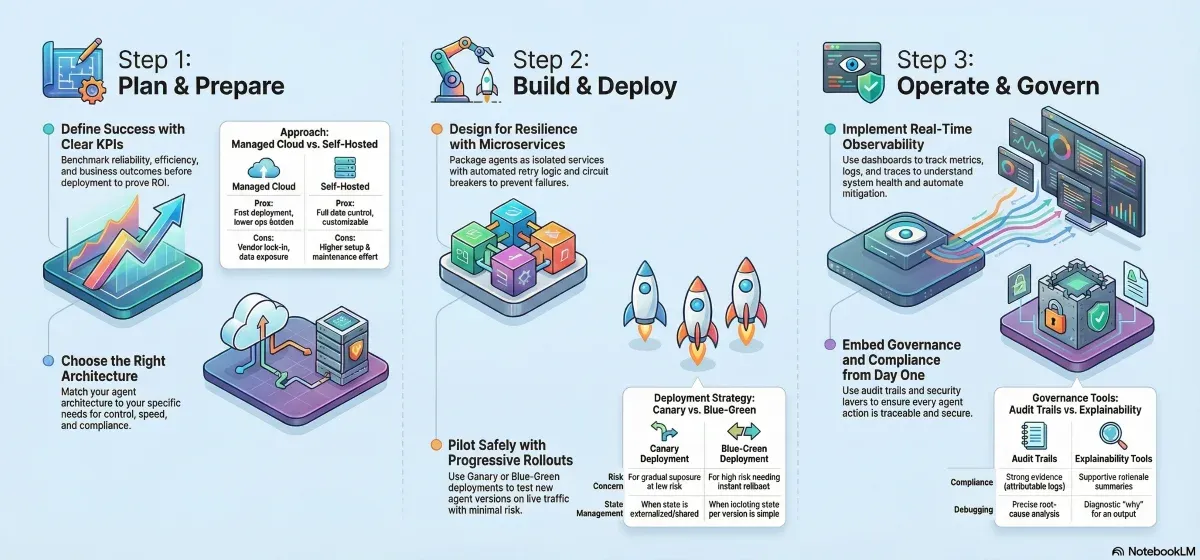
Start where business continuity is protected, and value is clear. Identify mission-critical workflows, their data sensitivity, and regulatory constraints using an executive guide to real‑world AI. Determine where agents augment rather than replace core decision points in the early phases.
Prioritize KPIs that reflect both system health and business value:
Reliability: mean time to recovery (MTTR), error rate, failed-job retry rate, SLA misses
Efficiency: latency, throughput, cost-per-transaction.
Business outcomes: conversion uplift, cycle-time reduction, and first-contact resolution, directly attributable to agent actions.
Before introducing agents, benchmark current baselines for these metrics. Clear before/after comparisons are essential to prove ROI and catch regressions early.
Architecture choices determine observability, reliability, and future scalability. Decide upfront how much control you need, where data can live, and how you’ll govern updates.
Options include low-code platforms, code-first frameworks, and managed cloud services. Visual low-code accelerates business-led adoption; code-first gives granular control for complex, stateful, multi-agent scenarios; managed cloud speeds deployment but may constrain compliance or governance. A helpful overview of AI agent orchestration frameworks outlines trade-offs across control, velocity, and integrations.
Low-code platforms use visual tooling to help non-developers or hybrid teams assemble agent flows quickly (for example, Slack or Notion integrations and rapid prototypes). Code-first approaches use SDKs, APIs, and scripting (such as LangChain, AutoGen, or CrewAI) for precise logic, security controls, and custom integrations.
When to choose:
Low-code: rapid integrations, business-user empowerment, and proofs-of-concept; examples include n8n and Vellum.
Code-first: complex, stateful workflows; strict security and compliance; custom toolchains; examples include LangChain and CrewAI.
Managed cloud services deliver an AI backend-as-a-service for speed and simplicity, but introduce vendor lock-in and reliance on third-party data practices. Self-hosting agents and, where needed, models offer tighter control over data, privacy, and compliance, at the cost of setup and ongoing operations (for example, running LLMs locally with Ollama or Mistral).
Pros/cons
ApproachProsConsBest fitManaged cloudFast deployment, rich SaaS integrations, lower ops burdenVendor lock-in, data exposure/egress, and limited low-level controlLow–moderate sensitivity, rapid pilotsSelf-hostedData/control/compliance, customizable stack, flexible scalingHigher setup/maintenance, infra/ML ops skills neededRegulated data, strict governance, bespoke integrations
Recommendation: Match to data sensitivity, regulatory posture, and integration complexity; plan for exit paths either way. For production readiness patterns, see production-ready agentic AI frameworks.
Package agents as microservices to isolate failures, scale independently, and enable targeted rollbacks. Treat each agent as a first-class service with its own SLOs, dashboards, and deployment pipelines.
Core requirements:
Autoscaling to absorb spikes without manual intervention
Persistent state management for memory, context, and workflow checkpoints
Retry and circuit-breaker logic to handle transient and systemic failures
Pipeline isolation and backpressure to prevent cascade failures
Structured observability (metrics, logs, traces) and cost tracking
Kubernetes-native deployment runs containerized agent workloads on a common orchestration layer with service discovery, resource quotas, and standardized rollouts. Horizontal Pod Autoscaler and queue-based scaling help agents ride out 10x traffic surges without operator toil, while standard K8s controls support compliance in regulated industries. See production-ready agentic AI frameworks.
State management persists agent memory, context, and workflow progress in stores like Redis, PostgreSQL, or MongoDB. Configure idempotency keys and checkpoints to enable safe retries. In production, retry policies frequently salvage a significant share of transient failures; teams often target aggressive retry backoff to recover most failed jobs without human intervention.
Circuit breakers detect recurrent failures and route traffic to stable versions or degrade gracefully (for example, automatically fall back to the previous agent version if the error rate crosses a 2% threshold). Shadow traffic, mirroring requests to a new agent without affecting users, lets you validate behavior before switching live. For orchestration patterns including shadow modes, see AI agent orchestration frameworks.
Suggested flow for resilience:
Receive request and validate state
Execute with retries and exponential backoff
Trip circuit breaker on error-threshold breach
Route to fallback agent/version and log incident
Repair the state and gradually restore traffic
Launch with phased pilots, tight monitoring, and ready rollback. Validate not just technical metrics but also business impact and user acceptance. Capture qualitative feedback from frontline teams to refine prompts, tools, and guardrails before expanding scope.
Canary deployments route a small percentage of traffic to new agent versions to observe performance in vivo. Blue-green maintains two production environments, allowing instantaneous cutover and rollback. Organizations using these patterns routinely achieve four-nines availability and reduce incident rates through rapid rollback and containment, as reported in production-ready agentic AI frameworks.
CriterionPrefer CanaryPrefer Blue-GreenAgent statefulnessWhen the state is externalized and comparable across versionsWhen isolating state stores per version is simplerBlast radius concernsLow risk and gradual exposureHigh risk and desire for instant rollbackTraffic volumeSufficient volume to observe statisticallyLower volume or strict change windowsExperimentation needsIncremental tuning and A/BClean cutovers and straightforward rollbacks
Human-in-the-loop adds checkpoints where people review or approve agent actions before they proceed, vital in healthcare, finance, and manufacturing. Before full-scale, validate service-level objectives with both automated tests and expert review against policy and compliance norms.
Observability is the ability to understand system health through real-time metrics, logs, and traces. Track latency, error rates, throughput, cost-per-query, and business impact metrics on shared dashboards. Combined with automated mitigation, such as autoscaling, circuit breaking, and failover, teams report substantially lower MTTR and fewer false alarms in production-ready environments.
Instrument every agent and tool call with telemetry: latency histograms, error taxonomies, token/compute costs, and dependency timings. Set threshold-based alerts with on-call workflows for both automated responses and human escalation. Tools like Prometheus and Grafana, along with native trace exporters in modern agent frameworks, make this straightforward; see AI agent orchestration frameworks.
Automated failover shifts workloads to healthy replicas or standby regions when an agent or dependency degrades. Dynamic scaling adds or removes compute and agent replicas as demand changes. Together, these patterns enable near-zero-downtime operations while smoothing cost curves during peaks and troughs.
Governance is the framework of processes and technologies that manage AI agent behavior and data flows. Non-negotiables include decision auditability, explainability, layered security, data protection, and alignment with legal standards such as GDPR and HIPAA. Prioritize these controls first in sectors handling regulated or sensitive data.
Audit trails record each agent's decision and action with the context and rationale needed for compliance and debugging. Explainability tools such as SHAP and LIME help teams understand what drove an output and whether it aligns with policy. For a primer, see agentic AI explainers.
Benefit matrix
CapabilityAudit TrailsExplainability ToolsCompliance evidenceStrong—chronological, attributable logsSupportive—model rationale summariesRoot-cause analysisPrecise—who/what/when chain of eventsDiagnostic—feature/step influenceBusiness stakeholder trustHigh—traceable accountabilityHigh. intelligible reasoning
Layer security across the stack: strong authentication and authorization, encryption in transit/at rest, network segmentation, and strict secrets management. Define data residency so information is stored and processed only in approved jurisdictions or enterprise-owned environments. Choose cloud or on-prem strategies consistent with regulatory burden and industry standards, reinforced by production-ready controls.
Scale in steps: pilot one domain, harden with observability and governance, then expand to adjacent workflows. Document lessons learned, update policies and SLOs, and keep clear exit paths to avoid vendor or architectural lock-in. For enterprise patterns, see our guide to enterprise AI agents.
Specialist partners and vertical platforms can accelerate trust, integration, and compliance, particularly in regulated industries, by providing domain-tuned workflows and proven controls.
Vendor selection checklist:
Domain fit and integration with your systems of record
Proven delivery at enterprise scale with referenceable case studies
Flexibility for custom workflows and controls
Industry certifications and support SLAs aligned to your risk posture
If you need a build-with partner rather than a platform-only choice, consider an AI agent development partner like Folio3 AI, focused on reliability and measurable outcomes.
Proven strategies include blue-green deployments and canary releases, enabling parallel introduction of new versions with rapid rollback and near-continuous uptime.
Pair staged rollouts with robust monitoring and clear SLOs so each phase can be halted or reverted instantly if issues emerge.
Prioritize MTTR, error rate, SLA compliance, cost-per-transaction, and business outcome metrics directly tied to agent actions.
Circuit breakers divert traffic away from failing versions, while shadow traffic validates new agents under real load without user impact.
State management, overload, and integration fragility are common; mitigate with persistent stores, autoscaling, clear interfaces, and progressive rollouts.