Loading...

Urban streets worldwide are struggling under traffic growth, with commuters spending countless hours trapped in gridlock while cities fight to maintain liveable environments. Traditional traffic management systems, designed decades ago, simply cannot handle today's complex mobility demands or provide the real-time insights needed for efficient urban planning.
According to the Texas A&M Transportation Institute, traffic congestion costs U.S. drivers $166 billion annually in lost time and fuel, highlighting the urgent need for intelligent solutions. Custom AI vehicle detection solutions are revolutionizing how smart cities approach traffic management, offering real-time analytics, predictive insights, and automated responses that traditional systems cannot match.
Furthermore, these advanced systems transform ordinary cameras into intelligent monitoring networks, providing cities with the data-driven tools necessary to create more efficient, safer, and sustainable urban transportation ecosystems for growing populations.

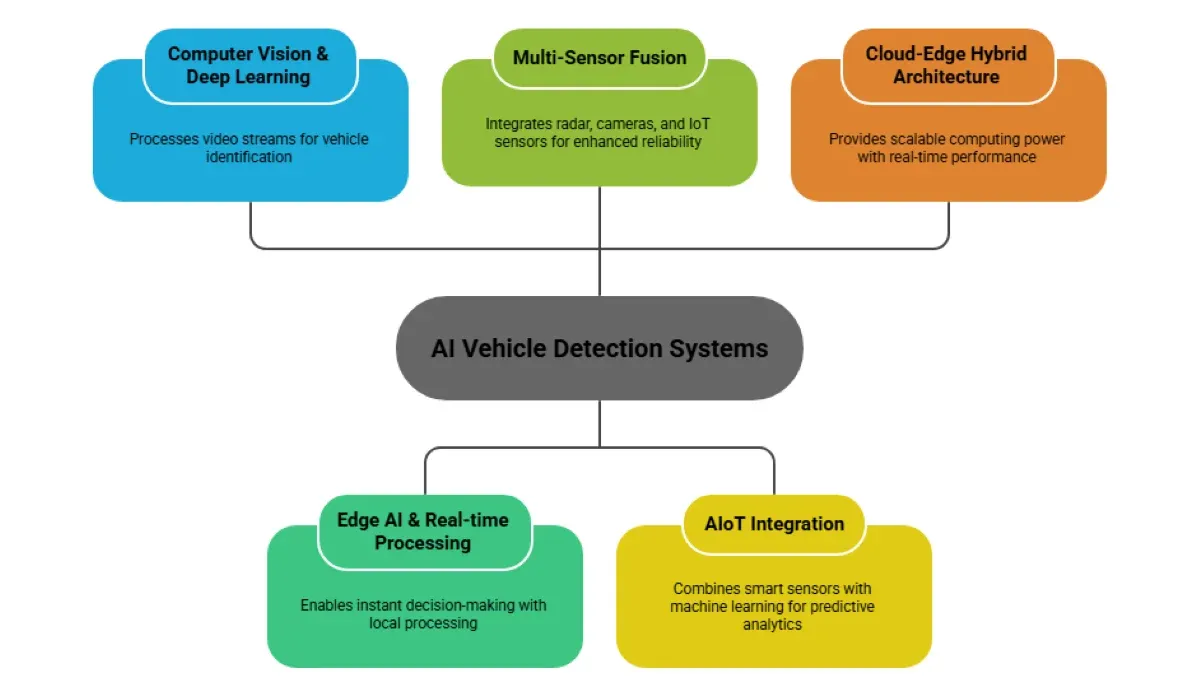
Modern vehicle detection systems combine multiple advanced technologies, including computer vision, edge computing, machine learning, and sensor fusion, to create intelligent, responsive traffic monitoring networks. These systems operate reliably across diverse urban environments and challenging conditions.
Advanced neural networks process video streams in real-time, identifying and classifying vehicles with high accuracy across various lighting conditions and weather scenarios. Additionally, these systems maintain consistent performance standards and reliability even during complex traffic situations and diverse urban environments.
Local processing capabilities eliminate network latency, enabling instant decision-making and reducing bandwidth requirements while maintaining system responsiveness. Consequently, this technology performs optimally during peak traffic periods, emergency situations, and high-demand scenarios that require immediate automated responses.
Integration of radar, video cameras, and IoT sensors creates comprehensive detection systems with enhanced reliability across conditions. Studies show that multi-sensor fusion systems achieve detection accuracy rates of 97% or higher with redundant data sources, ensuring consistent operation regardless of environmental challenges.
Artificial Intelligence of Things combines smart sensors with machine learning algorithms, enabling predictive analytics and automated responses across interconnected city systems. This approach facilitates holistic management, improved efficiency, and comprehensive urban intelligence that enhances decision-making capabilities.
Seamless integration between edge processing and cloud analytics provides scalable computing power while maintaining real-time performance for critical traffic management functions. Furthermore, this architecture supports data storage, analysis capabilities, and long-term system scalability that accommodates growing urban demands.
Legacy traffic systems lack the intelligence and adaptability required for modern urban challenges, creating inefficiencies, safety risks, and missed opportunities for data-driven decision-making that custom AI solutions can effectively address through advanced technology integration.
Generic systems cannot adapt to unique city layouts, traffic patterns, or specific infrastructure requirements, resulting in suboptimal performance and wasted resources. Additionally, these one-size-fits-all solutions often miss opportunities that could significantly improve smart city objectives and operational efficiency goals for sustainable urban development.
Passive monitoring systems only record incidents after they occur, while AI-powered solutions actively analyze real-time data for immediate response and prevention. Moreover, these intelligent systems enable proactive traffic management and smart decision-making that enhances overall city operations and citizen safety significantly.
Custom solutions seamlessly integrate with existing city infrastructure, scaling from single intersections to comprehensive citywide networks without compatibility issues. Consequently, this approach prevents performance degradation, operational disruptions, or system failures that could compromise traffic management effectiveness and reliability standards.
Traffic congestion drains up to 3% of a city's GDP annually through lost productivity, increased fuel consumption, delayed deliveries, and reduced business efficiency, making intelligent traffic management a critical economic investment with measurable returns.
Custom systems ensure compliance with local privacy regulations while providing cities full control over sensitive traffic and citizen data collection. Therefore, these solutions maintain processing, storage protocols, and access management to preserve public trust and legal compliance standards.
Comprehensive AI vehicle detection systems offer multiple specialized capabilities designed to address diverse smart city traffic management and public safety requirements. These systems utilize advanced technology integration, intelligent automation, and data-driven decision-making that enhances operational efficiency.
Advanced algorithms accurately identify and categorize cars, trucks, buses, motorcycles, bicycles, and pedestrians, providing detailed traffic composition data for comprehensive urban planning. Subsequently, this capability enables infrastructure optimization and evidence-based decision-making that supports sustainable city development initiatives.
Instantaneous traffic flow monitoring, speed analysis, occupancy rates, and violation detection enable immediate responses to changing traffic conditions and emergencies. Additionally, comprehensive data visualization and actionable insights help traffic managers make informed decisions and respond to safety concerns effectively.
Proactive detection of wrong-way vehicles, accident prediction, unusual traffic patterns, and safety hazards helps prevent incidents before they occur. Moreover, intelligent monitoring, automated alerts, and preventive measures significantly improve overall road safety through advanced threat detection.
License plate recognition combined with vehicle attribute analysis enables comprehensive vehicle tracking while maintaining privacy compliance and security monitoring capabilities. This technology provides law enforcement support and automated violation detection that enhances public safety and traffic management effectiveness significantly.
Robust performance across all lighting conditions and weather scenarios ensures 24/7 operation reliability, crucial for continuous smart city traffic management operations. Therefore, consistent service delivery maintains citizen safety and emergency response capabilities regardless of environmental challenges.

AI-powered vehicle detection delivers measurable improvements across multiple urban management areas, creating significant value for cities and their residents. These systems provide enhanced efficiency, safety improvements, environmental benefits, and comprehensive data-driven decision-making capabilities.
Cities implementing AI traffic systems report up to 25% reduction in travel times and 40% decrease in intersection delays, significantly improving commuter experiences and productivity. Consequently, operational efficiency and overall quality of life improve while reducing transportation costs and time waste.
Optimized traffic flow reduces vehicle idling time, cutting CO2 emissions by millions of tons annually while supporting sustainability goals and air quality improvements. Furthermore, green initiatives and environmental protection efforts contribute to healthier urban living conditions and reduced carbon footprints.
Real-time accident detection and emergency vehicle prioritization systems demonstrate significant results. Studies show emergency response times improve by 25-35% with AI traffic management systems, potentially saving lives and minimizing traffic disruption from incidents and critical situations.
Smart traffic systems generate substantial ROI through reduced congestion costs, improved fuel efficiency, enhanced productivity, and operational savings. These benefits justify infrastructure investment costs quickly while providing long-term economic advantages for cities and citizens.
AI-enabled signal priority systems increase bus schedule reliability by 15% and reduce passenger wait times, encouraging public transportation adoption rates. Additionally, these improvements support sustainability initiatives and reduce private vehicle dependency, which promotes environmental goals.
Smart cities deploy AI vehicle detection across various scenarios to address specific urban challenges while maximizing technology investment returns. These applications improve citizen services, enhance public safety, and create comprehensive intelligent transportation systems.
Adaptive signal control responds to real-time conditions, automatically adjusting timing to maintain optimal flow and reduce congestion at critical intersections. Subsequently, this technology improves overall traffic efficiency, reduces delays, and enhances commuter satisfaction throughout the city.
Real-time space monitoring and occupancy tracking help drivers locate available spots quickly, reducing circling time and associated emissions in busy areas. Smart parking solutions improve parking efficiency, reduce congestion, and enhance urban mobility significantly.
Automated violation detection for speeding, red-light running, and unauthorized lane usage enhances traffic safety while optimizing officer resource allocation. Therefore, enforcement effectiveness and public safety outcomes contribute to safer streets and reduced accident rates.
Priority routing systems detect approaching emergency vehicles and automatically adjust traffic signals, ensuring faster response times during critical situations. This technology improves public safety and emergency services effectiveness significantly while coordinating life-saving responses citywide.
Comprehensive traffic data collection supports evidence-based infrastructure decisions, helping cities optimize road design and predict future transportation needs. Consequently, traffic analysis systems enable sustainable development, efficient resource allocation, and long-term urban planning that serves growing populations.
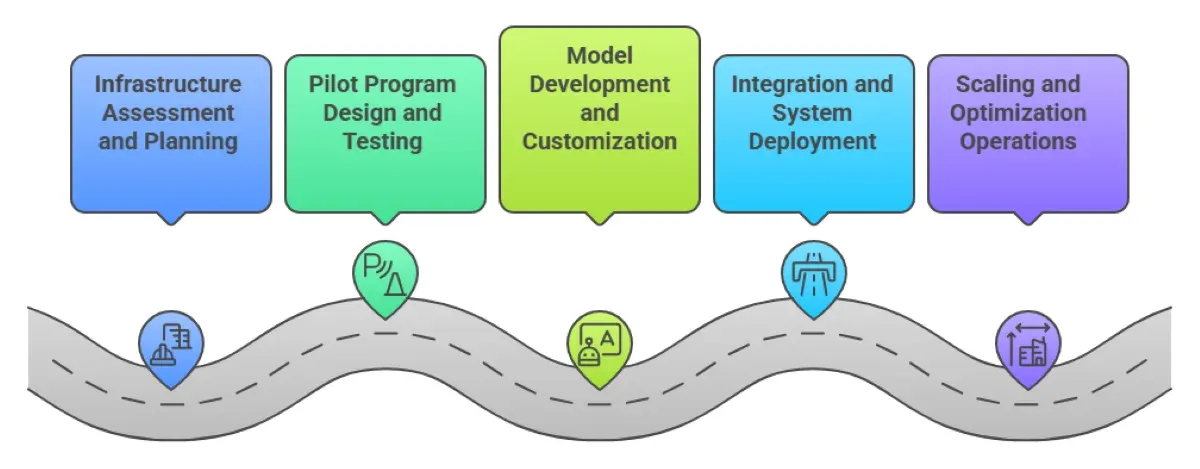
Successful AI vehicle detection deployment requires systematic planning and phased execution to ensure optimal performance and stakeholder buy-in. This approach delivers measurable results, risk mitigation, and sustainable long-term success while minimizing disruption.
Comprehensive evaluation of existing camera networks, connectivity, processing capabilities, and infrastructure conditions establishes baseline requirements. Additionally, this assessment identifies necessary upgrades for successful deployment, long-term sustainability, and optimal system performance across operational environments.
Small-scale testing at selected intersections validates system performance, refines algorithms, demonstrates value, and identifies potential issues. Therefore, this approach minimizes risk before committing to larger investments and citywide implementation strategies.
Custom algorithm training using local traffic patterns, vehicle types, and environmental conditions ensures optimal accuracy and performance. Furthermore, this customization addresses specific city conditions, infrastructure requirements, and operational needs that maximize system effectiveness.
Systematic connection with traffic management systems, emergency services, existing city infrastructure, and municipal departments ensures seamless operation. Consequently, data sharing capabilities and comprehensive integration maximize system benefits and operational efficiency.
Gradual expansion across the city includes continuous monitoring, performance optimization, staff training, and system refinement. This approach maximizes effectiveness, user adoption, and long-term success while ensuring sustainable growth and consistent service quality.
Cities face various obstacles when deploying AI vehicle detection systems, but proven strategies and comprehensive planning help overcome these barriers effectively. Therefore, experienced guidance ensures successful long-term outcomes, sustainability, and measurable benefits for stakeholders.
Legacy system compatibility issues require careful planning, sometimes hardware upgrades, and strategic migration approaches. However, standardized APIs, gradual implementation strategies, and expert technical guidance ensure smooth transitions without service disruption.
High initial costs concern many cities and decision-makers, but detailed ROI analysis demonstrates strong returns. Additionally, grant opportunities, phased implementation approaches, and comprehensive financial planning help justify and manage investments while maximizing available resources.
Privacy laws and data governance regulations vary by jurisdiction and require specialized knowledge and customized approaches. Nevertheless, legal expertise and compliance frameworks ensure full regulatory compliance while maintaining system effectiveness and citizen trust.
Staff training, public acceptance campaigns, and stakeholder engagement address resistance to new technology while building support for smart city initiatives. Furthermore, education and demonstration programs help community members, employees, and decision-makers understand the benefits and functionality.
Ongoing maintenance, algorithm updates, system monitoring, and technical support ensure long-term performance and reliability. This comprehensive approach protects the city's technology investment over time while adapting to changing conditions and requirements.
Folio3.ai delivers comprehensive AI vehicle detection solutions through our advanced software platform that provides cities with intelligent analytics and precise monitoring capabilities. Our robust data collection tools are designed to enhance smart traffic management across diverse urban environments and complex infrastructure requirements.
Configure specific zones for targeted counting and monitoring, allowing precise analysis of designated areas, entrances, exits, and intersections. This capability provides specialized attention, detailed surveillance, and enhanced security measures for optimal traffic management effectiveness and operational control.
Real-time and historical traffic data visualization through an intuitive interface provides actionable insights to optimize traffic flow and identify patterns. Additionally, performance metrics and data-driven decisions improve overall transportation system efficiency, effectiveness, and strategic planning capabilities.
Our intelligent system categorizes transit vehicles within designated areas, accurately distinguishing between cars, buses, trucks, motorcycles, bicycles, and pedestrians. Subsequently, detailed insights into traffic composition distribution across different time slots support comprehensive urban planning and infrastructure optimization.
Tailor software solutions to specific municipal needs and enhance traffic analysis capabilities with customizable reports, dashboards, and alerts. Integration options meet unique business requirements, operational workflows, and strategic objectives for individual smart city implementations.
Leverage automatic license plate recognition capabilities that identify vehicles from images captured by integrated smart camera systems. This technology provides comprehensive vehicle tracking data for traffic management, law enforcement applications, and security monitoring while maintaining privacy compliance standards.
Access comprehensive data on total vehicle counts, directional flow patterns, and movement trends with the ability to analyze daily data. Additionally, drill down into specific time slots for understanding traffic patterns, peak hours, congestion points, and behavioral insights that support strategic transportation planning.
Multiple camera perspectives capture and verify vehicle counts accurately, even in crowded or complex traffic settings. Therefore, reliable data collection, reduced counting errors, and comprehensive coverage maintain high accuracy rates across challenging operational conditions.
Emerging technologies and evolving urban needs will shape the next generation of AI vehicle detection systems. These developments create new opportunities for smart cities to enhance efficiency, sustainability, citizen services, and urban management through advanced technological integration.
Ultra-low latency networks enable real-time processing of massive data streams, supporting more sophisticated AI applications and instantaneous city-wide traffic coordination. Additionally, enhanced performance capabilities and advanced features require high-speed connectivity and immediate response times.
Vehicle-to-Infrastructure communication protocols will require advanced detection systems capable of managing mixed traffic flows, including self-driving cars and traditional vehicles. Therefore, seamless, safe, and efficient integration maintains optimal traffic management while accommodating emerging transportation modes.
Machine learning models will anticipate traffic patterns, predict maintenance needs, and optimize city operations before problems occur. Consequently, reactive management transforms into proactive strategies that prevent issues, reduce costs, and improve overall system performance significantly.
Green city initiatives will drive demand for AI systems that optimize energy consumption, reduce emissions, and support environmentally conscious urban development goals. These systems contribute to sustainable transportation ecosystems that protect the environment effectively while promoting clean mobility solutions.
Integration with other city systems, including energy management, waste collection, public safety, and municipal services, creates comprehensive urban intelligence networks. This holistic approach improves efficiency and coordinated city operations that enhance the quality of life for residents.
Financial analysis demonstrates that AI vehicle detection systems deliver substantial returns through quantifiable improvements in traffic efficiency and safety outcomes. Additionally, operational cost reductions and long-term benefits support urban development goals, sustainability initiatives, and comprehensive city management strategies.
Systematic evaluation methodology compares implementation costs against measurable savings in time, fuel consumption, maintenance expenses, and emergency response efficiency. This comprehensive ROI assessment supports financial planning and investment justification for decision-making processes.
Most smart cities achieve full cost recovery within 3-5 years through reduced congestion costs, improved fuel efficiency, enhanced productivity, and operational savings. These measurable benefits demonstrate the financial value of intelligent transportation system investments and long-term sustainability.
Traffic time savings, emission reductions, accident prevention, and operational improvements generate millions in annual value for medium-sized cities. Comprehensive systems with proper deployment strategies, ongoing optimization, and effective management practices deliver significant returns on investment.
Grant programs, public-private partnerships, phased implementation approaches, and innovative financing solutions help cities manage upfront costs. These options maximize available financial resources, minimize fiscal risks, and ensure sustainable funding for long-term success and continued system improvements.
Beyond immediate traffic improvements, comprehensive data insights support better urban planning decisions and infrastructure optimization. Strategic development creates lasting value for growing city populations, economies, and sustainable urban development over extended timeframes.

Custom AI systems analyze real-time traffic patterns and automatically adjust signal timing, reducing travel times by up to 25% and intersection delays by 40%. Unlike fixed-schedule traditional systems, AI adapts continuously to changing conditions, optimizing flow throughout the day.
Training requires diverse video footage covering different times, weather conditions, and traffic scenarios specific to the city's infrastructure. Typically, 4-6 weeks of continuous data collection from key intersections provides sufficient variety for accurate model development and validation.
Modern AI systems achieve 97% accuracy rates in real-world deployments, maintaining performance across various weather conditions and lighting scenarios. Advanced multi-sensor fusion and robust algorithms ensure consistent results even during challenging environmental conditions.
Most modern IP camera networks can support AI detection with software upgrades and edge computing additions. Older analog systems may require camera replacement, but existing mounting and networking infrastructure often remains usable, reducing upgrade costs.
Privacy protection includes data encryption, automatic license plate blurring, anonymized analytics, and strict data governance policies. Systems can operate effectively while complying with GDPR, CCPA, and local privacy regulations through careful design and implementation protocols.
Cities typically achieve full ROI within 3-5 years through reduced congestion costs, improved fuel efficiency, and enhanced productivity. The $166 billion annual cost of traffic congestion in the U.S. means even modest improvements generate substantial savings.
Advanced AI algorithms trained on diverse datasets maintain accuracy across rain, snow, fog, and varying light conditions. Multi-sensor approaches combining radar and video provide redundancy, ensuring 24/7 operation reliability regardless of environmental challenges.
Edge deployment requires industrial-grade computing units, high-resolution cameras, and reliable network connectivity. Typical installations include weatherproof enclosures, backup power systems, and standardized mounting hardware compatible with existing traffic infrastructure.
Emergency integration includes automatic priority signal adjustments for approaching vehicles, real-time incident detection and alerts, and coordinated route clearing. Systems can reduce emergency response times by 25-35% through intelligent traffic management and immediate notifications.
Folio3.ai combines deep AI expertise with proven smart city implementation experience, offering custom solutions rather than generic products. Our end-to-end approach includes ongoing support, continuous optimization, and measurable results that exceed client expectations while delivering comprehensive AI-powered traffic management systems.