
Loading...

Your fleet is bleeding money, and you might not even see it happening. Without ALPR data for fleet optimization, every vehicle movement, fuel gallon, and maintenance decision risks profitability, leaving money on the table.
Fleet fuel costs represent a major portion of the total budget, making data-driven optimization no longer optional; it's essential for survival. According to the US. Department of Transportation, American fleets collectively consume over 20 billion gallons of fuel annually, highlighting the massive impact of even small efficiency improvements.
Automatic License Plate Recognition (ALPR) technology transforms this challenge into an opportunity by capturing comprehensive operational intelligence from every vehicle movement. Leading fleets leveraging ALPR data achieve remarkable efficiency improvements and substantial cost savings through reduced downtime and optimized operations.
This guide reveals the exact data points driving these outcomes and how to implement them in your operations.

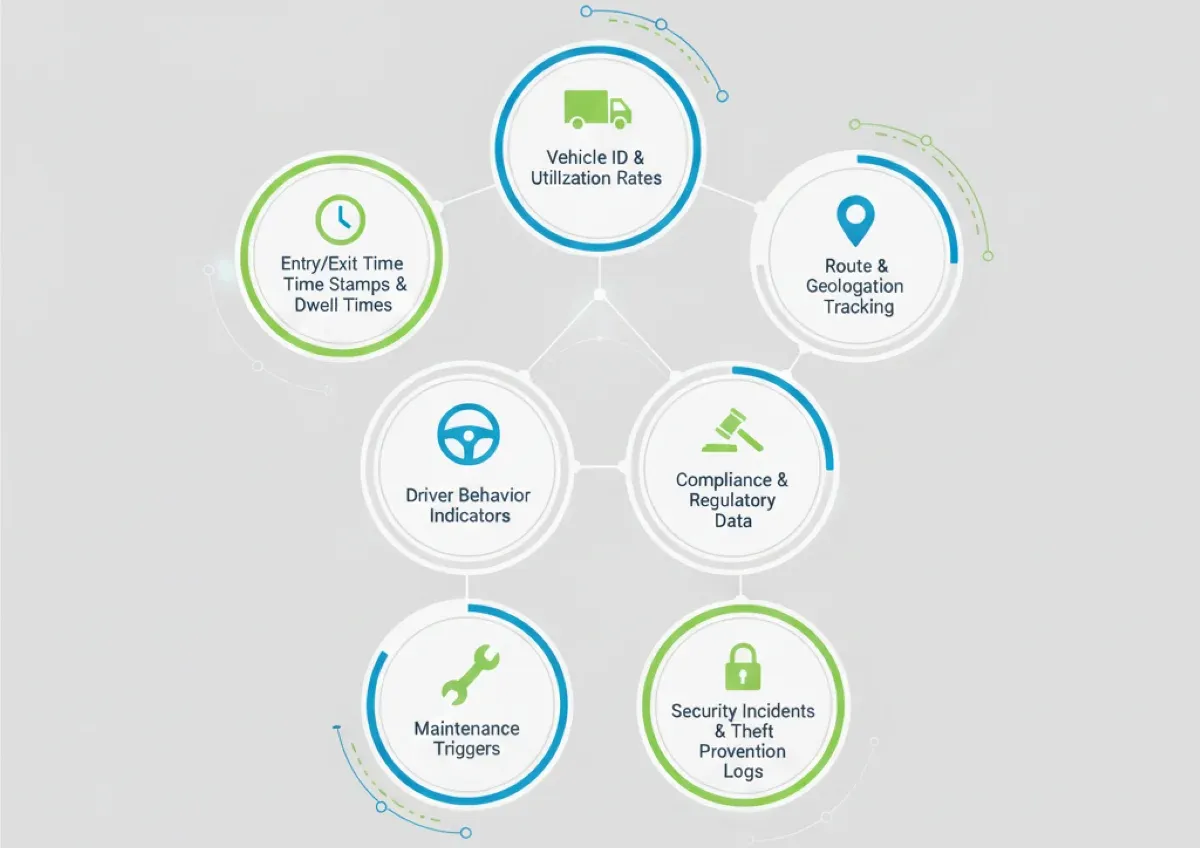
Automatic license plate recognition systems transform raw plate scans into actionable intelligence. By capturing granular vehicle data at every checkpoint, ALPR enables fleet managers to optimize routes, reduce costs, and enhance operational efficiency across their entire vehicle network.
ALPR instantly identifies each vehicle in your fleet, tracking how frequently assets are deployed. This data reveals underutilized vehicles, helps balance workloads across your fleet, and supports data-driven decisions about right-sizing your vehicle inventory for maximum return on investment.
Precise timestamps at entry and exit points measure how long vehicles remain at job sites, depots, or customer locations. Extended dwell times may indicate inefficiencies, while patterns reveal optimal scheduling windows, helping you reduce idle time and improve daily operational throughput.
By correlating plate reads across multiple fixed cameras, ALPR reconstructs vehicle routes without GPS hardware. This location intelligence validates planned routes, identifies unauthorized detours, uncovers traffic bottlenecks, and helps optimize future dispatch decisions based on actual travel patterns.
ALPR systems detect speed violations when vehicles pass cameras too quickly and flag unauthorized route deviations from approved corridors. These behavioral insights enable targeted driver coaching, reduce accident risk, lower insurance premiums, and ensure adherence to company policies and safety standards.
Automated capture of toll plaza passages and low-emission zone entries ensures accurate billing reconciliation and regulatory compliance. This data prevents costly fines, validates expense reports, supports environmental reporting requirements, and helps plan routes that minimize regulatory costs across your operations.
Frequent ALPR reads between known locations help estimate cumulative mileage, triggering preventive maintenance schedules before breakdowns occur. Unusual movement patterns, like unexpected night activity or weekend usage, can signal mechanical issues, unauthorized use, or theft requiring immediate investigation and intervention.
ALPR creates comprehensive audit trails showing when and where each vehicle appeared, enabling rapid theft recovery and investigation support. Real-time alerts when stolen or unauthorized vehicles enter monitored zones enhance security, while historical logs provide evidence for insurance claims and law enforcement collaboration.
ALPR systems combine high-performance cameras with artificial intelligence to automatically identify vehicles and generate actionable fleet intelligence. Understanding the technology foundation helps fleet managers maximize their investment returns and operational benefits.
High-resolution cameras continuously monitor vehicle traffic at entry points, exits, and key operational zones. The system captures license plate images along with contextual vehicle photographs, timestamps, and GPS coordinates for comprehensive tracking records.
Advanced optical character recognition algorithms powered by machine learning analyze captured images to extract alphanumeric plate data. Modern systems achieve 95-98% accuracy even in challenging conditions like rain, darkness, or glare.
Edge AI processes data locally for instant decisions and offline capability, ideal for remote locations. Cloud processing enables scalable analytics and cross-location intelligence. Hybrid approaches combine real-time response with comprehensive historical analysis.
Advanced systems process thousands of plates per minute across multiple lanes simultaneously. This capacity handles high-traffic depot environments, toll plazas, and busy facility entrances without creating bottlenecks or delays.
Data flows through REST APIs, webhooks, and standard formats like JSON, XML, and CSV into existing fleet platforms. Seamless integration eliminates manual data entry and automatically updates dashboards with real-time vehicle intelligence.
Data collection means nothing without intelligent analysis. Transform raw ALPR captures into operational improvements through strategic integration, real-time processing, and predictive analytics that drive measurable cost savings and efficiency gains.
Systems support REST APIs, webhooks, FTP transfers, and direct database connections with JSON, XML, and CSV outputs. Pre-built fleet management software integrations enable seamless connection with existing ERP, dispatch, and telematics platforms.
Instant notifications trigger for security breaches, compliance violations, or operational exceptions requiring immediate response. Real-time alert systems contrast with batch processing for scheduled reports and trend analysis, balancing immediate action with strategic planning.
Advanced algorithms analyze historical patterns to forecast future vehicle needs, maintenance requirements, and demand fluctuations. Machine learning models continuously improve route optimization, identify anomalies before failures occur, and recommend proactive operational adjustments.
Customizable KPI visualization provides at-a-glance operational status while drill-down reporting enables deep analysis by vehicle, driver, location, or time period. Automated exception reporting highlights deviations requiring attention, with mobile access for field managers.
Route efficiency improvements generate 7%+ fuel economy gains through intelligent planning. Idle time reduction programs, preventive maintenance scheduling, demand prediction, fleet rightsizing recommendations, and driver performance management create a comprehensive operational transformation.

Measurable results vary by industry vertical but consistently deliver substantial returns. Real-world implementations across logistics, waste management, rental operations, construction, and municipal fleets demonstrate ALPR's transformative financial impact.
Automated depot access control reduces congestion while GPS-integrated tracking enables route visualization and dynamic rerouting. Real-time route compliance verification optimizes last-mile delivery. Results include reduced delivery times, improved customer satisfaction, and lower insurance premiums.
IoT-integrated dynamic collection scheduling delivers 35% operational efficiency gains through intelligent route automation. Smart bin sensors combined with ALPR ensure trucks only visit full containers, cutting fuel usage and emissions while streamlining municipal billing processes.
Automated vehicle check-in/check-out combined with fleet rebalancing based on demand patterns and seasonal variations improves turnaround times. Utilization tracking enables predictive maintenance scheduling while theft prevention systems reduce unauthorized use and associated losses.
Equipment location tracking across job sites, combined with utilization monitoring, enables accurate rental billing. Theft prevention and rapid recovery systems paired with usage-based maintenance reduce downtime by 20-30% while improving billing accuracy.
Regulatory compliance automation generates comprehensive audit trails while reducing administrative overhead. Public accountability improves through transparent reporting. Emergency vehicle response tracking enhances public service delivery metrics while automated documentation simplifies complex compliance requirements.
Folio3 AI augmented Aiden's staff with an experienced MLOps team to manage machine learning workloads, enabling faster deployment, reduced system errors, and seamless cloud integration for their vehicle sensor data platform.
Founded by Volvo Cars innovators and backed by Silicon Valley entrepreneurs, Aiden is a California-based startup providing the first software solution that transforms vehicle sensor data into actionable insights for various consumers.
Aiden needed an end-to-end MLOps team to manage their cloud-connected embedded software for electric vehicles. They required experienced machine learning developers to overcome deployment challenges and ensure smooth processes throughout the software development lifecycle.
Folio3 AI delivered a comprehensive MLOps solution consisting of three critical modules: vehicle fleet provisioning with AWS IoT Core, an automated data ingestion pipeline for consumer distribution, and consent management enabling owner-controlled data sharing.
Vehicle fleet provisioning: Automatically provisions new vehicles with AWS IoT Core using bootstrap certificates, ensuring unique vehicle identification and secure future communication.
Data ingestion pipeline: Collects vehicle data on the cloud and distributes it to different consumers through respective data pipelines for seamless information flow.
AWS cloud deployment: Leverages AWS IoT services for automatic vehicle provisioning and secure communication, ensuring scalability and reliability across the fleet management system.
Consent management: Enables consumers to send consent forms to vehicle owners, including revocation capabilities and automated notifications for transparent data sharing control.
End-to-end MLOps service: Folio3's machine learning developers ensured smooth module deployment and integration according to consumer requirements with minimum errors and maximum efficiency.
Data segregation and distribution: Vehicle sensor data flows to AWS IoT Core, gets segregated based on consumer needs, and is distributed to respective stakeholders for actionable insights.
Folio3 AI's MLOps team completed all project modules on time with maximum productivity, successfully meeting project challenges and enhancing Aiden's software functionality by as much as 50%.

Technology selection determines long-term success. Evaluate processing architecture, recognition capabilities, integration flexibility, scalability, and compliance features to identify partners delivering sustainable competitive advantages rather than temporary tactical improvements.
Edge AI processing enables real-time decisions and offline capability for remote locations. Cloud scalability powers cross-location intelligence and long-term analytics. Hybrid architectures balance immediate response needs with comprehensive historical analysis for optimal performance.
Systems must achieve 95-98% accuracy in challenging conditions, including night operation, rain, fog, snow, glare, high speeds, and dirty plates. Multi-format support for US, European, and Asia-Pacific plates enables international operations.
Open API architecture supporting REST, webhooks, and multiple data formats ensures compatibility. Pre-built integrations with major fleet management platforms accelerate deployment. Legacy system compatibility via custom connectors protects existing investments while IoT sensor integration future-proofs operations.
Systems must handle 10 to 10,000+ vehicles seamlessly without performance degradation. The processing capacity of thousands of plates per minute supports high-traffic environments. Cloud and on-premise deployment options with multi-site, multi-country support accommodate growth.
GDPR compliance for European operations and CCPA compliance for California protect against regulatory penalties. Encryption for data in transit and at rest, role-based access controls, configurable, and regional data storage options ensure security.
Folio3 AI delivers comprehensive fleet management capabilities powered by advanced ALPR technology and custom AI/ML algorithms. Our end-to-end platform transforms raw vehicle data into strategic intelligence that drives measurable cost savings and operational excellence.
AI-powered algorithms assign vehicles instantly based on proximity, capacity, and priorities. Dynamic reallocation responds to changing conditions while digital work orders route automatically to appropriate drivers based on skills and location.
Advanced algorithms process real-time traffic, weather, and delivery windows for optimal multi-stop sequencing. Systems automatically recalculate routes when conditions change. Custom virtual boundaries trigger alerts when vehicles enter or exit designated zones.
GPS, ELD, and OBD integration provides precise vehicle location and engine health metrics. Customizable dashboards display real-time positions, assignments, and KPIs. Telematics sensors capture driver behavior patterns while real-time fuel monitoring identifies waste opportunities.
Accelerometer sensors detect collisions automatically, triggering immediate safety team notifications with GPS coordinates. Mobile apps guide drivers through post-accident procedures with photo documentation. Seamless handoff from incident reporting to insurance claims eliminates coordination delays.
Comprehensive utilization analysis reveals efficiency gaps while granular expense allocation identifies high-cost outliers. Historical service data reveals failure patterns enabling proactive maintenance scheduling. Machine learning generates actionable recommendations with confidence scoring for prioritization.

ALPR systems capture vehicle type, make, and model along with GPS coordinates, timestamps, and location data. Additional data includes vehicle speed, direction, entry/exit times, dwell durations, and photographs of the vehicle. When integrated with IoT sensors, the system also tracks fuel levels, cargo status, and bin fill levels for waste fleets.
ALPR data reduces operating costs through multiple channels. Eliminating unnecessary idle time delivers significant annual savings per vehicle while improving fuel economy. Automated maintenance scheduling prevents costly breakdowns and reduces overall maintenance expenses. Optimized routing cuts fuel consumption and improves delivery efficiency.
Yes, ALPR integrates seamlessly through REST APIs, webhooks, FTP transfers, and direct database connections. The system outputs data in standard formats like JSON, XML, and CSV for universal compatibility. Pre-built integrations exist for major fleet management platforms, while custom connectors support legacy systems.
Modern ALPR systems achieve 95-98% accuracy even in challenging conditions. They use infrared lighting for night operation and advanced algorithms to handle rain, fog, snow, glare, and dirty plates. Proper camera placement and calibration ensure consistent performance across all weather conditions and lighting scenarios.
Enterprise ALPR systems employ encryption for data in transit and at rest, combined with role-based access controls and comprehensive audit logging. Regional data storage options ensure sovereignty compliance while regular security assessments identify vulnerabilities. Access is strictly restricted to authorized personnel with a lawful purpose, and all data access is monitored and audited.
Yes, ALPR tracks vehicle utilization and movement patterns to enable predictive maintenance scheduling and prevent missed service intervals. Movement frequency generates mileage estimates for usage-based scheduling while unusual patterns signal potential mechanical issues. This proactive approach delivers a 20-30% reduction in fleet downtime compared to reactive maintenance strategies.
ALPR integrates with GPS tracking to visualize actual routes taken, compare them against planned paths, and detect unauthorized deviations. The system identifies excessive stop durations and correlates location data with speed thresholds for comprehensive accountability. Historical tracking combined with behavior-based coaching programs improves both safety and operational efficiency over time.
Data retention laws vary by state, ranging from 3 minutes in New Hampshire to 3 years in Colorado. European operations require GDPR compliance, while California operations must follow CCPA requirements. Additional considerations include driver privacy protections, cross-border data transfer regulations, and industry-specific compliance for transportation, waste management, or government fleets.
Mid-size fleets (50-100 vehicles) typically achieve 12-18 month payback periods with measurable results across multiple areas. Logistics fleets realize substantial annual savings from fuel optimization, reduced accidents, and improved utilization. Waste management operations see major efficiency gains while rental operations achieve significant cost reductions through better asset utilization and reduced labor costs.
Folio3 combines deep AI/ML expertise with proven transportation and logistics deployments, optimizing performance for specific fleet environments and challenging conditions. Our platform offers seamless integration through flexible APIs and pre-built connectors, with international format support covering both ALPR and ANPR requirements.