
Loading...

The United Kingdom operates one of the world's largest automatic number plate recognition (ANPR) networks, with 11,000 cameras processing around 50 million number plate reads daily across England, Wales, Scotland, and Northern Ireland. This extensive ANPR traffic enforcement in the UK has transformed how British authorities approach traffic enforcement, public safety, and urban mobility management.
From London's congestion charging zones to rural crime prevention, these intelligent systems operate around the clock to support law enforcement agencies, local councils, and transport authorities. The technology seamlessly connects with government databases, including the DVLA, Home Office systems, and the National ANPR Service, to create a unified approach to vehicle monitoring and compliance enforcement.

ANPR technology captures vehicle registration plates through high-resolution cameras and converts visual data into searchable digital records. The UK's implementation combines sophisticated hardware with artificial intelligence to create a network that supports both proactive monitoring and reactive enforcement across multiple agencies.
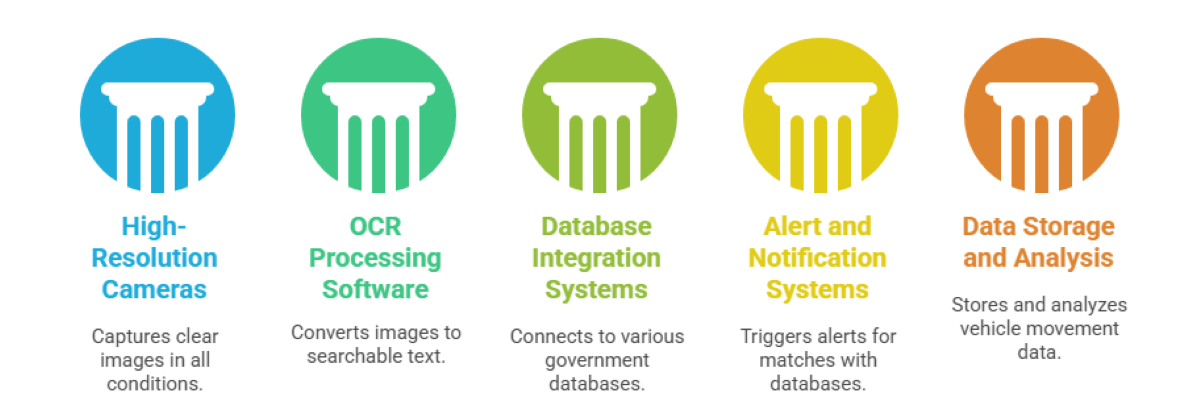
Modern UK ANPR systems integrate specialized hardware, intelligent software, and secure database connections to create comprehensive vehicle monitoring capabilities across diverse conditions.
Advanced camera technology captures clear number plate images at speeds up to 150mph in all weather conditions using specialized infrared illumination systems.
Optical Character Recognition software immediately processes visual data into searchable text for database matching and enforcement actions across multiple government systems.
Direct integration connects to DVLA, police intelligence networks, and local authority systems for instant verification of vehicle status and compliance information.
Automated alert systems trigger immediately when plates match databases of stolen vehicles or persons of interest, enabling rapid response coordination.
Secure storage systems retain vehicle movement data while analytical platforms provide traffic pattern insights and investigative support for law enforcement agencies.
Mobile ANPR deployments provide complementary coverage, with permanent installations ensuring continuous monitoring while mobile units offer tactical flexibility for targeted operations.
Fixed installations at motorway gantries and city centers provide 24/7 monitoring of key transport corridors.
Mobile units mounted on police vehicles enable real-time enforcement during routine patrols and operations.
Wireless synchronization connects mobile systems to national databases instantly for immediate threat detection.
Rural coverage extends through mobile deployments where fixed infrastructure isn't economically practical.
Strategic positioning at entry/exit points maximizes coverage while minimizing infrastructure costs and maintenance requirements.
Seamless integration with government databases creates a thorough vehicle intelligence system that processes thousands of reads per second while maintaining secure connections.
Instant alerts are transmitted to control rooms and mobile units when cameras detect vehicles of interest.
Multi-layered integration includes DVLA registration data, insurance status, and MOT compliance information for comprehensive checks.
Outstanding warrant databases enable the identification of vehicles connected to criminal investigations and enforcement actions.
Automated cross-referencing eliminates the need for manual verification in routine checks, thereby improving operational efficiency.
Secure data transmission protocols ensure reliable communication between field units and central command systems.
Artificial intelligence has transformed ANPR capabilities beyond basic plate recognition, enabling sophisticated analysis of vehicle movements, behaviors, and potential security threats.
Vehicle classification algorithms automatically identify car types, commercial vehicles, and motorcycles for targeted enforcement strategies.
Journey analysis detects impossible travel times between cameras to identify potentially cloned vehicles.
Recognition accuracy exceeds 98% in optimal conditions through machine learning improvements and adaptive algorithms.
Advanced features detect obscured plates, non-standard fonts, and foreign registration formats for detailed coverage.
Behavioral pattern analysis helps identify suspicious vehicle movements for security applications and threat assessment.
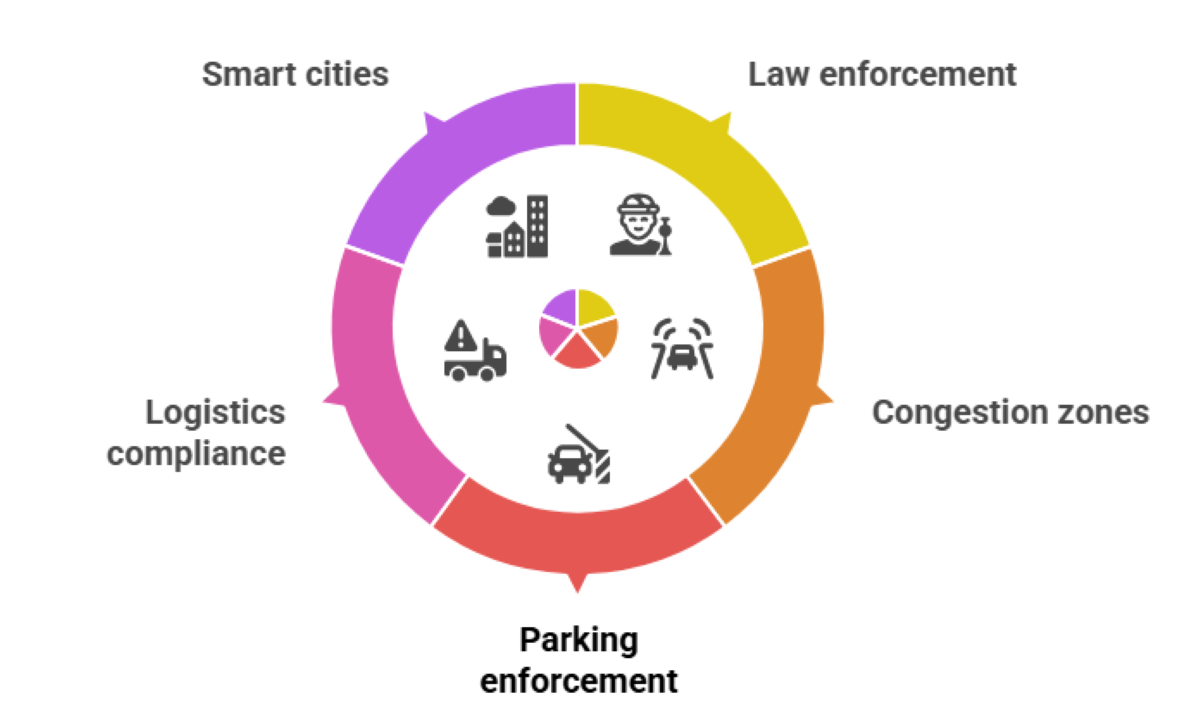
British authorities deploy ANPR technology across a diverse range of applications, including urban traffic management and rural crime prevention. The technology's versatility has made it an essential tool for multiple sectors working to improve safety, compliance, and operational efficiency. Modern traffic monitoring systems incorporate ANPR as a key component for comprehensive analysis.
Police forces throughout the UK rely on ANPR systems for both proactive crime prevention and reactive investigation support. The technology enables rapid identification of vehicles connected to ongoing investigations, missing persons cases, and organized crime activities. Recent operations by the City of London Police using ANPR resulted in five arrests and eight vehicle seizures during a two-night focused enforcement period.
The system's crime detection capabilities extend to identifying uninsured vehicles, expired MOTs, and vehicles with outstanding warrants. This multifaceted approach enables officers to address various compliance issues while maintaining a focus on serious crime prevention. Mobile ANPR units in patrol vehicles enable real-time enforcement during routine patrols, expanding the effective reach of limited police resources.
London's congestion charging and Ultra Low Emission Zone (ULEZ) programs demonstrate the effectiveness of ANPR in large-scale urban traffic management. The systems automatically identify vehicles entering restricted zones and verify payment compliance, processing hundreds of thousands of vehicle movements daily. Transport for London's network ensures extensive coverage while maintaining smooth traffic flow through automated enforcement.
The technology has proven essential for environmental compliance initiatives, automatically identifying vehicles that don't meet emission standards and ensuring proper charging for zone usage. This automated approach has enabled London to expand environmental zones while maintaining operational efficiency and reducing manual enforcement costs.
Private parking operators and local councils utilize ANPR systems to automate permit validation and detect violations across thousands of car parks nationwide. The technology eliminates the need for physical permits while enabling rapid identification of overstays and unauthorised parking. Integration with DVLA databases allows operators to access vehicle keeper information for enforcement purposes.
Modern parking ANPR systems can differentiate between various permit types, validate visitor registrations, and calculate precise parking durations. This automation has improved compliance rates while reducing operational costs for parking management companies and local authorities.
Commercial vehicle operators utilize ANPR technology to monitor fleet movements, ensure driver compliance, and verify adherence to environmental regulations. These systems enable logistics companies to track vehicle locations, monitor route compliance, and ensure drivers observe mandatory rest periods. Integration with tachograph data provides more fleet management capabilities.
Environmental compliance monitoring through ANPR helps ensure commercial vehicles meet emission standards when entering restricted zones. This capability becomes increasingly important as cities expand low-emission zones and implement stricter environmental regulations for commercial traffic. Advanced vehicle counting systems support fleet analytics.
Local councils use ANPR data to understand traffic patterns, optimize signal timing, and plan infrastructure improvements. The technology provides detailed journey time analysis, enabling authorities to identify congestion hotspots and measure the effectiveness of traffic management initiatives. Real-time data helps councils respond quickly to incidents and adjust traffic management strategies.
Smart city applications extend to emergency services coordination, where ANPR data helps optimize response routes and track the movements of emergency vehicles. This integration supports faster response times while providing valuable data for the continuous improvement of emergency services delivery.
FeatureTraditional CCTVANPR System UKManual monitoring✅❌Real-time plate matching❌✅Violation alerts❌✅Integration with DVLA❌✅Emission compliance❌✅
The widespread adoption of ANPR traffic enforcement in the UK reflects its proven value in addressing multiple challenges facing modern authorities
Automated, scalable vehicle enforcement - Technology processes millions of vehicle movements automatically, reducing personnel requirements while maintaining comprehensive coverage.
Supports clean air and ULEZ initiatives - London's ULEZ expansion has been supported by comprehensive ANPR coverage, enabling automatic emission zone enforcement.
Enables rapid response and stolen vehicle recovery - Real-time location data allows immediate alerts to patrol units when stolen vehicles are detected.
Improves public safety and traffic flow - Automatically detecting uninsured vehicles and optimizing traffic flow through congestion pattern analysis.
Data-driven insights for city planning - Detailed datasets support evidence-based decision making for transport planning and urban development projects.
Despite proven benefits, ANPR traffic enforcement in the UK faces several challenges that require careful consideration and management from authorities and stakeholders.
Privacy & GDPR - The National ANPR Service maintains strict data retention policies, typically storing vehicle movement data for 12 months while balancing operational needs with privacy rights.
Budget constraints - Single camera solutions start around £7,000, while multi-camera systems require substantially larger investments for smaller councils.
Environmental limitations - UK weather conditions present ongoing challenges for ANPR accuracy during heavy rain, snow, or fog.
Integration issues - Legacy systems may not integrate easily with modern ANPR platforms, requiring database compatibility and staff training.
Public sentiment - Balancing public safety benefits with privacy concerns requires ongoing community engagement and transparent communication strategies.
Real-world implementations demonstrate ANPR's effectiveness in addressing diverse challenges while delivering measurable results for authorities and communities across the UK.
Folio3 partnered with a major metropolitan authority to implement comprehensive AI-powered traffic management solutions that transformed urban mobility across the region.
Deployed an integrated ANPR network with advanced AI analytics to create intelligent transport corridors throughout the city.
Achieved 30% reduction in traffic congestion during peak hours and 25% improvement in emergency response times.
Implemented real-time traffic monitoring, predictive congestion analysis, and automated incident detection for proactive management.
Established foundation for broader smart city initiatives with environmental monitoring and emission zone compliance automation.
Enabled evidence-based policy making and infrastructure investment prioritization through comprehensive real-time analytics capabilities.
Folio3's approach to ANPR technology addresses the evolving needs of UK authorities while supporting the broader transformation toward intelligent urban management.
Our machine learning algorithms provide predictive insights that help authorities anticipate traffic patterns and optimize resource allocation proactively rather than reactively.
ANPR systems connect seamlessly with broader smart city infrastructure, including environmental monitoring, emergency services coordination, and public transport management systems.
Future developments will focus on enhanced privacy protection features, improved accuracy in challenging conditions, and expanded analytical capabilities for evidence-based policy-making.
AI-powered solutions combine proven expertise with innovative features that deliver measurable improvements in operational efficiency and public safety outcomes across the nation.
A holistic approach enables authorities to maximize their technology investments while delivering comprehensive benefits to communities through integrated urban management solutions.

Yes, ANPR is legal in the UK under the Protection of Freedoms Act 2012, which established statutory regulation for the technology. The Home Office publishes standards for its use, and data protection regulations ensure proper handling of collected information.
ANPR (Automatic Number Plate Recognition) and ALPR (Automatic License Plate Recognition) refer to the same technology, with ANPR being the preferred term in the UK. Both describe systems that automatically read vehicle registration plates and process the data for various applications.
Access to ANPR data is strictly controlled and limited to authorized law enforcement agencies, approved organizations listed in national standards, and specific government departments. The National ANPR Service maintains comprehensive access controls and audit trails for all data usage.
Yes, modern ANPR systems incorporate infrared illumination and advanced imaging technology, enabling effective operation in rural areas and low-light conditions. Their weather resistance and adaptive algorithms help maintain recognition accuracy across diverse environmental conditions throughout the UK.
ANPR integrates with parking systems through automated permit validation, payment verification, and violation detection capabilities. The technology eliminates physical permits while providing comprehensive monitoring and enforcement tools that improve operational efficiency and customer experience.