Loading...

Input project parameters like site constraints, budget, and sustainability targets into generative AI systems to automatically generate thousands of optimized building design alternatives.
Integrate generative AI with BIM platforms (Revit, ArchiCAD) to run real-time performance simulations that evaluate energy consumption, carbon impact, and structural efficiency during design.
Start with assessment and pilot projects on smaller buildings, then scale by establishing data pipelines, training design teams, and standardizing AI workflows across projects.
Use AI-generated designs to optimize material selection, structural systems, and building orientation, achieving 15-30% carbon reduction and 20-40% energy savings.
Partner with specialists like Folio3 to develop custom generative models trained on your project data, ensuring AI outputs match your firm's design standards and sustainability goals.
Have you ever thought about exploring 5,000 building design alternatives in 48 hours instead of spending six weeks on manual iterations? What if your team could simultaneously optimize for carbon reduction, cost control, and faster delivery? According to the World Green Building Council, buildings account for 39% of global carbon emissions, making design-phase decisions critical for sustainability outcomes.
Generative AI in construction design transforms this challenge into a competitive advantage by automating design exploration and accelerating timelines. Traditional workflows test 5-10 options over weeks; generative AI evaluates thousands in hours, each optimized for embodied carbon, operational energy, structural efficiency, and cost, enabling construction firms to win bids, meet net-zero mandates, and deliver profitable projects faster than competitors.
Generative AI in construction design refers to machine learning systems that automatically create and optimize building designs based on specified parameters and constraints. Unlike traditional CAD tools, where designers manually create each iteration, generative AI algorithms explore thousands of design possibilities in minutes, evaluating each against criteria like structural integrity, energy performance, cost, and carbon footprint. The system learns from historical project data, building codes, material properties, and performance simulations to generate novel solutions that human designers might never conceive. It's similar to having a tireless design assistant that can instantly test every "what if" scenario across multiple disciplines simultaneously.

Generative AI transforms construction design through five interconnected processes that move from data input to actionable building solutions, creating an intelligent design ecosystem.
Design teams specify project constraints, including site dimensions, zoning requirements, budget limits, sustainability targets, and performance goals. The AI system ingests this alongside historical project data, material databases, and environmental conditions to establish the solution space it will explore.
Machine learning algorithms explore thousands of design permutations, creating variations in building geometry, structural systems, material selections, and spatial configurations. Each iteration automatically satisfies fundamental constraints like structural stability, building codes, and functional requirements while optimizing for specified priorities.
The system evaluates each generated design against competing objectives, minimizing embodied carbon while maximizing daylighting, reducing costs while improving energy efficiency. Advanced algorithms identify Pareto-optimal solutions where improvements in one area don't compromise others, presenting designers with the best possible trade-offs.
Generated designs undergo instant simulation for energy consumption, thermal performance, structural loading, daylighting quality, and lifecycle carbon impact. What traditionally required separate analysis by multiple consultants happens simultaneously, with results feeding back to refine subsequent design iterations.
Architects and engineers review AI-generated options through intuitive visualization interfaces, selecting preferred designs based on aesthetic judgment, client requirements, and strategic priorities. Selected designs can be further refined, with AI continuing to optimize within new constraints, creating an iterative human-AI collaboration loop.
The construction sector’s sustainability transformation is accelerating as generative AI capabilities mature. This advancement is creating measurable environmental and economic benefits across project lifecycles.
AI algorithms optimize structural systems and material selections to minimize embodied carbon from extraction through construction. By analyzing carbon intensity across supply chains and suggesting lower-impact alternatives like timber or recycled steel, systems achieve 20-30% carbon reductions compared to conventional designs.
Generative models simultaneously optimize building orientation, envelope design, fenestration placement, and HVAC integration to minimize operational energy, decisions that later inform downstream tools, such as flat-rate HVAC software, during installation and service planning. Real-time energy modeling during design ensures buildings meet or exceed net-zero targets before construction begins, eliminating costly post-design retrofits.
AI systems identify opportunities for material reuse, design for disassembly, and adaptive reuse potential. Algorithms prioritize materials with high recycling rates and design modular systems that enable future reconfiguration, extending building lifecycles and reducing long-term environmental impact significantly.
By optimizing material quantities and reducing design changes during construction, generative AI cuts material waste by 15-25%. Precise fabrication specifications generated by AI enable off-site prefabrication with minimal scrap, while accurate quantity takeoffs eliminate over-ordering.
AI systems automatically verify designs against evolving green building standards, including LEED, BREEAM, and local energy codes. Instant compliance checking during design prevents late-stage revisions, accelerates permitting, and ensures projects meet 2026 sustainability mandates from conception.
Construction firms worldwide deploy generative AI across diverse project types, demonstrating tangible improvements in sustainability, cost, and delivery timelines.
Residential developers use generative AI to explore thousands of massing options for multi-unit housing projects within days. AI-optimized designs typically achieve better solar access, reduce structural material requirements, and lower embodied carbon while maintaining budget targets and meeting density requirements.
Engineering teams apply generative algorithms to optimize structural systems for office towers and commercial buildings. The technology tests multiple column layouts, beam configurations, and material options to reduce steel or concrete tonnage, lower foundation loads, and improve floor-to-floor heights for enhanced natural lighting.
Hospital and medical facility design teams leverage AI to optimize department adjacencies, patient flow patterns, and daylighting for wellness environments. Generative systems evaluate layouts against infection control protocols, staff efficiency requirements, and patient experience indicators to deliver operationally efficient designs.
Universities and educational institutions employ generative AI to design buildings targeting net-zero or low-energy operation. The systems optimize envelope performance, renewable energy integration, and passive design strategies to achieve significant energy reductions while compressing design timelines from months to weeks.
Architecture firms use AI for complex urban developments, combining multiple program types like residential, retail, and office space. Algorithms balance zoning constraints, view corridors, structural efficiency, and parking requirements while maximizing leasable area and minimizing carbon footprint across interconnected building systems.
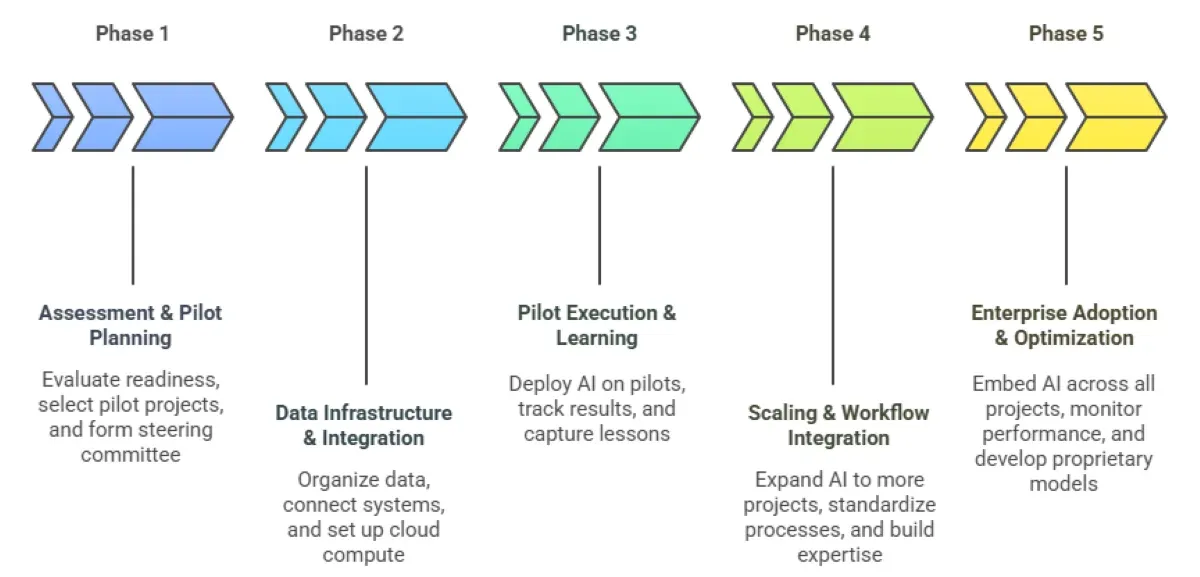
Strategic implementation of generative AI requires phased adoption that builds organizational capability while delivering measurable value at each stage.
Conduct an AI readiness assessment evaluating data quality, technical infrastructure, team skills, and process maturity. Identify 1-2 pilot projects with clear success metrics, preferably with a smaller scope and sustainability targets. Establish a cross-functional steering committee including architects, engineers, sustainability leads, and IT.
Audit and organize historical project data, including BIM models, performance data, cost information, and sustainability metrics. Establish data pipelines connecting design tools, BIM platforms, and simulation software. Implement cloud compute infrastructure capable of handling AI training and inference workloads at scale.
Deploy generative AI on pilot projects with embedded training for design teams. Document workflows, track time savings, measure design quality improvements, and quantify sustainability gains. Capture lessons learned regarding integration challenges, user experience issues, and process modifications needed.
Based on pilot results, expand generative AI to additional project types and teams. Standardize processes integrating AI into design phases from conceptual through detailed development. Develop internal expertise through advanced training, hiring AI specialists, or partnering with implementation experts like Folio3.
Embed generative AI as standard practice across all projects meeting specified criteria. Establish MLOps practices for model monitoring, continuous improvement, and performance tracking. Build proprietary models trained on your firm's project history, creating competitive differentiation through domain-specific AI capabilities.
Despite significant benefits, firms face technical, organizational, and regulatory obstacles when deploying generative AI that require proactive mitigation strategies.
Generative AI requires substantial training data, including completed project BIM models, performance data, and outcomes. Many firms lack organized historical data or have inconsistent documentation practices. Solution: Begin data collection immediately, standardize BIM protocols, and consider synthetic data generation or transfer learning from public datasets.
Most firms use established BIM platforms and analysis tools that weren't designed for AI integration. Creating seamless workflows between generative systems and existing software requires custom API development and careful change management. Folio3 specializes in building integration layers that connect AI engines with legacy systems.
Architects and engineers may resist AI-driven workflows, fearing job displacement or loss of creative control. Technical teams often lack the machine learning expertise needed to deploy and maintain AI systems. Address through comprehensive training emphasizing AI as creative amplification, not replacement, while augmenting teams with MLOps specialists.
Training and running generative models demands significant computing power, particularly for complex buildings with multiple optimization objectives. Cloud infrastructure costs can surprise unprepared firms. Mitigate through phased cloud adoption, optimized model architectures, and right-sizing compute resources based on actual project requirements.
Questions around professional responsibility for AI-generated designs remain unresolved. Who's liable if an optimized structural system fails? How do building departments review AI-designed projects? Maintain human oversight at all decision points, document AI recommendations versus human selections, and work with legal counsel on professional liability coverage.
Generative AI's trajectory through 2026 and beyond points toward a fundamental transformation in how buildings are conceived, designed, and delivered.
AI systems will directly generate fabrication instructions for off-site manufacturing, creating seamless digital threads from design intent through robotic fabrication. Generative algorithms will optimize not just design but also construction sequencing, logistics, and assembly methods, collapsing timelines and eliminating coordination errors.
Future systems will combine generative design with IoT sensors and computer vision on active construction sites. As conditions change, weather delays, material substitutions, and field modifications, AI will instantly regenerate affected design elements and construction plans, maintaining optimization objectives throughout project execution.
Generative AI will extend beyond initial design into building operations through digital twin connections. Systems will continuously optimize facility performance based on actual occupancy patterns and equipment performance, automatically suggesting renovations or retrofits that maintain sustainability targets as building use evolves.
Advanced natural language processing will enable non-technical stakeholders to interact with generative systems using plain English. Owners could specify "reduce our office building's carbon footprint by 30% while staying under $15M" and receive optimized designs instantly, democratizing access to sophisticated design intelligence.
AI systems will learn across entire industry datasets, not just individual firm histories. Federated learning approaches will let companies contribute to shared models while maintaining data privacy, accelerating improvement rates, and establishing industry-wide best practices for sustainable design encoded in AI algorithms.
Folio3 AI delivers construction-specific generative AI solutions from strategy through production deployment, accelerating your path to measurable sustainability and efficiency gains.
We design and build custom generative AI models fine-tuned to construction data, including BIM geometries, material properties, and structural performance. Our models deliver accuracy and scalability for building design optimization, whether working with architectural layouts, structural systems, or sustainability metrics specific to your projects.
We seamlessly embed generative AI solutions into your existing design ecosystem. Our integration approach ensures smooth deployment without disrupting established workflows, connecting AI capabilities with the design tools your teams already use daily.
Our experts craft optimized prompts tailored to construction design scenarios, ensuring consistent, code-compliant, and constructible outputs. The result is better model performance for tasks like massing studies, structural optimization, and MEP coordination, delivering reliable results aligned with your firm's standards.
Strengthen your internal capabilities with our seasoned MLOps specialists who manage model deployment, performance monitoring, and ongoing optimization. We support your generative AI infrastructure by handling scaling and continuous improvement, keeping your AI systems production-ready as project demands grow.
We automate repetitive design tasks using AI-driven tools, including quantity takeoffs, code compliance checking, and drawing generation. This accelerates documentation cycles, reduces manual effort, and ensures consistency, freeing your architects and engineers to focus on high-value design decisions.

Generative AI in construction design uses machine learning algorithms to automatically create and optimize building designs based on specified constraints like budget, sustainability targets, and site conditions. Unlike traditional CAD, where designers manually create each option, generative systems explore thousands of alternatives in hours, evaluating each against multiple objectives, including structural efficiency, energy performance, and cost.
Generative AI optimizes multiple environmental factors simultaneously, minimizing embodied carbon through material selection, reducing operational energy via envelope optimization, and cutting construction waste through precise calculations. Real-time performance simulation ensures buildings meet net-zero targets before construction while exploring thousands of alternatives that reveal sustainability solutions designers might never discover manually.
Generative AI enables embodied carbon reductions of 15-30% through optimized structural systems and low-carbon materials, while operational energy drops 20-40% via AI-optimized envelope design. Material waste decreases 15-25% through precise quantity takeoffs, and lifecycle assessments ensure designs support adaptive reuse aligned with circular economy principles.
No, generative AI augments rather than replaces design professionals by handling computational tasks like exploring design variations and running performance simulations. Architects make critical decisions about which AI-generated options align with project goals and cultural contexts; the technology amplifies human creativity by enabling designers to focus on high-value strategic decisions.
Begin with an AI readiness assessment, evaluating data quality and infrastructure, then launch 1-2 pilot projects with clear metrics. Scale successful approaches while standardizing integration processes, building internal expertise through training or partnerships like Folio3, and embedding generative AI as standard practice with continuous optimization.
Generative AI integrates with BIM platforms through APIs and plugins that enable bidirectional data exchange with Revit, ArchiCAD, and other environments. Integration maintains parametric relationships, materials, and families, ensuring AI-generated designs remain fully documented BIM models ready for construction documentation.
Successful implementation requires historical BIM models, performance data including energy consumption, cost information, and sustainability metrics like embodied carbon. Projects need parametric constraints, including zoning codes, building standards, and material databases; quality matters more than quantity for training effective models.
The biggest challenges include data quality issues where firms lack organized historical information, integration complexity with established BIM workflows, and skills gaps. Computational costs and liability questions regarding professional responsibility for AI-generated designs also require careful consideration and human oversight.
Small and mid-sized firms access sophisticated design capabilities previously available only to large firms, leveling the playing field through instant sustainability analysis without hiring additional consultants. Cloud-based AI platforms require minimal upfront investment, while partnerships with experts like Folio3 provide enterprise-grade capabilities without building internal AI teams.
Folio3 brings construction-specific AI expertise, combining machine learning with a deep understanding of BIM workflows and building systems, creating custom models trained on construction data. Our seamless integration connects AI with existing design tools while MLOps support ensures production-ready systems that scale, delivering measurable ROI through time savings and sustainability improvements.