

Loading...
Every morning, millions of drivers across American cities face the same frustrating routine. First, they circle blocks hunting for parking spots. With smart city parking solutions with AI, this wasted time could be eliminated, freeing drivers for activities that matter more. This daily struggle creates significant problems beyond individual inconvenience.
According to the INRIX 2024 Global Traffic Scorecard, American drivers lost an average of 43 hours to traffic congestion in 2024, costing $771 per driver in lost time and productivity. Nationwide, this resulted in more than four billion hours lost, costing $74 billion. Meanwhile, research indicates that between 20-30% of traffic in congested downtown business districts comes from drivers searching for parking spaces, with some studies showing this can account for up to 40% of total traffic during rush hours in major cities.
Folio3 AI specializes in smart city parking solutions that leverage advanced artificial intelligence to transform urban parking management while reducing traffic congestion.

Smart city parking solutions represent a fundamental shift from traditional parking management to intelligent, data-driven systems. These innovative platforms integrate artificial intelligence with Internet of Things sensors, computer vision technology, and real-time analytics. Consequently, they create parking ecosystems that automatically adapt to demand patterns and optimize space utilization.
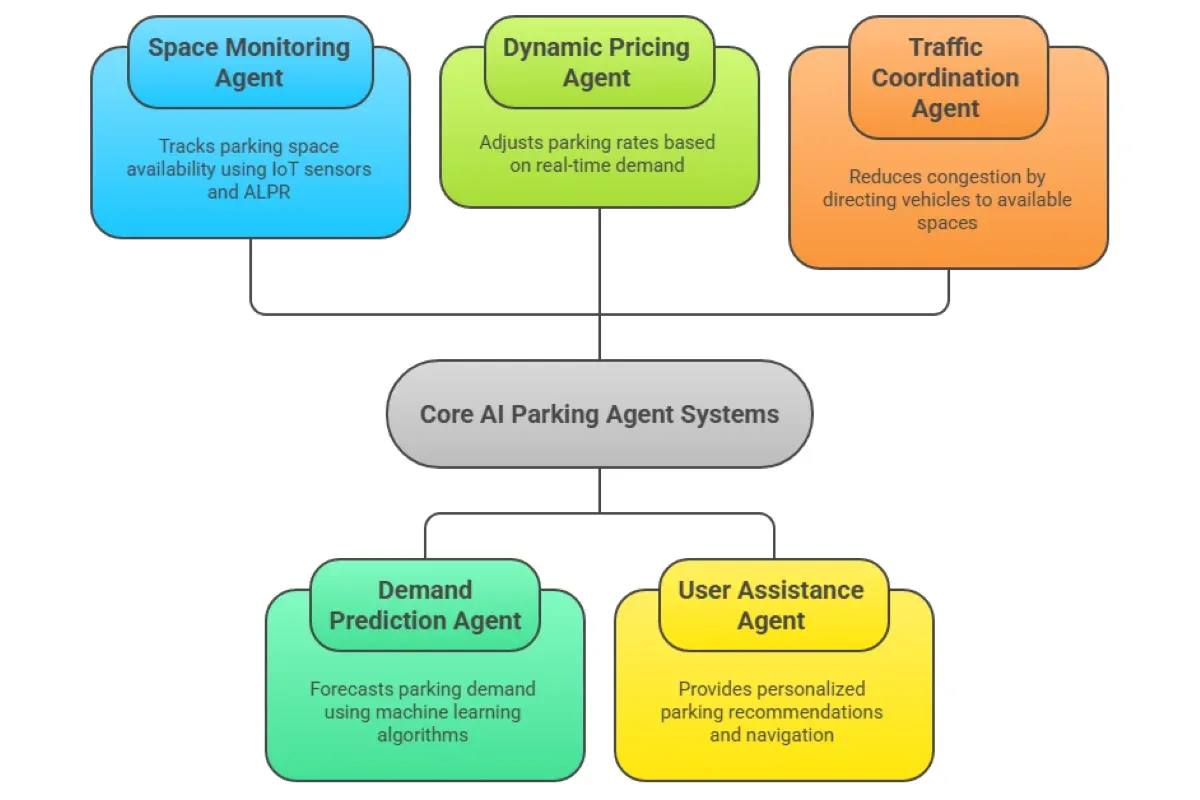
Modern smart parking solutions operate through interconnected AI agents working collaboratively to manage parking resources efficiently. Each agent specializes in specific functions while maintaining seamless communication with other system components.
This intelligent system continuously tracks parking space availability using IoT sensors, computer vision cameras, and automated license plate recognition (ALPR) systems. Additionally, it maintains real-time occupancy data and provides instant updates to central management systems for immediate response.
Machine learning algorithms analyze historical usage patterns, weather conditions, local events, and traffic flows to forecast parking demand accurately. This predictive capability helps cities prepare for peak periods and optimize resource allocation before congestion develops.
Based on real-time demand and availability data, this agent automatically adjusts parking rates to optimize space utilization. Higher prices during peak periods encourage turnover, while lower rates during off-peak hours maximize revenue and accessibility.
This system interacts directly with drivers through mobile applications, providing personalized parking recommendations, navigation assistance, and seamless payment processing. Natural language processing capabilities ensure intuitive and user-friendly interactions.
Working with citywide traffic management systems, this agent reduces congestion by directing vehicles to available parking spaces. Furthermore, it coordinates with traffic signals to optimize traffic flow around parking areas.
Smart parking systems operate through a layered architecture that processes data from multiple sources. Subsequently, they deliver actionable insights to both drivers and city managers in real-time.
Sensors embedded in parking spaces, computer vision cameras, ALPR systems, and mobile application data continuously feed information about parking availability, vehicle movements, and user preferences into central processing systems.
Artificial intelligence systems analyze incoming data streams in real-time. Moreover, they make decisions about pricing adjustments, space allocation, and traffic routing based on current conditions and predictive models.
APIs connect parking systems with traffic lights, public transportation networks, emergency services, and other city infrastructure. This ensures coordinated responses and optimized urban mobility across all transportation modes.
Mobile applications, digital signage, in-vehicle displays, and voice-enabled systems provide drivers with real-time parking information. Additionally, they offer reservation capabilities and guided navigation to available spaces.
Real-time dashboards give city administrators oversight of parking operations, revenue generation, compliance monitoring, and data analytics for strategic planning and policy development.
Smart parking systems become truly powerful when integrated with broader smart city infrastructure. These connections create synergies that benefit the entire urban transportation ecosystem.
Parked electric vehicles equipped with V2G capabilities serve as mobile energy storage units. They feed power back into the grid during peak demand periods while generating additional revenue for drivers and cities.
Seamless integration with public transportation, ride-sharing, bike-sharing, and other mobility options helps drivers make informed decisions. They can choose transportation modes based on real-time availability and pricing.
Machine-readable signage, dedicated communication protocols, and automated payment systems prepare parking infrastructure for autonomous vehicles. These systems will require hands-free parking management capabilities.
Synchronized communication between parking systems and traffic management reduces congestion significantly. This optimization includes signal timing based on parking demand patterns and directing traffic flow around high-demand parking areas.
Automated space reservation for emergency vehicles, real-time communication with first responders, and rapid traffic rerouting capabilities ensure that parking systems support rather than hinder emergency operations.

American cities face mounting pressure from inefficient parking management that costs billions annually. Understanding these challenges proves essential for city leaders considering smart parking investments.
Cities lose significant potential parking revenue through manual enforcement limitations. Meanwhile, businesses suffer from reduced customer access during peak hours, affecting local economic development.
Vehicles searching for parking produce significantly more emissions than direct routes to destinations. This creates air quality degradation and public health impacts that burden healthcare systems nationwide.
When drivers circle blocks searching for parking, they contribute to gridlock, affecting public transportation schedules, emergency response times, and freight deliveries throughout metropolitan areas.
Traditional parking management cannot scale effectively as cities grow. Manual enforcement, static pricing, and a lack of real-time information create worsening inefficiencies and user frustration.
Frustrated drivers engage in aggressive behaviors, pedestrians navigate between slow-moving vehicles, and emergency responders face delayed access due to parking-related gridlock.
Smart parking solutions deliver measurable improvements across multiple dimensions of urban life. These comprehensive benefits provide clear justification for investment in AI-powered parking infrastructure.
Smart parking systems substantially reduce vehicle miles traveled for parking searches. This translates directly to lower emissions, reduced fuel consumption, and improved urban air quality metrics through optimized routing and reduced idle time in traffic.
Businesses near smart parking installations report increased customer visits due to improved accessibility. Property values show measurable increases as technology enhances neighborhood desirability and commercial attractiveness, contributing to overall urban economic growth and sustainable development.
Studies indicate drivers using smart parking systems report substantial time savings per parking trip. They also experience stress reduction and increased satisfaction with urban mobility through real-time information systems and predictive analytics capabilities.
Implementation of smart parking systems contributes to reduced car emissions from parking searches in major urban areas through optimized routing and reduced search times. These systems support broader sustainability initiatives and climate action goals in smart cities.
Smart parking data analytics provide valuable insights for urban planners, enabling data-driven decisions about infrastructure development, zoning optimization, and transportation network improvements. This comprehensive approach supports long-term sustainable urban development strategies.
Smart parking implementations across American cities provide concrete evidence of technology effectiveness. These success stories demonstrate both the challenges and rewards of transitioning to intelligent parking management systems.
San Francisco's pioneering SFpark program serves as America's most comprehensive smart parking case study. The pilot program equipped 7,000 of the city's 28,800 metered spaces with sensors across seven pilot neighborhoods from 2011 to 2013. Research studies confirmed the program achieved a 43% reduction in parking search time and a 50% reduction in cruising for parking. The success led to citywide expansion to all 28,000 parking meters by 2018.
New York City implemented the Connected Vehicle Pilot Program as part of the federal USDOT initiative, installing 450 roadside units (RSUs) and equipping 3,000 city fleet vehicles with connected vehicle technology. While primarily focused on safety applications rather than parking specifically, this infrastructure modernization project created the foundation for advanced traffic management and smart transportation systems throughout Manhattan and Brooklyn.
The Western United States leads in smart parking adoption through high urbanization rates and technology-focused urban planning. Cities like Los Angeles, San Francisco, and Seattle demonstrate comprehensive approaches to sustainable transportation technology integration, though specific deployment statistics vary by municipality.
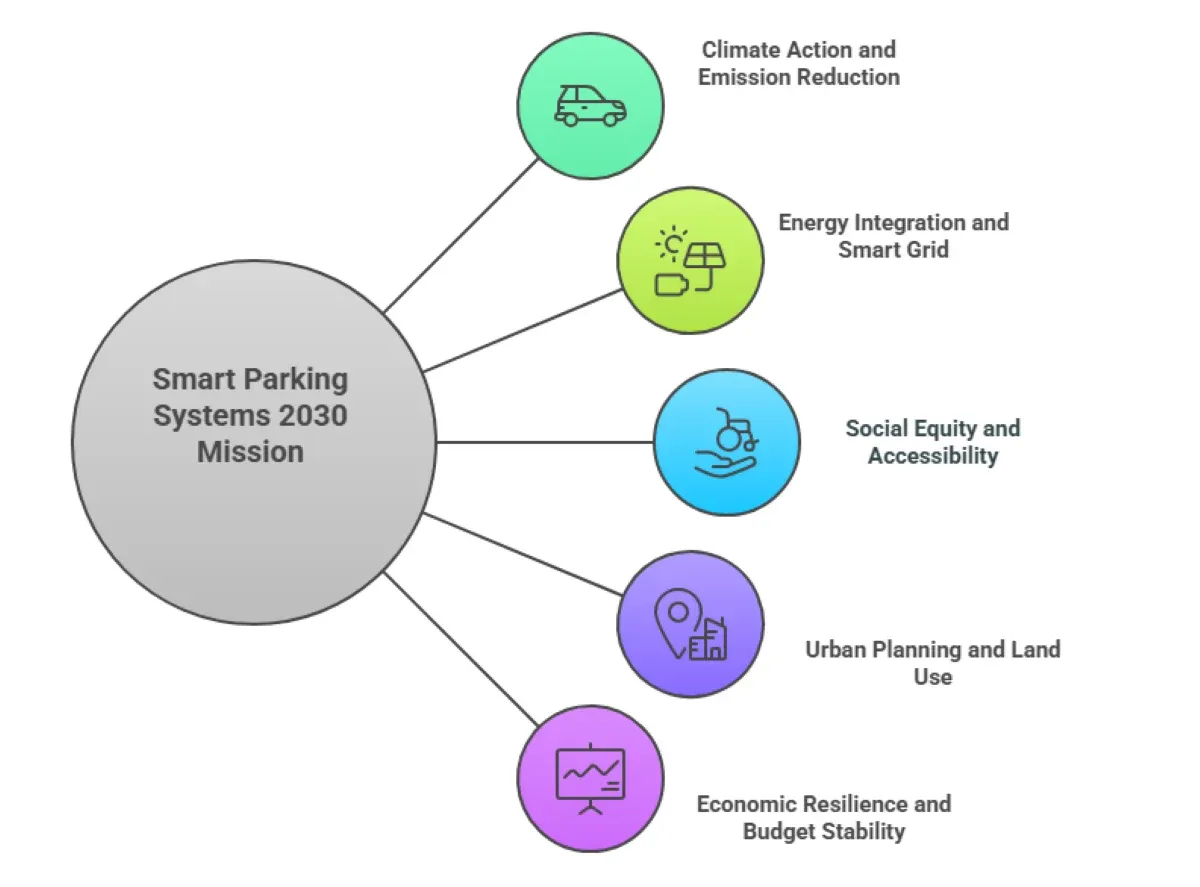
Smart parking systems play a crucial role in broader sustainability initiatives, defining urban development. These technologies contribute to environmental, social, and economic sustainability in measurable ways.
Climate action plans across American cities increasingly include smart parking as key components. Smart parking reduces vehicle emissions and supports electric vehicle infrastructure development nationwide while contributing to carbon neutrality goals.
Solar-powered parking lots with photovoltaic panels harness renewable energy while providing covered parking. Vehicle-to-grid technology transforms charging stations into energy exchange points supporting grid stability and renewable energy integration.
Dynamic pricing offers affordable off-peak options for all economic levels. Real-time accessibility features ensure disability access, while multilingual interfaces serve diverse urban populations effectively across demographic boundaries and cultural differences.
Real-time occupancy data, usage patterns, and demand forecasting help planners make informed decisions about zoning, transportation infrastructure, and mixed-use development opportunities citywide. This data-driven approach supports sustainable urban growth.
Cities with smart parking systems report more stable transportation budgets. They demonstrate improved ability to fund additional mobility improvements through consistent revenue streams and operational efficiency gains over traditional parking management methods.
Smart parking systems handle sensitive personal data and integrate with critical city infrastructure. Security and privacy protection prove essential considerations for successful implementations.
Data protection requirements include encryption of personal information, secure transmission protocols, and limited data retention periods. These maintain operational effectiveness for parking management and enforcement while protecting user privacy rights.
Multi-layered security approaches include encrypted communications between system components, secure cloud storage with regular backups, and intrusion detection systems monitoring unauthorized access attempts continuously across all network endpoints.
Compliance frameworks address federal, state, and local requirements for data handling, civil rights protection, and public procurement through regular audits and transparency reporting mechanisms that ensure accountability and legal compliance.
Modern systems implement privacy by design principles, collecting only necessary data for operational purposes. They provide users with clear information about data usage and storage practices with comprehensive opt-out options and user control mechanisms.
Standardized protocols ensure interoperability when parking systems operate across municipal boundaries. They integrate with state and federal transportation systems while maintaining security and privacy protections across different governmental levels.
Folio3 AI brings specialized expertise in artificial intelligence, Internet of Things integration, and smart city infrastructure development. We deliver comprehensive parking solutions addressing both immediate operational needs and long-term urban mobility goals.
Our advanced sensor networks and computer vision systems provide instant monitoring and display of parking spot availability to drivers. This reduces search time significantly while enhancing overall user convenience and satisfaction.
We utilize AI-based LPR technology for seamless vehicle entry and exit processing. This ensures secure access control and automated billing systems that eliminate manual processing errors while reducing operational costs.
Our AI algorithms analyze demand patterns in real-time to adjust pricing strategically. This ensures optimal space utilization during peak periods while maximizing revenue potential for cities and private operators.
Advanced machine learning models analyze parking trends and predict peak demand times accurately. This helps businesses and cities anticipate resource needs, allocate staff efficiently, and reduce operational costs proactively.
AI-enhanced video surveillance detects anomalies, manages traffic flow patterns, and ensures security for both vehicles and parking facilities through automated threat detection and response capabilities.

AI improves parking management by processing real-time data from sensors and cameras to predict demand patterns, optimize pricing automatically, and direct drivers to available spaces. This reduces search times significantly and increases parking efficiency through data-driven decision-making processes.
Smart parking systems use IoT sensors, computer vision cameras, automated license plate recognition, machine learning algorithms, cloud computing platforms, and mobile applications working together to create intelligent parking management that adapts to changing conditions.
Research indicates AI parking systems can substantially reduce traffic congestion by eliminating the need for drivers to circle blocks searching for parking. This directly addresses the significant portion of urban traffic that results from parking searches in congested areas.
Smart parking systems generate revenue through dynamic pricing that adjusts rates based on demand, automated enforcement capabilities, and operational efficiency improvements that lower management costs while increasing space turnover rates and overall utilization.
Automated License Plate Recognition enables contactless entry and exit, automated billing, enforcement automation with high accuracy, and real-time occupancy tracking without requiring physical tickets or manual payment processing by attendants.
These systems support sustainability through reduced emissions from parking searches, integration with electric vehicle charging infrastructure, and data-driven urban planning that optimizes transportation networks for long-term efficiency and environmental goals.
Drivers benefit from real-time availability information, mobile payment options, reservation capabilities, personalized recommendations, and significantly reduced time spent searching for parking spaces, leading to stress reduction and improved urban mobility satisfaction.
Smart parking systems integrate seamlessly with electric vehicle charging stations, providing reservation systems for charging spots, vehicle-to-grid energy exchange capabilities, and optimized charging scheduling based on grid demand and user preferences.
Implementation costs vary by scale and features, but systems typically demonstrate strong return on investment through increased revenue, reduced operational costs, and improved efficiency. Pilot programs can start with smaller areas to demonstrate value before expansion.
Folio3 AI combines deep expertise in artificial intelligence, proven experience with smart city infrastructure, robust security frameworks, and end-to-end implementation support to deliver parking solutions that meet both immediate operational needs and long-term urban mobility goals.