Loading...
Contact centers are experiencing a fundamental shift in how customer service operates. The traditional model of hiring more agents to handle growing call volumes no longer makes economic sense. AI contact center automation has moved from experimental technology to business-critical infrastructure in just two years.
According to Gartner's 2025 predictions, agentic AI will autonomously resolve 80% of common customer service issues without human intervention by 2029. Large language models and intelligent agents are already delivering instant responses, reducing operational costs by 30%, and enabling proper 24/7 support. The technology exists today; the question is whether you'll adopt it before your market share erodes.
AI contact center automation combines large language models with autonomous intelligent agents to handle customer interactions without human intervention. These systems leverage natural language processing, machine learning, and conversational AI to understand context, detect intent, and generate responses across voice, chat, and email channels.
Unlike traditional rule-based systems, LLM-powered automation learns from interactions, adapts to conversation flow, and executes complex workflows independently. The technology orchestrates seamless handoffs between AI and human agents, maintains conversation context across channels, and scales instantly to handle unlimited simultaneous interactions while reducing operational costs and delivering 24/7 customer support.

Modern AI contact center platforms integrate multiple specialized technologies working together. Each component handles specific functions, from understanding customer language to executing actions across enterprise systems, creating end-to-end automation that feels natural.
Large language models process customer queries using neural networks trained on billions of conversations. They generate contextually relevant responses, maintain coherence across multi-turn dialogues, and adapt tone based on customer sentiment without requiring manual programming.
Machine learning models analyze incoming messages to determine customer objectives, billing inquiries, technical support, or account changes. Intent classifiers route requests to appropriate workflows, triggering automated resolutions or human escalations based on confidence scores.
AI monitors emotional tone throughout conversations by analyzing word choice, speech patterns, and linguistic cues. Real-time sentiment detection identifies frustrated customers, triggers empathetic responses, and escalates high-risk interactions to human agents before situations deteriorate.
APIs connect AI agents to Salesforce, Zendesk, helpdesk platforms, and phone systems. These integrations enable real-time data access, automatic record updates, ticket creation, and synchronized customer profiles across all enterprise systems without manual data entry.
Routing algorithms orchestrate workflows between AI and human agents. They evaluate conversation complexity, customer value, and agent availability to determine optimal handling paths. Seamless handoffs transfer complete context when escalating to human representatives.
LLMs process customer language through neural networks trained on billions of conversations, while intelligent agents execute actions across integrated systems, creating seamless automated experiences that feel surprisingly human.
Speech-to-text engines convert voice into transcribed text with 95%+ accuracy. NLP layers tokenize words, identify entities like names and dates, determine grammatical structure, and extract semantic meaning. This processed data feeds into LLMs for response generation.
Machine learning models classify customer intent, like billing questions, technical support, or product inquiry. Simultaneously, sentiment analyzers detect frustration, satisfaction, or urgency through tone, word choice, and speech patterns. These signals trigger appropriate routing and response strategies.
LLMs access your knowledge base, customer history, and product data. They generate contextually relevant responses by predicting the most helpful next words based on training data. Temperature settings control creativity versus consistency, ensuring brand-aligned communication while maintaining conversational flexibility.
APIs connect AI agents to Salesforce, Zendesk, Microsoft Teams, and legacy phone infrastructure. Agents pull customer records automatically, log interaction details, create tickets, and update fields across systems. This eliminates manual data entry and ensures synchronized information.
Every interaction improves the system. Successful resolutions strengthen response patterns. Escalations identify gaps requiring additional training data. Human agent corrections refine accuracy. Performance metrics guide iterative improvements, increasing automation rates 5-10% quarterly without manual reprogramming.
Contact centers face mounting pressure from customer expectations, operational costs, and scaling demands. LLMs and AI agents directly address these pain points with measurable improvements in efficiency and experience.
Customers expect instant support regardless of time zones or holidays. Hiring night shifts and weekend coverage doubles labor costs. AI agents operate continuously, handling midnight queries with the same quality as noon interactions, eliminating overtime and shift differential expenses.
Human agents vary in knowledge, tone, and problem-solving approaches. New hires require months to reach proficiency. AI delivers standardized responses aligned with your brand voice, ensures policy compliance on every call, and provides consistent quality regardless of query complexity.
Holiday surges and campaign spikes overwhelm traditional contact centers. Temporary hiring is expensive and slow. AI agents scale instantly from 100 to 10,000 concurrent conversations without infrastructure changes, maintaining response times during your busiest periods without recruitment costs.
Answering "Where's my order?" for the hundredth time destroys morale. High-performing agents quit when stuck on routine queries. AI handles repetitive tasks automatically, freeing human agents for complex problem-solving and relationship building that actually engages talent.
Sampling 2-5% of calls provides incomplete insights. Manual QA misses emerging issues until they become crises. AI analyzes 100% of interactions, surfaces trending complaints in real-time, identifies coaching opportunities automatically, and predicts customer churn before it happens.
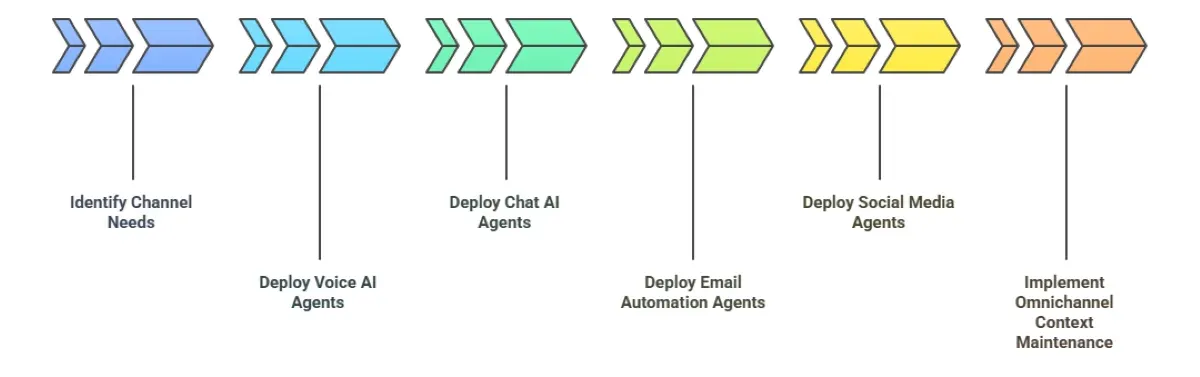
Different channels require specialized AI architectures. Voice agents handle phone calls, chat agents manage text conversations, and omnichannel agents maintain context as customers switch between platforms throughout their journey.
Voice AI converts speech to text, processes intent, generates responses, and speaks naturally using text-to-speech engines. These agents handle inbound calls, conduct outbound surveys, and manage appointment confirmations. Sub-second latency creates conversational flow without awkward pauses.
Chat agents respond instantly through web widgets, mobile apps, and messaging platforms like WhatsApp. They handle multiple conversations simultaneously, include rich media like images and links, and maintain conversation history. Response formatting matches human agent style for seamless experiences.
Email agents parse incoming messages, extract intent and urgency, draft contextual responses, and route complex issues to specialists. They handle confirmation requests, status updates, and document attachments. Response times drop from hours to minutes while maintaining a professional tone.
SMS agents work within 160-character constraints, providing concise answers to urgent queries. Social media agents monitor brand mentions, respond to public comments, and escalate reputation threats. They maintain brand voice across Twitter, Facebook, and Instagram simultaneously.
Omnichannel AI tracks customers across voice, chat, email, and social media. When someone starts a chat, then calls, the agent references previous messages without repetition. This unified view prevents customer frustration and reduces redundant explanations, improving satisfaction scores.
LLMs and intelligent agents unlock advanced capabilities that traditional automation couldn't achieve, like understanding context, detecting emotion, making autonomous decisions, and learning from every interaction to continuously improve performance.
LLMs remember conversation history, reference previous statements, and maintain topic coherence across 10+ exchanges. They handle clarifying questions, topic switches, and follow-ups naturally. Context windows spanning thousands of tokens enable truly conversational experiences, not robotic question-answer patterns.
AI agents search documentation, policies, and FAQs in milliseconds. They extract relevant passages, synthesize information from multiple sources, and present answers in conversational language. This eliminates hold times for routine questions and reduces dependency on human agent expertise.
Intent classifiers determine whether customers need billing help, technical support, or account changes. Confidence scores trigger automatic resolution or human escalation. High-confidence queries resolve instantly. Ambiguous requests route to specialists immediately, reducing transfers and improving first-call resolution.
Sentiment analysis detects frustration, anger, or satisfaction mid-conversation. When negativity spikes, agents adjust tone, offer proactive solutions, or escalate immediately to human agents. This prevents churn by addressing emotions before customers become detractors, protecting brand reputation.
AI agents schedule callbacks, send confirmation emails, create support tickets, and update customer records automatically. They close loops without human involvement, sending survey requests post-resolution, following up on promised actions, and ensuring no customer falls through cracks.
Real-world applications demonstrate how LLMs and AI agents transform contact center operations across industries. These use cases deliver measurable ROI through automation, efficiency gains, and improved customer satisfaction.
AI handles "What are your hours?", "How do I reset my password?" and similar repetitive questions are answered instantly. Resolution rates for FAQ-type queries reach 85%+. Customers receive immediate answers without queue times. Human agents focus on complex investigations requiring judgment.
Customers checking order status create massive call volume. AI integrates with logistics systems, retrieves shipment data, provides tracking numbers, and sends proactive delivery alerts. This automation alone can reduce contact center volume by 20-30%.
AI explains charges, processes payments securely, updates payment methods, and handles subscription changes. It accesses account history, identifies billing anomalies, and resolves discrepancies within policy guidelines. Escalation occurs only for disputes requiring authorization.
AI guides customers through diagnostic steps: "Is the device plugged in?" "Can you see the power light?", following the troubleshooting trees intelligently. It resolves connectivity issues, software glitches, and configuration problems. Successful tier-1 resolution frees specialists for complex failures.
During complex calls, AI suggests responses, retrieves policy information, and guides agents through procedures. Real-time coaching highlights compliance requirements, recommends next-best actions, and surfaces relevant case histories. New agents perform like veterans immediately.
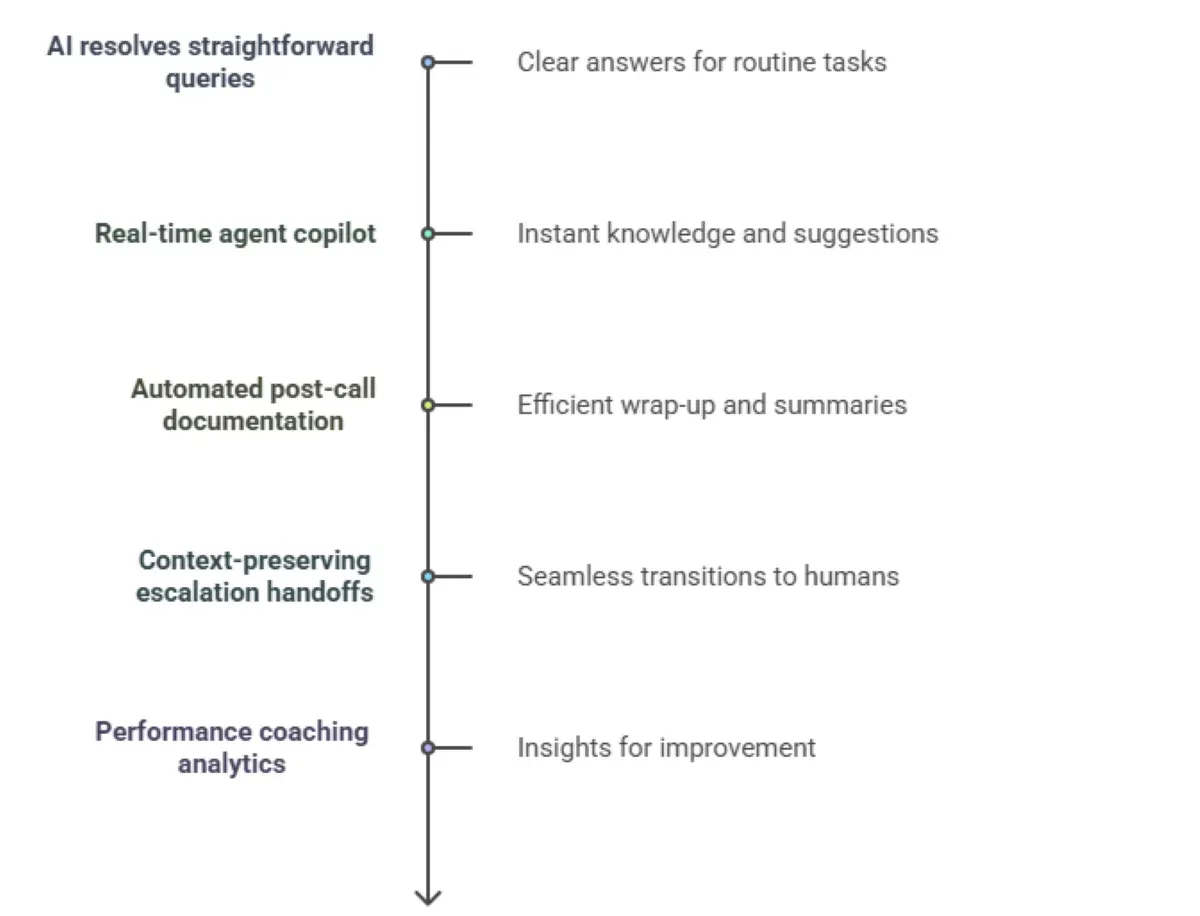
The most successful implementations combine AI efficiency with human empathy. This hybrid approach automates routine tasks while leveraging human judgment for complex situations, creating superior experiences at lower costs.
AI resolves straightforward queries with clear answers, like account balances, appointment scheduling, and password resets. Humans handle emotionally charged situations, complex negotiations, policy exceptions, and unique problems outside training data. Escalation rules ensure smooth handoffs based on confidence scores.
AI acts as a copilot, monitoring live conversations and surfacing relevant knowledge articles instantly. Agents receive suggested responses, compliance reminders, and product information without searching manually. This reduces handle time by 25% while improving accuracy and consistency.
AI transcribes calls, extracts key points, updates CRM fields, and generates summaries automatically. Agents move to their next call immediately instead of spending 5-7 minutes on wrap-up. This increases daily capacity by 15-20% without sacrificing record quality.
When escalating to humans, AI transfers the complete conversation history, detected sentiment, customer profile, and attempted solutions. Agents see everything, no "Can you repeat that?" frustration. Customers experience continuity, not starting over with each transfer.
AI analyzes 100% of interactions, identifying coaching opportunities human QA teams would miss. It spots excellent performance for recognition, flags compliance issues immediately, and reveals skill gaps requiring training. Managers receive actionable insights, not just call volumes.
AI contact center automation delivers quantifiable returns across cost reduction, customer satisfaction, agent productivity, and scalability. Enterprises typically achieve positive ROI within 6-12 months of deployment.
AI handles 60-80% of tier-1 queries without human intervention. This eliminates hiring needs during growth, reduces overtime expenses, and lowers facility costs as fewer seats are required. Average cost per interaction drops from $5-15 to $0.50-2.00 for automated resolutions.
AI responds in under 3 seconds versus 3-5 minute average hold times. Customers receive instant acknowledgment even during peak hours. Queue abandonment rates drop 40%+ as wait frustration disappears, protecting revenue from lost conversions.
Consistent, accurate responses improve satisfaction scores by 15-25%. Customers appreciate immediate resolutions and 24/7 availability. Reduced frustration from holds and transfers directly impacts net promoter scores. Better experiences correlate with higher retention and lifetime value.
Black Friday, tax season, or product launches create 5-10x traffic spikes. AI scales instantly without temporary hiring, training lag, or quality degradation. Infrastructure costs rise marginally while handling capacity increases exponentially, protecting margins during high-revenue periods.
Automating repetitive tasks, documentation, and basic queries frees agents for value-added work. They handle fewer but more complex cases, developing expertise instead of answering "What's my balance?" Engagement improves, turnover decreases, and skill development accelerates.
Successful AI deployment follows a structured approach from strategy through optimization. This roadmap ensures alignment with business goals, minimizes risks, and delivers measurable value incrementally rather than attempting big-bang transformations.
Identify high-volume, low-complexity interactions ideal for automation. Prioritize use cases by ROI potential, like order tracking, appointment scheduling, and FAQs, which typically deliver quick wins. Define success metrics: automation rate, CSAT, cost per interaction, and resolution time targets.
Gather historical call transcripts, chat logs, and support tickets. Clean data by removing personally identifiable information, normalizing formats, and labeling intents. Quality directly impacts LLM performance; garbage in, garbage out. Invest time here to avoid downstream accuracy problems.
Choose between GPT-4, Claude, or domain-specific models based on use case requirements. Fine-tune your data to improve accuracy for industry terminology, brand voice, and customer language patterns. Develop agent workflows defining escalation logic and system integrations.
Connect AI agents to Salesforce, Zendesk, Five9, or your existing tech stack via APIs. Configure data flows, authentication, and error handling. Test integrations thoroughly, failed CRM lookups destroy customer experience. Ensure real-time synchronization across systems.
Launch with 10-20% of traffic to validate performance before full rollout. Monitor automation rates, escalation triggers, customer sentiment, and resolution accuracy daily. Gather agent feedback, analyze edge cases, and refine responses iteratively. Expand gradually as confidence increases.
Even well-planned implementations face predictable challenges. Understanding these failure patterns and mitigation strategies prevents expensive delays, protects brand reputation, and accelerates time-to-value for AI investments.
LLMs occasionally generate plausible-sounding but factually wrong responses; AI contact center automation with LLMs and agents delivering 24/7 support, lower costs, faster resolution, and higher CSAT.a phenomenon called hallucination. This damages customer trust immediately when AI provides wrong account balances, incorrect policies, or false product details. Implement fact-checking layers, restrict responses to verified data sources, and route uncertain queries to humans automatically.
Disconnected systems force customers to repeat information and prevent AI from accessing the complete context. This recreates the exact problems you're trying to solve. Design a comprehensive integration architecture before deployment. Ensure real-time data synchronization, unified customer profiles, and workflow orchestration across platforms.
Without clear metrics, you can't prove value or identify improvement opportunities. Teams lose confidence, executives withdraw support, and projects stall despite technical success. Establish baselines before launch. Track cost per interaction, automation rates, CSAT, and agent productivity weekly.
Agents fear job loss when AI arrives. Without proper communication, they sabotage implementations by providing poor feedback, refusing adoption, or bad-mouthing technology to customers. Involve agents early in design. Emphasize AI as a copilot, not a replacement. Demonstrate how automation removes frustrating tasks.
Contact centers handle sensitive data—payment information, health records, and personal details. AI implementations must encrypt data, maintain audit trails, and comply with GDPR, CCPA, and HIPAA. Violations trigger massive fines and reputation damage. Embed security and compliance from day one, not as afterthoughts.
AI contact centers process sensitive customer data across voice, chat, and email. Robust security, regulatory compliance, and ethical safeguards protect your business from legal liability, financial penalties, and brand damage.
All customer data must be encrypted at rest and in transit using AES-256 standards. Role-based access controls limit who views sensitive information. For payment card data, PCI DSS compliance requires tokenization, secure transmission, and regular audits. AI systems should never store raw credit card numbers.
European GDPR and California CCPA mandate explicit consent, data portability, and deletion rights. Your AI systems must honor these requests automatically. Implement data retention policies, consent management, and geographic data residency rules. Document AI decision-making processes for regulatory scrutiny.
LLMs trained on biased data perpetuate discrimination. Test AI responses across demographics, like age, gender, ethnicity, and accent, ensuring consistent treatment. Monitor for unintentional bias in routing, pricing, or service quality. Regular fairness audits protect against discrimination lawsuits and reputational harm.
Regulators and customers increasingly demand explanations for AI decisions. Black-box models create liability when you can't explain why someone was denied service or routed differently. Implement explainable AI frameworks, log decision factors, and provide human review pathways for disputed outcomes.
AI should never operate without human oversight. Establish clear escalation triggers based on confidence scores, sentiment, and topic sensitivity. Human QA teams audit samples regularly. Implement kill switches allowing instant human takeover when AI behaves unexpectedly or handles high-stakes situations.
Folio3 delivers specialized LLM integration and AI agent development for contact centers, combining deep technical expertise with proven enterprise deployment experience. We provide end-to-end services from strategy and custom model development through integration and ongoing optimization, ensuring your automation initiatives deliver measurable business impact.
Our contact center AI journey begins with understanding your business needs, customer interaction patterns, and automation goals. Leveraging expertise in NLP and machine learning, we collaborate to create custom LLM strategies that align with your operational objectives and compliance requirements.
Folio3 builds custom Large Language Models from scratch for contact center applications. Our process includes detailed consultation, meticulous data preparation using your historical interactions, and model training that captures your brand voice, industry terminology, and specific customer service scenarios.
We fine-tune pre-trained models like GPT-4, Claude, and Llama for contact center use cases. Our fine-tuned LLMs understand industry-specific terminology, compliance requirements, and conversational nuances, delivering contextually accurate responses that improve customer satisfaction and first-call resolution rates.
Folio3 builds custom AI solutions that transform contact center operations—voice agents, chat automation, email responders, sentiment analyzers, and intelligent routing systems. Our solutions integrate seamlessly with your existing infrastructure, delivering automation that scales with your business growth.
Our developers ensure smooth LLM integration into your existing CRM, helpdesk, phone systems, and enterprise applications. We prioritize minimal downtime during deployment, comprehensive testing, and real-time synchronization across platforms, ensuring operations continue without disruption while automation capabilities go live.

AI contact center automation uses artificial intelligence to handle customer interactions autonomously, reducing manual work and increasing accuracy. It combines natural language processing, machine learning, and intelligent agents to resolve queries across voice, chat, and email without human intervention.
LLMs understand context, reducing repetitive tasks and improving response quality at scale. They generate natural language responses, maintain conversation coherence across multiple turns, and learn from interactions to continuously improve accuracy without manual reprogramming.
Not fully. Best performance comes from AI-assisted human collaboration plus autonomous agent automation. AI excels at routine queries, 24/7 availability, and instant responses. Humans handle complex negotiations, emotional situations, and unique problems requiring judgment and creativity.
Faster response times, fewer escalations, reduced workforce costs, and increased CSAT deliver primary ROI. Additional benefits include 24/7 availability without overtime expenses, scalability during peak demand, improved agent productivity, and data-driven insights for continuous optimization.
Yes, with proper controls, encryption, and governance frameworks. Implementations must include data encryption, access controls, PCI compliance for payments, GDPR/CCPA adherence, audit trails, and human oversight protocols. Security and compliance should be embedded from day one.
Deployment timelines vary based on complexity, typically ranging from weeks to a few months. Simple use cases like FAQ automation deploy faster. Complex integrations with legacy systems, custom LLM fine-tuning, and extensive workflow automation require longer implementation periods.
Yes, end-to-end integration is a core Folio3 service. We connect AI agents to your CRM, helpdesk, phone systems, and databases regardless of platform, Salesforce, Zendesk, Five9, Microsoft Teams, or custom infrastructure. Our integration expertise ensures seamless data flow and unified customer experiences.