Loading...

Mexico’s rapid urbanization is expected to accelerate in 2025, making it increasingly challenging for cities to maintain smooth traffic flow. With 1.55 million new vehicles sold in the past year, a 3.97% increase from 2024, Mexican cities face mounting pressure to modernize their enforcement systems. This guide to ALPR solutions in Mexico discusses everything you're looking for.
Mexico City currently ranks as the world's second-most congested city, with a Traffic Congestion Index of 46.83. However, the country has demonstrated progress through systems like the national REPUVE network and Mexico City's C5 surveillance system, which features over thousands of cameras, achieving a 40% crime reduction in specific districts.
ALPR (Automatic License Plate Recognition) technology provides Mexican authorities a practical approach to address these challenges while supporting broader digital transformation objectives.

Automatic License Plate Recognition (ALPR) refers to advanced systems that capture, read, and analyze vehicle license plates using cameras, optical character recognition (OCR), and artificial intelligence (AI). These systems are increasingly used in Mexico for urban traffic control, law enforcement, toll collection, and crime prevention.
By automating vehicle identification, ALPR enhances real-time monitoring and improves operational efficiency in cities facing rapid urbanization and traffic congestion. It’s a smart, scalable solution for modernizing transportation and public safety infrastructure.
ALPR systems follow a streamlined process to detect and identify license plates across Mexico’s busy urban roads and highways.
Image capture: Cameras automatically detect and photograph vehicles as they pass specific checkpoints or zones, regardless of vehicle speed or traffic density.
Plate detection: AI algorithms isolate the license plate region within the image using computer vision techniques trained for local plate formats and designs.
Character recognition: OCR technology decodes plate numbers and converts them into searchable text data, which is stored in databases or cross-referenced in real-time.
Data matching: The decoded plate data is compared against watchlists, stolen vehicle databases, or toll account records to trigger alerts or take action.
User notification: Dashboards notify relevant personnel, such as traffic managers or law enforcement, when a match, violation, or toll event is detected, enabling quick response or record-keeping.
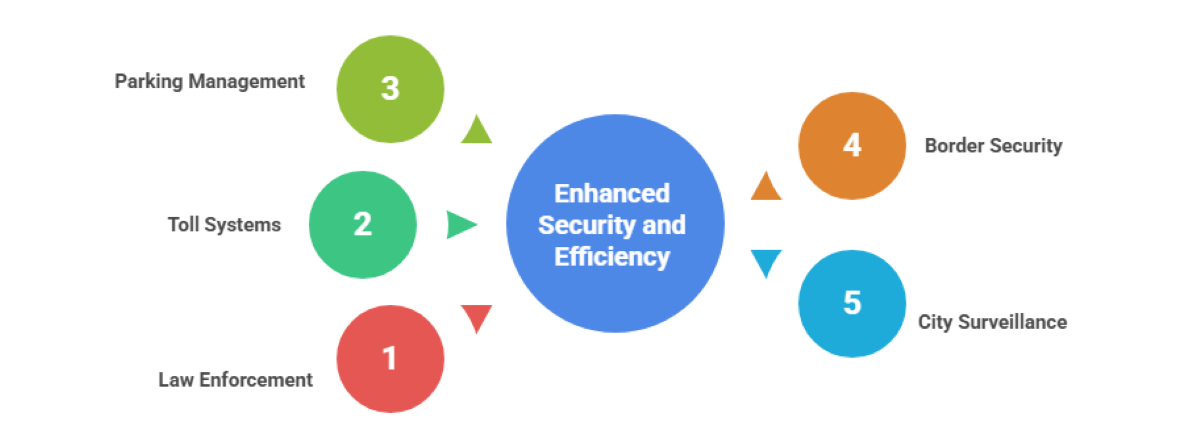
Mexican organizations across multiple sectors recognize ALPR's potential to address operational challenges while supporting government digitization initiatives currently transforming the country's infrastructure and security systems.
Municipal and federal police departments utilize ALPR systems for the recovery of stolen vehicles, tracking of suspects, and support in crime investigations. Mexico City's C5 surveillance system represents one of the world's most ambitious implementations, featuring over 64,000 cameras with AI-enhanced license plate recognition capabilities and 8,000 RADAR kits deployed across different police stations for thorough coverage.
Mexico's toll road operators integrate ALPR technology with electronic payment systems through the national REPUVE system, inaugurated in 2009. The system now covers 7 toll plazas with 115 lanes, processing 85 million transactions annually with a 0.16% error rate, generating more than 1,300 hits annually for law enforcement purposes.
Shopping centers, airports, and business districts adopt ALPR for automated entry management and billing systems. The technology streamlines vehicle access while providing detailed analytics for capacity planning and security monitoring in high-traffic commercial environments.
Customs authorities along the U.S.-Mexico border implement ALPR systems to track vehicle movements and identify security threats. ALPR cameras scan license plates of vehicles entering or leaving Mexico at land border crossings, allowing border authorities to monitor traffic flow and identify potential security threats while maintaining efficient traffic flow at major crossing points.
Mexico City, Monterrey, and Guadalajara integrate Automatic License Plate Recognition (ALPR) into smart city platforms that combine traffic management, security monitoring, and urban planning systems. Districts like Benito Juarez and Cuajimalpa have deployed RADAR (Radio Detection and Ranging) systems with impressive crime rate reductions, demonstrating measurable improvements in neighborhood security through integrated surveillance networks.
Successful ALPR deployment requires addressing technical, infrastructure, and regulatory challenges specific to Mexico's diverse operational environment and regulatory framework governing surveillance technology.
Mixed implementation results, despite massive investment, create challenges for agencies expecting immediate crime reduction. While Mexico City's C5 system achieved a 40% reduction in crime in specific districts, violent crime has risen in other areas since 2011, highlighting the need for comprehensive deployment strategies that extend beyond technology alone.
Security vulnerabilities in surveillance networks pose risks to operational effectiveness and officer safety. Documented incidents include Sinaloa Cartel hackers accessing Mexico City's surveillance camera system to track and kill informants, demonstrating the critical importance of cybersecurity measures in ALPR deployments.
Integration with legacy systems presents compatibility challenges for agencies using older databases and communication networks. ALPR solutions must work with existing infrastructure while providing upgrade paths that don't require complete system replacement.
Data privacy compliance with Ley Federal de Protección de Datos Personales requires careful attention to data collection, storage, and sharing protocols. ALPR systems must incorporate encryption, access controls, and audit capabilities that comply with federal privacy regulations while facilitating effective law enforcement operations.
Technological weaknesses and the accuracy of evidence gathering impact system reliability and legal admissibility. Concerns about inaccurate evidence gathering, system limitations, and potential police misconduct necessitate robust quality control measures and effective officer training programs.
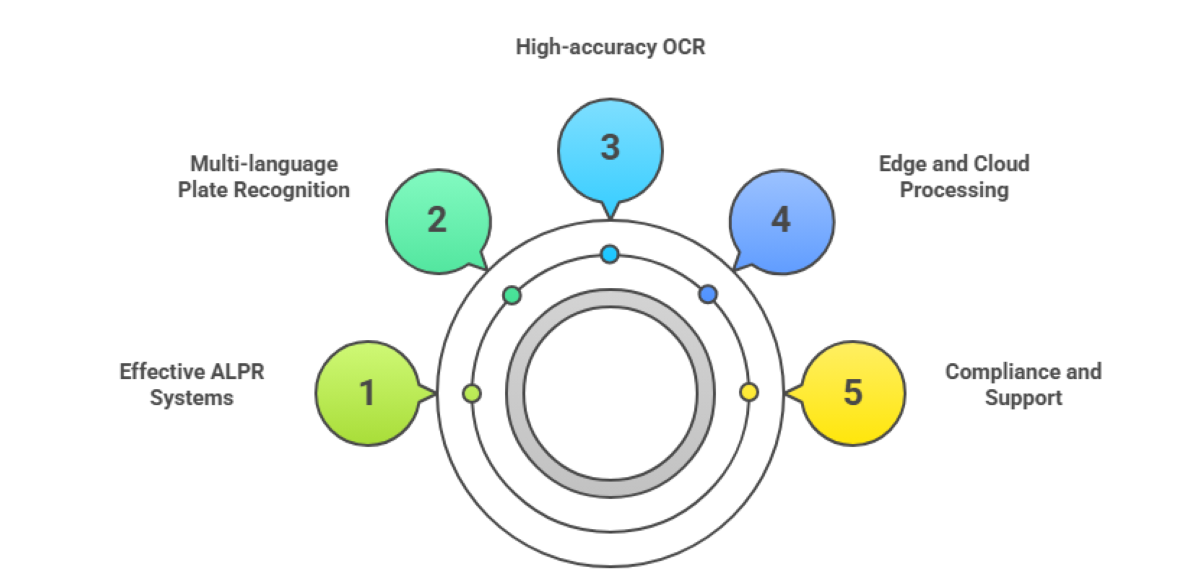
To deploy effective ALPR systems, Mexico must address local operational requirements while providing flexibility for diverse applications across law enforcement, commercial, and government sectors.
Systems must accurately read both Mexican and U.S. license plates to support border security and cross-jurisdictional enforcement. Advanced OCR engines trained on diverse plate formats ensure reliable recognition of vehicles from both countries in border regions and tourist areas.
Mexico's 24/7 traffic patterns require systems that maintain accuracy during challenging conditions. Industrial-grade ALPR cameras equipped with infrared illumination capture clear images, regardless of lighting conditions, while advanced algorithms process moving vehicles at highway speeds without compromising recognition rates.
Deployment flexibility becomes essential given Mexico's varied infrastructure conditions. Hybrid systems perform initial processing locally while syncing with cloud databases when connectivity allows, ensuring continuous operation in remote areas with limited internet access.
Integration capabilities with REPUVE and other national databases streamline verification processes. Mexico's national REPUVE system processes millions of transactions annually, utilizing ALPR and RFID components, which demonstrates the scale and effectiveness of properly integrated vehicle identification systems.
User interfaces in Spanish, incorporating Mexico-specific terminology, enhance adoption and operational effectiveness. Local technical support and training programs ensure that staff can maximize system capabilities while adhering to proper procedures for data handling and privacy compliance.
Emerging technologies and changing operational requirements drive the global evolution of ALPR deployments, as agencies seek more flexible and capable solutions for diverse applications.
AI and machine learning integration enhances recognition accuracy through deep learning algorithms that adapt to challenging conditions like weather, lighting variations, and damaged plates.
Edge computing deployment reduces dependence on cloud connectivity by processing license plate data locally at camera sites. This approach enables real-time alerts in areas with limited internet infrastructure while lowering bandwidth costs and improving response times.
Multi-modal vehicle recognition expands beyond license plates to identify vehicle make, model, color, and unique characteristics. Advanced computer vision analyzes vehicle features, enabling identification even when plates are obscured, damaged, or intentionally hidden by criminals attempting to avoid detection.
Cloud-native platforms offer scalable processing power and advanced analytics capabilities for large-scale deployments. Modern ALPR systems offer real-time analysis, predictive insights, and seamless integration with existing smart city infrastructure through API-based cloud architectures designed to meet the specific requirements of municipalities.
Mobile and portable ALPR systems enhance deployment flexibility through trailer-mounted units and vehicle-based solutions. These systems facilitate rapid deployment for special events, temporary enforcement zones, and emergency response situations, eliminating the need for permanent infrastructure installation or extensive setup time.
A Mexican fugitive was located and arrested in South Carolina after U.S. Marshals received an ALPR hit on his associated vehicle.
ALPR lead triggered search: License plate recognition flagged a Virginia plate linked to the fugitive’s car, initiating real-time tracking in North Charleston.
Rapid on-ground response: Law enforcement confirmed the vehicle at an apartment complex and coordinated immediate surveillance while assembling support teams.
Coordinated arrest execution: Following a short foot chase, multiple agencies arrested the fugitive, crediting ALPR for enabling the operation’s precision and speed.
Smart city officials, police departments, and commercial operators across Mexico have opportunities to modernize enforcement and security operations through strategic ALPR implementation that supports broader digital transformation goals.
Folio3 offers comprehensive end-to-end deployment services, encompassing site assessment, system design, installation, and training, specifically tailored to meet the needs of Mexican operational environments. Our local expertise ensures compliance with federal regulations while maximizing system effectiveness for a wide range of applications.
Our machine learning algorithms are trained on datasets of Mexican license plates to ensure optimal recognition accuracy. The system handles diverse plate formats, challenging weather conditions, and high-speed traffic scenarios common in urban environments throughout Mexico.
Seamless connectivity with current databases, communication systems, and operational workflows minimizes implementation disruption. API-based integration supports gradual deployment while protecting existing technology investments and maintaining operational continuity during system transitions.

Yes. ALPR technology is legal throughout Mexico when appropriately implemented and accompanied by appropriate data protection measures. Organizations must comply with the Federal Law on Protection of Personal Data (Ley Federal de Protección de Datos Personales) and maintain proper documentation of data collection and usage policies.
Yes, our ALPR solutions are designed for seamless integration with existing camera networks, databases, and communication systems. We provide API connections and custom interfaces that work with the current infrastructure while adding automated license plate recognition capabilities.
Pricing varies based on deployment scale, feature requirements, and integration complexity. We offer flexible models, including equipment purchase, software licensing, and managed service options that accommodate different budget structures and operational requirements for Mexican organizations.
Our AI-powered OCR engines deliver high recognition accuracy even under challenging conditions such as worn, damaged, or non-standard license plates. Advanced algorithms specifically trained on Mexican plate variations can handle legacy formats and degraded plates more effectively than standard recognition systems.