Loading...
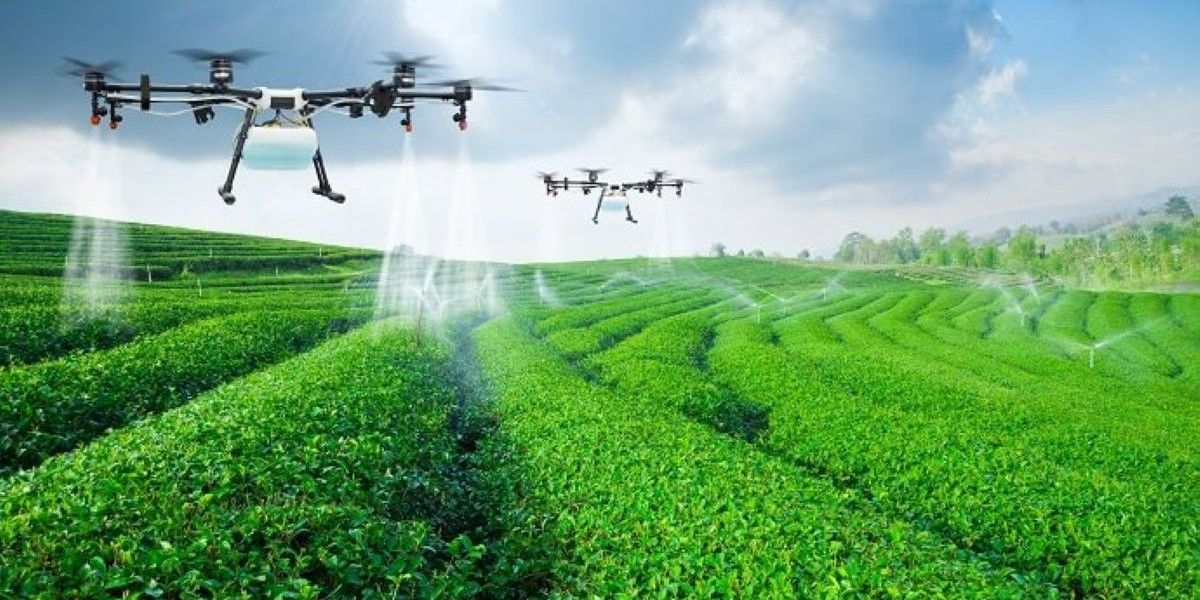
Modern agricultural drones deliver remarkable results, with farmers experiencing up to 20% higher crop yields and a 30% reduction in pesticide usage through precision monitoring, automated spraying, smart irrigation, and livestock tracking.
Drone technology in agriculture is changing farming practices worldwide. These advanced aerial systems collect critical field data and survey vast agricultural areas, enabling farmers to make informed decisions about crops, livestock, and resource management. Market analysts project the agricultural drone sector will reach $3.2 billion by 2025, driven by enhanced crop monitoring, precision resource application, real-time field intelligence, and detailed aerial insights.
The rapid adoption of these technologies demonstrates their transformative impact on modern agriculture, making farming operations more efficient, cost-effective, and environmentally responsible for sustainable food production.

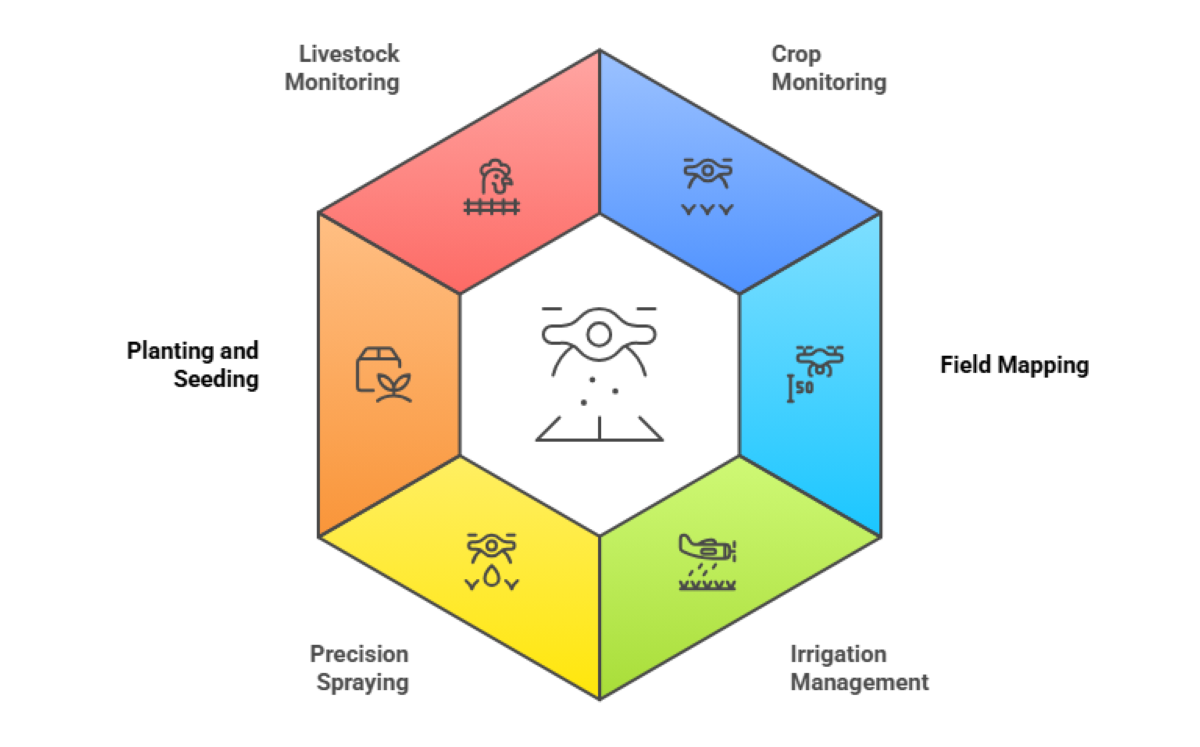
Here are the key applications of drones in agriculture that are revolutionizing modern farming practices, enhancing productivity, and enabling farmers to make data-driven decisions for optimal crop management.
Using drones in agriculture has enhanced crop monitoring by providing farmers with a bird's-eye view of their crops. Drones are equipped with advanced sensors and high-resolution cameras that capture every detail of crops, revealing potential issues invisible to the human eye.
The images that these drones take are used to further analyze signs of stress, nutrient deficiencies, and even early signs of pest or disease outbreaks. Due to their speed and efficiency, drones eliminate the need for time-consuming manual inspections, thereby saving farmers valuable time and resources.
They also cover larger areas in a short time, and the data that drones capture empowers farmers to implement corrective measures that ensure optimal crop health and productivity. Modern applications of machine learning algorithms in agriculture enable automated analysis of crop health patterns.
Because drones are equipped with high-quality cameras and can capture outstanding images of fields, they are used to create detailed and precise field maps that significantly aid in planning and management.
These maps are then used for various purposes, such as calculating field area, measuring crop health variability, and planning irrigation systems.
Furthermore, by flying over fields, drones collect data from multiple angles, generating 3D terrain models of agricultural land.
This model is valuable as it gives comprehensive data for designing efficient irrigation and drainage systems, minimizing water usage, and mitigating erosion risks. Terrain mapping solutions powered by AI algorithms can create detailed 3D terrain maps using LiDAR technology.
Regarding irrigation management, water is a precious resource in agriculture for healthy crops and optimal yields. In agriculture, drones are used to monitor soil moisture levels across fields with great accuracy.
The use of drones in agriculture is vast, as they are equipped with multispectral sensors. This helps them gather data on soil moisture levels and water stress in plants.
The captured information is then used to generate maps showing areas with high or low moisture levels, which enable farmers to implement precision irrigation techniques such as drip irrigation, saving both water and costs. This targeted approach ensures water is used efficiently, reducing waste and promoting better crop growth.
We are well aware that the traditional methods of applying pesticides, herbicides, and fertilizers often involve blanket spraying across entire fields.
But drones, which have also become a valuable tool in agriculture, revolutionize the application of fertilizers, pesticides, and herbicides by offering pinpoint accuracy.
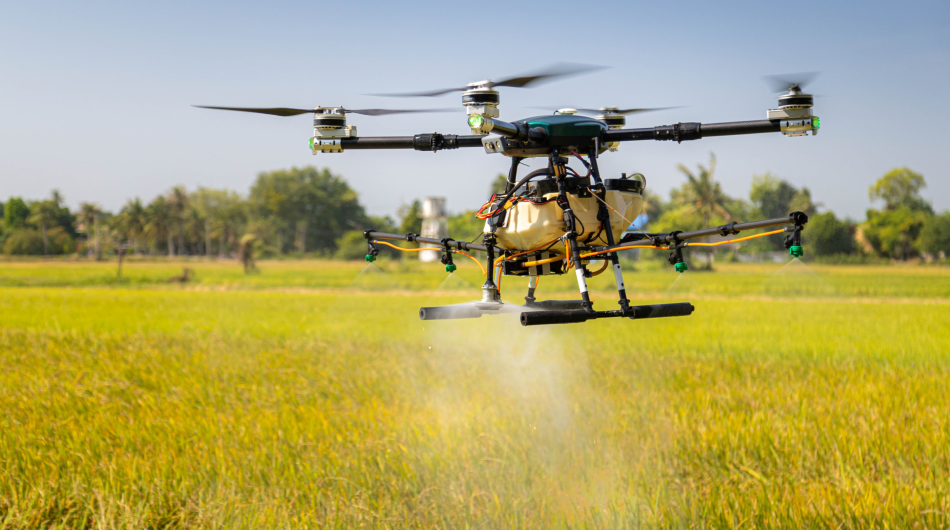
Drones come with specialized sprayers and sensors that deliver pesticides, herbicides, and fertilizers directly to targeted areas.
This minimizes waste and reduces the risk of overspray reaching non-target areas or waterways. Moreover, it also reduces farmers' exposure to harmful chemicals and improves the overall health of crops. AI-powered drone inspection software enables automated analysis and precision application.
Automated drone systems excel in planting seeds with high precision. These drones ensure uniform seed distribution, thereby reducing waste and promoting even crop growth.
This approach allows planting in areas that would otherwise be difficult or impossible to cultivate.
Additionally, drones used in agriculture also have the potential to grow more precisely and efficiently on slopes or hard-to-reach areas that are challenging for traditional machinery.
Farmers used to work with heavy machinery to compact the soil, but now they use drones that deliver a lighter touch, minimizing soil compaction and promoting healthy root development.
Drones in farming help track animal movement and health by providing real-time data on livestock's location and condition.
This capability enables more effective management of grazing patterns and pasture conditions, resulting in healthier animals and improved resource utilization.
For instance, drones equipped with thermal imaging can detect signs of illness early, allowing for prompt and targeted interventions.
The adoption of drones in agriculture brings numerous benefits that significantly enhance farming practices. This section will explain the primary ways drones assist modern farming and how they influence its future.
Drones can significantly reduce the time spent monitoring and managing crops. Traditional techniques for surveying large fields can take hours or even days, whereas drones operate at a fraction of the time. This efficiency enables farmers to focus on other essential farm tasks, thereby increasing overall productivity.
Drones enable highly accurate farming operations by gathering detailed data and monitoring crops in real-time. They allow for the targeted use of resources such as water, fertilizer, and pesticides, which reduces waste while promoting optimal crop growth and health. This precision leads to healthier crops and more efficient farming practices.
Incorporating agricultural drone applications into farming operations leads to cost savings. Drones monitor and distribute resources, reducing manual labor and resource usage. This lowers operational expenses while maintaining high crop yields and quality. Long-term savings and increased efficiency often offset the initial investment in drone technology.
Drones used for agriculture contribute to sustainable farming by promoting efficient resource management. Precise monitoring and targeted interventions help decrease chemical runoff and water consumption. This not only benefits the environment but also fosters the long-term health and viability of farms.
Drones provide high-resolution imagery and data, enabling better decision-making. Farmers can analyze this data to detect issues such as pest infestations, disease outbreaks, or nutrient deficiencies early, leading to timely and effective interventions. This advanced data collection enhances overall farm management and productivity.
By closely monitoring crops, drones help farmers quickly identify and address problems before they escalate. This proactive approach not only improves crop health but also boosts yield quality and quantity. Early detection and intervention are key to maintaining robust and productive crops.
Folio3 AI revolutionizes agriculture through intelligent drone technology and AI AgTech solutions, enabling timely intervention, minimizing crop losses, and maximizing productivity across farming operations.
Precision farming solutions: Harness AI-powered drones to optimize crop management, irrigation, and pest control through real-time data analysis, maximizing yields while minimizing resource usage and environmental impact.
Crop monitoring systems: Gain real-time insights into crop health and environmental conditions using AI-driven drone monitoring systems that enable proactive decision-making and early disease detection capabilities.
Supply chain optimization: Utilize AI algorithms integrated with drone data to forecast crop yields and market trends, ensuring efficient supply chain management and optimal pricing strategies.
Disease detection technology: Detect and diagnose crop diseases early with AI-enabled drone image recognition technology, minimizing losses and promoting healthier harvests through timely intervention and treatment.
Intelligent spraying systems: Implement AI-powered drone chemical spraying systems that reduce pesticide usage while enhancing crop protection through precision application and targeted treatment areas.
How are drones used in agriculture for small farmers?
Drones can be utilized in small farms to map out pre-plating patterns, which enable farmers to maximize the utilization of the area for the plantation of crops. The farmers can also strategize preferred planting patterns for individual crops using drones, which significantly reduces the time to map out the plantation pattern on foot.
How long have drones been around in agriculture and farming?
While drones have been around for nearly a century (maybe not in their current form), the use of drones in agriculture may be traced by to a decade in the early 2010s, when drones were first used to get real-time imagery of farms.
What is the range of the cost of drones in agriculture and farming?
The price of agricultural drones may vary depending on the type, complexity, and intended use of the system. Nonetheless, on average, agricultural drones may range between $2000 to over $25000.
Connect with us for more information at Contact@folio3.ai