
Loading...
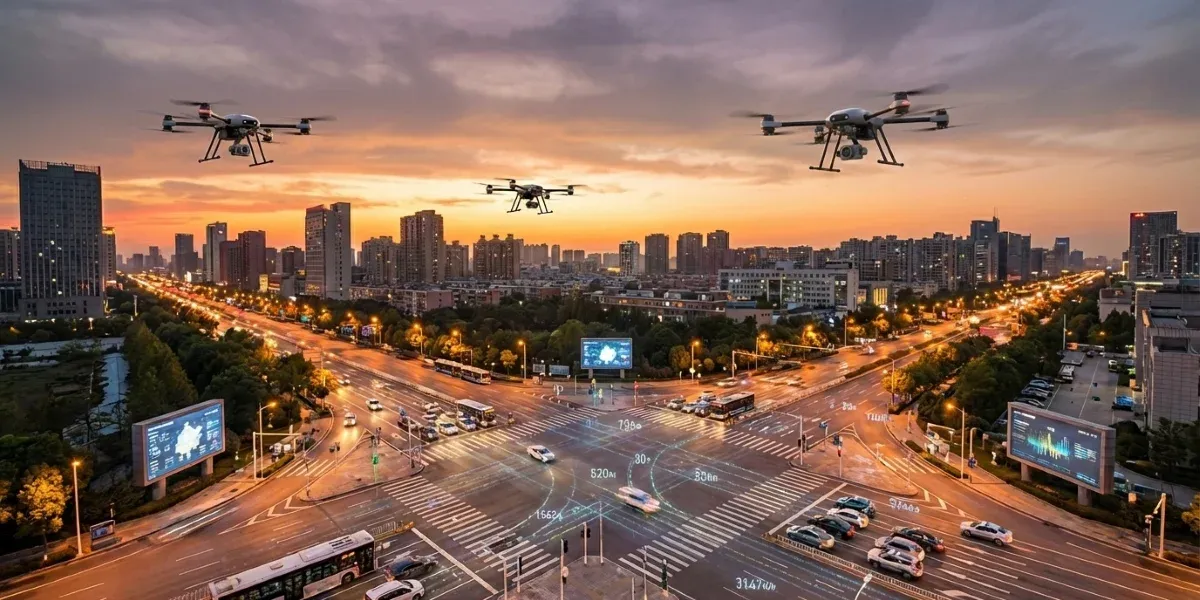
Urban traffic congestion costs you more than just time; it drains city budgets, increases pollution, and impacts public safety daily. As cities grow denser, transportation departments struggle to gather accurate, real-time traffic data that can actually improve mobility. You need visibility into what's happening on your roads right now, not yesterday.
According to the World Health Organization, road traffic crashes result in approximately 1.35 million deaths annually worldwide, making effective traffic monitoring critical for safety. Smart drones for traffic monitoring offer a solution that combines an aerial perspective with artificial intelligence to count vehicles, detect congestion, and provide actionable insights without expensive infrastructure. This technology transforms how you understand and manage traffic flow in your city.
Smart drones equipped with high-resolution cameras and AI algorithms capture traffic from above, processing vehicle movements in real-time. This bird's-eye perspective reveals patterns invisible from ground level, transforming raw video into actionable traffic intelligence instantly.
Modern traffic drones fly at 200-220 meters altitude with 4K or 5.4K cameras capturing 30-60 frames per second. Three-axis gimbals stabilize footage during flight, while 30-minute battery life enables comprehensive monitoring of intersections, highways, or event areas without interruption.
Convolutional neural networks (CNNs) analyze each video frame to identify vehicles, distinguishing cars from trucks, buses, motorcycles, and bicycles. YOLO (You Only Look Once) algorithms process images in milliseconds, enabling real-time detection even in dense traffic conditions.
Multi-object tracking algorithms follow individual vehicles across consecutive frames, creating complete trajectory paths. This temporal tracking handles occlusions when large trucks temporarily hide smaller vehicles, maintaining accurate counts despite visual obstructions throughout the monitoring period.
NVIDIA Jetson edge computers mounted on drones process basic detection locally for instant results with minimal latency. Complex analytics like pattern prediction run in cloud servers, while hybrid approaches balance real-time needs with deep analytical capabilities for comprehensive insights.
Traditional horizontal boxes poorly fit vehicles viewed from above at various angles. Rotated bounding boxes adapt to vehicle orientation in aerial footage, reducing false detections in parking lots and congested areas where vehicles pack densely at arbitrary angles.

You're probably relying on methods that were designed decades ago, before real-time data became essential. These legacy approaches create blind spots, waste resources, and delay the insights you need to make smart decisions about traffic management.
Human surveyors standing at intersections counting vehicles is labor-intensive and dangerous. A single four-arm roundabout requires up to 16 surveyors stationed at entry and exit points, manually recording license plates and vehicle types with inevitable errors.
Inductive loop sensors embedded in pavement require extensive construction, disrupt traffic during installation, and fail frequently due to road wear. Each sensor costs thousands to install and maintain, with limited coverage of only specific lanes or points.
Static cameras provide narrow fields of view, creating blind spots at complex intersections. They can't adapt to changing needs, require expensive pole infrastructure, and miss traffic patterns outside their fixed sight lines, giving you incomplete data.
Traditional methods demand continuous staffing, equipment maintenance, and infrastructure repairs. You're paying surveyor hourly rates ($40-80 per person), sensor replacement costs, and camera maintenance contracts that strain budgets without delivering comprehensive coverage or real-time insights.
Manual surveys take 24-48 hours to compile and analyze, making the data outdated before you receive it. Fixed sensors provide point data but lack context about broader traffic patterns, preventing you from responding quickly to congestion or incidents.
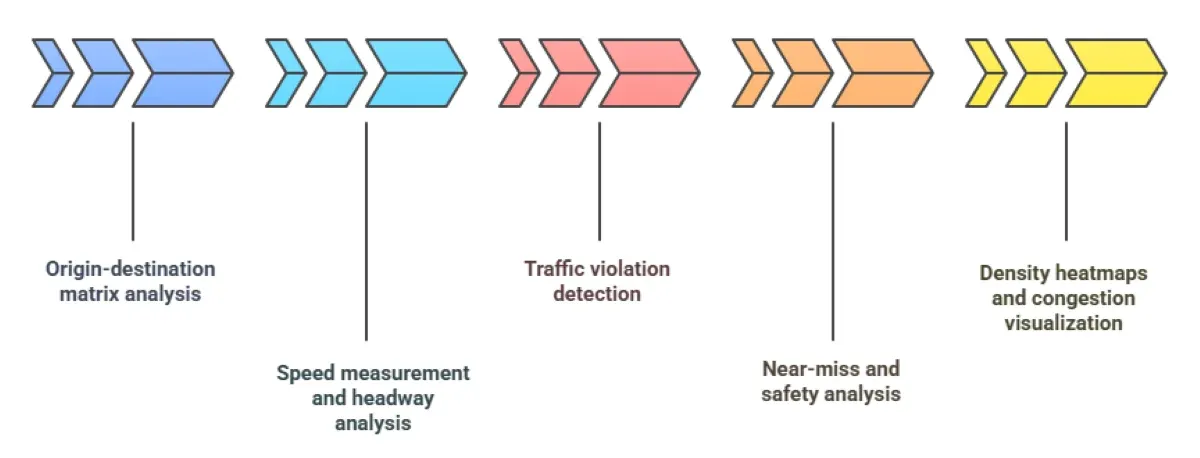
Beyond simple vehicle counts, smart drones for traffic monitoring extract sophisticated metrics that reveal how traffic actually flows through your infrastructure. These analytics enable you to identify problems and optimize operations with unprecedented precision and depth.
Drones track where vehicles enter and exit monitored areas, creating origin-destination (O-D) matrices that map complete journey patterns. You'll understand route preferences, cut-through traffic, and travel demand between specific locations for informed infrastructure planning and signal timing optimization.
AI calculates vehicle speeds with ±2-3 km/h accuracy by tracking position changes across frames at known frame rates. Time gaps (headways) between successive vehicles reveal traffic flow quality, helping you identify bottlenecks and optimize throughput at critical intersections.
Computer vision automatically identifies illegal lane changes, double parking, crosswalk obstructions, and speed violations without human monitoring. Geofencing defines enforcement zones, while trajectory analysis flags dangerous maneuvers, enabling proactive safety interventions and automated violation documentation for authorities.
Advanced algorithms detect close-call situations where vehicles nearly collide, identifying dangerous locations before crashes occur. This predictive safety intelligence helps you prioritize infrastructure improvements, adjust signal timing, and implement targeted enforcement at high-risk locations.
Real-time density calculations create color-coded heatmaps showing congestion intensity across monitored areas. You'll instantly see where queues form, how congestion propagates, and which routes vehicles take to avoid bottlenecks, enabling dynamic traffic management responses.
Switching to drone-based monitoring transforms your traffic management capabilities while reducing costs. You'll gain comprehensive visibility, respond faster to incidents, and make data-driven decisions that improve mobility throughout your city with measurable results.
A single drone covers 2-3 square kilometers versus a fixed camera's 100-200 meter radius. You'll eliminate blind spots at complex interchanges, monitor entire corridors, and redeploy drones to temporary problem areas without installing permanent infrastructure anywhere.
Deploy a drone traffic monitoring system in minutes compared to weeks or months for fixed infrastructure. Emergency detours, special events, construction zones, and temporary congestion points get immediate monitoring capability without permits, construction crews, or capital expenditure.
Eliminate expensive surveyor teams, reduce infrastructure installation costs, and minimize ongoing maintenance expenses. One drone system replaces 16 manual surveyors at a roundabout while providing superior data quality, accuracy, and coverage at a fraction of traditional survey costs.
Remove human surveyors from hazardous roadside positions where they risk being struck by vehicles. Drones safely monitor high-speed highways, dangerous intersections, and adverse weather conditions without exposing personnel to traffic, dramatically reducing workplace injury risks.
Detect accidents, breakdowns, and obstructions within seconds of occurrence, enabling faster emergency response dispatch. Aerial views help coordinators assess incident severity, identify optimal response routes, and clear scenes quickly, reducing secondary accidents and minimizing congestion impacts significantly.
Monitoring traffic from drones presents unique technical hurdles that ground-level systems don't face. AI and advanced computer vision techniques specifically address these aerial perspective challenges, ensuring accurate detection and counting regardless of conditions.
Vehicles appear smaller and pack closely in aerial views, making individual detection difficult in congestion. Multi-scale feature pyramids in detection models identify objects at various sizes, while high-resolution 4K imaging maintains pixel detail necessary for accurate vehicle separation.
Large trucks temporarily hide smaller vehicles, and overpasses create shadows that obscure traffic. Temporal tracking across multiple frames maintains vehicle identity through occlusions, while predictive algorithms estimate hidden vehicle positions until they reappear in clear view.
Vehicles angle in any direction relative to drone cameras—especially in parking lots or turning movements. Rotated bounding box detection adapts to vehicle orientation, fitting boxes tightly around cars regardless of angle, eliminating the excess area that horizontal boxes capture.
Rain, fog, and nighttime reduce visual clarity for standard cameras. Thermal imaging cameras detect vehicle heat signatures in darkness and poor visibility, while AI models trained on diverse weather datasets maintain detection accuracy despite challenging environmental conditions.
Fewer training datasets exist for aerial traffic views compared to ground-level autonomous driving datasets. Transfer learning adapts ground-level models to aerial perspectives, while data augmentation and synthetic data generation expand training sets to improve detection accuracy continuously.
Operating drones for traffic monitoring requires navigating airspace regulations and protecting citizen privacy. Understanding these requirements ensures your deployment complies with laws while maintaining public trust and acceptance of this beneficial technology.
Drones cannot fly near airports (typically a 5-mile radius), military installations, or government buildings without authorization. Coordinate with aviation authorities for flight approvals, respect altitude limits (typically 400 feet maximum), and maintain visual line of sight per local regulations.
Automatically blur license plates and faces in recorded footage before human review or storage. Implement data retention policies limiting how long footage is kept, encrypt stored data, and ensure access controls prevent unauthorized viewing of potentially sensitive surveillance information.
Establish pre-flight checklists, maintain backup landing areas, and monitor weather conditions before operations. Train operators on emergency procedures, implement geofencing to prevent drones from entering restricted areas, and maintain liability insurance covering potential incidents or equipment failures.
European GDPR, California CCPA, and similar regional privacy laws govern traffic data collection and storage. Conduct privacy impact assessments, inform the public about drone operations, allow data access requests, and establish legal grounds for processing personal data captured during monitoring.
Transparency builds community support for drone monitoring programs. Communicate benefits clearly, host public consultations before deployment, address surveillance concerns openly, and demonstrate how data improves safety and reduces congestion rather than enabling invasive tracking of individuals.
Smart drones for traffic monitoring solve diverse transportation challenges across urban, highway, and event scenarios. These practical applications demonstrate how cities and agencies currently use drone technology to improve traffic flow and safety.
Monitor long freeway stretches for incidents, disabled vehicles, and congestion formation without expensive gantry infrastructure. Drones quickly assess accident scenes, identify optimal detour routes, and provide aerial views, helping incident commanders coordinate emergency response effectively across multi-mile corridors.
Analyze complex roundabouts, multi-leg intersections, and downtown grid systems where fixed cameras miss turning movements. Origin-destination data reveals actual travel patterns, enabling signal timing adjustments that reduce wait times, improve throughput, and decrease stop-and-go driving that increases emissions.
Concerts, sporting events, and festivals create temporary traffic surges requiring adaptive management. Deploy drones to monitor parking lot filling, guide attendees to available spaces, manage ingress and egress flows, and coordinate traffic control personnel responding to real-time conditions.
Assess how work zones impact traffic, verify detour effectiveness, and ensure worker safety zone compliance. Drones document traffic patterns around construction, help contractors optimize lane closures, and provide evidence of traffic control setup for regulatory compliance and dispute resolution.
Identify infrastructure hazards, dangerous intersections, and accident-prone locations through trajectory analysis and near-miss detection. Collect detailed before-and-after data when implementing safety improvements, validating which interventions actually reduce conflicts and improve safety outcomes measurably.
Drone monitoring data becomes exponentially more valuable when integrated with existing urban technology systems. These integrations create unified traffic management platforms that coordinate multiple data sources for comprehensive situational awareness and automated responses.
Feed real-time vehicle counts and queue lengths directly into traffic signal controllers, enabling dynamic timing adjustments. Signals automatically extend green phases when queues build, create green waves for major flows, and optimize coordination based on actual traffic rather than fixed schedules.
Visualize drone data alongside other city sensors on unified dashboards accessible to transportation managers, emergency services, and city planners. Historical analytics reveal trends, while real-time overlays show current conditions, enabling informed decisions across departments.
Combine drone mobility with fixed camera permanence for comprehensive coverage. Drones fill gaps between fixed cameras, provide temporary monitoring during camera outages, and verify detections from ground-level systems, while data fusion improves overall detection accuracy.
Integrate drone traffic data into vehicle-to-infrastructure (V2I) communications, informing connected vehicles about congestion ahead, incidents, or optimal speeds. This coordination enables smoother traffic flow as autonomous and connected vehicles respond to real-time conditions.
Share live drone feeds and traffic data directly with police, fire, and ambulance dispatch systems. Responders see current conditions, optimal routes, and incident details before arrival, reducing response times and improving emergency outcome success rates significantly.
We've developed end-to-end traffic monitoring systems that combine custom AI models with proven hardware and seamless integration. Our approach delivers accurate vehicle counting and traffic analytics tailored to your specific monitoring requirements and existing infrastructure.
Our software adapts to your unique operational requirements, whether you need specific reporting formats, custom vehicle categories, or specialized analytics. Configure detection zones, adjust sensitivity parameters, and modify data outputs to match your existing workflows and decision-making processes seamlessly.
Automatic license plate recognition captures and reads vehicle registration numbers from drone and camera footage. This capability enables traffic enforcement, parking management, toll collection verification, and origin-destination tracking by accurately identifying individual vehicles throughout your monitored network.
Define virtual boundaries around specific areas—intersections, lanes, parking zones, or restricted areas—for targeted vehicle detection. The system counts only vehicles entering, exiting, or dwelling within designated zones, providing precise data for localized traffic analysis and enforcement applications.
View real-time traffic metrics and historical trends through intuitive web-based dashboards featuring customizable visualizations. Access vehicle counts, classifications, speed data, and congestion indicators instantly, with filtering options by time period, location, or vehicle type for actionable insights.
Advanced AI distinguishes between cars, SUVs, sedans, buses, trucks, motorcycles, bicycles, and specialized vehicles automatically. Analyze traffic composition by vehicle type across different times of day, revealing patterns like morning commuter car dominance or afternoon delivery truck concentrations for informed planning.
Track total vehicle volumes and directional flows at intersections or road segments. Identify dominant traffic movements, turning patterns, and flow imbalances throughout the day. Drill into specific time slots to understand peak hour characteristics and optimize signal timing accordingly.
Leverage multiple camera viewpoints simultaneously to eliminate blind spots and verify vehicle counts across overlapping coverage areas. This redundancy improves accuracy in complex environments with occlusions, maintaining reliable detection even when single camera views become temporarily obscured.
Choose a deployment that fits your data security requirements and infrastructure capabilities. Cloud deployment offers scalability and remote access, while on-premise solutions keep sensitive traffic data within your controlled environment. Both options support various hardware configurations flexibly.
Emerging technologies will expand drone monitoring capabilities dramatically over the next decade. You'll see smarter systems with greater autonomy, predictive capabilities, and integration depth that fundamentally transform how cities manage transportation.
Coordinated drone fleets will cover entire metropolitan areas simultaneously, maintaining complete visibility across city-wide road networks. Autonomous swarm algorithms will distribute drones optimally, ensuring coverage continuity as individual units return for charging while others fill gaps seamlessly.
Machine learning models will predict congestion 30-60 minutes ahead by analyzing current patterns, historical trends, weather data, and event schedules. Traffic managers will implement preventive measures before congestion forms, routing vehicles proactively rather than reacting to problems after they develop.
AI will detect incidents automatically and dispatch drones without human intervention, arriving at accident scenes within minutes. Drones will assess severity, alert appropriate emergency services, and provide live feeds to responders while implementing dynamic traffic management measures autonomously.
Real-time drone data will feed city digital twin platforms, creating living 3D models of traffic flow. Planners will simulate infrastructure changes virtually, predicting impacts before construction begins, while AI optimizes traffic signals across entire networks based on digital twin insights.
Ultra-low-latency 5G networks will enable instant data transmission and distributed processing across drone fleets. Edge AI will advance, allowing drones to perform increasingly sophisticated analytics onboard, reducing cloud dependency while enabling faster decision-making for time-critical traffic management tasks.
Standard battery-powered drones monitor for 25-30 minutes per flight before requiring battery changes. Tethered drone systems connected to ground power sources enable continuous monitoring for multiple hours at fixed locations like intersections or highway segments, ideal for persistent surveillance needs.
Modern computer vision systems achieve 95-98% counting accuracy in optimal conditions, with detection rates remaining above 90% even in moderate rain or low-light situations. Accuracy depends on altitude, camera resolution, traffic density, and weather, but consistently outperforms manual counting by eliminating human error.
Yes, drones equipped with thermal imaging cameras detect vehicle heat signatures in complete darkness, fog, or rain when standard cameras struggle. While extreme weather (high winds, heavy storms) grounds flights for safety, thermal systems maintain monitoring capability through most challenging conditions requiring visibility.
Systems automatically anonymize footage by blurring license plates and faces before human review or storage. Strict data retention policies, encryption, and access controls protect privacy while GDPR compliance ensures legal data processing. Transparency and clear public communication build community acceptance by demonstrating that benefits outweigh concerns.
Initial system costs range from $50,000-$150,000, depending on drone specifications, camera quality, software features, and integration requirements. Operating costs remain minimal compared to traditional methods, with no infrastructure maintenance, fewer personnel, and redeployable assets delivering 3-5 year ROI through survey cost elimination and efficiency gains.
Yes, modern systems offer API integrations connecting drone data to traffic signal controllers, smart city dashboards, CCTV networks, and emergency services platforms. Data exports in standard formats enable compatibility with GIS software, business intelligence tools, and legacy traffic management systems without requiring complete infrastructure replacement.
Aviation authorities regulate drone operations, including altitude limits (typically 400 feet), airspace restrictions near airports, visual line-of-sight requirements, and operator certification. Privacy laws like GDPR govern data collection and storage. Local ordinances may impose additional restrictions requiring coordination with municipalities and aviation officials before deployment.