
Loading...

Your AI demo wowed the board. The prototype generated reports in seconds, answered complex queries, and promised to revolutionize operations. Six months later, it's still sitting in a sandbox while your team manually processes the same workflows they always have.
This isn't a unique failure; it's the industry standard. According to BCG's 2024 research, 74% of companies adopting AI struggle to see real results from their investments. The gap isn't technical capability. These models work brilliantly in controlled environments. The problem emerges when you try connecting them to real business systems, messy data lakes, compliance frameworks, and skeptical employees who've seen plenty of "transformative" tools come and go. Let’s get started by understanding the most common integration challenges.
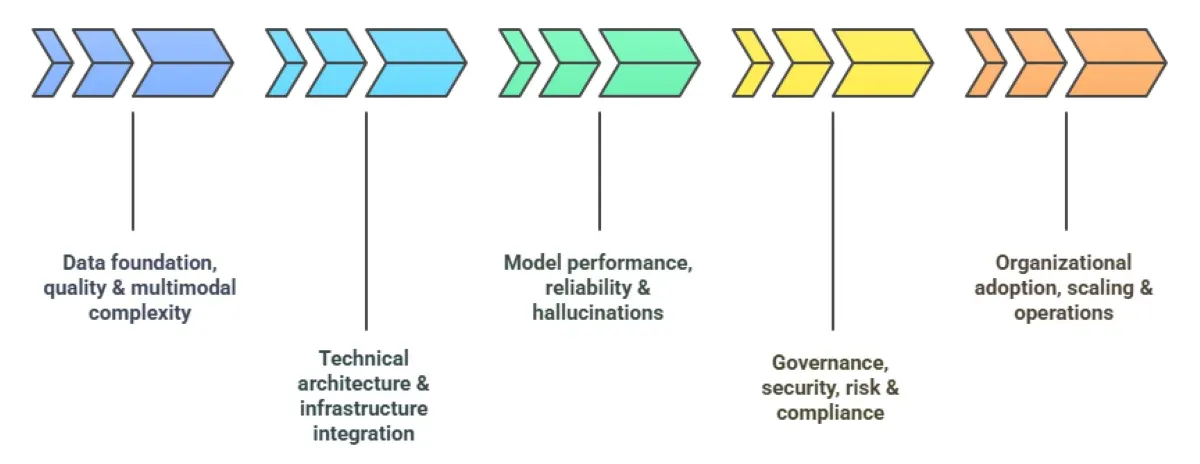
Generative AI integration failures rarely stem from the models themselves. Instead, organizations encounter predictable barriers across data quality, technical architecture, model reliability, governance frameworks, and organizational readiness that prevent production deployment and scaling.
Your generative AI system is only as reliable as the data feeding it. Unlike traditional AI that works with structured datasets, GenAI demands clean, diverse, multimodal data across text, images, code, and documents. This data is often scattered across legacy systems, siloed departments, and incompatible formats that create fundamental performance barriers.
Enterprise data typically exists in disconnected repositories: CRM systems, ERP platforms, document management tools, and departmental databases. GenAI models require unified access to these sources, but most organizations lack the data architecture to consolidate information without manual intervention or complex ETL processes.
Generative AI applications process multiple data types simultaneously, like customer emails, product images, technical documentation, and transaction records. Each modality requires different preprocessing, storage formats, and retrieval mechanisms. Organizations struggle to implement vector databases and embedding systems that handle this complexity while maintaining semantic relationships across data types.
When proprietary data proves insufficient for model training, synthetic data generation offers a solution. However, over-reliance on synthetic datasets introduces risks: models trained exclusively on artificial data produce lower-quality outputs, exhibit limited diversity, and fail to capture real-world nuances that affect performance in production environments.
Retrieval-Augmented Generation systems require breaking documents into manageable chunks while preserving context. Poor chunking strategies cause information loss, redundant retrieval, decreased coherence, and slower performance. Organizations must balance chunk size, overlap, and semantic boundaries, which are technical decisions that directly impact accuracy and computational costs.
Data localization laws in APAC and EMEA regions mandate that certain data types remain within geographic boundaries. Financial institutions face GDPR constraints on customer data, healthcare organizations navigate HIPAA requirements, and multinational corporations must reconcile conflicting regional regulations while maintaining unified AI capabilities across markets.
GenAI models don't simply plug into existing systems. The gap between isolated prototypes and production-ready deployments involves architectural decisions about computational resources, API design, orchestration layers, and workflow integration that determine whether your AI investment delivers business value or becomes shelfware.
Most enterprise software wasn't designed for AI integration. Legacy ERP systems, CRM platforms, and proprietary applications lack modern APIs, forcing development teams to build custom connectors, middleware layers, and translation services. These integration points become maintenance burdens and single points of failure in production environments.
GenAI models demand significant GPU/TPU resources for both training and inference. A single model serving real-time requests can consume thousands of dollars monthly in cloud computing costs. Small and medium businesses often lack access to high-performance infrastructure, while enterprises struggle to justify ongoing operational expenses without clear ROI.
Implementing Retrieval-Augmented Generation requires coordinating multiple components: vector databases for embeddings, retrieval systems for relevant context, language models for generation, and orchestration layers to manage the pipeline. Each component introduces latency, potential failure points, and complexity that must be monitored and optimized continuously.
Business applications demand sub-second response times, but GenAI inference often takes several seconds per request. Financial trading systems need millisecond latency, customer service chatbots require near-instantaneous responses, and manufacturing systems can't tolerate delays. Edge computing offers partial solutions but introduces deployment and synchronization challenges.
Organizations must choose between cloud-based models (flexible but expensive), on-premise deployment (secure but resource-intensive), or hybrid architectures (complex but balanced). Logistics companies need edge deployment for real-time vehicle tracking, while healthcare providers require on-premise solutions for patient data privacy, complicating standardized deployment strategies.

Even well-integrated models fail when they generate plausible but incorrect information, drift from optimal performance, or lack transparency in decision-making. Model reliability challenges, particularly hallucinations, represent the most cited concern among enterprises.
Generative AI models produce confident-sounding responses that contain factual errors, invented citations, or fabricated data. Research from one of the Chinese universities has found hallucination rates between 20%-30% for large language models. These errors undermine trust, create compliance risks, and can damage customer relationships when deployed in customer-facing applications without verification systems.
Models trained on historical data gradually lose accuracy as real-world conditions change. Customer language evolves, business processes shift, and market dynamics fluctuate, all causing model predictions to drift from acceptable performance levels. Without continuous monitoring systems, organizations discover degradation only after the business impact becomes measurable.
Ineffective prompts force users to reformulate queries multiple times, consuming computational resources and frustrating end-users. Deloitte research identified organizations spending $105,000 monthly on compute costs from inefficient prompting alone, with users averaging 3.5 iterations per query. Standardized prompt libraries reduce waste but require ongoing curation and testing.
Regulated industries demand an understanding of how AI systems reach conclusions. The "black box" nature of large language models creates compliance challenges for financial services, healthcare, and legal applications where decisions must be auditable. Organizations need interpretability frameworks that expose reasoning processes without compromising model performance.
Production GenAI systems require automated validation mechanisms to catch errors before they reach users. Techniques include automated reasoning checks, confidence scoring, human-in-the-loop verification workflows, and neurosymbolic AI approaches that apply formal logic to constrain uncertain outputs. Each verification layer adds latency and cost but proves essential for trustworthy deployment.
Generative AI introduces novel risk vectors that traditional IT governance frameworks don't address. From prompt injection attacks to algorithmic bias, organizations must establish new policies, security measures, and compliance protocols while navigating regulations that vary by region and industry.
GDPR in Europe mandates strict data privacy controls, HIPAA in healthcare governs patient information handling, CCPA in California establishes consumer data rights, and Singapore's Model AI Governance Framework sets transparency standards. Organizations operating across regions must reconcile conflicting requirements while maintaining consistent AI capabilities.
Traditional model training requires centralizing data, which is often impossible with privacy regulations. Federated learning enables training across decentralized datasets without exposing raw information. Differential privacy adds mathematical guarantees that individual records can't be reconstructed from model outputs. These techniques preserve privacy but increase technical complexity and computational requirements.
Prompt injection attacks manipulate model behavior through carefully crafted inputs. Model extraction attacks steal proprietary models through API queries. Data poisoning compromises training datasets to introduce backdoors. Adversarial examples fool models with imperceptible input modifications. Traditional cybersecurity tools don't detect these AI-native threats.
Training data reflects historical biases in hiring, lending, healthcare, and other domains. Models amplify these biases unless actively mitigated through fairness testing, demographic parity checks, and bias correction techniques. Regulated industries face legal liability when AI systems produce discriminatory outcomes, making bias audits essential for production deployment.
Effective AI governance requires establishing usage policies, approval workflows, model registries, and comprehensive logging systems. Organizations need clear ownership, with many appointing Chief AI Officers to coordinate efforts. Human oversight, ethical review boards, and documented decision-making processes build accountability and enable compliance during regulatory audits.
Technical readiness doesn't guarantee success. Organizations fail at GenAI integration when employees resist adoption, skills gaps prevent effective use, or operational maturity can't support production AI at scale. The human factors, like change management, training, and cultural transformation, determine whether AI investments deliver returns.
Recent industry research shows that while a majority of executives feel increasing pressure to adopt generative AI, many acknowledge their organizations lack the skills required to do it effectively. Prompt engineering, model fine-tuning, MLOps practices, and AI system design require specialized knowledge. Most enterprises can't hire enough AI talent and must upskill existing teams through structured training programs.
Workers fear job displacement, managers worry about accountability for AI decisions, and domain experts resist tools they don't understand. Successful adoption requires executive sponsorship, transparent communication about AI's role, pilot programs that demonstrate value, and involvement of end-users in design decisions to build trust.
Low-code and no-code AI platforms democratize access, allowing business analysts and domain experts to deploy models without deep technical expertise. These tools simplify integration, reduce dependence on scarce AI specialists, and accelerate time-to-value. However, they introduce governance challenges around shadow AI deployments.
Scaling GenAI across geographies requires handling multiple languages, cultural contexts, regulatory environments, and infrastructure constraints. Translation alone proves insufficient; models need cultural adaptation, region-specific training data, and localized knowledge bases. Multi-tenant architectures support regional customization while maintaining centralized oversight and cost efficiency.
Production AI demands continuous integration/continuous deployment pipelines, automated testing, model versioning, performance monitoring, incident response procedures, and cost tracking. Organizations progress through MLOps maturity stages from manual deployments to fully automated operations. Most enterprises remain at early maturity levels, struggling with basic monitoring and retraining processes.
Successful organizations address integration challenges through systematic approaches that combine technical solutions, governance frameworks, and organizational strategies. These proven practices reduce risk, accelerate deployment, and establish foundations for sustainable AI operations at enterprise scale.
Implement enterprise data lakes or warehouses that consolidate siloed information into a single source of truth. Deploy vector databases for embeddings, knowledge graphs for semantic relationships, and metadata management for lineage tracking. Use data quality frameworks to ensure consistency, completeness, and accuracy across sources.
Start with controlled pilot projects in non-critical environments to identify integration issues early. Define clear success metrics, gather user feedback, and iterate before scaling. Phased rollouts reduce risk, build organizational confidence, and allow course correction without disrupting operations or wasting resources.
Design verification workflows where human experts review AI outputs before critical decisions. HITL systems catch hallucinations, ensure quality, and build trust while AI systems mature. Gradually automate as confidence grows, but maintain human oversight for high-stakes applications in healthcare, finance, and legal domains.
Establish AI ethics committees, document usage policies, create model registries, implement approval workflows, and maintain audit trails. Assign clear ownership executive sponsors for strategy, technical leads for implementation, and compliance officers for risk management. Regular governance reviews ensure policies evolve with technology and regulations.
Develop structured AI literacy programs for all employees, specialized training for technical teams, and leadership education for executives. Create internal communities of practice, recognize early adopters, and celebrate successes publicly. Change management requires sustained effort—budget accordingly and measure adoption metrics continuously.
Generative AI fundamentally differs from traditional AI systems, requiring new approaches to integration, operation, and risk management. Understanding these distinctions prevents costly mistakes when applying conventional AI practices to GenAI implementations that operate on different principles.
Traditional AI systems produce consistent outputs for given inputs. It’s a deterministic behavior that simplifies testing and validation. GenAI models generate probabilistic outputs that vary between runs, introducing uncertainty that affects quality assurance, debugging, and compliance verification. Organizations need new testing frameworks that account for output variability.
Unlike narrow AI trained for specific tasks, GenAI uses foundation models trained on broad datasets and fine-tuned for applications. This approach enables rapid deployment across use cases but introduces dependencies on third-party models, concerns about training data provenance, and challenges in controlling model behavior.
GenAI models process limited context, typically thousands to hundreds of thousands of tokens. Applications requiring extensive historical context, long documents, or complex conversational memory must implement external memory systems, retrieval architectures, and context management strategies that traditional AI systems don't require.
Traditional models are trained once and deployed until retrained. GenAI applications increasingly incorporate continuous learning, real-time knowledge updates through RAG, and adaptive behaviors that respond to user feedback. This dynamism improves performance but complicates version control, testing, and compliance documentation.
GenAI systems process and generate across modalities like text, images, audio, video, and code within single applications. This versatility creates powerful capabilities but requires integrated data pipelines, unified embedding spaces, and cross-modal reasoning systems that add architectural complexity compared to unimodal traditional AI.
Before committing to GenAI integration, organizations should evaluate readiness across technical infrastructure, data maturity, governance capabilities, organizational skills, and cultural factors. This structured assessment identifies gaps, prioritizes investments, and establishes realistic timelines for successful deployment.
Assess data quality, accessibility, and governance.
Can you easily access and combine data across systems?
Do you have metadata management, data lineage tracking, and quality monitoring?
Is sensitive data properly classified and protected?
Organizations with an immature data infrastructure should address foundational issues before pursuing GenAI.
Evaluate computational resources, API capabilities, integration patterns, and deployment infrastructure.
Do you have GPU/TPU access or cloud partnerships?
Are systems designed for microservices and API-first architectures?
Can you support real-time inference at scale?
Legacy monolithic architectures require modernization before successful GenAI integration.
Examine existing policies for AI ethics, data privacy, risk management, and regulatory compliance.
Do you have approval processes for AI deployments?
Are bias detection and fairness testing part of your development cycle?
Can you produce audit trails for AI decisions?
Weak governance creates legal and reputational risks.
Map current capabilities against required skills: prompt engineering, model fine-tuning, MLOps, data engineering, and AI system design.
Do you have in-house AI expertise or rely entirely on external consultants?
Can your current team handle model deployment and ongoing maintenance?
What's your capacity for upskilling existing staff versus hiring new talent?
Identify skill gaps and assess capacity for upskilling versus external hiring. Calculate the investment needed for training programs, certifications, and knowledge transfer initiatives.
Evaluate cultural readiness for AI adoption.
Do executives champion AI initiatives?
Are business units willing to change workflows?
Can you dedicate resources to pilot projects without disrupting operations?
Organizations with change-resistant cultures or competing priorities should address these factors before large-scale GenAI commitments.
Different industries face unique challenges when integrating generative AI, driven by regulatory environments, operational requirements, data characteristics, and business models. Understanding sector-specific considerations ensures integration strategies align with industry realities and compliance obligations.
Financial institutions operate under strict regulatory oversight requiring explainable AI decisions, audit trails for compliance, and protection of sensitive customer data. Real-time fraud detection demands low-latency inference, while credit decisioning requires bias-free models that comply with fair lending laws. On-premise deployment often proves necessary for data sovereignty.
Property data spans listings, contracts, images, and tenant records, requiring unified systems. Valuation models need localized training data reflecting regional market variations. Integration with MLS platforms and property management systems creates technical complexity across fragmented software ecosystems
Predictive maintenance applications require edge deployment for real-time sensor data processing. Supply chain optimization needs integration with ERP, inventory management, and logistics systems. Computer vision for quality control demands low-latency inference and high accuracy. IoT device constraints limit model complexity and computational requirements.
Personalization engines require real-time customer data processing while respecting privacy regulations. Inventory optimization and demand forecasting integrate with existing merchandising systems. Customer service chatbots need seamless handoff to human agents. High transaction volumes demand a scalable inference infrastructure with cost-effective resource utilization.
Fleet management systems require edge computing for vehicle-based AI, GPS integration for route optimization, and real-time decision-making for dispatch operations. ALPR (Automated License Plate Recognition) systems need high accuracy in varied lighting and weather conditions. Integration with warehouse management and transportation management systems proves critical for operational value.
Building production-ready GenAI systems requires selecting appropriate technologies across model hosting, orchestration, data management, monitoring, and deployment infrastructure. Understanding the ecosystem helps organizations make informed architectural decisions that balance capabilities, costs, and operational complexity.
Cloud hyperscalers offer managed services: AWS Bedrock provides access to multiple foundation models, Azure OpenAI integrates with Microsoft's ecosystem, and Google Vertex AI offers enterprise-grade model deployment. Open-source alternatives like Hugging Face enable self-hosting with greater control but require more operational expertise.
Framework tools simplify building RAG applications, agent workflows, and prompt management. These frameworks abstract complexity in retrieval, chaining model calls, and managing conversation state. However, they introduce dependencies and learning curves that affect development velocity and long-term maintenance.
Vector database solutions store and retrieve high-dimensional embeddings efficiently. These specialized databases enable semantic search, similarity matching, and context retrieval essential for RAG architectures. Selection depends on scale requirements, latency tolerance, and integration with existing data infrastructure.
MLOps platforms provide model versioning, experiment tracking, and deployment pipelines. Observability tools monitor model performance, detect drift, and track inference costs. Production GenAI requires comprehensive monitoring beyond traditional application performance management.
Container orchestration platforms enable scalable model serving, deployment, and resource management. GPU-optimized instances from cloud providers or on-premise infrastructure support inference workloads. CI/CD pipelines automate testing, validation, and deployment, reducing human error and accelerating iteration cycles.
Generative AI integration practices continue evolving as new capabilities emerge, standards develop, and organizations mature their AI operations. Understanding emerging trends helps enterprises make strategic decisions that position them for long-term success rather than short-term tactical gains.
Next-generation GenAI moves beyond responding to prompts toward autonomous agents that plan, execute, and optimize workflows independently. These systems integrate with enterprise applications to trigger actions, make decisions within defined parameters, and coordinate complex multi-step processes. As a result, organizations need new governance frameworks to manage and oversee increasingly autonomous operations.
Models increasingly process and generate across modalities like text, images, audio, video, 3D, and code, within unified architectures. This convergence simplifies application development but demands integrated data pipelines, cross-modal reasoning capabilities, and evaluation frameworks that assess performance across diverse output types.
Computational constraints drive the deployment of smaller, specialized models to edge devices and client applications. Techniques like model quantization, pruning, and distillation enable running capable models on smartphones, IoT devices, and vehicles, reducing latency and cloud costs while introducing new challenges in model distribution and updating.
Governments worldwide develop AI-specific regulations. The EU AI Act sets risk-based requirements, while various jurisdictions propose transparency mandates, bias testing obligations, and liability frameworks. Industry consortia establish technical standards for model evaluation, documentation, and interoperability, creating compliance baselines for enterprise deployments.
Static models give way to systems that incorporate feedback, update knowledge bases, and refine performance continuously. Retrieval-augmented generation enables real-time knowledge updates without retraining, while techniques like reinforcement learning from human feedback (RLHF) allow models to improve through user interactions, requiring new operational practices.
Folio3 AI specializes in bridging the gap between generative AI potential and production reality. Our generative AI integration services are multifaceted and built to align with business objectives. We provide autonomous intelligence to enable self-optimizing systems, real-time decision augmentation, and faster AI-driven workflow orchestration.
Folio3 integrates AI into enterprise ecosystems, enabling autonomous intelligence, real-time decision augmentation, and cognitive process automation. Our AI-driven architectures refine operational agility, ensuring quick interoperability across enterprise applications and scalable AI adoption.
We engineer domain-specific, high-fidelity generative AI applications that incorporate neural architecture search (NAS), transformer-based models, and multimodal AI to drive content synthesis, advanced simulations, and AI-powered automation tailored to business objectives.
We embed LLM-powered orchestration, reinforcement learning agents, and adaptive AI pipelines into business workflows, automating complex decision-making, optimizing resource allocation, and enhancing process intelligence for next-gen operational efficiency.
We specialize in fine-tuning foundation models, transfer learning, and meta-learning techniques to customize AI models for industry-specific applications. Our approach ensures hyper-personalization, domain-specific accuracy, and continuous learning capabilities that evolve with business needs.
Our AI-native semantic search engines, vectorized embeddings, and knowledge graph-based systems revolutionize information retrieval, enabling context-aware search, real-time data extraction, and intelligent query resolution to empower data-driven decision-making at scale.

Primary challenges include data quality and multimodal complexity, technical architecture integration, model reliability and hallucinations, governance requirements, and organizational adoption barriers requiring systematic approaches.
Costs vary by complexity and infrastructure choices. Initial pilots typically require significant investment, with enterprise deployments ranging higher. Ongoing costs include compute resources, retraining, and maintenance.
Timeline depends on organizational readiness. Well-prepared enterprises complete pilots in several months and reach production deployment within a year. Immature infrastructure may require longer timelines.
GenAI requires clean, annotated data across domains. Preparation includes quality assessment, consolidation, metadata tagging, standardization, classification, and chunking for retrieval systems with vector embeddings.
Establish governance frameworks with policies, review boards, workflows, and audit trails. Implement bias detection, hallucination monitoring, human review, and compliance checks with regular assessments.
While specialized skills accelerate deployment, organizations succeed through upskilling teams, leveraging low-code platforms, and vendor partnerships. Training programs build internal capabilities over time.
Define KPIs aligned with objectives: productivity metrics, quality improvements, cost savings, revenue impact, and compliance metrics. Baseline performance, track improvements, and calculate financial impact.
Yes, through custom APIs, middleware, and integration platforms. Microservices architectures expose legacy functionality, enabling GenAI interaction without core modifications despite added complexity.
Multi-region scaling requires localized training data, multilingual models, cultural adaptation, regional storage for compliance, and customized evaluation metrics with local expert partnerships.
Financial services, healthcare, manufacturing, retail, and logistics all benefit significantly. Success depends more on use case selection and implementation quality than on a specific industry vertical.