
Loading...
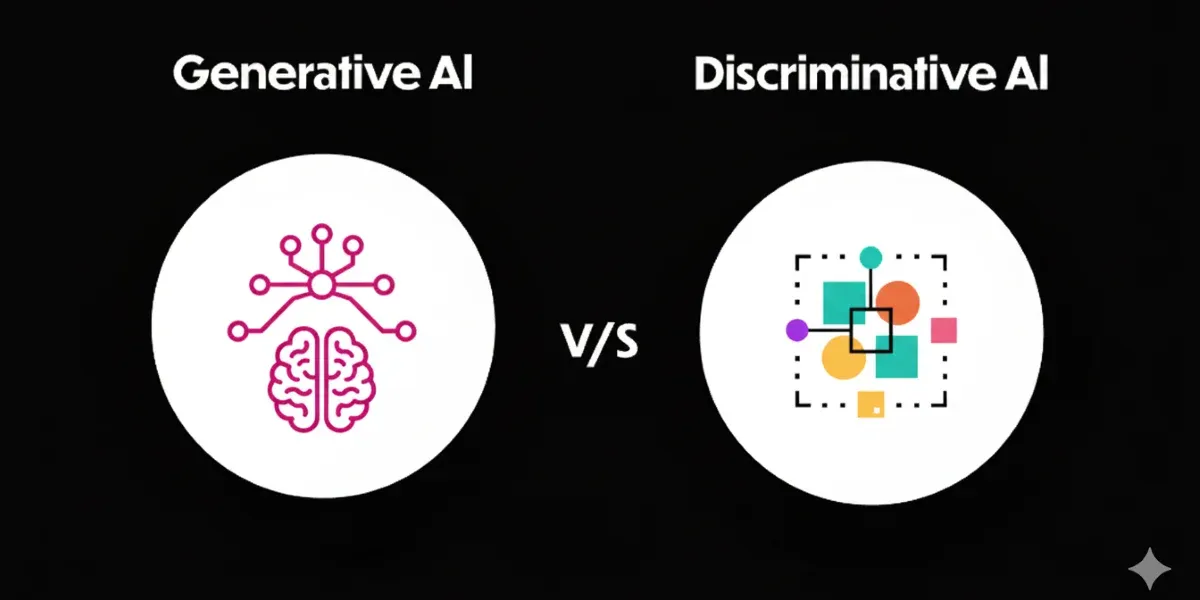
Discriminative AI classifies, generative AI creates. One sorts data into categories, the other produces new content from learned patterns.
Choose based on your output needs. Need predictions or classifications? Discriminative AI. Need new text, images, or code? Generative AI.
They require different resources. Discriminative models train faster with labeled data. Generative models need massive datasets and more compute.
Both approaches work better together. GANs, RAG systems, and quality pipelines combine for superior results.
Match the model to the business problem. Fraud detection suits discriminative AI. Content creation suits generative AI.
You've probably used both generative AI and discriminative AI today without realizing it. Your email spam filter? Discriminative AI. That AI-generated image? Generative AI. These two approaches power nearly every AI application you interact with, yet they work in fundamentally different ways.
The generative AI market alone is projected to reach $967.65 billion by 2032, growing at 39.6% annually. Understanding the difference between generative AI and discriminative AI helps you choose the right approach for your specific problem, whether you need to classify data or create something new.
AspectDiscriminative AIGenerative AIPrimary functionClassifies and categorizes existing dataCreates new content from learned patternsCore question"What category does this belong to?""What new data can I create?"Mathematical approachConditional probability P(Y|X)Joint probability P(X,Y)Learning typePrimarily supervised learningUnsupervised, semi-supervised, self-supervisedOutputLabels, predictions, classificationsText, images, audio, video, codeData requirementsLabeled datasetsLarge unlabeled datasetsTraining complexityGenerally simpler and fasterMore complex and resource-intensiveDecision boundariesExplicitly learns boundaries between classesIndirectly captures boundaries through data distributionCommon modelsSVM, Random Forest, Logistic Regression, CNNsGANs, VAEs, Transformers, Diffusion ModelsTypical use casesSpam detection, fraud detection, and medical diagnosisContent creation, image generation, text synthesisComputational costLower training and inference costsHigher computational requirementsInterpretabilityEasier to interpret and explainHarder to interpret outputs
Discriminative AI focuses on classification. It learns to distinguish between different categories of data. Think of it as a sorting system that draws boundaries between classes. When you show it an email, it determines whether it is spam or not spam. When you show it a medical scan, it identifies a tumor or healthy tissue.
These models learn the conditional probability of an output given an input. They don't try to understand how the data was generated. They only care about what separates one class from another. This focused approach makes them highly accurate for prediction and classification tasks where you need clear, decisive answers.
Discriminative models learn decision boundaries by analyzing labeled training data. They identify patterns that separate different classes and use these patterns to classify new inputs accurately and efficiently.
Discriminative AI requires labeled training data where each example has a known category assigned by humans. The model learns by comparing its predictions against these ground-truth labels and adjusting internal parameters to minimize classification errors. This iterative process continues until accuracy plateaus.
The model identifies which input features matter most for distinguishing between classes effectively. It learns which characteristics, like pixel patterns in images, word frequencies in text, and numerical ranges in tabular data, correlate strongly with specific outcomes and ignore irrelevant noise.
During training, the model draws mathematical boundaries in high-dimensional feature space that separate different classes cleanly. These boundaries become sharper and more precise as training progresses and the model processes more labeled examples through multiple epochs.
When new unseen data arrives, the model maps it to the learned feature space and determines which side of the decision boundary it falls on. This geometric positioning determines the predicted class, category, or label assigned to the input.
Most discriminative models output confidence scores alongside their predictions, not just hard classifications. A spam classifier might return 94% spam probability, giving you both the final classification decision and a measure of certainty to inform downstream actions.

Several model architectures excel at classification and prediction tasks across different data types. Each offers distinct strengths depending on your data volume, feature complexity, accuracy requirements, and interpretability needs.
Despite its name, logistic regression handles classification by modeling the probability of class membership using a sigmoid function. It's fast to train, highly interpretable, and works well for linearly separable data. Use it as a baseline model or when you need explainable predictions in regulated industries.
SVMs find optimal hyperplanes that maximize margins between different classes in feature space. They handle high-dimensional data effectively and work well with smaller datasets where other models struggle. Kernel tricks let them capture non-linear relationships without requiring explicit manual feature engineering.
Random forests combine hundreds of decision trees, each trained on different random data subsets using bootstrap aggregation. This ensemble approach reduces overfitting significantly and handles mixed data types naturally. They're robust to outliers, require minimal hyperparameter tuning, and provide useful feature importance rankings.
Boosting algorithms build decision trees sequentially in stages, with each new tree specifically correcting errors made by previous trees. They consistently win machine learning competitions and handle structured tabular data exceptionally well. Expect high accuracy, but watch carefully for overfitting on smaller datasets.
CNNs dominate image classification tasks by learning hierarchical visual features automatically from raw pixels. Early layers detect simple edges and textures, while deeper layers recognize complex patterns and objects. They require substantial training data but achieve state-of-the-art accuracy on visual recognition tasks.
Discriminative AI fits specific scenarios where classification accuracy and prediction speed matter more than content creation. Match your problem characteristics to these key indicators for optimal results.
When your task involves sorting inputs into predefined categories, like yes/no decisions, spam/not spam filtering, or multiple distinct classes, discriminative models excel by design. They're purpose-built for drawing precise boundaries between known categories with high precision and recall rates.
Discriminative models require substantial labeled examples to learn effective decision boundaries from supervised signals. If you have properly tagged datasets where inputs map to known correct outputs, these models can extract discriminative patterns efficiently. Without labels, consider unsupervised or generative alternatives instead.
When you need fast inference speeds for production systems, like fraud detection at transaction time, content moderation at upload, or recommendation at page load, discriminative models deliver consistently. Their simpler architectures enable millisecond predictions without requiring heavy computational overhead or expensive GPU infrastructure.
In regulated industries like healthcare and finance, or for high-stakes business decisions, you need to explain why the model made specific predictions clearly. Discriminative models like logistic regression and decision trees offer transparent reasoning paths that satisfy compliance requirements and stakeholder scrutiny.
When computational budget, training time, or infrastructure is limited, discriminative models provide excellent accuracy-to-resource ratios consistently. They train faster on standard hardware, require less memory during inference, and deploy effectively on modest infrastructure compared to large generative models.
Discriminative AI powers critical systems across industries where accurate classification drives substantial business value, operational efficiency, and risk reduction at scale.
Financial institutions use discriminative models to analyze transaction patterns in real-time during the payment process. The models flag statistical anomalies, unusual locations, amounts, frequencies, or merchant categories that indicate potentially fraudulent activity. This protects customers and reduces losses significantly without blocking legitimate transactions unnecessarily.
Healthcare organizations leverage discriminative AI to analyze medical images systematically for tumors, lesions, fractures, and other abnormalities. Models trained on millions of annotated scans assist radiologists by highlighting areas of concern automatically. Early detection through AI screening improves patient outcomes across cancer, diabetic retinopathy, and cardiac conditions.
Email providers and social platforms use discriminative models to classify incoming content before users see it. These systems analyze text patterns, sender reputation, attachment types, and metadata to block spam, phishing attempts, malware, and policy-violating content effectively at a massive scale.
Businesses monitor customer feedback across reviews, social media posts, and support tickets using sentiment classification models. These systems categorize opinions as positive, negative, or neutral automatically, enabling rapid response to emerging issues and continuous measurement of brand perception and customer satisfaction trends.
Manufacturing and logistics companies deploy discriminative models to predict equipment failures before they occur and cause disruption. Sensors feed continuous operational data to classifiers that identify subtle patterns preceding mechanical breakdowns. This enables proactive scheduled maintenance, significantly reducing unplanned downtime and emergency repair costs.
Generative AI creates new content by learning patterns and structures from existing data. Rather than classifying inputs, it generates outputs, including text, images, music, and code that resemble its training data. Think of it as an artist who studies thousands of paintings and then creates original artwork in a similar style.
These models learn the joint probability distribution of data, understanding not just what categories exist but how the data itself is structured and generated. This deep understanding of data patterns enables them to produce entirely new samples that didn't exist before. The outputs can be creative, realistic, and remarkably human-like.

Generative models learn underlying data distributions to produce new samples that match training data characteristics. They capture complex relationships between features and use this comprehensive knowledge to synthesize original, realistic content.
The model analyzes massive training datasets to understand their statistical properties comprehensively. It includes how features relate to each other, common recurring patterns, and typical variations within the data. This creates an internal representation of what "valid" data looks like across all dimensions.
Generative models compress high-dimensional data into lower-dimensional latent spaces where similar items cluster together naturally. This compressed representation captures essential characteristics while filtering noise, enabling controlled generation and smooth interpolation between different outputs.
During generation, the model samples from learned probability distributions and reconstructs full outputs from latent representations. It combines patterns in novel ways that remain consistent with training data statistics to create original but realistic and coherent results.
Many generative models use iterative improvement processes to enhance output quality progressively. GANs pit generators against discriminators in adversarial training, diffusion models progressively denoise random inputs through multiple steps. Each iteration improves quality until results become indistinguishable from real data.
Advanced generative models accept prompts, conditions, or control signals that guide and constrain output generation. Text prompts steer image generation toward specific subjects, context shapes text completion style and content, and style references influence creative outputs, giving you precise control over results.
Generative architectures have evolved rapidly over recent years, each designed for specific content types and quality requirements. Understanding their differences and tradeoffs helps you select the right tool for your needs.
GANs use two competing neural networks: a generator creating synthetic samples and a discriminator detecting fakes. This adversarial training dynamic produces highly realistic images through competition. They excel at image synthesis, style transfer, and data augmentation, but can be notoriously unstable to train properly.
VAEs encode input data into probabilistic latent spaces with learned distributions and decode samples back to original dimensions. They offer smooth interpolation between different samples and mathematically grounded controllable generation. Use them when you need structured latent spaces or continuous meaningful variation in outputs.
Transformers use self-attention mechanisms to process sequential data effectively, capturing long-range dependencies that earlier architectures missed. GPT models generate text autoregressively, token by token; BERT handles bidirectional context understanding. They dominate natural language tasks and increasingly power multimodal applications combining text and images.
Diffusion models learn to reverse a gradual noise-adding process, progressively denoising random Gaussian inputs into coherent, structured outputs. They produce exceptional image quality with fine-grained detail control through guidance. Currently, the leading architecture for high-quality text-to-image generation tasks.
LLMs scale transformer architectures to billions of parameters trained on massive internet-scale text corpora. They generate coherent long-form text, follow complex multi-step instructions, and perform sophisticated reasoning tasks. Claude, GPT-4, and Llama represent current frontier capabilities in language understanding and generation.
Generative AI transforms creative and knowledge work by producing original content at an unparalleled scale across multiple formats and industries simultaneously.
Marketing teams use generative AI to draft blog posts, social media content, email campaigns, product descriptions, and advertising copy quickly. Models generate coherent first drafts in seconds, which human editors then refine for accuracy and brand voice. This accelerates content production dramatically while maintaining quality standards.
Creative professionals generate product mockups, marketing visuals, concept art, and storyboards using text-to-image models like DALL-E and Midjourney. Video generation tools enable rapid prototyping of advertisements and explainer content. These capabilities compress production timelines from weeks to hours while expanding creative possibilities.
Software developers use generative AI to write boilerplate code, suggest intelligent completions, debug errors, and translate between programming languages automatically. Models trained on vast code repositories understand syntax, common patterns, and engineering best practices deeply. This accelerates development velocity while reducing tedious repetitive coding tasks.
Pharmaceutical companies use generative models to design novel molecular structures with specific desired therapeutic properties computationally. Models learn complex chemical patterns from existing compounds and generate promising candidates for specific disease targets. This expands the search space far beyond human intuition and dramatically accelerates early-stage research timelines.
Organizations generate artificial datasets that preserve statistical properties and patterns of real data without exposing private information. This enables robust model training when actual data is scarce, highly sensitive, or prohibitively expensive to collect. Synthetic data augments training sets effectively and enables broader AI development across privacy-sensitive domains.
Generative AI fits scenarios requiring content creation, data synthesis, or creative exploration at scale. Match your specific needs to these key indicators for optimal implementation results.
When you need to produce large volumes of text, images, or media consistently, product descriptions across catalogs, marketing variations for testing, personalized communications for segments, generative AI multiplies output capacity dramatically. It handles volume efficiently while humans focus on strategy, quality control, and creative direction.
For brainstorming sessions, concept development phases, or exploring diverse design alternatives quickly, generative AI produces varied options in minutes. It generates unexpected variations and combinations you wouldn't have considered independently, expanding creative possibilities substantially before you commit resources to final production directions.
When training data is limited in quantity, expensive to acquire, or restricted by privacy regulations, generative models create synthetic alternatives that preserve statistical properties. This augmented artificial data improves downstream model performance significantly without collecting additional real samples or exposing sensitive personally identifiable information.
When you need to customize content for individual users at scale, personalized product recommendations, tailored email communications, and adaptive learning experiences, generative AI produces relevant variations efficiently. It enables true one-to-one personalization far beyond what manual creation or simple templating approaches allow practically.
For rapid visualization of abstract concepts, like product designs from descriptions, architectural layouts from requirements, and interface mockups from specifications, generative AI produces tangible visual outputs from text descriptions instantly. This accelerates feedback cycles dramatically and enables faster stakeholder alignment before investing significant resources in full production.
These approaches complement each other naturally, and many advanced production systems combine both for superior results. Understanding their synergy unlocks more powerful and robust solutions.
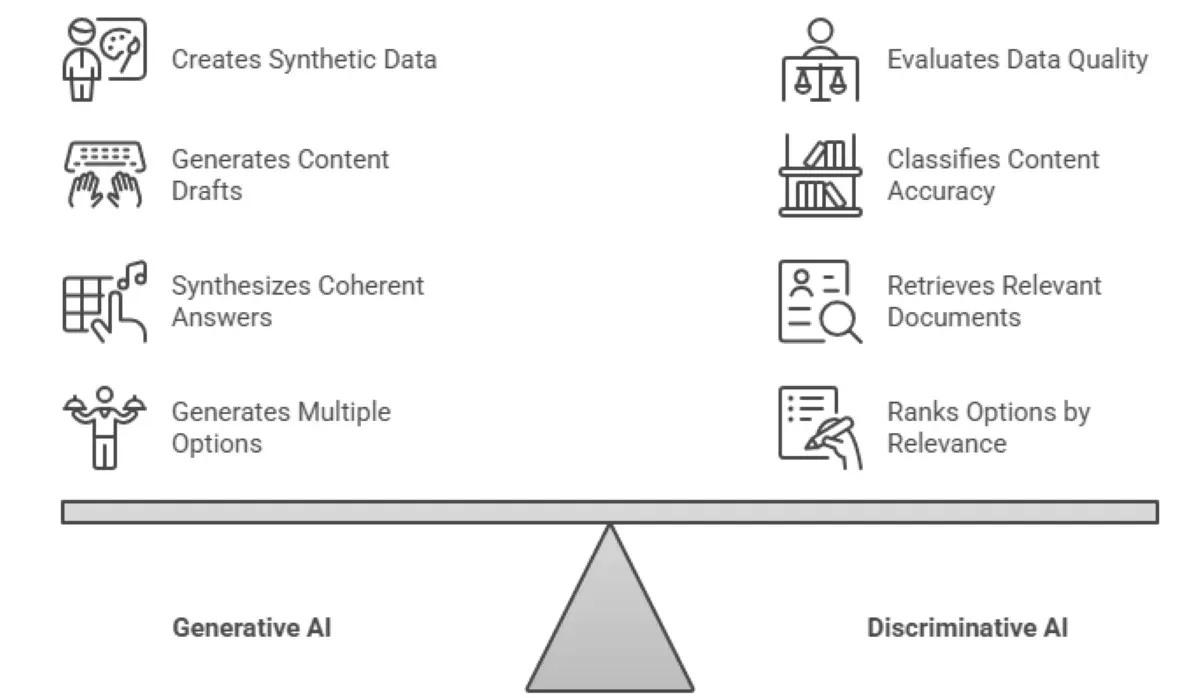
GANs explicitly combine both approaches in a single architecture; a generative network creates synthetic samples while a discriminative network classifies them as real or fake. This adversarial competitive dynamic pushes both networks to improve continuously, producing increasingly realistic high-quality outputs through sustained competition during training.
Generative models create synthetic training data that discriminative models subsequently learn from effectively. When real labeled data is scarce or expensive to obtain, generated samples augment existing datasets significantly. The discriminative model gains exposure to more variations and edge cases, improving its classification accuracy and robustness.
Generative AI produces content drafts at scale while discriminative AI evaluates quality automatically before publication. A text generator creates articles or descriptions; a classifier checks systematically for policy violations, factual inconsistencies, or brand voice deviations. This combination automates high-volume production with built-in quality gates.
RAG systems use discriminative models to retrieve relevant documents from knowledge bases and generative models to synthesize coherent answers. The retriever classifies which source documents match the user query best; the generator produces natural language responses grounded accurately in retrieved factual information.
Generative AI creates multiple options rapidly while discriminative AI and humans filter results collaboratively. The generator produces diverse candidates for consideration; classifiers rank them automatically by relevance, quality, or compliance; humans make final selections efficiently. This workflow maximizes throughput while maintaining appropriate oversight and control.
As a trusted generative AI development partner, Folio3 AI delivers end-to-end solutions that accelerate innovation and optimize operations. From strategy to deployment, our consulting and technology services help enterprises unlock efficiency and measurable growth.
Our generative AI services break down data silos, process large datasets, and generate actionable insights in real time. This empowers smarter, faster decision-making across every business unit, turning raw data into a competitive advantage.
Through specialized generative AI consulting, we define clear AI adoption roadmaps aligned with your business objectives. We address compliance requirements, integration challenges, and long-term ROI expectations to ensure successful implementation from day one.
For enterprises needing more control, we offer tailored large language model fine-tuning and secure hosting options. This lets you safeguard proprietary data, optimize model performance for your domain, and meet strict privacy requirements.
We prioritize ethical AI practices throughout every engagement. Your generative AI solutions deploy securely and responsibly, aligned with regulatory and governance standards—reducing organizational risk while protecting your brand reputation.
We build intelligent AI agents customized to your specific workflows and business goals. Our agents automate complex multi-step tasks, deliver natural language interactions, and integrate seamlessly with existing systems to enhance productivity and customer engagement.
Discriminative AI classifies existing data into predefined categories by learning decision boundaries between different classes. Generative AI creates entirely new content by learning underlying data patterns and probability distributions. One answers, "What is this?" while the other answers, "What can I create?" They serve fundamentally different purposes classification versus creation.
GPT-4 and Claude are generative AI models that create coherent text based on user prompts. DALL-E and Stable Diffusion generate detailed images from text descriptions. These models learned complex patterns from massive datasets and use that deep knowledge to produce original content, like articles, code, images, music that didn't exist before.
A spam filter using logistic regression or random forest is a classic discriminative model. It analyzes email features systematically and classifies messages as spam or legitimate. Medical imaging systems that detect tumors in X-rays, fraud detection systems flagging suspicious transactions, all are discriminative AI making critical classification decisions.
Use discriminative AI when you need to classify, predict, or sort existing data, like fraud detection, customer segmentation, quality inspection, or risk scoring. Use generative AI when you need to create new content, like marketing copy, product descriptions, code, and visual designs. Many enterprises use both: generative for content creation, discriminative for analysis and automation.
Yes, and this combination often produces superior results compared to either approach alone. GANs explicitly pair both; generators create, discriminators evaluate adversarially. RAG systems use discriminative retrieval with generative synthesis. Quality pipelines generate content and then classify it for compliance automatically. These hybrid approaches leverage each model type's distinct strengths.
Discriminative AI powers fraud detection, spam filtering, medical diagnosis, sentiment analysis, predictive maintenance, customer churn prediction, and credit scoring. Generative AI drives content creation, code generation, product design, drug discovery, personalized marketing, synthetic data generation, and creative prototyping. Choose based on whether you're classifying existing data or creating new content.
Discriminative models risk bias from imbalanced training data and may fail unpredictably on edge cases outside their training distribution. Generative models risk hallucinations (confident but incorrect outputs), potential copyright issues with training data, and significantly higher computational costs. Both require appropriate guardrails, continuous monitoring, and human oversight for safe deployment.
Folio3 AI evaluates your specific business problems, existing data assets, and infrastructure constraints to recommend optimal approaches, discriminative, generative, or hybrid architectures. We handle end-to-end model selection, custom development, seamless integration with existing systems, and ongoing optimization. Our focus on agentic AI means we build comprehensive solutions that combine multiple model types for complete workflow automation.