Loading...
Generative AI is changing how businesses operate, offering exciting new ways to create content, automate tasks, and get insights. But for this technology to be truly useful in a business setting, it needs to be reliable, accurate, and secure. This is where Retrieval-Augmented Generation (RAG) in your enterprise systems comes into play. RAG is a powerful approach that combines the creative power of large language models (LLMs) with the ability to pull information from a company's own trusted data.
The retrieval-augmented generation (RAG) market is valued at USD 1.94 billion in 2025 and is expected to grow to USD 9.86 billion by 2030, reflecting a strong CAGR of 38.4% over the 2025–2030 period. It shows how much businesses are investing in these advancements to solve real-world problems. This guide will walk you through how to bring RAG into your organization, making your AI applications smarter and more dependable.
Getting to grips with Retrieval-Augmented Generation (RAG) means understanding how it helps AI models deliver more accurate and relevant information. This approach combines the broad knowledge of an AI model with the specific, trusted data a business already owns, leading to better results.
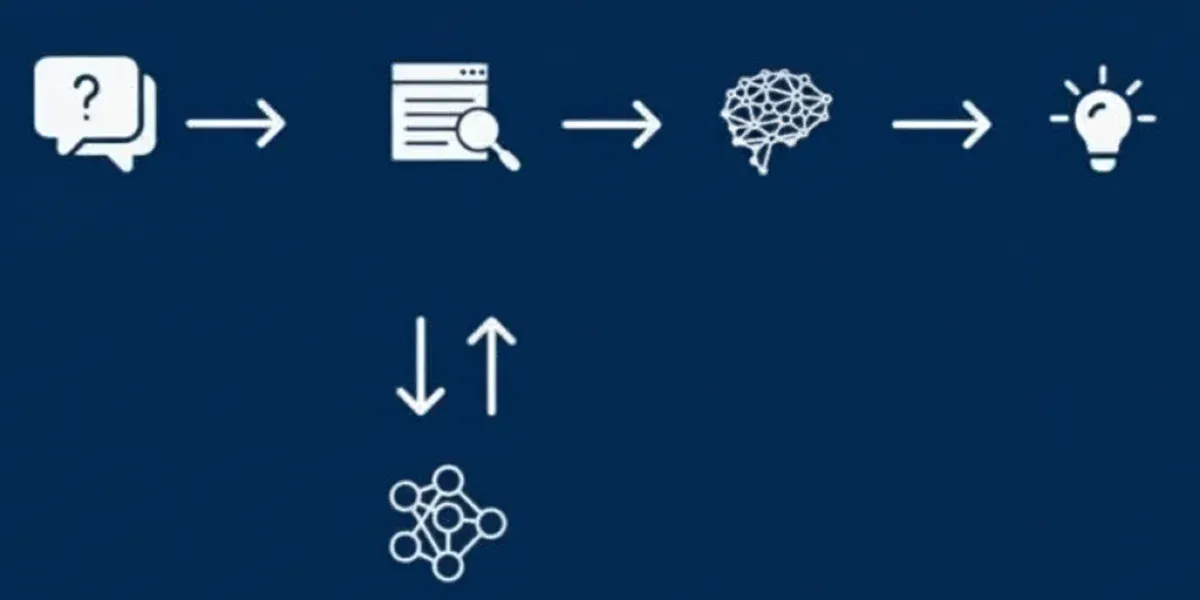
RAG is a way to make large language models (LLMs) smarter by giving them access to external knowledge sources when they need to answer a question or generate text. Instead of relying only on what they learned during their initial training, RAG allows LLMs to "look up" facts and details from a separate, relevant database. This process helps the AI create responses that are not just creative but also factually correct and based on specific, current information.

RAG significantly improves AI responses by addressing a common issue with large language models: the tendency to "hallucinate" or make up information. By providing the AI with relevant documents or data snippets at the time of inquiry, RAG ensures that its answers are grounded in real, verifiable information. This direct access to an external knowledge base makes the AI's output more reliable, accurate, and directly applicable to the user's specific context.
A RAG system typically has two main parts.
First, there's the "retriever," which acts like a smart search engine, finding relevant pieces of information from a company's data sources based on the user's question.
Second, there's the "generator," which is a large language model (LLM).
Once the retriever finds the pertinent information, the generator uses both the user's original question and the retrieved data to formulate a comprehensive and accurate answer.
For businesses, RAG is incredibly important because it allows AI systems to use a company's unique and often proprietary data securely and effectively.
This means AI can answer questions about internal policies, specific product details, or customer history without exposing sensitive information.
It builds trust by ensuring AI outputs are consistent with internal records and industry standards, which is vital for compliance and maintaining business reputation.
Traditional LLMs generate text based solely on the vast amount of data they were trained on, which can sometimes lead to outdated, generic, or even incorrect information (hallucinations).
RAG, on the other hand, augments these LLMs by giving them a real-time, up-to-date knowledge base to consult before generating a response. This fundamental difference means RAG systems offer greater accuracy, relevance, and control over the information provided, making them much more suitable for enterprise use where precision and data integrity are key.
Bringing Retrieval-Augmented Generation (RAG) into your business operations offers many advantages that can directly impact efficiency, decision-making, and customer satisfaction. By making AI outputs more reliable and relevant, RAG helps companies leverage their data in powerful new ways.
One of the most immediate benefits of RAG is its ability to deliver highly accurate and relevant information. By connecting large language models (LLMs) to a company's specific and verified data sources, RAG ensures that AI-generated responses are factually correct and directly pertinent to the user's query.
A significant challenge with standalone LLMs is their tendency to "hallucinate," meaning they generate plausible-sounding but incorrect or fabricated information. RAG directly addresses this by grounding the AI's responses in factual, retrieved data. This capability is crucial for businesses where accuracy is paramount, such as in legal, financial, or medical fields.
Businesses often deal with rapidly changing data, internal documents, and unique operational knowledge that is not publicly available or up-to-date in standard LLM training data. RAG solves this by providing AI with real-time access to a company's latest internal databases, reports, and documents.
Data security and compliance are top priorities for any enterprise. RAG systems can be designed to access only specific, authorized data sources within a company's secure environment, ensuring sensitive information remains protected. This architecture helps businesses meet stringent regulatory requirements, such as GDPR or HIPAA.
While fine-tuning a large language model can be very expensive, requiring vast computational resources and specialized expertise, RAG offers a more cost-effective alternative for making LLMs domain-specific. Instead of retraining the entire model, RAG leverages an existing, powerful LLM and simply augments it with a company's data.
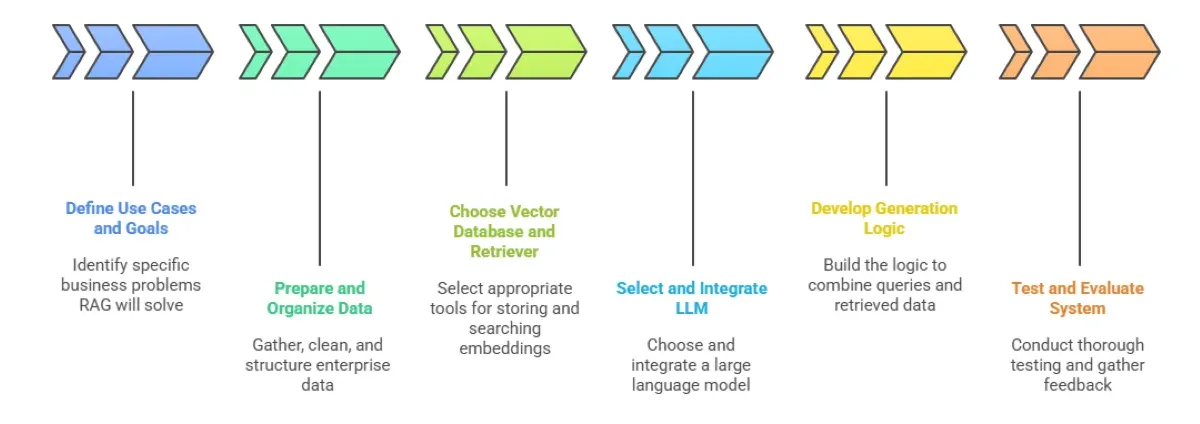
Bringing Retrieval-Augmented Generation (RAG) into your company requires a structured approach. Following these essential steps will help ensure a smooth and effective deployment, turning your enterprise data into a powerful resource for intelligent AI applications.
Before diving into technical details, clearly identify how RAG will solve specific problems or enhance existing processes in your business. Are you looking to improve customer service, automate internal knowledge search, or assist legal teams with document analysis? Defining precise use cases and measurable goals will guide your entire implementation strategy, ensuring that the RAG system is built to deliver tangible value and address real business needs.
The success of RAG heavily relies on the quality and organization of your data. This step involves gathering all relevant documents, databases, and information sources from across your enterprise. You'll need to clean, format, and structure this data, breaking it down into smaller, manageable "chunks" (like paragraphs or sections). These chunks are then converted into numerical representations called "embeddings," which allow the AI to quickly understand and compare their meaning for retrieval.
Once your data is prepared and embedded, you need a system to store and efficiently search these embeddings. A vector database (also known as a vector store) is specifically designed for this purpose, allowing for fast and accurate semantic searches. Simultaneously, you'll select a "retriever" component, which is the algorithm responsible for querying the vector database and identifying the most relevant data chunks based on a user's question. The choice of database and retriever is critical for the speed and accuracy of your RAG system.
With your data and retrieval system in place, the next step is to choose the large language model (LLM) that will serve as the "generator" in your RAG setup. This could be a publicly available model via an API (like OpenAI's GPT models or Google's PaLM) or an open-source model hosted internally for more control. The chosen LLM needs to be integrated with your retrieval system so it can receive the user's query along with the relevant retrieved information to formulate its final response.
This step involves building the "brain" that connects the retriever and the generator. When a user asks a question, the logic first sends it to the retriever to fetch relevant data. Then, it skillfully combines the original question with the retrieved information to create a detailed prompt for the LLM. This "augmented" prompt guides the LLM to generate an answer that is both coherent and factually supported by your enterprise data, rather than just relying on its general knowledge.
After building your RAG system, thorough testing is essential. This involves running various queries, evaluating the accuracy, relevance, and coherence of the generated responses. Collect feedback from intended users and domain experts. Based on these evaluations, you'll likely need to fine-tune components like the data chunking strategy, embedding models, retriever algorithms, or even the LLM's prompt. This iterative process of testing, learning, and refining is crucial for optimizing your RAG system's performance over time.
Implementing RAG successfully goes beyond just setting up the technical components; it involves strategic planning and continuous refinement. Adhering to these best practices will help ensure your RAG system is robust, accurate, and truly beneficial for your business operations.
The output quality of any AI system, especially RAG, is directly tied to the input data quality. "Garbage in, garbage out" perfectly applies here. Ensure your enterprise data sources are clean, accurate, consistent, and free from irrelevant noise or duplicates. Invest time in data cleansing, standardization, and enrichment before creating embeddings.
When preparing your data, breaking it down into appropriate "chunks" is a delicate balance. If chunks are too small, they might lack sufficient context; if too large, they might contain irrelevant information or exceed the LLM's context window. Experiment with different chunk sizes, overlaps, and methods of splitting (e.g., by paragraph, section, or semantic meaning) to find what works best for your specific data and use cases.
The embedding model converts your text chunks into numerical vectors, and the retriever uses these vectors to find similar chunks to a query. The choice of embedding model (e.g., a general-purpose model or one fine-tuned for your domain) and the retriever algorithm can significantly affect performance. Continuously evaluate their effectiveness.
Given that RAG interacts with your enterprise's proprietary data, security cannot be an afterthought. Implement strict access controls to ensure that the RAG system (and the LLM within it) can only access authorized data sources. Encrypt data both at rest and in transit. Establish clear data governance policies, monitor access logs, and consider anonymizing sensitive information where possible.
Enterprise data is dynamic; new information is created, and existing information becomes outdated. For your RAG system to remain effective and provide current answers, its underlying knowledge base (your indexed enterprise data) must be regularly updated. Establish automated pipelines for ingesting new documents, revising existing ones, and re-indexing them into your vector database.
While technical metrics are useful, the ultimate success of a RAG system often depends on its practical utility and accuracy from a human perspective. Involve subject matter experts (SMEs) from your business units throughout the testing and evaluation phases. Their insights into the nuances of your data and business processes are invaluable for identifying subtle inaccuracies, improving response quality.
While Retrieval-Augmented Generation (RAG) offers many benefits, its implementation in complex enterprise environments comes with its own set of challenges. Knowing these hurdles beforehand and having strategies to overcome them is key to a smooth and successful deployment.
Enterprises typically have data scattered across many systems, formats, and departments, including databases, documents, emails, and presentations. Integrating these diverse sources into a unified, searchable knowledge base for RAG can be a complex task. To overcome this, start with a phased approach, prioritizing critical data sources. Use robust data integration tools and establish clear data governance policies to standardize data formats and ensure consistent ingestion into your RAG system.
Business data is rarely static; it constantly evolves. Keeping the RAG system's knowledge base updated with the latest information in real-time or near real-time can be challenging. Outdated information leads to inaccurate AI responses. Implement automated data pipelines that regularly sync your enterprise data sources with your vector database. Use change data capture (CDC) mechanisms to detect updates efficiently, and schedule frequent re-indexing cycles to ensure the RAG system always has access to the freshest data.
Users don't always ask straightforward questions. Complex queries, vague language, or questions that require synthesizing information from multiple, disparate data chunks can challenge a RAG system's retriever and generator. Improve this by enhancing your embedding models for better semantic understanding and by implementing advanced retrieval techniques like hybrid search (combining keyword and vector search). You can also use query expansion or rephrasing techniques before sending the query to the retriever.
For RAG to be truly useful in interactive applications like chatbots or internal search tools, it needs to provide fast responses. Retrieving relevant documents from a large knowledge base and then having an LLM process them can introduce latency. To optimize performance, choose efficient vector databases, scale your infrastructure appropriately, and use optimized embedding and retrieval models. Caching frequently accessed information can also reduce response times, making the user experience smoother.
Integrating enterprise data into an AI system raises serious concerns about data security and privacy, especially with sensitive or regulated information. Overcome this by designing RAG with security from the ground up. Implement strict role-based access controls (RBAC) to ensure users only see information they are authorized to access, even through the AI. Encrypt all data, both in storage and during transfer. Regularly audit access logs and adhere strictly to data privacy regulations like GDPR or HIPAA to prevent breaches.
Retrieval-Augmented Generation (RAG) isn't just a theoretical concept; it's a practical solution that's already transforming various aspects of enterprise operations. By providing accurate, data-backed responses, RAG empowers businesses across diverse industries to achieve new levels of efficiency and intelligence.
RAG is a game-changer for customer support. Imagine chatbots that don't just give generic answers but can instantly access a company's entire knowledge base, product manuals, FAQs, customer history, and troubleshooting guides, to provide precise, personalized, and up-to-date solutions. This dramatically improves resolution rates, reduces wait times, and frees human agents to focus on more complex issues, leading to higher customer satisfaction.
For large organizations, finding specific information buried in countless internal documents, reports, and communication channels can be a massive time sink for employees. RAG transforms internal search by allowing employees to ask natural language questions and get immediate, accurate answers drawn from the company's private knowledge base. This empowers teams with instant access to policies, project details, HR documents, and best practices, boosting productivity and collaboration.
The legal and compliance sectors deal with vast amounts of complex textual data, from contracts and case law to regulatory documents. RAG systems can quickly retrieve and synthesize relevant information from these extensive libraries, helping legal professionals draft documents, review contracts for specific clauses, and ensure compliance with regulations much faster and more accurately than manual methods. This reduces errors and significantly streamlines labor-intensive legal research.
In finance, timely access to accurate market data, company reports, and economic indicators is crucial. RAG can power intelligent assistants that quickly summarize financial documents, answer questions about market trends, or retrieve specific data points from earnings reports. This enables financial analysts to conduct more thorough research, generate reports faster, and make more informed investment decisions, leading to a competitive edge.
Healthcare professionals often need quick access to the latest research, patient records, clinical guidelines, and drug information. RAG can provide doctors and researchers with immediate, evidence-based answers by pulling from vast medical databases and internal hospital records. This supports clinical decision-making, assists in diagnoses, helps with treatment planning, and contributes to better patient outcomes by ensuring access to the most current and relevant medical knowledge.
Businesses in marketing, education, and content creation can use RAG to generate highly personalized content. For example, a marketing team could use RAG to create tailored ad copy or product descriptions based on specific customer segments and product features from their internal databases. Educational platforms could generate personalized learning materials or answer student questions by pulling from course content, making learning more engaging and effective.
The field of Retrieval-Augmented Generation (RAG) is constantly evolving, with researchers and developers pushing the boundaries of what's possible. Looking ahead, several exciting trends are emerging that promise to make RAG systems even more powerful, intuitive, and seamlessly integrated into enterprise workflows.
Current RAG systems often rely on basic vector similarity search for retrieval. The future will see more sophisticated techniques, such as hybrid retrieval that combines keyword search with semantic search, or advanced graph-based retrieval that understands relationships between data points. Multi-hop retrieval, where the system asks follow-up questions to itself to refine the search, will also enhance accuracy, allowing RAG to handle even more complex and nuanced queries by navigating the knowledge base more intelligently.
Today's RAG largely focuses on text, but enterprises deal with various data types, including images, audio, and video. Multi-modal RAG will enable systems to retrieve information from and generate responses based on a combination of these formats. Imagine asking an AI about a product, and it retrieves both text specifications and a relevant product image or video demonstration, then provides a summarized answer. This capability will unlock new applications in areas like media analysis, e-commerce, and industrial inspection.
As AI becomes more integrated into daily workflows, RAG systems will evolve to offer increasingly personalized experiences. This means the system will learn individual user preferences, common queries, and specific roles to tailor both the retrieval process and the generated responses. Personalized RAG could provide highly relevant information for a financial analyst, different from what it provides for a marketing manager, even when querying the same underlying data, making AI assistants truly bespoke.
A significant trend is the move towards agentic RAG architectures, where the AI doesn't just answer questions but can also plan, execute, and monitor complex tasks. These "AI agents" will use RAG not only to retrieve information but also to decide which tools to use, what steps to take, and how to verify outcomes. This could lead to AI systems that can autonomously solve multi-step problems, interact with various enterprise systems, and adapt to changing environments, moving beyond simple question-answering.
As RAG handles sensitive enterprise data, future developments will focus heavily on enhancing security and privacy, alongside greater explainability. This includes more granular access controls, homomorphic encryption for processing data without decrypting it, and privacy-preserving retrieval methods. Additionally, RAG systems will offer clearer explanations of how they arrived at an answer, highlighting the specific source documents and reasoning paths. This transparency builds trust and helps users understand and audit AI decisions, which is crucial for compliance and critical applications.
As a trusted Generative AI development partner, we deliver end-to-end solutions that help enterprises accelerate innovation and optimize operations. Our scalable services enable measurable business impact and sustainable growth.
We design and build custom Generative AI models fine-tuned to your data, industry, and use cases. Our models deliver accuracy, scalability, and business-specific value across text, visuals, and datasets.
We seamlessly embed Generative AI solutions into your existing IT ecosystem. From CRM and ERP systems to proprietary platforms, we ensure smooth integration without disrupting workflows—maximizing operational efficiency.
Our experts craft optimized prompts tailored to your enterprise applications, ensuring consistent, relevant, and high-quality AI outputs. The result: better model performance and reliable results, every time.
Strengthen your internal teams with our seasoned MLOps specialists. We manage model deployment, monitoring, scaling, and ongoing optimization, keeping your generative AI systems production-ready and performing at peak efficiency.
We automate repetitive coding tasks using AI-driven tools, accelerating software development cycles, reducing manual effort, and ensuring higher code quality, all while freeing your teams to focus on high-value initiatives.

RAG (Retrieval-Augmented Generation) enhances an existing large language model (LLM) by giving it access to external, real-time data sources to inform its responses, without changing the core model itself. Fine-tuning, on the other hand, involves retraining a pre-existing LLM on a smaller, domain-specific dataset to make the model itself learn and adapt to that specific information. RAG is generally more flexible for rapidly changing information and more cost-effective for leveraging proprietary data, while fine-tuning alters the model's fundamental knowledge.
While RAG offers powerful benefits for large enterprises with vast data stores, it is also highly suitable for small to medium-sized businesses (SMBs). RAG allows SMBs to leverage sophisticated AI without the immense cost and complexity of training or fine-tuning their own LLMs. By connecting an off-the-shelf LLM to their specific product catalogs, customer FAQs, or internal documents, even small businesses can deploy highly accurate and intelligent AI assistants, making advanced AI more accessible.
There isn't a strict minimum amount of data required, as effectiveness depends more on the quality and relevance of your data to your specific use cases. However, the more comprehensive and well-organized your enterprise data is, the better your RAG system will perform. Even a few hundred high-quality, domain-specific documents can significantly improve the accuracy of an LLM's responses when augmented with RAG. The key is having data that directly answers the types of questions your users will ask.
When implementing RAG, robust security measures are crucial. You should focus on implementing strict access controls to your data sources, encrypting all data both when it's stored (at rest) and when it's moving (in transit). Ensure the RAG system only has the minimum necessary permissions to access information. Regularly audit access logs, comply with data privacy regulations (like GDPR, HIPAA), and consider anonymizing sensitive data where possible to protect proprietary and confidential information from unauthorized access.
The timeline for implementing RAG can vary widely, from a few weeks for a basic prototype to several months for a fully integrated, enterprise-grade solution. Factors influencing this include the complexity and volume of your data, the number of data sources, the specific use cases, the level of integration with existing systems, and the resources available. A well-planned, phased approach, starting with a clear proof-of-concept, can help manage expectations and deliver value incrementally.