
Loading...
You're probably hearing "AI agents" and "agentic AI" thrown around in every tech meeting lately. They sound similar, maybe even identical at first. But here's the reality: choosing the wrong one could cost your enterprise millions in wasted implementation efforts. The difference isn't just semantic; it's strategic.
According to Gartner research, by 2028, approximately 15% of daily work decisions will be handled autonomously by AI systems, yet most enterprises still struggle to understand which technology fits their specific needs. This confusion leads to misaligned investments, disappointed stakeholders, and projects that never deliver promised ROI.
Whether you're automating customer service or orchestrating complex multi-departmental workflows, understanding the distinction between AI agents and agentic AI isn't optional; it's fundamental to your digital transformation success in 2026 and beyond.
FeatureAI AgentAgentic AIAutonomyLow - requires human directionHigh - operates independentlyReasoningLimited - follows rules or patternsMulti-step - plans and strategizesDecision-MakingReactive - responds to inputsProactive - anticipates needsLearningStatic - needs retrainingContinuous - adapts in real-timeTask ComplexitySimple, well-defined tasksComplex, multi-step workflowsError HandlingFails and requires interventionSelf-corrects through iterationTool OrchestrationSingle API or predefined toolsDynamically coordinates multiple systemsHuman DependenceRequires constant supervisionMinimal oversight neededInteraction StyleTransactional Q&AStrategic collaborationMemoryShort-term context onlyPersistent organizational knowledgeBest ForRepetitive, predictable processesDynamic, strategic operationsImplementation Cost$50K-$200K$200K-$2M+ROI Timeline6-12 months12-24 monthsValue CreationEfficiency gains (30-40%)Transformation (10x improvements)
An AI agent is a software entity designed to perceive its environment through sensors or data inputs, process information using algorithms or large language models, and execute specific actions to achieve predefined objectives within established parameters. These agents operate as sophisticated responders, waiting for triggers like user queries, system events, or scheduled tasks before initiating their analysis processes. Once triggered, they analyze requests using natural language processing, rule engines, or pattern-matching algorithms before delivering predetermined outputs.
Whether manifesting as customer service chatbots answering frequently asked questions, robotic process automation bots processing invoices, recommendation engines suggesting products, or virtual assistants scheduling meetings, AI agents excel at handling discrete, well-defined tasks with remarkable consistency and speed. They process millions of repetitive interactions without fatigue while maintaining accuracy and performance standards that would overwhelm human teams.

Understanding different agent categories helps enterprises match specific automation needs with appropriate technological approaches, maximizing efficiency. This also helps manage implementation complexity and costs effectively for optimal return on investment and sustainable operational improvements.
These agents respond immediately to current inputs without maintaining memory or developing complex planning capabilities. They're perfect for simple queries requiring instant responses like password reset requests, basic form validation tasks, straightforward FAQ answers, or simple command execution without contextual dependencies.
Monitor environmental conditions continuously and automatically trigger predefined actions when specific thresholds are met, or patterns are detected. Common examples include inventory reorder systems, purchasing stock when levels drop below targets, predictive maintenance alerts before equipment failure, or automated security responses to detected threats.
Improve performance progressively through experience, feedback loops, and continuous exposure to new data patterns. Examples include fraud detection systems adapting to emerging threat signatures, recommendation engines refining suggestions based on user interactions, or chatbots improving response accuracy through machine learning from conversations and corrections.
Focus systematically on achieving specific objectives by evaluating potential actions against desired outcomes and selecting optimal paths forward. Examples include scheduling assistants optimizing meeting times based on availability, priorities, and preferences, or route planning systems minimizing delivery times while considering traffic, fuel efficiency, and customer priorities.
Combine reactive and proactive capabilities dynamically, switching operational modes based on contextual requirements and environmental conditions. Smart home assistants exemplify this category, responding to voice commands while also proactively suggesting actions, monitoring conditions, adjusting settings automatically, and learning user preferences to improve future interactions seamlessly.
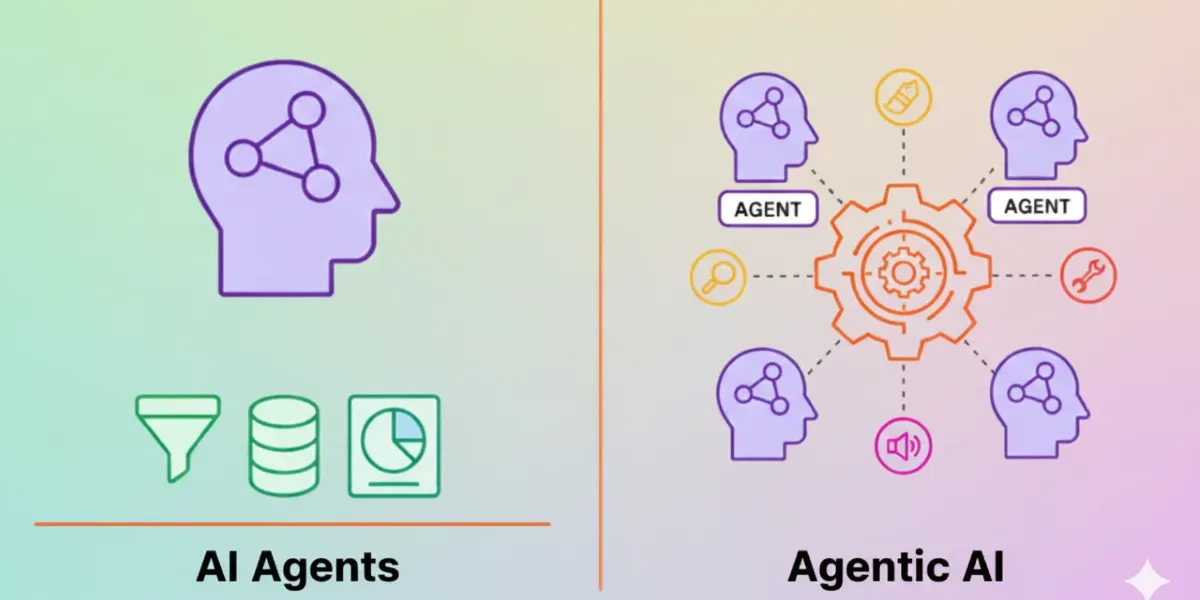
Agentic AI represents a fundamental paradigm shift from mere task execution to comprehensive outcome ownership through genuine autonomous capabilities. Unlike traditional AI agents that wait for commands and execute predefined responses, agentic systems possess true autonomy. It has a capacity to independently analyze complex situations, formulate strategic goals, develop sophisticated multi-step plans, coordinate resources across systems, and execute actions with minimal human supervision while continuously adapting to changing conditions.
These systems don't simply respond to commands or follow scripts; they actively pursue strategic objectives, making independent decisions about priorities, resource allocation, and tactical approaches while maintaining alignment with overarching business goals. Agentic AI adapts multiple specialized agents, tools, and APIs simultaneously, coordinating intricate workflows across departmental boundaries and system architectures. It maintains persistent memory across interactions, building organizational knowledge that improves decision quality over time.
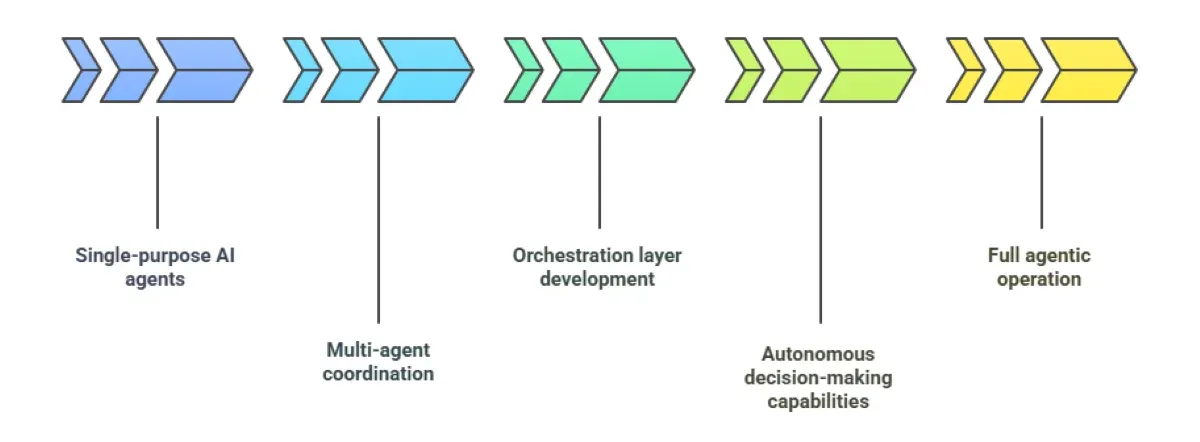
The transformation from simple agents to sophisticated autonomous systems follows predictable developmental stages, each building essential capabilities. Enterprises can implement these progressively, managing risk while advancing automation maturity systematically toward full autonomy.
Organizations begin their automation journey by deploying isolated agents handling specific, well-defined tasks independently. A customer service chatbot answering FAQs, an RPA bot entering data, a recommendation engine suggesting products, each operating in isolation without coordination, shared context, or integrated intelligence across systems.
Multiple specialized agents start working together through programmed workflows and defined integration points. Customer service systems coordinate routing agents directing inquiries, knowledge agents searching documentation, and ticketing agents logging issues, creating basic collaborative capabilities but still requiring human orchestration for complex scenarios and exceptional cases.
Enterprises introduce sophisticated middleware managing agent communication protocols, data sharing across systems, workflow sequencing logic, and basic decision routing. This technical infrastructure creates essential foundations for autonomous operations by enabling agents to exchange information, coordinate actions, and maintain consistency across distributed processes without constant human intervention.
Systems gain advanced planning algorithms, independent choice-making about resource allocation and task prioritization, and adaptive strategy adjustment based on real-time feedback and outcome analysis. Agents no longer simply execute predefined steps but actively determine optimal approaches, evaluate trade-offs, and adjust tactics without requiring constant human approval or intervention.
Complete autonomous systems emerge that independently set strategic sub-goals supporting business objectives, orchestrate diverse agents and tools across enterprise systems, learn continuously from every interaction and outcome, self-correct when approaches prove ineffective, and take comprehensive ownership of complex business outcomes rather than merely executing assigned tasks.
Understanding comprehensive investment requirements, hidden costs, and realistic return timelines helps enterprises make informed technology decisions. This ensures they deliver appropriate value relative to organizational maturity, resource availability, and strategic transformation objectives rather than pursuing capabilities that exceed practical needs.
Building AI agents typically requires $50,000-$200,000, depending on complexity factors including integration requirements, customization needs, and platform selection. Most enterprise implementations complete within 3-6 month development timelines using existing platforms like Microsoft Bot Framework, Dialogflow, or custom development leveraging LangChain with pre-trained models, reducing time-to-value.
Standard cloud computing resources suffice for most AI agent deployments, with moderate API costs for LLM access, minimal specialized hardware beyond typical enterprise infrastructure, and predictable scaling costs. This makes agents financially accessible even for mid-sized organizations operating with limited technology budgets and constrained IT resources.
Maintenance overhead remains low with predictable token usage patterns based on interaction volumes, occasional retraining cycles when business logic changes or new patterns emerge, and straightforward monitoring through standard observability tools. Organizations rarely need dedicated AI operations teams to manage agent performance, troubleshoot issues, or optimize configurations continuously.
Agentic AI systems demand substantial $200,000-$2 million-plus investments reflecting architectural complexity, including planning engines, memory systems, orchestration layers, multi-agent coordination frameworks, and extensive testing phases. Implementation timelines stretch 6-18 months or longer, depending on organizational integration complexity, data infrastructure maturity, and change management requirements across affected departments.
High-performance computing environments with GPU clusters for parallel processing, sophisticated orchestration platforms managing agent coordination, vector databases maintaining organizational memory and context, continuous monitoring systems tracking system behavior, and significant cloud resources supporting multi-agent parallel operations. Infrastructure costs alone can exceed $50,000 monthly for enterprise-scale deployments processing millions of transactions.
Operational expenses run three to five times higher than AI agents due to dramatically increased token consumption from multi-step reasoning chains, complex infrastructure maintenance requiring specialized skills, continuous model optimization preventing performance degradation, and dedicated teams managing system health, fine-tuning strategies, and addressing emerging issues proactively.
Technical architecture differs fundamentally between these systems, requiring distinct development approaches and infrastructure configurations. Successful deployment also depends on operational management strategies that meet performance requirements while managing complexity appropriately for organizational capabilities and resource constraints.
This is a relatively simple input–processing–output pipeline with a large language model or rule engine at the center and optional API connectors enabling data retrieval from enterprise systems. It uses stateless or short-memory context management to maintain conversation continuity within individual sessions, but not across interactions, requests, or user sessions.
User submits query → preprocessing and intent classification determine request type → model inference or rule matching generates appropriate response → response generation formats output → delivery to user interface.
Direct API calls to one to three predefined external systems with synchronous operations completing in seconds, minimal complexity in error handling beyond basic retry logic, and straightforward data mapping between agent and integrated systems. Implementation teams can typically complete integrations in days or weeks rather than months.
This sophisticated multi-layered system architecture includes an autonomous planning engine that generates execution strategies, along with persistent memory storage that maintains organizational knowledge across all interactions. It also features a tool orchestration framework coordinating multiple APIs and services, execution monitoring to track action results, verification loops to validate outcomes against objectives, and self-correction mechanisms that enable adaptive strategy refinement.
High-level goal received → planning phase generates multi-step execution strategy → orchestration layer coordinates specialized agents → distributed tools execute actions in parallel → results validated against success criteria → feedback incorporated into planning model → execution plan dynamically adjusted → cycle repeats until objective achieved or alternative strategy required.
This involves dynamic discovery and intelligent coordination of ten-plus APIs and enterprise systems, along with asynchronous multi-agent communication that enables parallel processing. It also includes sophisticated error handling with automatic retry strategies and fallback approaches, adaptive resource allocation to optimize compute distribution, and complex state management to maintain consistency across distributed operations requiring specialized architecture expertise.
Selecting appropriate technology requires understanding specific scenarios where each delivers maximum value based on workflow complexity characteristics, autonomy requirements, integration depth needed, and strategic business objectives balanced against implementation costs, timeline constraints, and organizational change management capacity.
Intelligent chatbots handle 60-70% of routine customer inquiries, including account balance checks, password resets, order status tracking, and policy questions. These agents reduce support costs dramatically while maintaining 24/7 availability, delivering consistent responses, and capturing interaction data that improves service quality continuously without requiring proportional headcount increases.
HR virtual assistants answer frequently asked policy questions, process standard leave requests, update employee information, route complex issues to appropriate specialists, and guide employees through self-service workflows. This automation frees HR teams from repetitive administrative tasks, enabling focus on strategic initiatives like talent development, culture building, and organizational effectiveness programs.
Automated lead scoring agents analyze prospect behavior patterns across touchpoints, assign priority scores based on engagement signals, route qualified opportunities to appropriate sales representatives based on territory and specialization, and trigger nurturing campaigns for prospects requiring additional cultivation before sales engagement, improving conversion rates systematically.
Supply chain optimization
Autonomous systems continuously monitor demand signals across channels and coordinate procurement, logistics, and inventory management activities across enterprise systems. They dynamically adjust purchase orders based on forecasts and constraints, optimize routing to minimize costs while maintaining service levels, and proactively address disruptions before they impact operations, reducing costs while improving reliability.
Financial operations automation
Autonomous systems continuously monitor demand signals across channels and coordinate procurement, logistics, and inventory management activities across enterprise systems. They dynamically adjust purchase orders based on forecasts and constraints, optimize routing to minimize costs while maintaining service levels, and proactively address disruptions before they impact operations, reducing costs while improving reliability.
R&D research automation
Sophisticated systems independently review scientific literature across databases, design experiments through hypothesis generation, coordinate laboratory equipment execution, and analyze complex results using statistical methods. They identify significant patterns across massive datasets, propose new research directions based on findings, and accelerate innovation cycles from months or years to weeks.
Enterprise AI deployment demands robust frameworks that comprehensively address accountability challenges, data protection requirements, regulatory compliance obligations, and operational risks. These risks scale proportionally with system autonomy levels and the complexity of the decision-making authority granted to autonomous systems.
Predictable behavior patterns within clearly defined operational guardrails make auditing straightforward with clear input-output mappings documenting decision logic. Limited decision authority reduces compliance complexity significantly for regulated industries, and deterministic behavior enables reliable validation that agents operate within intended boundaries, making governance manageable for most organizations.
Bounded access to specific systems and carefully delimited data sets substantially minimizes attack surface exposure, with simpler authentication requirements reflecting limited system access. Easier security validation is possible through standard API security protocols, monitoring tools, and periodic penetration testing rather than sophisticated continuous security operations.
Well-documented decision trees and transparent rule structures facilitate regulatory audits efficiently and enable explainable AI requirements without sophisticated techniques. They also provide clear accountability trails that satisfy most industry compliance frameworks, including financial services regulations, healthcare privacy requirements, and data protection laws like GDPR.
Autonomous decision-making demands sophisticated oversight, including emergency kill switches for immediate shutdown, authorization tiers that restrict decision types by risk level, and continuous monitoring to validate goal alignment with business objectives. It also requires regular validation to ensure systems pursue intended objectives without drift, along with dedicated governance teams and frameworks that exceed traditional IT governance approaches.
Multi-system access spanning enterprise architectures creates substantially larger attack surfaces that require zero-trust security architectures and comprehensive API security across dozens of integrated systems. It also requires data encryption across complex orchestration layers and protection against prompt injection attacks, adversarial inputs, and sophisticated exploitation of autonomous decision-making capabilities.
Complex audit trails span multiple systems and decision chains, creating significant explainability challenges for multi-step reasoning that require specialized interpretability techniques. This also creates a pressing need for comprehensive frameworks addressing AI accountability, algorithmic bias detection and mitigation, and evolving regulatory requirements, including the EU AI Act, algorithmic transparency laws, and sector-specific AI governance mandates.
Strategic technology selection requires systematically evaluating workflow characteristics, organizational maturity indicators, available resource pools, enterprise risk tolerance, and long-term business objectives to match autonomous capabilities with actual needs rather than pursuing cutting-edge capabilities exceeding practical requirements.
Deploy AI agents for repetitive, well-defined processes with clear boundaries, predictable inputs following established patterns, and acceptable human-in-the-loop oversight requirements. In these cases, efficiency gains between 30–40% justify moderate automation investments without demanding transformational business process redesign or extensive organizational change management across departments.
Choose agentic systems for complex, multi-step workflows that require sophisticated cross-departmental coordination, dynamic adaptation to changing business and market conditions, and strategic autonomy. In these cases, 10× performance improvements justify significantly higher implementation costs, extended timelines, and substantial organizational transformation, including process redesign, skill development, and cultural adaptation.
Many enterprises benefit from combining both approaches strategically: AI agents handle routine tasks, providing quick wins, building confidence, and generating immediate ROI, while agentic AI tackles strategic workflows, delivering transformational value. This progressive approach manages risk through gradual capability building while maintaining business continuity throughout transformation.
Folio3 AI delivers end-to-end AI agent solutions for enterprises, from strategic planning and custom development to integration, optimization, and continuous learning, ensuring intelligent automation that evolves with your business.
We analyze your operations, identify automation opportunities, and create implementation roadmaps. Our strategy defines which agents deliver maximum ROI, prioritizes use cases, and establishes scalable deployment frameworks aligned with business objectives.
We build intelligent agents using AutoGen, LangChain, and CrewAI frameworks powered by GPT-4 and Claude. Each agent is custom-designed for your workflows, ensuring adaptive decision-making, real-time processing, and seamless performance.
Our integration expertise ensures AI agents connect smoothly with your existing systems, CRMs, databases, APIs, and enterprise platforms. We prioritize data security, compatibility testing, and reliable information exchange across your technology stack.
We provide ongoing support, including performance monitoring, model updates, and continuous optimization. Our maintenance services ensure your agents remain effective as business needs evolve, maintaining peak performance and reliability long-term.
We design intuitive multimodal interfaces that facilitate natural human-agent interaction. Our UX approach builds user trust, encourages adoption, and ensures agents enhance rather than complicate workflows through thoughtful experience design.
We implement feedback loops and performance analytics to continuously improve agent capabilities. Through ongoing training with real operational data, your agents become smarter, more accurate, and increasingly valuable over time.
Emerging trends indicate a convergence toward sophisticated hybrid architectures that combine specialized agents with autonomous orchestration capabilities. These architectures will fundamentally reshape enterprise operations and competitive dynamics through 2027 and beyond as AI capabilities mature and democratize across industries.
Rather than making binary technology choices between agents and agentic systems, organizations will increasingly deploy AI solutions across continuous autonomy spectrums, from simple reactive agents to fully autonomous systems. They will match precise capability levels to specific workflow requirements, risk profiles, and compliance constraints instead of relying on one-size-fits-all approaches.
Enterprises will maintain comprehensive libraries of specialized agents functioning as domain experts that agentic orchestration layers dynamically compose into customized solutions on demand. This architectural approach enables rapid deployment of new capabilities without rebuilding entire systems, accelerating innovation cycles dramatically while reducing development costs and maintaining system stability.
Vertical-focused agentic AI will emerge for specialized domains, including healthcare treatment coordination, financial portfolio management, manufacturing quality control, legal case management, and regulatory compliance. These solutions embed deep industry best practices, domain-specific workflows, and regulatory compliance frameworks, accelerating adoption and reducing implementation risks substantially.
Agentic AI will increasingly leverage edge computing, enabling real-time decisions without cloud latency, quantum computing solving complex optimization problems impossible for classical computers, and blockchain providing trusted multi-party coordination and audit trails. These convergences will exponentially expand capability boundaries, enabling applications currently impossible with existing infrastructure.
User-friendly platforms will enable business teams and non-technical users to configure and deploy both agents and agentic systems without deep technical expertise or programming skills. This democratization will accelerate adoption dramatically, enabling innovation at unprecedented scale across all organizational levels, departments, and use cases previously requiring scarce technical resources.
{ "@context": "https://schema.org", "@type": "FAQPage", "mainEntity": [ { "@type": "Question", "name": "What is an AI agent?", "acceptedAnswer": { "@type": "Answer", "text": "An AI agent is a software program that perceives its environment, processes information using algorithms or LLMs, and executes tasks within predefined parameters. These range from simple chatbots to automated systems that respond to triggers and perform programmed actions." } }, { "@type": "Question", "name": "What is agentic AI?", "acceptedAnswer": { "@type": "Answer", "text": "Agentic AI refers to autonomous systems that independently analyze situations, formulate goals, plan multi-step strategies, and execute actions with minimal supervision. Unlike traditional AI that responds to commands, agentic AI actively pursues objectives and orchestrates multiple agents." } }, { "@type": "Question", "name": "How are AI agents and agentic AI different?", "acceptedAnswer": { "@type": "Answer", "text": "AI agents are task-oriented executors that respond to inputs within predefined limits and require human coordination. Agentic AI is goal-driven, capable of independent planning, dynamic adaptation, and decision-making without continuous supervision." } }, { "@type": "Question", "name": "Which one is better for enterprise use?", "acceptedAnswer": { "@type": "Answer", "text": "Neither is universally better. AI agents excel at repetitive tasks with lower cost ($50K–$200K, 3–6 months), while agentic AI is suited for complex workflows requiring autonomy ($200K–$2M+, 6–18 months). The choice depends on enterprise goals and workflow complexity." } }, { "@type": "Question", "name": "Is agentic AI more costly to implement?", "acceptedAnswer": { "@type": "Answer", "text": "Yes. Agentic AI typically costs $200K–$2M+ compared to $50K–$200K for AI agents, with longer timelines (6–18 months vs. 3–6 months). While agents deliver 30–40% efficiency gains, agentic AI can achieve transformational 10x improvements." } }, { "@type": "Question", "name": "Can AI agents and agentic AI work together?", "acceptedAnswer": { "@type": "Answer", "text": "Yes. A hybrid approach is best for most enterprises. Agentic AI orchestrates multiple specialized AI agents, with the autonomous layer handling planning while individual agents execute specific tasks efficiently." } }, { "@type": "Question", "name": "Do I need clean data before using agentic AI?", "acceptedAnswer": { "@type": "Answer", "text": "Yes, data quality significantly affects performance, although perfect data is not required. Agentic AI needs reasonably accurate, accessible data via APIs. Incomplete or contradictory data limits reasoning quality and strategic decision-making." } }, { "@type": "Question", "name": "Does agentic AI replace human teams?", "acceptedAnswer": { "@type": "Answer", "text": "No. Agentic AI augments human capabilities by handling repetitive tasks and freeing people for strategic work. Organizations usually redeploy staff to higher-value roles rather than reducing headcount." } }, { "@type": "Question", "name": "Is agentic AI secure for enterprise environments?", "acceptedAnswer": { "@type": "Answer", "text": "Yes, when architected with strict frameworks such as zero-trust architecture, robust API security, audit trails, continuous monitoring, and human-in-the-loop oversight for high-risk decisions." } }, { "@type": "Question", "name": "Can Folio3 AI develop both AI agents and agentic AI solutions?", "acceptedAnswer": { "@type": "Answer", "text": "Yes. Folio3 AI builds both AI agents and agentic AI systems using platforms like AutoGen, LangChain, CrewAI, and LangGraph, powered by GPT-4 and Claude. We provide end-to-end services including strategy, development, deployment, optimization, and governance." } } ] }
An AI agent is a software program that perceives its environment, processes information using algorithms or LLMs, and executes specific tasks within predefined parameters. These agents range from simple chatbots to sophisticated automation systems that respond to triggers and execute programmed actions.
Agentic AI refers to autonomous systems that independently analyze situations, formulate goals, plan multi-step strategies, and execute actions with minimal supervision. Unlike traditional AI that responds to commands, agentic AI actively pursues objectives, orchestrates multiple agents, and takes ownership of outcomes.
AI agents are task-oriented executors responding to inputs within predefined parameters, requiring human direction for coordination. Agentic AI is goal-oriented and strategic, capable of independent planning and dynamic adaptation without constant supervision.
Neither is universally better; the choice depends on your needs, workflow complexity, and objectives. AI agents excel for repetitive tasks ($50K-$200K, 3-6 months), while agentic AI suits complex workflows requiring autonomy ($200K-$2M+, 6-18 months).
Yes. Agentic AI costs $200K-$2M+ versus $50K-$200K for AI agents, with 6-18 month timelines versus 3-6 months. However, while agents deliver 30-40% efficiency gains, agentic AI can deliver transformational 10x improvements.
Absolutely. This hybrid approach represents the best practice for most enterprises. Agentic AI systems orchestrate multiple specialized AI agents, with the orchestration layer providing autonomous planning while individual agents handle specific task execution efficiently.
Yes, data quality significantly impacts effectiveness, though perfect data isn't required. Agentic systems need reasonably accurate, accessible data through APIs; incomplete or contradictory data limits reasoning capabilities substantially.
No. Agentic AI augments capabilities rather than replacing people, handling repetitive tasks and freeing humans for strategic work. Organizations typically redeploy staff to higher-value activities rather than reducing headcount.
Agentic AI can be highly secure when properly architected, but requires sophisticated frameworks, including zero-trust architecture, comprehensive API security, and audit trails. Leading implementations incorporate human-in-the-loop approval for high-risk decisions and continuous monitoring.
Yes, Folio3 AI specializes in delivering both implementations using platforms like AutoGen, LangChain, CrewAI, and LangGraph, powered by GPT-4 and Claude. We provide end-to-end services from strategy through deployment, ongoing optimization, and governance framework implementation.
Custom LLM Development for Large Enterprises: Architecture, ROI & Vendor Selection
Who Owns AI Governance? Organizational vs Model-Governance Stakeholders
GDPR and Generative AI: Compliance Guide for B2B Companies