
Loading...

Enterprise automation is advancing beyond simple rule-based systems to intelligent agents that can think, learn, and act independently. According to McKinsey's 2025 AI report, 72% of organizations now regularly use AI, up from 65% in 2024. This surge reflects a fundamental shift in how businesses approach automation and decision-making across departments and workflows.
AI agents for enterprises are being considered as the next evolution in this transformation, moving beyond simple task automation to intelligent systems that can reason, adapt, and operate autonomously across complex business environments. Unlike traditional automation, these systems analyze context, learn from experience, and deliver outcomes that create a tangible business impact.

AI agents are intelligent software systems that fundamentally differ from traditional automation. While conventional systems follow predetermined rules and scripts, AI agents possess the ability to perceive their environment, make decisions based on available data, and adapt their behavior to achieve specific objectives without constant human intervention.
This distinction is important because traditional automation often breaks down when faced with unexpected scenarios or ambiguous inputs. In contrast, AI agents can process unstructured data, understand context, and respond intelligently to situations they haven't encountered before, making them far more versatile for complex enterprise environments.
Traditional automation excels at repetitive, rule-based tasks with predictable inputs and outputs. Think of it as a basic chatbot that responds to keywords or a workflow that triggers when specific conditions are met. These systems work well for structured processes but struggle with ambiguity or unexpected scenarios.
AI agents, however, bring cognitive capabilities to automation. They can understand context, interpret natural language, learn from interactions, and make decisions in uncertain situations. When a customer asks a complex question that doesn't match predefined responses, an AI agent can analyze the query, access relevant information from multiple sources, and provide a thoughtful answer, all without human intervention.
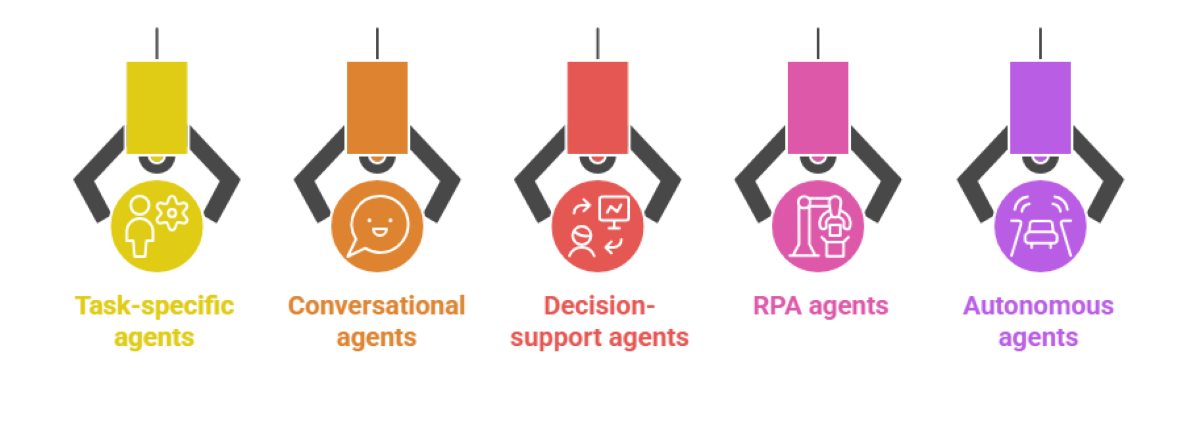
Enterprise AI agents come in several forms, each designed for specific operational needs and complexity levels.
Task-specific agents focus on specific functions, such as invoice processing, email classification, or document analysis. These agents excel at single-purpose activities where they can achieve high accuracy through specialized training. They're ideal for departments that need reliable automation for routine tasks without requiring broader decision-making capabilities.
Conversational agents handle natural language interactions for customer service, employee support, and internal communications. They understand context, maintain conversation history, and provide personalized responses. These agents can escalate complex issues to human staff while resolving straightforward inquiries independently, improving response times and user satisfaction.
Decision-support agents analyze data from multiple sources and provide recommendations for strategic choices. They process market trends, financial data, and operational metrics to suggest optimal actions. These agents don't make final decisions but present insights and options that help executives and managers make informed choices quickly.
RPA agents combine traditional automation with AI capabilities for complex workflows that require both structured processing and intelligent decision-making. They can handle exceptions, interpret unstructured data, and adapt to process variations. These agents bridge the gap between simple automation and full AI autonomy.
Autonomous agents operate independently, making decisions and taking actions across multiple systems and processes without human oversight. They can coordinate with other systems, learn from outcomes, and adjust their behavior based on changing conditions. These represent the most advanced form of enterprise AI agents.
AI agents address critical operational pain points that traditional solutions often struggle to handle effectively.
Repetitive task overload - Manual processes consume valuable human resources that could be focused on strategic initiatives, reducing overall productivity and employee satisfaction.
Slow decision-making due to data silos - Fragmented information prevents organizations from responding quickly to market changes and competitive threats.
Human error and inefficiency - Manual processes lead to costly mistakes and delays in critical business operations, negatively impacting quality and customer satisfaction.
Lack of real-time visibility across operations - Limited monitoring capabilities make it difficult to identify issues before they escalate into major problems.
Inconsistent service quality - Performance varies based on individual capabilities and availability, leading to unpredictable customer and employee experiences.

Real-world applications demonstrate how AI agents transform specific business functions across industries.
Companies like Shopify have deployed AI agents that handle over 80% of customer inquiries without human intervention. These agents understand customer intent, access order history, process returns, and escalate complex issues to human agents when necessary. The result is faster resolution times and improved customer satisfaction.
Financial institutions use AI agents to process loan applications, extracting data from various document types, verifying information against multiple databases, and flagging potential issues for human review. JPMorgan Chase's COiN (Contract Intelligence) system processes legal documents in seconds rather than the 360,000 hours previously required annually.
AI agents streamline employee onboarding by automatically creating accounts, scheduling training sessions, and ensuring compliance with company policies. In finance, they handle expense report processing, vendor payments, and budget tracking. Procurement agents negotiate with suppliers, manage contracts, and optimize purchasing decisions based on real-time market data.
UPS's ORION system utilizes AI agents to optimize delivery routes, taking into account factors such as traffic patterns, weather conditions, and package priorities. This has resulted in the company saving millions of gallons of fuel and reducing delivery times. Similar agents manage inventory levels, predict demand fluctuations, and automatically coordinate with suppliers.
General Electric uses AI agents to monitor industrial equipment, predicting failures before they occur and scheduling maintenance during optimal times. These agents analyze sensor data, historical patterns, and operational conditions to prevent costly downtime and extend equipment life.
The implementation of AI agents delivers measurable improvements across multiple dimensions of business performance.
24/7 operations with minimal errors - AI agents ensure consistent service quality regardless of time zones or human availability, maintaining high performance standards around the clock without fatigue or human limitations.
Cost savings through automation - Automated processes reduce labor costs while improving accuracy and speed, eliminating expensive human errors and allowing staff to focus on higher-value strategic activities.
Faster decision-making with real-time data - AI agents enable rapid responses to market changes and customer needs by processing information instantly and providing actionable insights without delays.
Enhanced customer and employee experience - Immediate responses and personalized interactions improve satisfaction levels, creating better relationships through consistent, tailored service that adapts to individual preferences and needs.
Scalable operations with minimal overhead - Businesses can grow without proportional increases in staff or infrastructure costs, as AI agents handle increasing workloads efficiently without additional resource requirements.
Successful AI agent deployment requires seamless integration with existing enterprise infrastructure and systems.
AI agents require seamless integration with existing enterprise infrastructure and systems to deliver maximum value and operational efficiency across all business functions.
Enterprise resource planning, customer relationship management, human resources, and business intelligence systems serve as primary data sources and action endpoints for AI agents. These integrations enable agents to access comprehensive business data and execute actions across multiple departments seamlessly.
Application programming interfaces (APIs) enable AI agents to communicate with various software platforms without requiring custom development or complex coding. This standardized approach allows for rapid deployment and ensures that agents can interact efficiently with both legacy systems and modern cloud-based applications.
Distributed computing infrastructure provides the computational power and data access necessary for complex AI operations. Cloud resources handle intensive processing, while edge computing enables real-time responses. Hybrid setups balance security requirements with performance needs for enterprise environments.
Modern AI agents connect through standardized APIs, allowing them to read data from SAP systems, update Salesforce records, trigger ServiceNow workflows, and generate reports in Tableau, all within a single automated process. This integration eliminates the data silos that previously hindered enterprise efficiency.
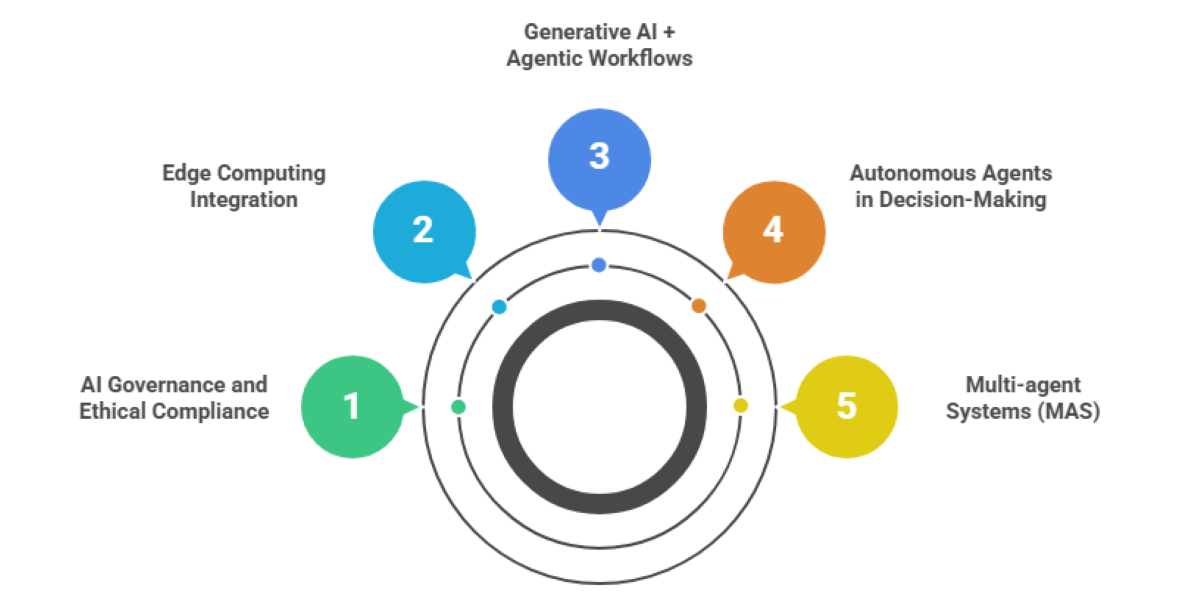
The evolution of AI agent technology continues to accelerate, with several key trends shaping the adoption of AI agents in enterprises.
Multiple AI agents collaborate on complex tasks, with each agent contributing specialized expertise to achieve common objectives. These systems enable sophisticated problem-solving, where individual agents handle specific domains while coordinating their efforts to deliver thorough solutions that exceed the capabilities of a single agent.
AI agents are increasingly handling strategic decisions previously reserved for human managers, including resource allocation, pricing strategies, and operational planning. These autonomous systems analyze complex data patterns and market conditions to make informed decisions within predefined parameters and escalation protocols.
The combination of content creation capabilities with process automation creates more sophisticated operations that can generate reports, create marketing materials, and produce documentation while simultaneously executing related business processes. This integration streamlines workflows that previously required multiple tools and human intervention.
Governance and ethical frameworks ensure the responsible deployment and operation of AI systems, including bias detection, decision transparency, and regulatory compliance. These governance structures provide oversight mechanisms that maintain ethical standards while enabling organizations to leverage AI capabilities with confidence and accountability.
Real-time processing capabilities enable AI agents to operate with minimal latency for time-sensitive applications, processing data locally rather than relying on cloud infrastructure. This integration supports manufacturing, logistics, and customer service scenarios where immediate responses are critical for operational success.
Implementing AI agents requires expertise that bridges technical capabilities with business understanding, making partner selection critical for success.
Our AI specialists design and deploy scalable solutions across various industries, utilizing advanced frameworks such as AutoGen Studio, Vertex AI Agent Builder, and CrewAI. We leverage expertise in reinforcement learning, NLP, and computer vision to create production-ready systems that drive measurable business outcomes.
We deliver custom AI models using machine learning, predictive analytics, and deep learning to boost efficiency and enhance customer engagement. Our solutions align with specific business processes and objectives rather than forcing organizations to adapt to generic tools or one-size-fits-all approaches.
Our AI agents seamlessly integrate into existing workflows, APIs, and enterprise systems, utilizing containerization for scalability and performance. We ensure connectivity across applications, databases, cloud environments, and on-premise systems, while minimizing disruptions to current operations and maximizing the value of technology investments.

{ "@context": "https://schema.org", "@type": "FAQPage", "mainEntity": [{ "@type": "Question", "name": "What are examples of AI agents in the enterprise?", "acceptedAnswer": { "@type": "Answer", "text": "Common examples include customer service chatbots that handle complex inquiries, document processing agents that extract data from invoices and contracts, and predictive maintenance agents that monitor equipment and schedule repairs. Sales teams use AI agents for lead scoring and customer outreach, while HR departments deploy them for resume screening and employee onboarding." } },{ "@type": "Question", "name": "How do AI agents differ from RPA?", "acceptedAnswer": { "@type": "Answer", "text": "Traditional RPA follows predetermined rules and scripts, while AI agents can understand context, learn from interactions, and make decisions in uncertain situations. RPA excels at repetitive tasks with structured inputs, but AI agents handle ambiguous scenarios, natural language processing, and complex decision-making that would otherwise require human intervention." } },{ "@type": "Question", "name": "Is data privacy maintained in AI agent deployments?", "acceptedAnswer": { "@type": "Answer", "text": "Yes, enterprise AI agents can be deployed with robust privacy controls, including data encryption, access controls, and compliance with regulations like GDPR and HIPAA. Many organizations deploy AI agents in private cloud or on-premises environments to maintain complete control over sensitive data while still benefiting from AI capabilities." } },{ "@type": "Question", "name": "Can AI agents work in hybrid or remote environments?", "acceptedAnswer": { "@type": "Answer", "text": "AI agents are particularly well-suited for hybrid and remote work environments since they operate independently of physical location. They can coordinate workflows across distributed teams, provide consistent support regardless of time zones, and maintain operational continuity even when human staff are unavailable." } }] }
Common examples include customer service chatbots that handle complex inquiries, document processing agents that extract data from invoices and contracts, and predictive maintenance agents that monitor equipment and schedule repairs. Sales teams use AI agents for lead scoring and customer outreach, while HR departments deploy them for resume screening and employee onboarding.
Traditional RPA follows predetermined rules and scripts, while AI agents can understand context, learn from interactions, and make decisions in uncertain situations. RPA excels at repetitive tasks with structured inputs, but AI agents handle ambiguous scenarios, natural language processing, and complex decision-making that would otherwise require human intervention.
Yes, enterprise AI agents can be deployed with robust privacy controls, including data encryption, access controls, and compliance with regulations like GDPR and HIPAA. Many organizations deploy AI agents in private cloud or on-premises environments to maintain complete control over sensitive data while still benefiting from AI capabilities.
AI agents are particularly well-suited for hybrid and remote work environments since they operate independently of physical location. They can coordinate workflows across distributed teams, provide consistent support regardless of time zones, and maintain operational continuity even when human staff are unavailable.