
Loading...
Your support team is drowning in password reset requests while high-value customers wait for responses. Every morning brings hundreds of repetitive tickets, like account lockouts, billing questions, and basic troubleshooting that consume hours your team doesn't have. The frustration builds on both sides: AI agents handle the same queries repeatedly, and customers face delays that push them toward competitors.
Here's the reality: enterprise service desks manage volumes that exceed 1,000 tickets per month, with most being routine Tier-1 requests. Traditional support models can't scale without exploding costs or sacrificing quality. AI agents tier 1 support changes this equation entirely, handling repetitive queries autonomously while your human team focuses on complex issues that actually require their expertise.
AI agents are fundamentally reshaping how B2B SaaS companies deliver customer support by automating repetitive Tier-1 tasks and dramatically improving response times. They also reduce operational costs while maintaining consistent service quality at scale without requiring proportional increases in headcount or support infrastructure investments.
AI agents instantly resolve common customer requests like password resets, account unlocks, and software access provisioning without any human intervention, eliminating wait times for straightforward issues. This autonomous resolution handles thousands of concurrent interactions, ensuring customers receive immediate assistance regardless of queue depth or time of day.
These intelligent agents operate continuously across email, live chat, Slack, Microsoft Teams, and in-app messaging channels, providing consistent support experiences regardless of time zones, holidays, or staffing constraints. Global customers receive the same quality assistance whether they reach out at 2 PM or 2 AM, eliminating the coverage gaps inherent in traditional shift-based support models.
AI agents automatically classify incoming support requests, extract relevant contextual information, and intelligently route complex issues to appropriate human specialists with complete conversation history and suggested next steps. This smart routing ensures tickets reach the right expert immediately, reducing resolution times and eliminating the frustrating experience of being transferred between multiple agents.
Instead of forcing customers to manually search through documentation, AI agents proactively retrieve precise answers from knowledge bases, product documentation, FAQ repositories, and past ticket resolutions in real-time. They synthesize information from multiple sources, presenting comprehensive yet concise responses tailored to each customer's specific situation and technical proficiency level.
By continuously analyzing interaction patterns, sentiment signals, and behavioral data, AI agents identify potential problems before they escalate into major issues, triggering proactive outreach or alerting human agents to at-risk accounts. This predictive capability transforms support from reactive firefighting into preventive customer success management, reducing churn and improving retention rates.

Tier-1 support represents the first line of technical assistance in B2B SaaS organizations, handling initial customer inquiries and resolving basic issues that don't require specialized technical expertise or deep product knowledge. This includes common requests like password resets, account provisioning, basic application troubleshooting, software access requests, billing inquiries, and initial onboarding guidance.
These support interactions typically follow predictable patterns and established resolution procedures, making them ideal candidates for automation through AI agents. Tier-1 teams manage high volumes of these repetitive tasks daily, serving as the critical entry point for all customer support interactions before escalating genuinely complex technical issues to Tier-2 or Tier-3 specialists who possess deeper product expertise.
Tier-1 support creates hidden operational costs, scalability constraints, and quality inconsistencies that directly impact profitability, customer satisfaction scores, and team efficiency. Understanding these fundamental bottlenecks reveals why intelligent automation delivers such high-leverage returns on investment for growing B2B SaaS companies.
Routine customer requests dominate support ticket queues, consuming disproportionate amounts of agent time and attention. These highly predictable tasks don't require human intelligence or creative problem-solving but still create significant backlogs during peak usage periods, degrading service quality precisely when customer expectations are highest.
Scaling traditional support operations means hiring additional agents linearly with customer growth, creating unsustainable cost structures as your user base expands. Annual turnover rates in customer support can exceed 30-40%, generating continuous recruitment expenses, extensive training investments, and institutional knowledge loss that progressively erodes service quality and operational efficiency over time.
Growing ticket volumes place enormous strain on response time commitments, making service level agreement compliance increasingly challenging to maintain without significant resource investments. Service quality varies substantially based on individual agent skill levels, fatigue, shift timing, and experience, leading to frustratingly inconsistent customer experiences that damage brand reputation and erode trust.
Support teams constantly juggle disconnected tools, like ticketing systems, CRM platforms, knowledge bases, and product analytics dashboards, requiring exhausting manual context-switching throughout their workday. Critical institutional knowledge lives scattered across Confluence documentation, Slack conversation threads, and undocumented tribal knowledge rather than in accessible, searchable systems that ensure consistent responses.
Product launches, major feature releases, market expansion initiatives, and seasonal demand spikes create unpredictable surges in support volume that traditional staffing models cannot accommodate quickly. Manual support operations can't flex capacity rapidly enough to maintain service quality, creating customer experience degradation precisely when positive impressions matter most for retention and word-of-mouth growth.
FeatureTraditional ChatbotsAI AgentsIntelligenceRule-based, scripted responsesContext-aware, reasoning-based decision makingLearning capabilityStatic, requires manual updatesContinuous learning from interactions and feedbackAction executionInformation only, cannot perform tasksAutonomous execution (password resets, account changes, API calls)Context handlingLimited to the current conversationMaintains context across sessions, integrates CRM/product dataEscalationRigid keywords trigger handoffIntelligent escalation with conversation history, sentiment analysis, and suggested solutionsIntegration depthSurface-level, typically single systemDeep integration across CRM, ticketing, knowledge bases, and product analyticsNatural languageKeyword matching struggles with variationsAdvanced NLP understands intent across diverse phrasingsWorkflow managementLinear, predetermined pathsMulti-step workflows, adapt based on user responses and dataPersonalizationGeneric responsesTailored responses based on user role, account history, and pand lan tierProblem solvingRetrieves pre-written answersReasons through problems, synthesizes information from multiple sources
Measuring AI agent performance through specific, quantifiable metrics demonstrates clear business impact and definitively justifies automation investments to stakeholders. These key performance indicators translate directly to substantial cost savings, improved customer satisfaction scores, and enhanced operational efficiency across your entire support organization.
AI agents autonomously handle 50-70% of all Tier-1 support tickets without any human intervention, dramatically reducing the workload burden on your human agent team. This fundamental metric demonstrates how many customer requests are entirely resolved through automation, freeing valuable capacity for complex issues that genuinely require human expertise, judgment, and creative problem-solving capabilities.
Customer response times drop precipitously from hours or even days to mere seconds when AI agents provide instant acknowledgment and immediate resolution attempts. Faster first response time correlates directly with measurably higher customer satisfaction scores, improved Net Promoter Scores, and significantly reduced churn rates, particularly among time-sensitive enterprise customers with strict SLA requirements.
Automating Tier-1 and Tier-2 requests can significantly reduce human ticket load, substantially lowering support operating expenses while simultaneously maintaining or even improving overall service quality levels. Calculate precise savings by comparing traditional manual resolution costs against automated resolution expenses, including infrastructure, licensing, and ongoing maintenance investments.
Consistent, accurate, 24/7 support availability across all channels and time zones drives measurable CSAT improvements. Tracking satisfaction scores, Net Promoter Scores, and customer sentiment metrics before and after AI agent implementation quantifies the tangible experience enhancement that automation delivers to your entire customer base.
Human support agents successfully resolve 2-3× more complex, high-value tickets when freed from repetitive, low-complexity query handling that consumes their time. Measure productivity improvements through metrics like tickets closed per agent daily, average handling time for escalated issues, agent utilization rates, and the proportion of time spent on strategic customer success activities.
Security and regulatory compliance aren't optional features or nice-to-have additions; they're absolutely foundational requirements for any enterprise-grade B2B SaaS AI deployment. Your AI agents handle sensitive customer data, authentication credentials, and confidential business information daily, making robust protection mechanisms essential for maintaining trust and meeting contractual obligations.
All customer interactions, conversation logs, and sensitive information must be encrypted during transmission using TLS 1.3 protocols and at rest using AES-256 encryption standards. This comprehensive encryption approach protects conversation transcripts, personally identifiable information, system credentials, and customer data from unauthorized access, interception, or breach by malicious actors, both internal and external.
AI support agents require compliance with GDPR, SOC 2, HIPAA, and ISO 27001 standards, depending on your customer base, industry vertical, and geographic markets. This includes implementing data residency controls, maintaining detailed consent management records, enforcing strict retention policies, and producing audit-ready documentation that demonstrates continuous compliance with evolving regulatory requirements.
Implement strictly enforced permission structures limiting which team members can access conversation transcripts, customer personal data, agent configuration settings, and system logs. Granular RBAC prevents unauthorized data exposure incidents, maintains clear accountability chains for compliance audits, and ensures that employees only access information necessary for their specific job functions.
Every customer query, agent response, automated action, and system modification requires timestamped, cryptographically signed, immutable logs for complete traceability and accountability. Comprehensive audit trails support regulatory compliance reviews, security incident investigations, performance analysis, and continuous improvement efforts while providing definitive evidence of proper data handling and customer consent.
AI agents must automatically identify and intelligently redact personally identifiable information like email addresses, payment card details, social security numbers, and account credentials before storage or model training. Robust PII protection prevents accidental data leakage, ensures compliance with privacy regulations, and maintains customer trust by demonstrating responsible data stewardship.
AI agents deliver tier-1 support automation across diverse B2B SaaS industries, each with unique compliance requirements, customer expectations, and support challenges. These industry-specific applications demonstrate how intelligent automation adapts to different operational contexts while delivering consistent efficiency gains.
AI agents handle account verification queries, explain transaction limits and compliance requirements, guide users through regulatory documentation, and troubleshoot payment processing issues. They maintain strict audit trails for regulatory compliance while providing instant responses to time-sensitive financial inquiries that directly impact business operations and cash flow management.
Agents assist with HIPAA-compliant access management, guide clinicians through EHR integration setup, answer billing code questions, and troubleshoot telehealth connectivity issues. They ensure patient data privacy while delivering 24/7 support for critical healthcare workflows where delays can impact patient care quality and clinical decision-making processes.
AI agents support merchants with payment gateway integration, inventory sync troubleshooting, shipping configuration questions, and order management issues. They handle high-volume seasonal support spikes during peak shopping periods without additional staffing, ensuring merchants maintain operations when revenue opportunities are greatest and customer expectations are highest.
Agents assist employees with benefits enrollment questions, payroll portal access, time-tracking issues, and performance review system navigation. They provide immediate support for time-sensitive HR processes while maintaining confidentiality and ensuring accurate information delivery across diverse organizational hierarchies and geographical locations.
AI agents help users with campaign setup questions, integration troubleshooting for third-party tools, reporting dashboard access, and contact list management issues. They support marketing teams working under tight campaign deadlines, reducing friction in workflows where delays directly impact campaign launch schedules and marketing ROI performance.
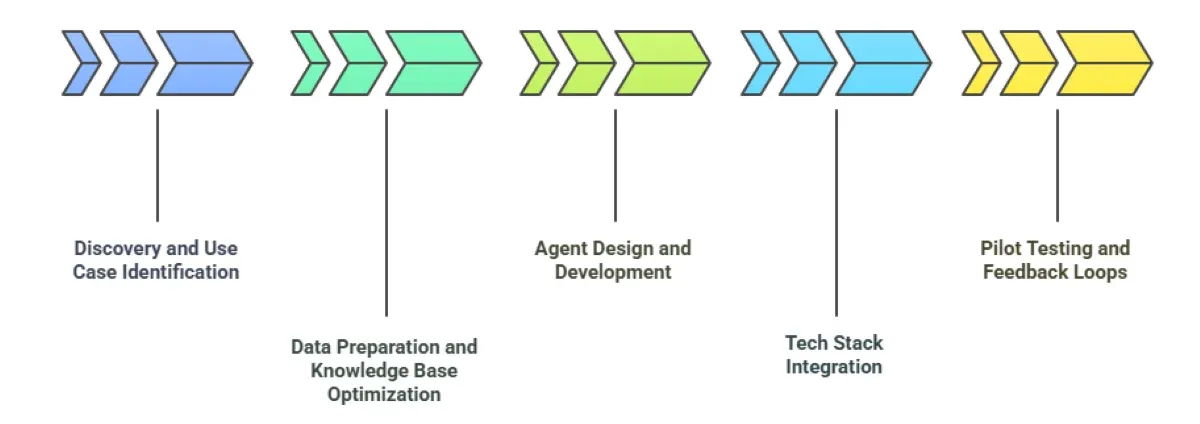
Successful AI agent deployment follows a structured, risk-mitigated approach that ensures proper system integration, delivers measurable business results, and scales effectively across your organization. This phased implementation roadmap guides you systematically from initial concept validation through full production deployment and continuous optimization.
Systematically analyze current support ticket data to identify high-volume, repetitive Tier-1 processes that are ideal candidates for automation based on frequency and predictability. Prioritize specific use cases by evaluating impact potential, implementation complexity, data availability, integration requirements, and strategic alignment with broader business objectives and customer experience goals.
Aggregate and consolidate historical ticket records, support conversation transcripts, product documentation, training materials, and CRM customer data into a unified dataset. Clean, structure, and carefully label this information while updating knowledge bases to ensure accuracy, completeness, and consistency for practical agent training and reliable real-world performance.
Build core agent capabilities using your skills library, like defining conversational flows, escalation trigger conditions, system integration points, and response templates that reflect your brand voice. Configure advanced natural language understanding models, incorporate domain-specific terminology and product knowledge, and establish guardrails that prevent inappropriate responses or unauthorized actions.
Connect AI agents securely to your existing CRM platforms, ticketing systems like Zendesk or Intercom, knowledge base repositories, and product analytics tools through authenticated APIs. Ensure seamless bidirectional data exchange, implement proper error handling for system failures, and establish workflow automation that spans multiple platforms while maintaining data consistency.
Launch initially with deliberately limited scope, like specific ticket categories or controlled user segments, while monitoring performance metrics closely through detailed dashboards. Systematically gather feedback from both support agents and customers, track satisfaction data and resolution accuracy metrics, and iteratively refine agent behavior before committing to full-scale rollout.
Evaluating AI support platforms requires carefully assessing technical capabilities, integration flexibility, security posture, and long-term scalability potential. These critical evaluation criteria separate truly enterprise-ready solutions from basic automation tools that will ultimately fail to meet your growing organizational needs.
The platform must accurately interpret customer intent across diverse phrasings, multiple languages, industry jargon, and varying levels of technical proficiency. Rigorously test NLU capabilities using real historical support queries from your actual ticket database to verify comprehension accuracy, intent classification precision, and entity extraction reliability before committing to implementation.
Pre-built, maintained connectors to major CRM platforms, ticketing systems, and collaboration tools dramatically reduce implementation time, technical complexity, and ongoing maintenance burden. Additionally, robust custom API support and webhook capabilities enable deep integration with proprietary systems, legacy applications, and unique workflows specific to your business operations.
Beyond simply answering customer questions with information, agents must perform actual tasks, like executing password resets, creating support tickets, modifying account settings, and provisioning access through secure, authenticated API calls. Verify precisely which tasks the platform can execute autonomously versus which require human intervention or approval workflows.
The platform architecture must handle thousands of concurrent customer conversations without latency degradation, scale elastically with customer growth, and maintain consistent sub-second response performance during unexpected traffic spikes. Request detailed load testing data, infrastructure redundancy information, and contractual uptime guarantees with financial penalties for service level violations.
Look for sophisticated feedback loops that systematically improve agent performance over time through interaction analysis, human agent corrections, model fine-tuning, and automated retraining. Static systems with manually updated rules become progressively outdated, requiring constant maintenance investment as your product evolves and customer needs change.
Folio3 AI specializes in building custom AI agents for B2B SaaS companies looking to automate their tier-1 support operations. Rather than offering one-size-fits-all solutions, we work with you to understand your specific support challenges and build agents that fit your existing workflows and customer needs.
We develop AI agents using platforms like AutoGen, LangChain, and CrewAI, powered by large language models such as GPT-4, Claude, and Gemini. Each agent is built around your actual support workflows, ticket patterns, and customer communication styles. This means the agent understands your product terminology, handles your specific edge cases, and responds in a way that matches your brand voice.
Before writing any code, we assess your current support operations to identify where automation will have the biggest impact. This includes analyzing your ticket data, understanding your support team's pain points, and mapping out which processes are ready for automation. The result is a practical roadmap that prioritizes quick wins while building toward more comprehensive automation over time.
Every support operation is different. Your agents need to handle specific workflows, integrate with particular systems, and respond to unique customer scenarios. We build agents that adapt to how your team actually works, whether that's handling multi-step troubleshooting, processing custom billing inquiries, or managing complex onboarding flows. The agents are designed to perform reliably under real-world load conditions.
Getting AI agents to work with your existing systems is often the hardest part. We handle integrations with your CRM, ticketing platform, knowledge bases, and other tools your support team uses daily. This includes setting up secure data connections, ensuring information flows correctly between systems, and building fail-safes so nothing breaks if a system goes down temporarily.
AI agents need ongoing attention to stay effective. As your product evolves, adds features, or changes pricing, your agents need updates. We monitor agent performance, track where responses could be better, and regularly update the training data. This includes reviewing tickets the agent handled, incorporating feedback from your support team, and adjusting response patterns based on customer satisfaction scores.
The way customers interact with your AI agent matters as much as what it can do. We design conversation flows that feel natural, know when to offer more detail versus keeping things brief, and handle the handoff to human agents smoothly. The goal is to make the experience helpful rather than frustrating, and customers should feel supported, not like they're talking to a robot.
Your AI agent gets better over time by learning from actual support interactions. We set up feedback loops where human agents can flag incorrect responses, customers can rate their experience, and the system tracks which answers successfully resolve issues. This data feeds back into the agent, improving accuracy and expanding its ability to handle more complex scenarios.

A Tier-1 support agent handles initial customer inquiries and resolves common issues like password resets, account access, billing questions, and basic troubleshooting. They serve as the first point of contact, managing high-volume requests before escalating complex problems to specialized Tier-2 or Tier-3 teams.
AI agents use natural language processing to understand customer queries, integrate with CRM and ticketing systems for context, and execute automated workflows for common tasks like password resets and access provisioning. They operate 24/7 across multiple channels and escalate complex issues to human agents with complete conversation context.
Automation significantly reduces operational costs, improves response times from hours to seconds, and provides 24/7 availability across global time zones. It frees human teams for complex problem-solving while scaling effortlessly with customer growth without proportional headcount increases.
Common automatable processes include password resets, account unlocks, software access provisioning, license management, basic troubleshooting, and billing inquiries. Any repetitive task following clear, documented resolution procedures is a strong candidate for automation.
Track metrics like ticket volume reduction, cost per ticket comparison, first response time improvements, and customer satisfaction score changes. Calculate ROI by comparing total implementation costs against quantified labor savings, efficiency gains, and churn reduction.
Start with discovery to identify high-volume use cases, prepare historical support data, design agent capabilities, and integrate with your tech stack. Then conduct pilot testing, gather feedback, refine behavior, and roll out fully while continuously monitoring performance.
AI agents connect via secure REST APIs to systems like Salesforce, Zendesk, or Intercom, enabling real-time data exchange. They read customer profiles and ticket records for context, automatically create or update tickets, and synchronize conversation logs across platforms.
Common challenges include integration complexity with legacy systems, maintaining knowledge base accuracy, and defining appropriate escalation triggers. Proper planning, phased rollout, and continuous monitoring help balance automation efficiency with maintaining the human touch that customers value.