
Loading...

Fleet operations across industries face increasing complexity as logistics demands grow and manual tracking systems struggle to keep pace. Modern fleet managers juggle between multiple software platforms daily, often spending valuable hours reconciling vehicle data instead of optimizing operations. A common question that arises is, can ALPR integrate with fleet management software to simplify these processes? Meanwhile, drivers continue filling manual logbooks while dispatchers make countless calls to locate assets, creating inefficiencies that compound across entire organizations.
The challenge extends beyond simple inconvenience. Disconnected systems create operational blind spots that directly impact profitability and customer satisfaction. According to Fortune Business Insights, the fleet management software market is projected to grow from $27.55 billion in 2024 to $116.56 billion by 2032, reflecting the urgent industry demand for integrated solutions that eliminate these operational bottlenecks while preserving existing technology investments and maintaining seamless business continuity.

Modern ALPR systems integrate seamlessly with existing fleet management platforms through standardized APIs, real-time data exchange protocols, and flexible deployment configurations. Furthermore, this integration doesn't require a complete system replacement or significant operational disruption across organizations.
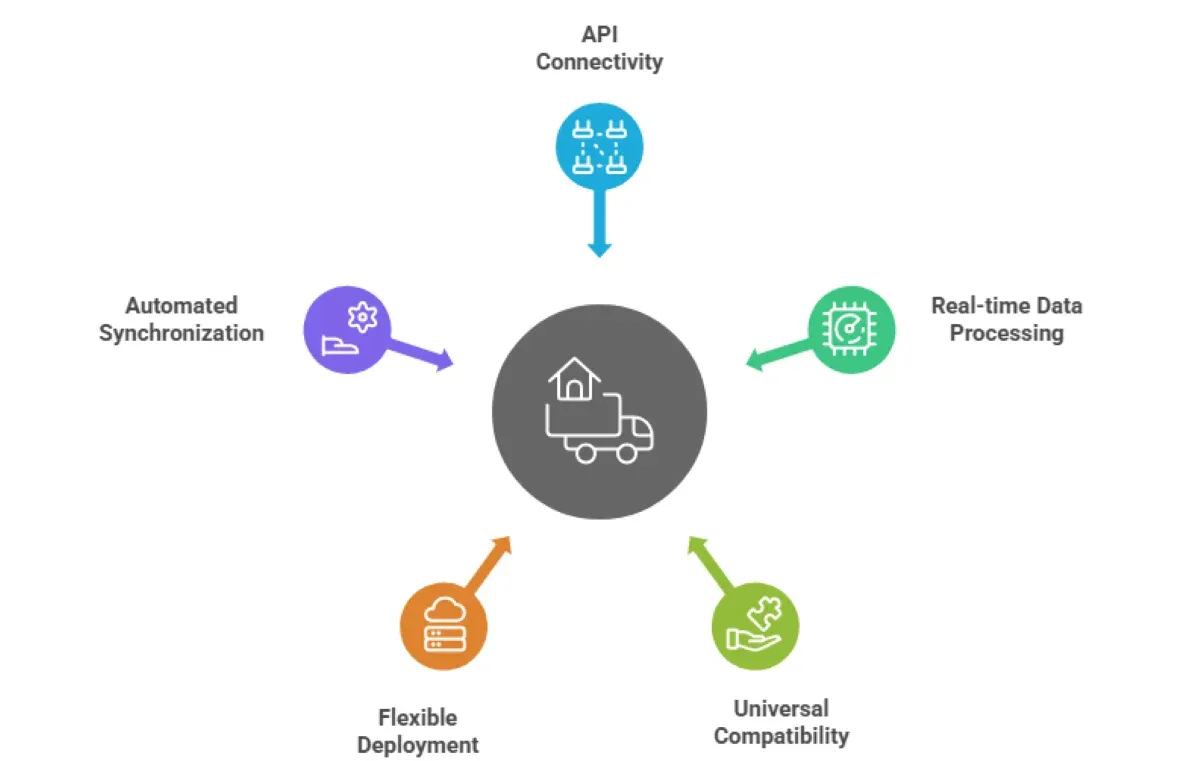
ALPR integration operates through sophisticated direct API connections that automatically synchronize comprehensive vehicle data with existing fleet management dashboards. Additionally, this approach eliminates time-consuming manual processes while maintaining consistent operational continuity and reliable system performance.
RESTful APIs and advanced webhooks enable instant bidirectional data exchange between sophisticated ALPR systems and current fleet dashboards. Moreover, this connectivity doesn't require expensive system replacement, time-consuming manual data transfers, or disruptive workflow interruptions across operations.
License plate reads become immediately available in existing management interfaces through advanced sub-second processing technology. Consequently, this delivers comprehensive vehicle data within precise moments of detection for continuous real-time operational awareness.
ALPR technology works seamlessly with major fleet systems, including Verizon Connect, GPS Insight, Samsara, Geotab, and custom-built platforms through standardized data formats. Additionally, well-established connection protocols ensure universal compatibility across different systems.
Advanced systems support cloud-based, on-premise, or hybrid configurations that perfectly match current infrastructure setups. Furthermore, these options maintain strict security requirements, operational continuity, and technical compatibility throughout the entire integration process.
Integration completely eliminates manual data entry by automatically updating vehicle logs, timestamps, and location data across all connected systems. Therefore, this reduces human intervention requirements, verification processes, and accuracy concerns for streamlined operations.
Five core technical capabilities enable seamless ALPR integration with any fleet management system. Specifically, these ensure perfect compatibility, optimal performance, and reliable functionality regardless of current platform configuration or operational requirements.
JSON, XML, and CSV outputs ensure universal compatibility with modern fleet management systems regardless of vendor specifications. Additionally, these formats support custom configurations and specific data exchange requirements for seamless communication across platforms.
REST APIs, webhooks, FTP transfers, and direct database connections provide comprehensive flexibility for different technical environments. Moreover, these methods support legacy system compatibility requirements and various operational setup configurations across diverse business environments.
Real-time updates maintain smooth operational flow without delays, system bottlenecks, or disruptions that could negatively impact daily fleet activities. Consequently, this prevents operational inefficiencies across multiple vehicle tracking systems.
The system supports operations from single-vehicle fleets to massive enterprise deployments with thousands of assets while maintaining consistent performance. Additionally, it ensures reliability and full functionality across all deployment sizes and operational requirements.
ALPR works effectively with Windows, Linux, and cloud environments through Docker containerization and standard web protocols. Therefore, it integrates seamlessly with existing IT infrastructure without requiring additional hardware investments or modifications.
Understanding complexity levels helps organizations plan appropriate resources, realistic timelines, and technical requirements for successful ALPR integration. Specifically, this planning should be based on current system architecture, operational needs, and available technical expertise within organizations.
Basic implementations are completed successfully within 2-4 weeks for standard API connections with modern fleet management systems. Moreover, these systems feature established integration capabilities, well-documented interfaces, and straightforward implementation processes without complex customization requirements.
Advanced implementations require 4-8 weeks for legacy systems needing custom middleware development, specialized data transformation layers, and compatibility bridges. Furthermore, these solutions ensure proper functionality across different platforms and systems through specialized technical approaches.
Phased rollout strategies maintain continuous business operations during setup while gradually introducing new ALPR functionality. Additionally, this approach prevents disruption to existing workflows, operational outages, or negative impacts on overall productivity levels.
Testing begins with 2-3 high-traffic locations to validate integration effectiveness before full deployment. Consequently, this reduces implementation risks and allows comprehensive system optimization based on real-world performance metrics and feedback.
Specialized translation layers bridge older systems with modern ALPR technology through custom development approaches. Therefore, these solutions preserve existing workflows while adding powerful new automation capabilities for enhanced operational efficiency and improved productivity.

Fleet integration eliminates costly operational inefficiencies that drain valuable resources and slow productivity. Specifically, it enables automated data flows instead of manual entry across multiple platforms and systems.
ALPR data automatically updates fleet dashboards, eliminates manual logbooks, and streamlines vehicle tracking across multiple locations. Some fleet management systems can achieve measurable efficiency improvements without requiring human intervention or additional staffing.
Automated data collection significantly cuts labor expenses while intelligent routing based on real-time vehicle location data reduces fuel costs. Furthermore, optimized fleet management can deliver substantial cost savings through optimized planning and route management.
License plate recognition consistently achieves 95-98% accuracy compared to manual tracking methods, virtually eliminating human error in vehicle identification. Additionally, this ensures reliable timestamp recording for dependable operations and data integrity.
Integration creates completely accurate audit trails for regulatory requirements while automatically generating comprehensive reports for DOT inspections. Moreover, safety reviews and operational assessments occur without manual documentation processes or human error.
The system provides instant updates on vehicle locations, driver activity, and fleet utilization that enable quick decision-making. Furthermore, improved customer service response times create competitive advantages in the marketplace through enhanced operational awareness.
Modern ALPR integration extends beyond basic vehicle tracking to create intelligent automation across all fleet operations. Specifically, this includes dispatch management, maintenance scheduling, compliance management, and comprehensive security monitoring systems.
Automated vehicle identification eliminates RFID scanning requirements while providing precise location data for GPS telematics and dispatch systems. Additionally, real-time accuracy enhances operational control and management through improved fleet tracking capabilities.
Integration streamlines payroll processing through automated timesheet validation and enables accurate billing calculations based on time-on-site data. Moreover, it integrates maintenance records with vehicle usage patterns for improved efficiency and cost control across business operations.
ALPR automatically triggers scale operations when vehicles approach facilities and verifies cargo manifests against expected loads. Furthermore, it generates accurate weight-based billing data for waste or freight operations with complete automation and enhanced accuracy.
The system provides completely hands-free gate entry for authorized vehicles while sending instant security alerts for unauthorized vehicles. Additionally, stolen vehicle detection prevents facility access attempts or restricted area entry through automated monitoring.
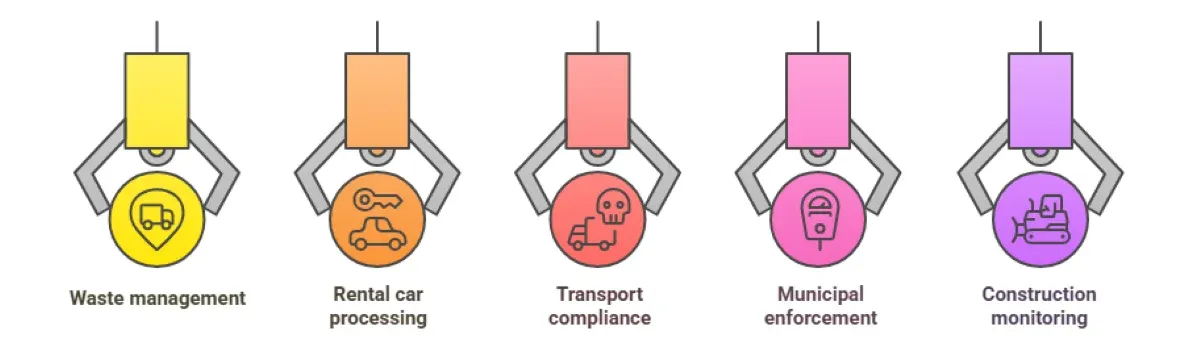
ALPR integration extends beyond basic tracking to solve unique operational challenges across specialized sectors. Each industry benefits from customized automation that addresses specific compliance requirements, operational workflows, and performance metrics tailored to its business model.
Automated route confirmation ensures trucks complete assigned collection schedules and visit required stops. Real-time verification eliminates customer complaints about missed pickups while providing managers with indisputable proof of service completion for billing accuracy.
Streamlined vehicle check-in automatically logs return times, locations, and mileage without manual intervention. Integration with billing systems enables instant processing of rental agreements, damage assessments, and automated invoicing for improved customer experience and operational efficiency.
Automated DOT compliance tracking monitors driver hours, vehicle inspections, and route adherence for regulatory requirements. Real-time alerts prevent violations while generating comprehensive audit trails that satisfy safety inspections and reduce compliance-related administrative overhead significantly.
Intelligent violation detection automatically identifies expired meters, permit violations, and restricted area breaches without manual patrol rounds. Integration with citation systems enables instant ticket generation, appeals processing, and revenue tracking for enhanced municipal enforcement efficiency.
Automated site access control tracks equipment arrivals, departures, and utilization across multiple project locations. Integration with project management systems provides real-time asset visibility, theft prevention alerts, and accurate billing records for equipment rental and project cost allocation.
Integration delivers measurable improvements across all fleet operations aspects, from reducing operational costs to improving customer satisfaction. Additionally, faster response times and enhanced accuracy in service delivery provide competitive advantages.
Automated workflows eliminate manual processes, reduce administrative overhead, and streamline vehicle management across all locations. Furthermore, systematic optimization and process automation increase operational efficiency through measurable improvements.
Operational expenses decrease in manual data entry, while fuel costs are reduced through optimized routing and theft prevention capabilities. Additionally, this maximizes resource utilization and operational efficiency for sustained cost management.
Plate recognition achieves consistent high accuracy compared to human error rates in manual tracking. Moreover, this virtually eliminates mistakes in vehicle identification and logging for reliable operations and data integrity.
Integration provides audit trail accuracy for regulatory requirements, automated DOT reporting, and instant compliance documentation. Furthermore, safety inspections and reviews occur without manual processes or documentation errors.
Response times improve through real-time vehicle visibility, accurate delivery estimates, and proactive issue resolution. Additionally, this builds customer trust and loyalty for competitive advantages in service delivery.
Even well-planned integrations face technical hurdles, but proven solutions minimize disruption and ensure successful deployment. Moreover, experienced technical support and implementation guidance address different operational environments effectively.
Older ERP systems often lack modern API support, requiring custom middleware development and specialized data transformation layers. Furthermore, these solutions bridge technology gaps and maintain functionality across different system architectures.
Existing systems frequently use incompatible data structures, resolved through real-time mapping protocols and standardization processes. Additionally, these maintain data integrity throughout the integration process and system communications.
Restricted real-time processing capabilities are addressed through edge computing deployment and data compression techniques. Moreover, these optimize bandwidth usage and enhance system performance for reliable operations and connectivity.
Workflow changes and training requirements are overcome through comprehensive education programs and gradual feature introduction. Furthermore, this builds confidence and system familiarity among operational staff and management teams.
Deployment stress is managed through phased rollout approaches that validate system performance before full-scale implementation. Additionally, this ensures successful deployment across all operational locations and user groups without operational disruption.
Technology advances rapidly, making it essential to choose integration solutions that adapt to emerging trends. Moreover, maintaining compatibility with future system upgrades and technological innovations ensures long-term value.
Advanced systems forecast maintenance needs and automatically optimize routes based on traffic patterns, weather conditions, and vehicle performance data. Furthermore, this maximizes operational efficiency and cost-effective fleet management across operations.
Integration connects ALPR with smart bins, cargo sensors, and environmental monitors to create comprehensive fleet intelligence. Additionally, this extends beyond basic vehicle tracking for enhanced operational insights and data collection.
Infrastructure readiness ensures coordination for self-driving vehicles, positioning operations ahead of transportation technology evolution. Moreover, this provides competitive advantages in the automated vehicle marketplace and future mobility solutions.
Systems continuously improve accuracy through pattern recognition that adapts to new license plate formats, vehicle types, and changing operational environments. Furthermore, sustained performance optimization and reliability ensure long-term effectiveness.
Enhanced connectivity enables faster data processing and sophisticated real-time analytics that support advanced fleet management capabilities. Additionally, instant decision-making processes provide competitive operational advantages and enhanced performance.
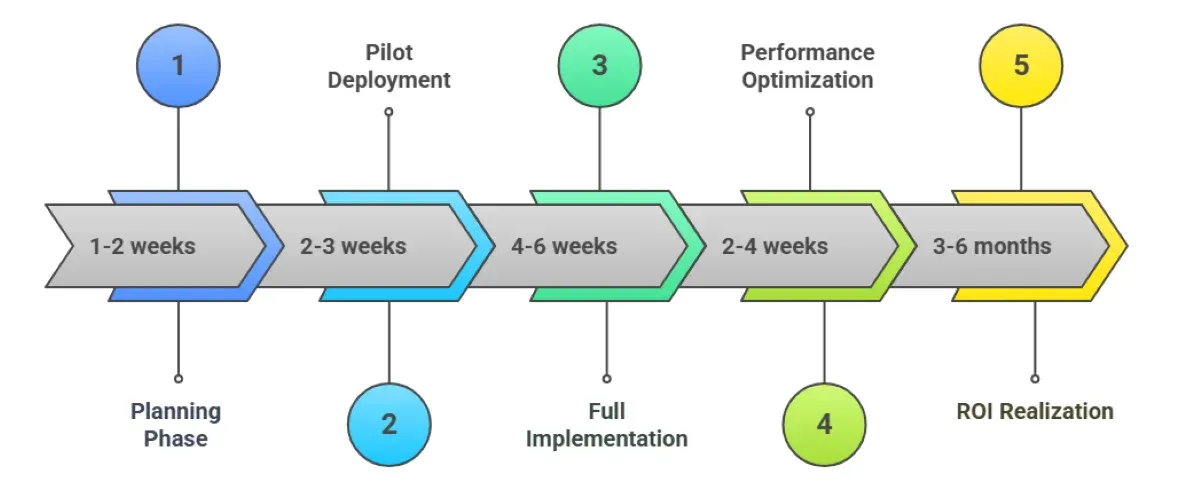
Successful ALPR integration follows structured approaches that minimize disruption while maximizing value realization. Moreover, careful planning, testing, and gradual deployment across all operational locations and business units ensure success.
Initial assessment requires 1-2 weeks for a comprehensive system assessment, API configuration, and stakeholder alignment. Furthermore, this ensures integration requirements match operational needs and technical capabilities for successful implementation and deployment.
Testing takes 2-3 weeks for initial testing, camera placement optimization, and workflow validation at selected high-traffic locations. Additionally, this occurs before full system rollout across all facilities and operational areas.
Complete deployment spans 4-6 weeks for system deployment, comprehensive staff training, and performance optimization. Moreover, this covers all operational locations and user groups throughout the organizational structure and business operations.
Fine-tuning continues for 2-4 weeks after deployment to adjust system settings, workflows, and maximize integration benefits. Additionally, this optimization is based on real-world usage patterns and operational feedback from users.
Returns typically occur within 3-6 months through measurable efficiency gains, cost reductions, and improved operational visibility. Furthermore, these justify initial investment and ongoing operational costs for sustainable business benefits.
Our ALPR technology is engineered for scalability, accuracy, and ease of integration with any type of fleet operations. Additionally, it provides comprehensive automation solutions for businesses across industries.
The system instantly recognizes and logs plates as vehicles enter or leave premises, ensuring real-time awareness and security. Furthermore, continuous monitoring capabilities provide instant alerts across all operational locations.
ALPR automatically records time of entry and exit, enabling accurate trip reports and utilization tracking without manual intervention. Moreover, this eliminates verification requirements for operational efficiency and precise record-keeping.
Fleet managers can set location boundaries and receive instant alerts if fleet vehicles go outside predefined zones. Additionally, automated monitoring systems help maintain security and operational compliance with real-time notifications.
The interface visualizes fleet activity in one place, reviews logs, gets summaries, and tracks performance over time. Furthermore, intuitive reporting interfaces provide comprehensive operational oversight and management control.
The system simultaneously tracks hundreds of vehicles across multiple locations, making it perfect for growing businesses. Additionally, scalable fleet management solutions offer centralized control capabilities and comprehensive monitoring.
Secure storage protects plate recognition data and integrates it with fleet management systems and CRMs through encrypted connections. Moreover, automated backup systems ensure reliability and data protection.

{ "@context": "https://schema.org", "@type": "FAQPage", "mainEntity": [ { "@type": "Question", "name": "Can ALPR complement my current fleet tracking software and telematics?", "acceptedAnswer": { "@type": "Answer", "text": "Yes, ALPR enhances existing telematics by adding automated vehicle identification that eliminates RFID scanning while providing precise location data for GPS systems. Integration typically takes 2-4 weeks and works with all major platforms, including Verizon Connect, Samsara, and GPS Insight." } }, { "@type": "Question", "name": "How does ALPR work with weighbridge or weigh-in systems?", "acceptedAnswer": { "@type": "Answer", "text": "ALPR automatically triggers scale operations when vehicles approach, matches vehicle IDs with expected loads, and generates weight-based billing data. This streamlines cargo manifest verification and eliminates manual vehicle identification at weigh stations." } }, { "@type": "Question", "name": "Will ALPR integration disrupt my ERP or CRM processes?", "acceptedAnswer": { "@type": "Answer", "text": "No, ALPR integration enhances ERP/CRM systems through automated data entry that reduces manual input. Vehicle data, timestamps, and utilization information feed directly into current workflows without requiring disruptive process changes." } }, { "@type": "Question", "name": "Do I need new hardware to integrate ALPR with existing systems?", "acceptedAnswer": { "@type": "Answer", "text": "No new hardware is required. ALPR works with existing IP cameras and integrates through software APIs. It uses current network infrastructure and can deploy on existing servers or cloud platforms without extra hardware investments." } }, { "@type": "Question", "name": "Can ALPR automate entry/exit logging without manual tagging?", "acceptedAnswer": { "@type": "Answer", "text": "Yes, ALPR automatically logs vehicle entry and exit times with high accuracy, eliminating manual logbooks and RFID scanning. Time-stamped data flows directly into fleet management systems for precise trip reports and utilization tracking." } }, { "@type": "Question", "name": "Is ALPR integration secure and privacy-compliant?", "acceptedAnswer": { "@type": "Answer", "text": "Yes, ALPR systems include encryption, access controls, and audit logging. They support GDPR compliance with data anonymization, secure storage, and controlled access to protect sensitive vehicle information." } }, { "@type": "Question", "name": "How quickly can ALPR data integrate into dashboards or reporting systems?", "acceptedAnswer": { "@type": "Answer", "text": "ALPR data appears in dashboards within seconds of detection through real-time API connections. It supports instant updates, automated reporting, and historical analysis without manual data transfers or delays." } }, { "@type": "Question", "name": "Can ALPR improve route compliance and reduce missed stops?", "acceptedAnswer": { "@type": "Answer", "text": "Yes, ALPR verifies route completion and confirms vehicles visited required locations. This reduces customer complaints, provides indisputable records for dispute resolution, and improves service reliability." } }, { "@type": "Question", "name": "What are the typical data outputs from an integrated ALPR system?", "acceptedAnswer": { "@type": "Answer", "text": "ALPR systems output license plate numbers, timestamps, vehicle images, location data, and vehicle characteristics such as make, model, and color. This data integrates into fleet, ERP, and CRM systems via JSON or CSV formats." } }, { "@type": "Question", "name": "How quickly is the ROI after integrating ALPR with fleet software?", "acceptedAnswer": { "@type": "Answer", "text": "ROI is usually achieved within 3-6 months thanks to efficiency gains, reduced manual data entry costs, and fuel savings from optimized routing. Most businesses recover their investment within the first year." } } ] }
Yes, ALPR enhances existing telematics by adding automated vehicle identification that eliminates RFID scanning while providing precise location data for GPS systems. Integration typically takes 2-4 weeks and works with all major platforms, including Verizon Connect, Samsara, and GPS Insight, without system replacement requirements.
ALPR automatically triggers scale operations when vehicles approach, matches vehicle IDs with expected loads, and generates weight-based billing data. The integration streamlines cargo manifest verification and eliminates manual vehicle identification at weigh stations, improving accuracy and reducing processing times significantly.
No, ALPR integration enhances existing ERP/CRM systems through automated data entry that reduces manual input significantly. The system feeds vehicle data, timestamps, and utilization information directly into your current workflows without requiring process changes or system modifications that could disrupt operations.
No new hardware is required. ALPR works with existing IP cameras and integrates through software APIs. The system uses your current network infrastructure and can deploy on existing servers or cloud platforms without additional hardware investments or infrastructure modifications.
Yes, ALPR automatically logs vehicle entry/exit times with high accuracy, eliminating manual logbooks and RFID scanning. Time-stamped data flows directly into fleet management systems for accurate trip reports and utilization tracking without human intervention or manual data entry requirements.
Yes, ALPR systems include encryption, access controls, and audit logging. The integration supports GDPR compliance through data anonymization, secure storage, and controlled access permissions that protect sensitive vehicle information while maintaining operational transparency and regulatory compliance standards.
ALPR data appears in dashboards within seconds of vehicle detection through real-time API connections. The integration supports instant updates, automated reporting, and historical data analysis without manual data transfer processes or delays in information availability for decision-making.
Yes, ALPR provides automatic verification that vehicles completed assigned routes and visited required locations. This eliminates customer complaints about missed pickups and provides indisputable records for dispute resolution while improving service reliability and customer satisfaction through accurate tracking.
ALPR systems output license plate numbers, timestamps, vehicle images, location data, and vehicle characteristics (make, model, color). This data feeds into fleet management, ERP, and CRM systems through standardized formats like JSON or CSV for seamless integration and comprehensive reporting capabilities.
ROI is typically realized within 3-6 months through operational efficiency gains, reduction in manual data entry costs, and fuel savings from optimized routing. Most businesses recover their investment within the first year of operation while achieving sustained cost savings throughout continued use.