
Loading...
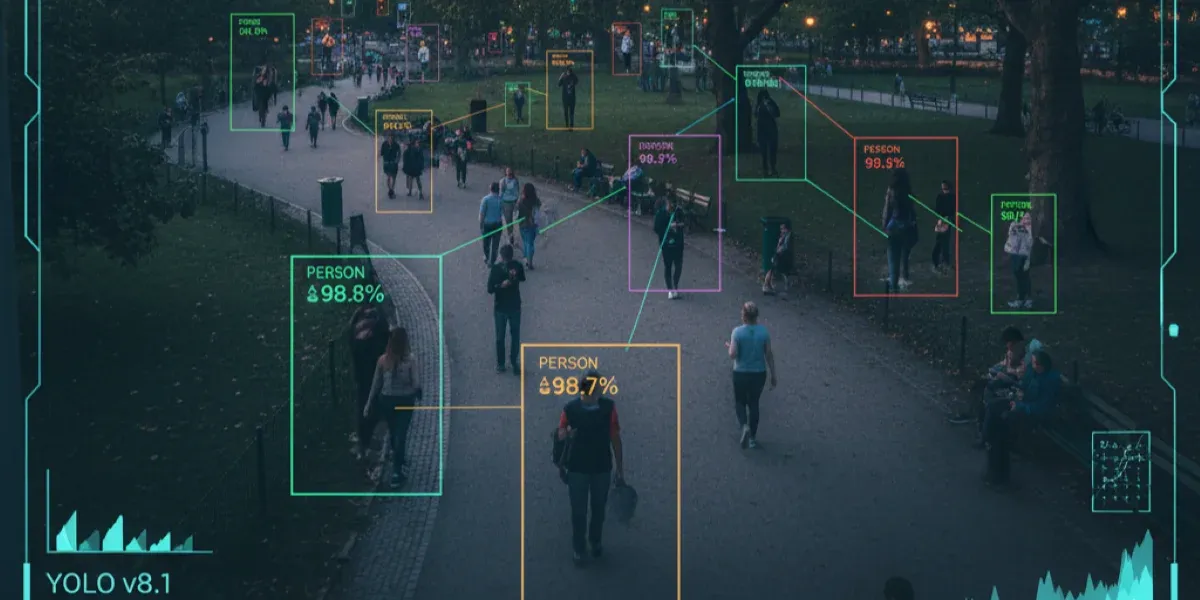
Person and object detection has become foundational to modern artificial intelligence systems, powering everything from security cameras to autonomous vehicles. This technology enables machines to identify, locate, and classify multiple objects within images or video streams in real-time.
The global computer vision market was valued at $17.84 billion in 2024 and is projected to grow to $20.75 billion in 2025, reflecting the massive adoption of person detection solutions across industries. These systems use sophisticated algorithms to draw bounding boxes around detected objects, assign confidence scores, and determine object classes, all within milliseconds.
The ability to process visual information at speeds matching or exceeding human perception has transformed industries ranging from healthcare diagnostics to retail analytics, making object detection one of the most commercially viable applications of artificial intelligence today.

YOLO stands for "You Only Look Once," a revolutionary object detection algorithm that treats detection as a single regression problem. Unlike traditional methods that scan images multiple times using sliding windows, YOLO processes the entire image in one forward pass through a neural network, simultaneously predicting bounding boxes and class probabilities.
The algorithm divides images into grid cells, with each cell responsible for detecting objects whose centers fall within it. For example, when analyzing a street scene, YOLO can instantly identify and locate pedestrians, vehicles, traffic lights, and road signs in a single evaluation, achieving detection speeds of 30-160+ frames per second depending on the model variant.
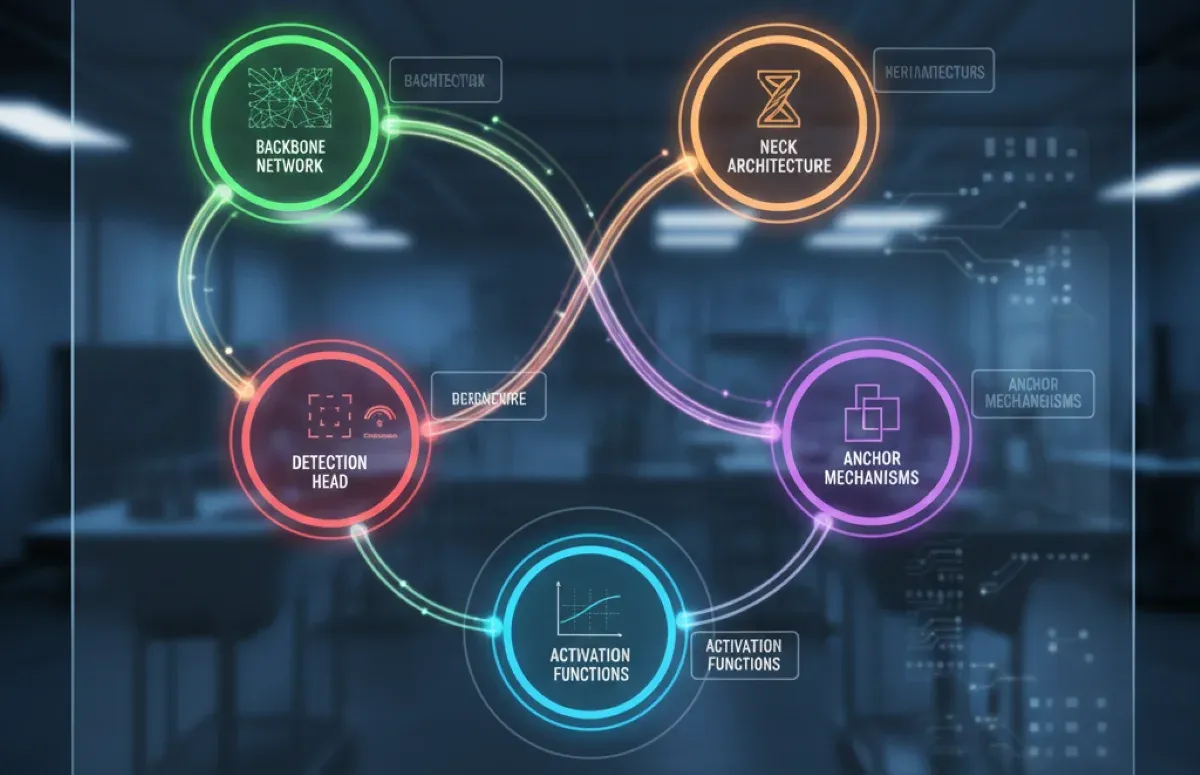
YOLO's architecture combines convolutional neural networks with intelligent design choices that balance speed and accuracy. Modern YOLO architectures consist of three main components working in harmony to achieve real-time detection performance.
The backbone extracts hierarchical features from input images using convolutional layers. Modern versions like YOLOv8 use CSPDarknet or EfficientNet backbones with residual connections, progressively downsampling images while capturing low-level edges and high-level semantic information.
The neck aggregates features from different backbone layers using techniques like Feature Pyramid Networks (FPN) or Path Aggregation Networks (PANet). This multi-scale fusion enables the detection of objects at various sizes, from small pedestrians to large vehicles.
The detection head generates final predictions including bounding box coordinates, objectness scores, and class probabilities. Decoupled heads separate classification and localization tasks, improving accuracy by allowing each branch to specialize in its specific function.
Traditional YOLO versions used predefined anchor boxes as detection templates. Modern variants like YOLOv8 and YOLO11 employ anchor-free detection, directly predicting box centers and dimensions, simplifying training and improving generalization across diverse object sizes.
YOLO architectures use activation functions like SiLU (Sigmoid Linear Unit) and Mish to introduce non-linearity. These functions help the network learn complex patterns while maintaining gradient flow during training, crucial for deep networks with 50+ layers.
VersionYearmAP (COCO)FPS (V100)ParametersKey InnovationBest ForYOLOv3201833.0%3062MMulti-scale predictionsLegacy systemsYOLOv4202043.5%6564MCSPDarknet, Mosaic augmentationGPU serversYOLOv5x202050.7%5886MPyTorch, auto-anchorGeneral purposeYOLOv7202256.8%16137ME-ELAN, trainable BoFHigh accuracyYOLOv8n202337.3%1403MAnchor-free, C2f modulesEdge devicesYOLOv8x202353.9%4868MTask-aligned assignmentProduction accuracyYOLOv9202453.1%10251MPGI, GELANDeep architecturesYOLOv10202454.4%300+29MNMS-free, end-to-endLow-latencyYOLO11n202439.5%1352.6MEnhanced C3k2, SPPFMobile deploymentYOLO11x202454.7%4556MImproved attentionHighest accuracyYOLO-NAS-S202347.5%15512MNAS-optimized, QA blocksINT8 deploymentYOLO-World202435.4%*3560MOpen-vocabularyZero-shot detection
YOLO's journey from 2015 to 2025 represents continuous architectural innovation driven by both academic research and industry demands. Each version addressed specific limitations while introducing techniques that became standard across computer vision.
The original YOLO introduced single-shot detection, treating object detection as regression. Using 24 convolutional layers inspired by GoogLeNet, it achieved 45 FPS but struggled with small objects and spatial localization, establishing the speed-accuracy paradigm that defined future development.
YOLOv2 introduced batch normalization, anchor boxes, and multi-scale training, improving mAP by 10%. YOLO9000 extended detection to 9,000 classes using joint training on COCO and ImageNet, demonstrating YOLO's scalability beyond standard object categories through hierarchical classification.
YOLOv3 adopted a Darknet-53 backbone with residual connections and multi-scale predictions at three different resolutions. Independent logistic classifiers replaced softmax, enabling multi-label detection. These changes improved small object detection while maintaining 30+ FPS, becoming the baseline for subsequent innovations.
YOLOv4 introduced CSPDarknet53 backbone, PANet neck, and numerous training improvements, including Mosaic augmentation and self-adversarial training. Optimized for parallel computation on GPUs, it achieved 43.5% mAP at 65 FPS, setting new standards for production deployments.
Ultralytics released YOLOv5 in PyTorch with five model sizes (n/s/m/l/x) for different speed-accuracy trade-offs. Auto-anchor calculation, focus layer, and extensive augmentation pipelines made training more accessible. Despite naming controversy, it became the most widely deployed YOLO variant through 2023.
YOLOR unified explicit and implicit knowledge learning through multi-task canonical representation. By combining feature alignment with prediction refinement, it demonstrated that architectural improvements could come from novel training paradigms, achieving state-of-the-art results on MS COCO with minimal inference overhead.
YOLOX decoupled classification and localization heads while introducing anchor-free detection and SimOTA label assignment. These changes simplified training dynamics and improved convergence, particularly for objects with extreme aspect ratios, influencing all subsequent YOLO architectures toward anchor-free approaches.
Meituan's YOLOv6 focused on industrial deployment with a hardware-friendly design and efficient decoupled head. Bi-directional Concatenation (BiC) and SimCSPSPPF modules reduced latency on GPUs and specialized accelerators, achieving 52.5% mAP at 500+ FPS on T4 GPUs for nano models.
YOLOv7 introduced Extended ELAN (E-ELAN) for improved gradient flow and trainable bag-of-freebies for efficient training. With compound scaling and architectural innovations from Scaled-YOLOv4, it achieved 56.8% mAP at 161 FPS, briefly holding the state-of-the-art title before YOLOv8's release.
Ultralytics' YOLOv8 marked a major architectural overhaul with C2f modules, anchor-free detection, and decoupled heads. Task-aligned assignment replaced IoU-based matching, improving training stability. Five model scales and seamless export to 10+ formats made YOLOv8 the de facto standard for new projects.
YOLOv9 introduced Programmable Gradient Information (PGI) to preserve information flow through deep networks and GELAN (Generalized Efficient Layer Aggregation Network) for better feature extraction. These innovations addressed information bottleneck problems in very deep architectures, achieving 53.1% mAP with 102 FPS.
YOLOv10 eliminated NMS post-processing through one-to-many training with one-to-one matching during inference. Spatial-channel decoupled downsampling and rank-guided block design reduced computational redundancy, achieving real-time end-to-end detection with 54.4% mAP at 300+ FPS on optimized implementations.
YOLO11 refined the YOLOv8 architecture with improved C3k2 modules and SPPF layers for better multi-scale feature fusion. Enhanced attention mechanisms and optimized training pipeline increased mAP by 2-3% over YOLOv8 while maintaining similar inference speed, representing incremental but meaningful improvements.
YOLO-World introduced open-vocabulary detection, enabling detection of arbitrary objects described in natural language without retraining. Using vision-language models and region-text contrastive learning, it bridges the gap between YOLO's speed and foundation models' flexibility, achieving 35.4% zero-shot AP.
Developed by Deci AI using Neural Architecture Search, YOLO-NAS automatically optimizes architecture for specific hardware targets. Quantization-aware blocks and attention mechanisms designed by NAS algorithms achieved superior performance on edge devices, particularly for INT8 deployment with 8-bit precision.
YOLO's detection process transforms raw images into structured object predictions through a carefully orchestrated sequence of operations. Understanding these steps reveals why YOLO achieves industry-leading speed without sacrificing accuracy.
Input images are resized to standard dimensions (typically 640x640 pixels) and normalized to values between 0 and 1. This standardization ensures consistent processing regardless of original image size, with letterboxing preserving aspect ratios to prevent distortion.
The network divides the image into an S×S grid (commonly 80×80 cells). Each grid cell predicts multiple bounding boxes and determines which objects it's responsible for detecting based on object center locations falling within its boundaries.
For each predicted box, the network outputs four coordinates (center x, center y, width, height) relative to the grid cell. These raw predictions are transformed using sigmoid and exponential functions to produce final pixel coordinates in the original image space.
Simultaneously with box regression, each detection receives class probability scores across all object categories. Modern YOLO versions use binary cross-entropy loss per class, enabling multi-label detection where objects can belong to multiple overlapping categories.
Final post-processing applies NMS to eliminate duplicate detections of the same object. Boxes with high Intersection over Union (IoU) overlap are filtered, keeping only the highest-confidence prediction per object, producing clean, non-redundant detection results.
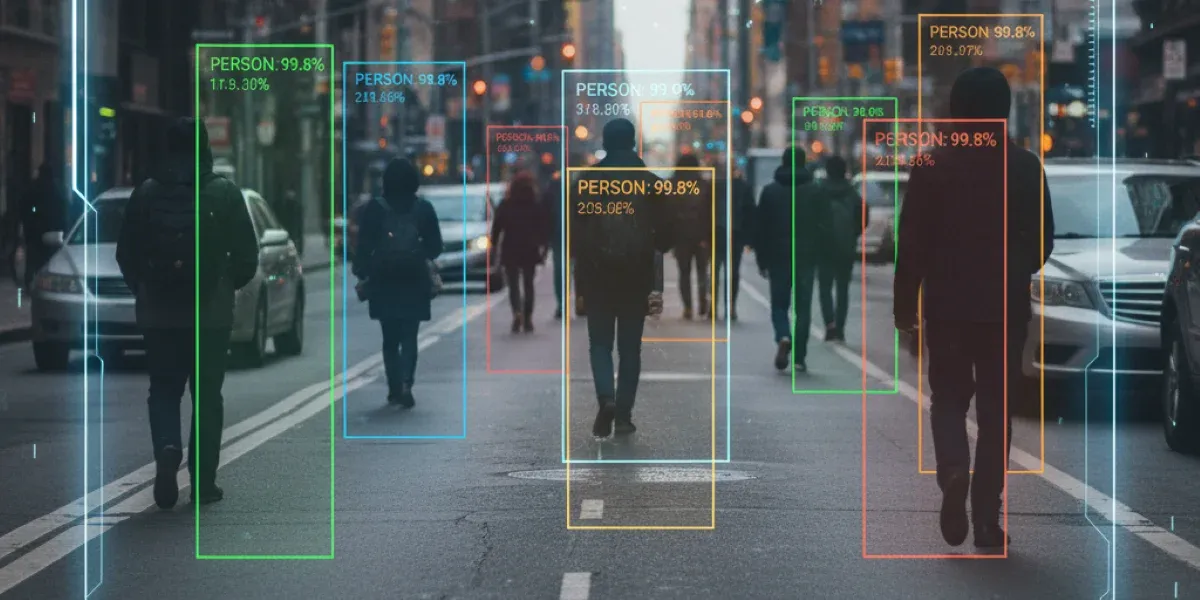
YOLO continues dominating the object detection landscape through continuous innovation and practical advantages that matter in real-world deployments. Its evolution addresses emerging challenges while maintaining the core strengths that made it industry-standard.
YOLO models achieve 30-160+ FPS on modern GPUs, with optimized versions running at 20+ FPS on edge devices. This real-time capability is essential for autonomous vehicles, robotics, and live video analytics, where latency directly impacts safety and usability.
YOLOv8 and YOLO11 achieve 50-55% mAP (mean Average Precision) on the COCO dataset while maintaining inference speeds under 10ms. This balance outperforms both faster but less accurate models and slower research-oriented detectors, making YOLO practical for production.
Ultralytics and other frameworks provide production-ready implementations with export to ONNX, TensorRT, CoreML, and TensorFlow Lite. One-line commands enable deployment across platforms from cloud servers to mobile devices, reducing engineering overhead significantly compared to research-only alternatives.
With millions of downloads and thousands of GitHub stars, YOLO benefits from extensive community contributions. Pre-trained models, tutorials, and troubleshooting resources accelerate development cycles, while continuous updates address emerging use cases and hardware platforms.
Modern YOLO versions are optimized for NPUs, edge TPUs, and specialized AI accelerators. Quantization-aware training produces INT8 models with minimal accuracy loss, enabling efficient inference on resource-constrained devices like smartphones, drones, and IoT cameras at 2-5 watts of power consumption.
YOLO's versatility and performance enable deployment across diverse industries where real-time visual understanding creates measurable business value. Modern applications leverage YOLO's efficiency to process video streams at scale.
Self-driving systems use YOLO for pedestrian detection, vehicle tracking, traffic sign recognition, and lane detection at 30+ FPS. Multi-camera setups process 360-degree surround views simultaneously, with sensor fusion combining YOLO detections with LiDAR and radar for redundant safety-critical perception.
Modern security systems deploy YOLO for intrusion detection, crowd analysis, suspicious behavior identification, and perimeter monitoring. Edge deployment on IP cameras with embedded accelerators enables privacy-preserving on-device processing, reducing bandwidth while providing instant alerting for security events.
Retailers use YOLO for customer traffic analysis, shelf inventory monitoring, checkout-free stores, and shrinkage prevention. Computer vision systems track product placement, detect out-of-stock situations, and analyze customer engagement with displays, providing actionable insights for merchandising and operations.
Manufacturing facilities deploy YOLO for defect detection, assembly verification, safety compliance monitoring, and robotic guidance. High-speed cameras with YOLO models inspect products at production line speeds, identifying defects with superhuman consistency while documenting quality metrics for process improvement.
Medical applications include surgical tool tracking, patient monitoring, wound assessment, and radiology assistance. While not replacing specialist analysis, YOLO provides rapid preliminary screening, identifies regions of interest in scans, and assists with workflow optimization in busy clinical environments.
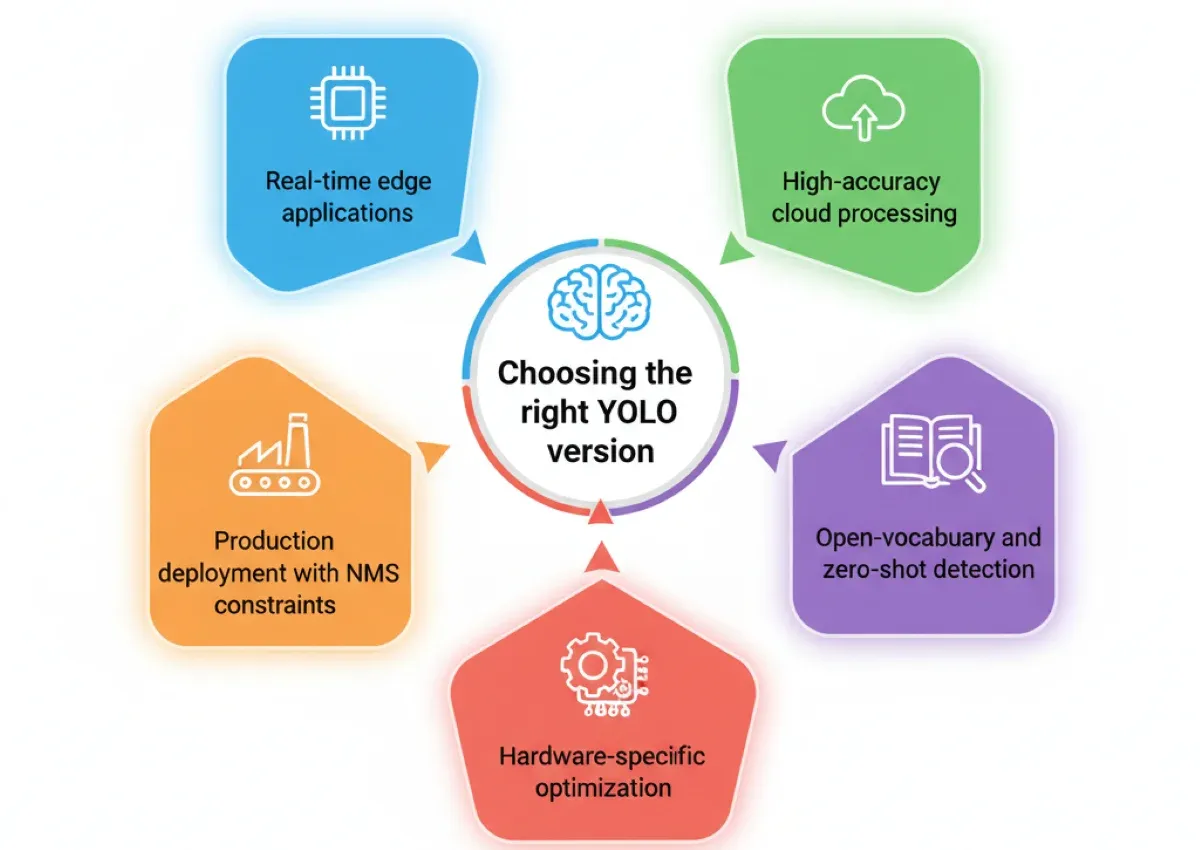
Selecting the optimal YOLO version requires balancing accuracy requirements, computational constraints, and the deployment environment. Modern YOLO variants offer distinct advantages for specific scenarios rather than universal superiority.
For resource-constrained devices like smartphones, drones, or IoT cameras, choose YOLOv8n, YOLO11n, or YOLO-NAS Small. These nano models achieve 25-38% mAP while running at 20+ FPS on mobile CPUs or NPUs, fitting within 6MB model sizes and 2-watt power budgets.
When accuracy is paramount and computational resources are available, deploy YOLOv8x, YOLOv9, or YOLO11x on server GPUs. These large models achieve 53-55% mAP on COCO, providing detection quality approaching specialized two-stage detectors while maintaining 30+ FPS throughput.
If post-processing latency is critical or the deployment environment doesn't support efficient NMS, select YOLOv10. Its end-to-end detection eliminates NMS overhead, reducing total latency by 30-40% compared to traditional YOLO variants, ideal for real-time interactive applications and robotics.
For applications requiring detection of novel objects without retraining, YOLO-World enables text-prompted detection of arbitrary categories. This flexibility suits applications like warehouse automation with constantly changing inventory, content moderation for emerging visual patterns, or research environments exploring new domains.
When targeting specific accelerators like Intel Neural Compute Stick, Google Coral Edge TPU, or NVIDIA Jetson, use YOLO-NAS or hardware-optimized YOLOv8 exports. These models include architecture modifications and quantization strategies tuned for target hardware, maximizing throughput while minimizing power consumption.
While YOLO dominates real-time detection, alternative architectures offer compelling advantages for specific use cases. Understanding these options enables informed architectural decisions based on project requirements rather than default choices.
RT-DETR applies transformer architectures to real-time detection, eliminating NMS through Hungarian matching. Achieving 53% mAP at 108 FPS, it offers competitive performance with better handling of occluded and overlapping objects, though requiring more memory than CNN-based YOLO variants.
Google's EfficientDet uses compound scaling and weighted bidirectional feature fusion, achieving state-of-the-art efficiency measured by FLOPs per accuracy point. Better suited for mobile deployment where power consumption matters more than absolute speed, EfficientDet offers 1-5 FPS advantages on battery-powered devices.
Two-stage detectors like Faster R-CNN prioritize accuracy over speed, achieving 5-10% higher mAP than YOLO at 5-10 FPS. Ideal for offline processing of high-value images where detection quality directly impacts business outcomes, such as medical imaging or satellite analysis applications.
Meta's SAM provides universal image segmentation rather than just bounding boxes, enabling pixel-precise object boundaries. While too slow for real-time use (1-3 seconds per image), SAM excels at interactive applications and creates high-quality training data for specialized YOLO fine-tuning.
DINO represents cutting-edge detection research with state-of-the-art accuracy (63.3% mAP) but limited real-time capability (3-5 FPS). Useful as a teacher model for knowledge distillation to smaller YOLO students, DINO demonstrates the accuracy ceiling achievable with sufficient computational resources.
Successful YOLO deployment extends beyond model selection to encompass data preparation, training strategies, and production optimization. Following modern best practices accelerates development while avoiding common pitfalls that degrade real-world performance.
Collect diverse training data representing deployment conditions, including lighting variations, occlusions, and edge cases. Apply the augmentation pipeline with Mosaic, MixUp, random HSV adjustments, and perspective transforms. Maintain 80/15/5 train/validation/test splits with stratified sampling, ensuring class balance.
Start with COCO-pretrained weights rather than training from scratch, reducing required training data by 5-10x. Freeze backbone layers initially, training only detection heads for 10-20 epochs before unfreezing the entire network. Use learning rate warmup and cosine annealing schedules.
Tune batch size to maximize GPU utilization (typically 16-64 depending on model size and memory). Use learning rates between 0.001-0.01 with weight decay around 0.0005. Adjust IoU thresholds (0.45-0.65) and confidence thresholds (0.25-0.4) based on precision-recall requirements.
Export trained models to ONNX or TensorRT format for 2-5x inference speedup. Apply INT8 quantization using calibration datasets, accepting 1-2% mAP loss for 3-4x speed improvement. Profile inference bottlenecks and optimize data loading pipelines to prevent GPU starvation.
Implement production monitoring, tracking inference latency, throughput, accuracy metrics, and failure cases. Establish data collection pipelines capturing edge cases and model errors for continuous retraining. Schedule monthly model updates incorporating new data, maintaining performance as the deployment environment evolves.
Folio3 AI delivers end-to-end computer vision development services tailored to your business needs. From strategy formulation to deployment and ongoing innovation, we provide comprehensive support throughout your AI transformation journey, ensuring solutions align with your objectives.
Folio3 AI collaborates closely with your team to understand strategic goals and operational challenges. We conduct thorough requirement analysis, identify optimal datasets, recommend appropriate models, and design computer vision roadmaps that deliver measurable business value and competitive advantage.
We build production-ready, scalable computer vision applications from concept to deployment. Our development process encompasses architecture design, backend infrastructure, user interface creation, testing, and deployment, ensuring robust performance and seamless user experiences across platforms.
Leveraging cutting-edge frameworks including OpenCV, TensorFlow, PyTorch, and YOLO variants, we design and optimize custom models for your specific use cases. GPU acceleration and quantization techniques ensure high-performance inference while maintaining accuracy for real-time applications.
Our team seamlessly integrates computer vision capabilities into your existing products, platforms, and workflows. We configure systems to align with business objectives, ensure compatibility with current infrastructure, and provide API endpoints for smooth data flow and operational efficiency.
Folio3 AI stays at the forefront of computer vision advancements, incorporating latest research from YOLO11, transformer-based detectors, and foundation models. We help your business maintain a competitive advantage through continuous innovation in visual recognition, object detection, and image analysis technologies.
For person detection specifically, YOLOv8 or YOLO11 offer the best balance of accuracy and speed. YOLOv8m achieves 45-48% AP on person class while maintaining 60+ FPS on modern GPUs. For edge deployment, YOLOv8n provides 38-40% person AP at 100+ FPS. Fine-tuning on person-specific datasets like CrowdHuman or WiderPerson improves performance by 5-8% over COCO pre-trained weights.
Yes, YOLO models are extensively optimized for mobile deployment. YOLOv8n and YOLO11n run at 20-30 FPS on modern smartphones using CoreML (iOS) or TensorFlow Lite (Android). On embedded boards like NVIDIA Jetson Nano or Raspberry Pi with Coral Edge TPU, optimized YOLO models achieve 15-25 FPS. INT8 quantization and model pruning further improve efficiency on resource-constrained devices.
With transfer learning from COCO pre-trained weights, 500-2,000 annotated images typically suffice for specialized applications. For novel objects not represented in COCO, 2,000-10,000 images provide robust performance. Data augmentation techniques effectively multiply the dataset size by 5-10x. Critical success factors include data diversity (lighting, angles, occlusions) rather than just quantity, with balanced class representation preventing bias.
For person detection specifically, YOLOv8 or YOLO11 offer the best balance of accuracy and speed. YOLOv8m achieves 45-48% AP on person class while maintaining 60+ FPS on modern GPUs. For edge deployment, YOLOv8n provides 38-40% person AP at 100+ FPS. Fine-tuning on person-specific datasets like CrowdHuman or WiderPerson improves performance by 5-8% over COCO pre-trained weights.
Yes, YOLO models are extensively optimized for mobile deployment. YOLOv8n and YOLO11n run at 20-30 FPS on modern smartphones using CoreML (iOS) or TensorFlow Lite (Android). On embedded boards like NVIDIA Jetson Nano or Raspberry Pi with Coral Edge TPU, optimized YOLO models achieve 15-25 FPS. INT8 quantization and model pruning further improve efficiency on resource-constrained devices.
With transfer learning from COCO pre-trained weights, 500-2,000 annotated images typically suffice for specialized applications. For novel objects not represented in COCO, 2,000-10,000 images provide robust performance. Data augmentation techniques effectively multiply the dataset size by 5-10x. Critical success factors include data diversity (lighting, angles, occlusions) rather than just quantity, with balanced class representation preventing bias.
Training YOLOv8n/s requires 8-16GB GPU memory (RTX 3060/3070), completing in 6-12 hours on custom datasets. Medium models (YOLOv8m) need 16-24GB (RTX 3090/4090), while large models (YOLOv8x) require 24-48GB (A100/H100) for batch sizes enabling stable training. CPU training is impractical, taking 50-100x longer. Cloud platforms like Google Colab, AWS EC2, or Lambda Labs provide accessible GPU access.
YOLO achieves 50-55% mAP on COCO, while human annotators score 70-75% when evaluated under the same metrics. However, this comparison is misleading—humans excel at context and common sense, while YOLO processes images consistently at superhuman speeds. For specific, narrow tasks with adequate training data, YOLO matches or exceeds human performance, particularly in repetitive scenarios where human attention degrades.
Yes, YOLO was specifically designed for multi-object real-time detection. Modern versions process 30-60 FPS on standard hardware, detecting 50-100+ objects per frame across 80 classes. Higher-end GPUs achieve 100-200 FPS for applications like autonomous driving, requiring multiple synchronized camera feeds. Performance scales with object count, image resolution, and model size, with optimization techniques maintaining real-time performance.
Traditional methods like R-CNN use two-stage detection: first generating region proposals, then classifying each region. YOLO uses single-stage detection, evaluating the entire image once through a unified network. This architectural difference provides a 10-100x speed advantage while maintaining competitive accuracy. YOLO treats detection as regression, predicting boxes and classes simultaneously rather than sequentially processing candidates.
Increase input resolution from 640 to 1280 pixels, improving small object detection by 8-12% at the cost of 4x slower inference. Use multi-scale training and test-time augmentation. Apply oversampling for small object classes in training data. Consider SAHI (Slicing Aided Hyper Inference) for very high-resolution images, dividing images into overlapping tiles. YOLOv9 and YOLO11 include architectural improvements specifically targeting small objects.
Yes, YOLO is widely deployed commercially with appropriate licensing. YOLOv5, YOLOv8, and YOLO11 use the AGPL-3.0 license, requiring open-source distribution or a commercial Ultralytics license. YOLOv3/v4/v7 use more permissive licenses, allowing commercial use without restrictions. Thousands of companies deploy YOLO in production for security, retail, manufacturing, and autonomous systems, with proven reliability and maintainability.
YOLO outputs require Non-Maximum Suppression (NMS) to eliminate duplicate detections of the same object, filtering boxes with IoU overlap above threshold (typically 0.45-0.65). Confidence thresholding removes low-confidence predictions below 0.25-0.4. Some applications apply tracking algorithms like DeepSORT or ByteTrack to maintain object identities across video frames. YOLOv10 eliminates the NMS requirement through end-to-end detection, simplifying the post-processing pipeline.