
Loading...
Vehicle sensors play an important role in both civilian and military settings, supporting applications such as highway traffic surveillance, traffic management, urban planning, smart city infrastructure, and autonomous vehicle ecosystems. Over the years, many detection methods have been developed to provide accurate traffic data, which is essential for building intelligent traffic monitoring solutions and modern transportation systems.
These detectors work by sensing the presence of a vehicle and sending a signal to a controller, such as one that operates a gate, door, or traffic signal. In safety applications, they can prevent gates or doors from closing on a vehicle once it is detected.
Modern systems now integrate with AI-powered analytics platforms, 5G networks, and edge computing infrastructure to provide real-time insights, predictive traffic management, automated incident detection, and seamless vehicle-to-everything (V2X) communication.
A key capability in advanced transportation systems is achieving reliable detection using multiple sensing technologies through sensor fusion approaches.
Vehicle detection and surveillance technologies generally consist of three main components:
Transducers – detect the presence or movement of a vehicle using advanced technologies, including LiDAR, radar, thermal imaging, and multi-spectral sensors
Signal processing devices – convert the transducer's output into digital signals with enhanced filtering, noise reduction, and real-time preprocessing capabilities
Data processing devices – analyze these signals using AI algorithms to generate comprehensive traffic parameters such as vehicle count, speed, classification, behavioral patterns, trajectory prediction, and anomaly detection
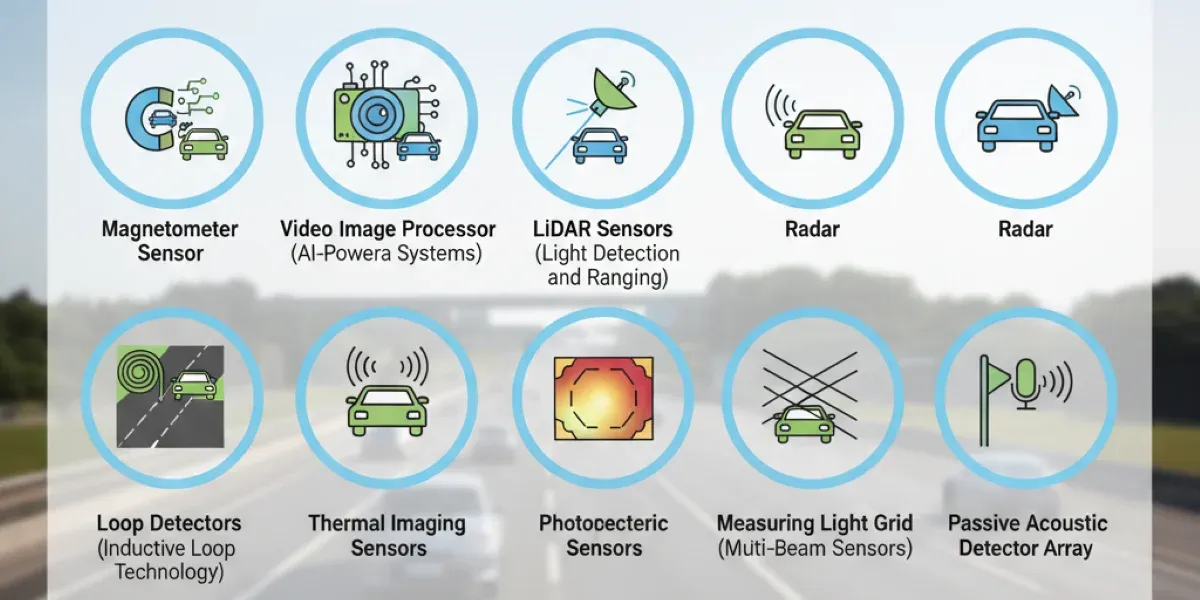
Sensor Type Detection Range Accuracy Weather Resistance Cost Best Use Cases Magnetometer 1-3 meters 90-95% Excellent Low Parking, intersection control AI Camera 50-200 meters 95-99% Good Medium-High Multi-lane monitoring, ALPR LiDAR 100-300 meters 98-99% Excellent High Intersection management, 3D mapping Radar 100-400 meters 93-97% Excellent Medium Highway monitoring, adaptive signals Ultrasonic 0.5-8 meters 95-98% Good (indoor) Low Parking guidance, access control Inductive Loop Loop size 95-98% Excellent Low-Medium Traffic signals, toll booths Thermal Imaging 50-500 meters 94-97% Excellent High All-weather monitoring, security Photoelectric 1-30 meters 97-99% Good Low Barriers, car washes, gates Light Grid Lane width 98-99% Good Medium-High Toll classification, weigh stations Acoustic Array 20-100 meters 85-92% Good Medium Urban monitoring, sensor fusion
Magnetometer sensors detect ferrous objects like trucks, cars, and trains by measuring disturbances in magnetic fields when vehicles pass through their detection zone.
Cost-Effective Deployment: Low installation and maintenance costs, all-weather operation, embedded or surface mounting options, and wireless network compatibility make them highly versatile.
Dual Detection Technology: Available in passive and active types, measuring Earth's magnetic field changes or creating localized magnetic fields for vehicle detection purposes.
Multi-Lane Monitoring Capability: Wide detection range allows monitoring of multiple traffic lanes simultaneously, making them cost-effective for large-scale traffic management deployments and operations.
AI-Powered Classification: Integration with deep learning algorithms enables vehicle type identification with up to 95% accuracy, supporting advanced traffic analytics and data collection.
Smart Parking Integration: Increasingly deployed in parking applications with real-time occupancy monitoring, mobile app connectivity, and automated payment system integration for user convenience.
AI-powered camera systems use high-definition imaging sensors with advanced computer vision algorithms to extract comprehensive traffic data from video streams in real-time.
Scalable Integration: Cloud connectivity enables multi-site management, centralized analytics, visual evidence archiving, and seamless integration with smart city platforms for comprehensive monitoring.
Advanced AI Algorithms: Utilize YOLO, vision transformers, and convolutional neural networks to achieve detection accuracy exceeding 98% for vehicles across multiple lanes simultaneously.
Multi-Application Platform: Simultaneously supports ALPR, incident detection, vehicle classification, wrong-way driver alerts, pedestrian counting, and traffic violation monitoring from a single camera unit.
Edge Processing Capability: Real-time decision-making through edge AI eliminates cloud dependency, reduces latency to milliseconds, and ensures continuous operation during connectivity issues.
Comprehensive Vehicle Analytics: Captures vehicle make, model, color, trajectory, queue length, and behavioral patterns, providing rich data for traffic studies and urban planning.
LiDAR sensors create detailed 3D environmental maps using laser pulses, measuring reflection times to determine the precise distance, shape, and position of vehicles.
Privacy-Preserving Technology: Captures spatial data without visual imagery, ensuring compliance with privacy regulations while supporting autonomous vehicle infrastructure and connected transportation systems.
Millimeter-Level Accuracy: Provides extremely precise measurements for vehicle detection, classification, and tracking with spatial accuracy unmatched by most other detection technologies available.
All-Lighting Operation: Functions effectively in complete darkness, bright sunlight, and varying lighting conditions, enabling reliable 24/7 traffic monitoring without external illumination requirements.
Advanced Classification: Distinguishes between cars, trucks, motorcycles, bicycles, and pedestrians with high confidence, even in complex multi-modal traffic scenarios and crowded environments.
3D Spatial Intelligence: Generates detailed volumetric data for intersection management, near-miss analysis, wrong-way detection, and comprehensive traffic flow modeling and prediction.
Radar sensors use millimeter-wave radio signals and FMCW technology to detect vehicles at extended ranges, unaffected by weather or environmental conditions.
Cost-Effective Scalability: Low maintenance requirements, long operational lifespan, and moderate pricing make radar ideal for large-scale deployments across extensive highway networks and corridors.
All-Weather Reliability: Performs consistently through rain, fog, snow, dust, extreme temperatures, and lighting variations, making it ideal for outdoor highway and intersection monitoring.
Extended Detection Range: Monitors traffic up to 400 meters away with simultaneous multi-target tracking capabilities, enabling early warning systems and comprehensive highway surveillance.
Stationary and Moving Detection: Identifies both moving vehicles and stopped traffic, supporting incident detection, queue management, and adaptive traffic signal control systems effectively.
V2X Communication Ready: Modern 5G-enabled radar sensors support ultra-low latency vehicle-to-everything communication, enhancing connected vehicle ecosystems and smart transportation infrastructure integration.
Ultrasonic sensors emit high-frequency sound waves to detect vehicle presence, commonly deployed in parking facilities for accurate short-range detection and occupancy monitoring.
Low-Cost Implementation: Affordable unit pricing, easy installation process, minimal maintenance needs, and reliable operation make ultrasonic sensors ideal for large parking facility deployments.
Precise Object Detection: Detects any object regardless of size, shape, or reflective properties within the detection zone, providing reliable presence confirmation for parking applications.
Smart Parking Integration: Connects with IoT platforms and mobile applications, delivering real-time occupancy data, guidance information, and payment system integration for enhanced user experience.
Wireless Deployment Options: Battery-powered models with 5-10 year lifespans eliminate wiring requirements, simplifying installation and reducing infrastructure costs for parking garage retrofits.
Indoor Environment Optimization: Performs exceptionally well in covered parking structures, garages, and indoor facilities where weather protection ensures consistent long-term operational performance.
Inductive loop detectors use electromagnetic coils embedded in pavement to sense vehicles through changes in inductance when metal objects pass overhead.
Wide Application Support: Extensively used in traffic signal control, toll collection, access gates, and vehicle counting with broad compatibility across traffic management systems.
Proven Reliability: Decades of field deployment have established loop detectors as highly dependable technology with well-defined detection zones and consistent performance characteristics.
Digital Signal Processing: Modern systems feature advanced electronics for self-diagnostics, remote monitoring, vehicle length measurement, and improved classification accuracy for different vehicle types.
Precise Detection Zone: Well-defined sensing area provides accurate vehicle positioning data, making loops ideal for traffic signal actuation and precise counting applications.
All-Weather Operation: Completely immune to weather conditions, lighting variations, and visibility issues, ensuring uninterrupted detection throughout all seasons and environmental conditions.
Thermal cameras detect infrared radiation emitted by vehicles, providing reliable all-weather detection independent of visible light or illumination conditions.
Security Applications: Ideal for perimeter monitoring, restricted area surveillance, and incident detection, where traditional cameras face limitations due to lighting or weather challenges.
Zero-Light Operation: Functions effectively in complete darkness without external lighting, detecting temperature differences between vehicles and surroundings for continuous 24/7 traffic monitoring.
Adverse Weather Performance: Operates through fog, smoke, light rain, and challenging visibility conditions where traditional cameras struggle, ensuring consistent data collection year-round.
Privacy-Preserving Detection: Captures heat signatures without identifying details, ensuring compliance with strict privacy regulations while maintaining effective traffic monitoring and analytics capabilities.
AI-Enhanced Analytics: Integration with machine learning enables vehicle classification, pedestrian detection, stopped vehicle identification, and wrong-way driver alerts with high accuracy.
Photoelectric sensors use light beams between emitters and receivers to detect vehicle presence through beam interruption or reflection mechanisms.
Cost-Effective Solution: Low equipment and installation costs combined with minimal maintenance requirements make photoelectric sensors economical for controlled environment applications.
Simple Operation: Straightforward detection principle using LED light sources provides reliable presence confirmation at defined points like toll booths, barriers, and access control gates.
Precise Detection Point: Creates clearly defined detection zones ideal for applications requiring exact vehicle position confirmation at specific locations along the travel path.
Fast Response Time: Instantaneous detection and signaling enable rapid gate operation, quick transaction processing, and minimal vehicle delay at access control and payment points.
Modern LED Technology: Enhanced range, improved reliability, and longer operational lifespan compared to older incandescent versions, with adjustable sensitivity for different applications.
Light grid systems deploy arrays of parallel light beams across lanes to capture detailed vehicle profiles for accurate classification and dimensional analysis.
Real-Time Processing: AI-powered analytics provide instant classification results, automated reporting, and integration with traffic management databases for comprehensive traffic monitoring.
High-Resolution Profiling: Dozens or hundreds of precisely arranged beams create detailed vehicle silhouettes, capturing height profiles, axle configurations, and load characteristics accurately.
Superior Classification Accuracy: Vehicle type identification exceeding 99% accuracy distinguishes passenger cars, trucks, buses, and trailers for toll classification and traffic studies.
Automated Toll Integration: Seamlessly connects with electronic toll collection platforms, weigh-in-motion systems, and automated payment processing for efficient revenue collection operations.
Multi-Standard Support: Compatible with various vehicle classification standards, including FHWA schemes, enabling consistent data collection across different jurisdictions and applications.
Acoustic arrays use sophisticated microphone networks with beamforming technology and AI-powered sound recognition to detect and classify vehicles through audio signatures.
Diverse Environment Suitability: Effective in conditions where visual detection faces challenges, supporting comprehensive traffic monitoring across tunnels, underpasses, and visually obstructed areas.
Non-Intrusive Installation: No pavement cutting or lane closures required, with sensors mounted on existing infrastructure like poles or overhead structures for quick deployment.
Beamforming Technology: Advanced signal processing focuses on specific traffic lanes while filtering background noise, enabling accurate detection in complex urban acoustic environments.
Emergency Vehicle Detection: Identifies emergency vehicles by siren signatures, enabling priority signal preemption, automated traffic clearance, and faster emergency response times.
Sensor Fusion Enhancement: Complements visual and electromagnetic sensors in multi-modal systems, providing redundancy and increased overall detection accuracy beyond single-sensor capabilities.
AI-powered vehicle detection has transformed transportation systems through advanced computer vision, deep learning, and edge computing, enabling real-time analytics, predictive management, and intelligent automation capabilities.
Convolutional neural networks, transformer models, and reinforcement learning algorithms continuously enhance detection accuracy, enabling automated vehicle classification, behavioral analysis, and adaptive system optimization.
Edge computing enables real-time decision-making directly at detection points without cloud dependency, reducing latency to milliseconds while enhancing privacy and ensuring continuous operation during connectivity issues.
5G networks support ultra-low latency communication for vehicle-to-everything (V2X) systems, enabling real-time data sharing between vehicles, infrastructure, and traffic management centers for connected mobility ecosystems.
Multi-modal systems combining cameras, radar, and LiDAR provide superior accuracy exceeding 99%, offering redundancy and comprehensive environmental awareness essential for autonomous vehicles and smart intersections.
Modern detection systems seamlessly integrate with urban platforms, supporting traffic optimization, parking management, emergency response coordination, and data-driven urban planning for sustainable intelligent cities.

Vehicle detection sensors are used to identify and monitor vehicles in various environments, including parking lots, traffic intersections, toll booths, highways, and smart transportation systems. They improve traffic flow, enhance safety, automate vehicle access control, and enable real-time data collection for analytics.
Car detection generally focuses on identifying passenger vehicles only, often in applications like parking systems or toll collection. Vehicle detection sensors have a broader scope and can detect multiple vehicle types, including trucks, buses, and motorcycles, making them ideal for traffic management, logistics, and smart city infrastructure.
Common types include inductive loop sensors, infrared sensors, ultrasonic sensors, radar sensors, magnetometer sensors, LiDAR, and video-based sensors. Each technology has unique advantages depending on detection range, accuracy requirements, and environmental conditions.
Inductive loop sensors are embedded into road surfaces and detect vehicles by sensing changes in the magnetic field when a metal object passes over them. They are widely used for traffic light control, toll collection, and entry/exit monitoring.
Smart parking management sensors, such as ultrasonic and infrared, are ideal for detecting vehicles in individual parking spaces due to their close-range accuracy. For advanced smart parking systems, camera-based and radar sensors provide real-time analytics, occupancy detection, and license plate recognition integration.
Radar Sensors: High accuracy, long-range detection, perform well in bad weather; moderate-to-high cost.
Infrared Sensors: Affordable, effective for short-range detection; performance may be affected by lighting.
Magnetometer Sensors: Cost-effective, compact, and ideal for embedded installations; slightly less accurate for object classification.
Vehicle detection sensors can feed data to AI-powered systems like Automatic License Plate Recognition (ALPR) or vehicle counting solutions. AI algorithms analyze the sensor data to provide advanced insights, detect anomalies, automate reporting, and enable predictive traffic management.
Inside cars, sensors like radar, ultrasonic, LiDAR, and cameras are used for Advanced Driver Assistance Systems (ADAS), collision avoidance, and parking assistance. Roadside infrastructure uses inductive loops, magnetometers, cameras, radar, and LiDAR for traffic control, tolling, and safety monitoring.
Radar uses radio waves for long-range detection and performs well in poor visibility conditions. LiDAR uses laser pulses for high-resolution mapping, offering precise object shape and distance measurements, but it can be affected by weather and lighting conditions.
Folio3 processes vehicle detection sensor data either on the edge or in real-time decision-making directly at the detection site, or in the cloud for large-scale analytics, storage, and integration with other smart city or transportation systems.