
Loading...

Market conditions are becoming more challenging as businesses attempt to scale. AI technologies need to be integrated for better operational efficiency. As of 2024, 72% of organizations have incorporated AI and LLM into at least one business function, significantly increasing from 55% the previous year.
Meanwhile, companies stuck with outdated systems struggle to keep up, falling behind their more innovative competitors. For CTOs, AI engineers, and product managers, staying competitive means addressing this challenge head-on.
A Generative AI Tech Stack is the foundation of any system designed to create new, innovative content, such as text, images, or music. Its core purpose is to drive creativity, automation, and efficiency—but only if it is optimized correctly.
Success requires selecting the right combination of tools, frameworks, and infrastructure. Each component must work in harmony to deliver cost-effective and high-performance results. As of January 15, 2025, understanding these foundational elements is crucial for maintaining a competitive edge in this rapidly evolving field.
Optimization is required in all businesses to improve outdated systems and make them more proficient. A well-designed tech stack enhances performance, guarantees scalability, and minimizes costs. Consider industries like healthcare, where AI is incorporated in diagnostics, or media, which automates content creation. An unoptimized system can lead to high latency, excessive costs, and poor scalability, making it more of a liability than an asset.
Let’s learn how to build and optimize a generative AI tech stack that ensures success.
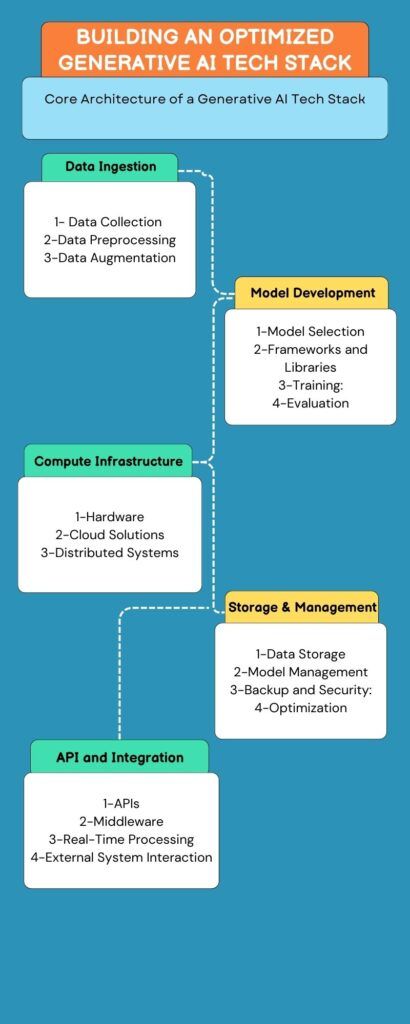
Building a robust generative AI system starts with understanding its foundational components.
Gathering and preprocessing data from various sources is the first step. It's critical to ensure the data is high-quality and diverse for training effective generative models.
This involves designing and training AI models capable of creating new content. Selecting the right algorithms and frameworks is key to achieving optimal performance.
A powerful and scalable infrastructure is necessary for training large AI models. Cloud-based solutions, GPUs, and distributed systems are commonly used to handle computational demands.
Efficient data storage and management systems ensure easy access to training data and models. Scalability and reliability are essential to handle growing datasets and model versions.
APIs facilitate the easy integration of AI models with applications, enabling real-time performance and ensuring the tech stack supports external system interaction.
The right tools can make or break your tech stack.
Cleaning: Pandas, PySpark—to refine raw datasets.
Annotation: Label Studio, Scale AI—for creating labeled datasets.
Augmentation: Albumentations (images), TextAttack (text).
Deep Learning: TensorFlow and PyTorch for building powerful neural networks.
Reinforcement Learning: Stable Baselines3 for decision-making tasks.
Experiment Tracking: MLflow to track model versions and experiments.
Model Serving: TensorFlow Serving, TorchServe for real-time inference.
Model Compression: Techniques like quantization, pruning, and distillation to improve efficiency.
Scalability ensures your system adapts to growing demands without spiraling costs.
Decoupling components allows for flexibility and easier upgrades.
Example: A modular framework can let you swap out the data processing module without affecting the entire system.
Training large models often requires splitting tasks across multiple GPUs.
Tools to consider:
Horovod: Simplifies distributed training.
Ray: Automates resource allocation for parallel tasks.
Use smaller models like GPT-NeoX and LLaMA for specific tasks.
Leverage spot instances and cloud credits to reduce costs.
Performance optimization ensures your system delivers results quickly and efficiently.
Real-time applications demand low latency for fast responses, while batch processing prioritizes throughput to handle large datasets efficiently. Adjusting configurations based on the use case ensures optimal performance for both scenarios, balancing speed and volume effectively.
Speed up the ETL process using tools like Apache Beam and Kafka, which ensure smooth data flow and reduce bottlenecks. Optimizing the pipeline helps in faster data preprocessing, which is critical for efficient model training and inference.
Techniques like LoRA and adapters focus on optimizing only specific parts of the model, reducing the resources needed during fine-tuning. This results in faster, more efficient training without compromising the model's performance.
Caching repeated inference results can drastically reduce computation time on subsequent requests. Preprocessing data before feeding it into the model also ensures quicker inference, reducing system load and improving overall response time.
At Folio3, we specialize in creating tailored, generative AI solutions that transform businesses. From data management to model deployment, our expertise ensures your tech stack is optimized for performance, scalability, and cost-efficiency.
By partnering with Folio3, you gain access to:
Industry-leading tools and frameworks.
Bespoke solutions designed for your unique needs.
Continuous support and monitoring to keep your systems running smoothly.

A generative AI tech stack is a set of technologies, tools, and processes designed to develop, train, and deploy AI models that generate new content, such as text, images, or audio.
Optimization improves performance, reduces costs, and ensures scalability, making your system efficient and ready for real-world applications.
The key components include the data layer, model development and training layer, compute infrastructure, integration and deployment layer, and monitoring and feedback layer.
Essential tools include TensorFlow, PyTorch, Apache Hadoop, Snowflake, Docker, Kubernetes, and MLflow.
Use modular design, parallel processing tools like Horovod, and cost-efficient solutions like smaller models and cloud credits.