
Loading...
Deepfakes Celeb exists in real world. Seek the greatest examples in this guide.
DeepFakes are fake versions of recordings that appear exactly like the real thing. Celeb DeepFakes utilizes machine learning solutions and computer vision technologies to draw deceptive capabilities for visual or audio content manipulation. People have been utilizing this to produce fictional, yet highly convincing photos and videos. Even audio is being deepfaked by creating “voice clones” of famous personalities. To many, this technology can be really helpful, while others have used it to wreak havoc.
The general public was made aware of the deepfake technology in 2017, when an anonymous Reddit user posted fake adult videos featuring famous celebrities like Scarlett Johansson. These were not real-life footage but celebrity faces and adult videos were combined using deepfake to make the videos appear real. Over the years the technology has picked up where the algorithm does not require ample video footage, which is only available for public figures to create fake videos.
Learn how Fraud detection solution will help out in detecting false patterns.
The creation of Face-swap videos involves a series of steps. It starts with running thousands of face shots of two people through the encoder (AI algorithm). The encoder finds similarities and differences between the two and compresses the images to combine the common features in the two faces.
Then a decoder is trained to recover the faces from the compressed images. A different decoder is used for each face. The final step involves feeding encoded images to the “wrong” decoder, for instance, feeding the images of person A to the decoder trained on person B. The decoder uses the expression and orientation of person A to reconstruct the face of person B. In order to produce a convincing video, the process needs to be repeated for each frame.
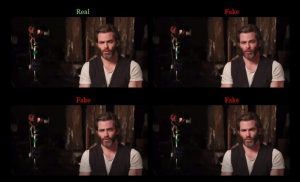
Check out this collage of Chris Pine morphing into some shape-shifting alien. LOL.
Artist Bill Posters in response to Facebook’s refusal to remove Nancy Pelosi’s video posted a fake video of Mark Zuckerberg in which he can be seen claiming to use Facebook users.
This video, Better Call Trump: Money Laundering 101 is based on a scene from Breaking Bad, whereby introducing Trump as James Gill.
A deepfake video was uploaded by Mystere Giraffe in which Will Smith’s face was plastered on Cardi’s body. It looked very real and was shared by both celebrities on their social media accounts.
How are celeb DeepFakes made for free?
People download apps like FakeApp generally and look at how-to tutorials online to train their computers to pull off face-swaps. Users in China can use easy solutions like Zao, whereas Carica is another app that creates deepfakes in a matter of seconds.
What software is used for DeepFakes?
Deep learning is a set of intelligent algorithms that can learn and make decisions on their own. DeepFake employs AI and Machine Learning as a service to create content. The method also involves training generative neural network architectures.

Connect with us for more information at Contact@folio3.ai
Celebrity deepfakes use AI and GANs to superimpose a celeb’s face or voice onto another body, creating realistic, fabricated videos, audio, and images.
Celebrities have abundant public images and high-profile visibility, making them easy targets for deepfake creators seeking attention or monetization.
Millions of deepfake videos exist online, growing exponentially each year (e.g., deepfakes increased by 550% from 2019 to 2023).
Yes, modern deepfake detectors trained on celebrity image datasets can achieve 80–95% detection accuracy, outperforming typical human detection.
Countries like the UK now prohibit sharing non-consensual celeb deepfake porn under laws like the Online Safety Act; legal gaps remain in many jurisdictions.
Reputation monitoring, digital watermarking, legal takedowns, and deploying AI detection models are key strategies for proactive protection.
Risks include non-consensual porn, fraud, identity theft, disinformation, and reputational damage—underscoring the need for detection and regulation.
Folio3.ai builds AI detection systems that analyze content, flag impersonation, and enable fast reputation response for public figures and brands.
When consent is obtained, deepfakes can support localization, visual effects, and immersive storytelling, but misuse remains a serious concern.
Early detection prevents reputational crises, fraud, and misinformation. AI surveillance helps maintain trust and brand integrity.