
Loading...

Customer service has transformed dramatically over the past decade. Businesses that once relied entirely on human agents now leverage automation to handle thousands of interactions simultaneously, reducing costs while improving response times. The challenge isn't whether to automate; it's choosing between chatbot vs. conversational AI solutions that align with your specific business needs.
Customer service teams handling 20,000 support requests per month can save more than 240 hours by using automated messaging technology, translating to cost reductions and freed-up resources for complex problem-solving. However, not all automation delivers equal results.
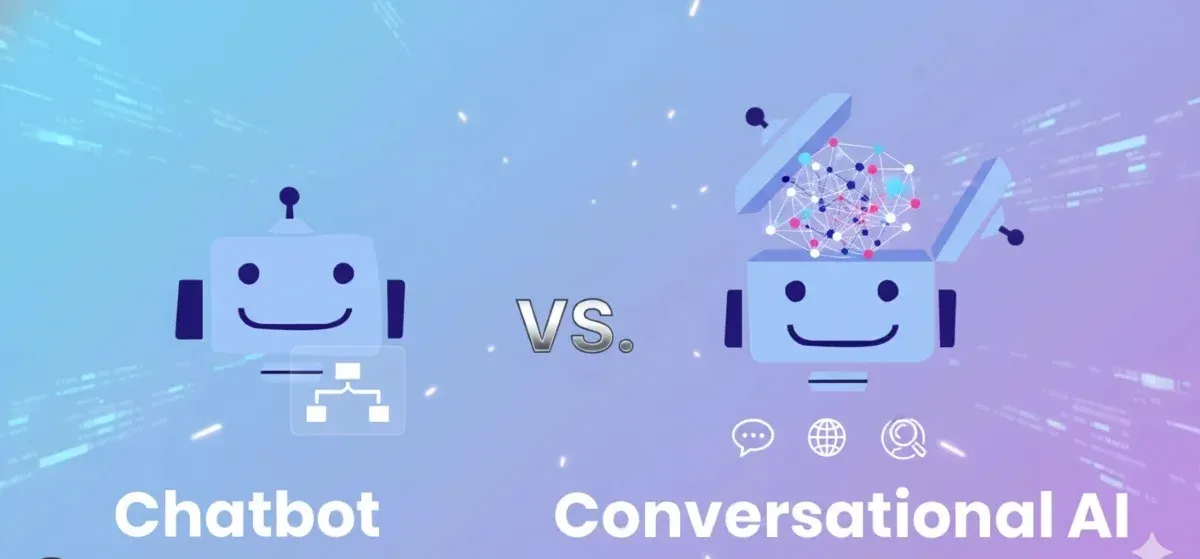
Traditional rule-based chatbots offer quick deployment and predictable responses, while conversational AI provides adaptive, context-aware interactions that learn and improve over time. Understanding these distinctions determines whether your automation strategy enhances customer satisfaction or creates frustration, directly impacting your bottom line and competitive positioning in an increasingly digital marketplace.

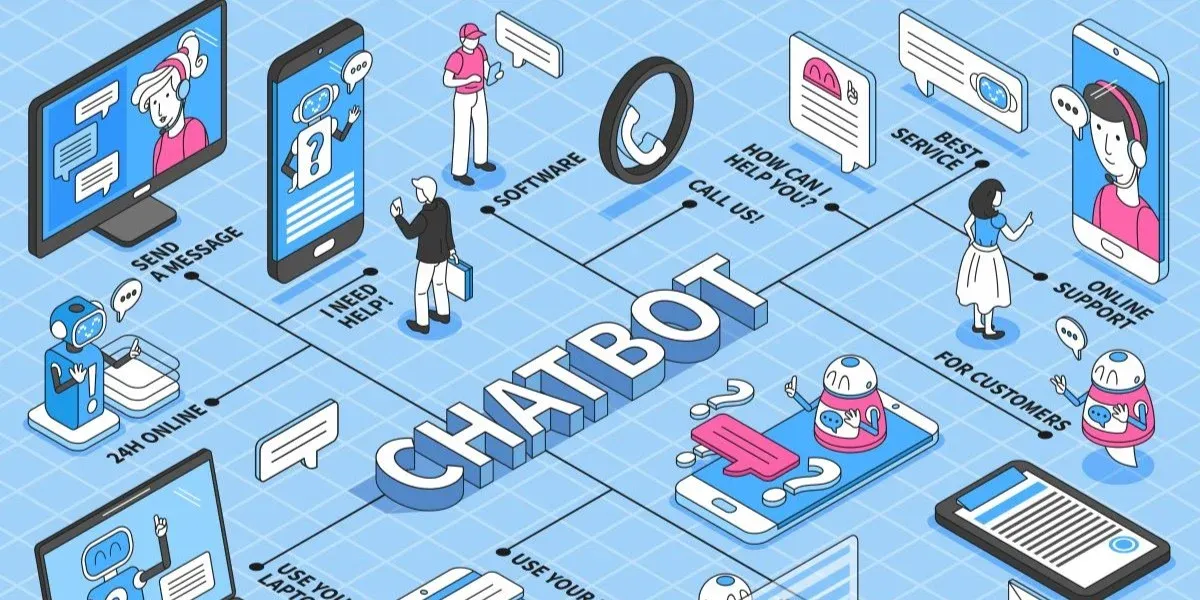
A chatbot is an automated software program designed to simulate human conversation through text or voice interfaces. These digital assistants interact with users by processing inputs and delivering pre-programmed responses, typically following scripted decision trees and "if-then" logic patterns. Traditional chatbots excel at handling repetitive, straightforward queries without requiring human intervention, making them ideal for businesses seeking cost-effective automation solutions.
The concept emerged in the 1960s with ELIZA, a computer program created at MIT that mimicked a psychotherapist's conversational patterns. Commercial adoption accelerated in the 2010s when messaging platforms like Facebook Messenger and WhatsApp opened their APIs, enabling businesses to deploy chatbots at scale. Today's chatbots range from simple FAQ responders to more sophisticated systems integrated with business databases and CRM platforms.
Traditional chatbots rely on foundational programming techniques and pattern-matching algorithms to function effectively across various customer touchpoints and business applications.
Chatbots operate using predefined decision trees where each user input triggers specific response pathways based on if-then statements, creating structured dialogues that guide users through predetermined options.
The system scans user messages for specific keywords or phrases, matching them against a comprehensive database of recognized terms to retrieve corresponding pre-written responses for common questions.
Advanced chatbots use regular expressions and sophisticated pattern-matching algorithms to identify variations in how users phrase questions while maintaining their scripted response structures without true language understanding.
Many chatbots present users with clickable options or quick-reply buttons, effectively simplifying interactions by eliminating free-text input and keeping conversations within manageable, predefined pathways for consistency.
Chatbots connect to external systems through Application Programming Interfaces, accessing databases, CRM platforms, or payment gateways to retrieve real-time information like order status or account details seamlessly.
Distinguishing between related automation technologies helps businesses make informed decisions and select the most appropriate solutions for their specific operational requirements and customer service objectives.
Traditional chatbots follow scripted rules without learning capabilities, while AI bots incorporate machine learning and natural language processing to understand context, adapt responses, and improve performance over time.
Chatbots typically handle specific business tasks like customer support or lead capture within defined boundaries, while AI assistants offer broader functionality across multiple domains through voice-activated interfaces.
Standard chatbots operate within rigid conversation flows and cannot deviate from programmed paths, whereas conversational AI employs natural language understanding, context retention, and continuous learning for dynamic conversations.

Conversational AI refers to advanced technologies that enable computers to understand, process, and respond to human language in natural, contextually appropriate ways. Unlike rule-based chatbots, these intelligent systems leverage artificial intelligence, machine learning, and natural language processing to engage in dynamic conversations that adapt based on user intent, sentiment, and historical interactions.
The foundation for conversational AI emerged in the 1950s with Alan Turing's theoretical work on machine intelligence, but practical applications materialized in the 2010s following breakthroughs in deep learning and neural networks.
Companies like Google, Amazon, and Apple pioneered consumer-facing conversational AI through virtual assistants, while enterprises adopted the technology for customer service, sales automation, and employee support. Modern conversational AI platforms now handle billions of interactions globally, continuously improving through sophisticated machine learning algorithms.
Conversational AI combines multiple sophisticated technologies to deliver human-like interactions that understand context, interpret intent, recognize emotional nuance, and continuously improve through data analysis and machine learning.
NLP enables machines to comprehend human language by breaking down sentences into components, analyzing grammar structures, and extracting meaning to process varied expressions of identical intent effectively.
NLU goes deeper than NLP by interpreting user intent and extracting entities from conversations, distinguishing subtle linguistic differences to ensure appropriate, contextually relevant responses every time.
ML algorithms analyze thousands of past interactions to identify patterns and improve response accuracy over time, learning from successful and unsuccessful exchanges without requiring explicit manual reprogramming efforts.
This component maintains conversation context across multiple exchanges, remembering previous topics and user preferences while managing turn-taking, handling interruptions, and determining optimal conversation paths based on accumulated data.
NLG creates human-like responses by constructing grammatically correct, contextually appropriate sentences rather than retrieving pre-written text, personalizing communication style based on user preferences and conversation tone naturally.
The conversational AI ecosystem includes various technologies that serve different purposes within the broader automation, each offering unique capabilities for specific business applications and customer engagement scenarios.
Conversational AI focuses on understanding and responding to user queries through sustained back-and-forth dialogue. Generative AI creates new content like text, images, or code based on prompts. While conversational systems prioritize dialogue management, generative models emphasize content creation without necessarily maintaining conversational context.
Conversational AI represents the underlying technology enabling intelligent interactions through natural language processing. Virtual assistants are specific applications that combine conversation capabilities with device control, information retrieval, and proactive task management features like scheduling and reminders.
Conversational AI handles communication and dialogue with users through natural language interfaces to understand intent. AI agents represent autonomous systems taking actions across multiple platforms, processing transactions, updating records, and executing workflows, often using conversational AI as their primary interaction interface.
Traditional chatbots prove most effective when businesses need simple automation for high-volume, repetitive interactions with predictable patterns, limited complexity, and well-defined customer service scenarios requiring quick deployment.
Businesses with well-documented, unchanging answers to common questions benefit from chatbot automation that instantly delivers store hours, return policies, shipping information, and basic product details without human intervention.
Chatbots efficiently collect contact information and basic qualification data from website visitors, guiding prospects through predefined questions about budget, timeline, and requirements before routing qualified leads systematically.
Service businesses use chatbots to automate booking processes when availability follows predictable patterns, allowing users to select from available time slots, provide contact details, and receive confirmations automatically.
E-commerce businesses deploy chatbots to retrieve order information when customers provide tracking numbers or order IDs, querying databases and returning shipping status instantly to eliminate wait times.
Companies with products requiring simple diagnostics benefit from decision-tree chatbots that guide users through step-by-step solutions using clear yes/no questions to narrow down issues and provide resolutions.
Quick deployment within 2-4 weeks using pre-built templates enables rapid automation benefits without extensive development resources or timelines.
Lower initial investment of $5,000-$25,000 makes automation accessible for small and mid-sized businesses with limited capital budgets available.
Predictable, consistent responses maintain brand messaging accuracy while businesses retain complete control over all conversation flows and customer interactions.
Cons:
Limited flexibility prevents handling unexpected queries or variations outside programmed scenarios, frustrating customers who expect adaptable, human-like assistance consistently.
No contextual understanding means each exchange exists in isolation, preventing personalized experiences that reference previous interactions.
High abandonment rates for complex issues as users quickly recognize limitations, leading to early escalation requests that defeat automation purposes.
Conversational AI becomes essential when businesses require sophisticated automation capable of handling complex queries and delivering personalized interactions. It continuously improves through machine learning while providing human-like engagement across multiple channels.
E-commerce platforms leverage conversational AI to analyze browsing history, purchase patterns, and stated preferences during dialogue. It then suggests relevant products through tailored recommendations that traditional chatbots cannot provide effectively.
Industries like financial services, healthcare, and technical support often require extended exchanges where context carries across multiple questions. Conversational AI remembers earlier conversation points to build a comprehensive understanding progressively.
Advanced systems detect frustration, satisfaction, or confusion through language patterns and adjust responses accordingly. They shift tone, offer alternatives, or escalate proactively when customers express dissatisfaction rather than continuing rigid scripts.
Global businesses use conversational AI to communicate naturally in dozens of languages while respecting cultural context. It adapts idioms, formality levels, and communication styles appropriate to different regional expectations.
Conversational AI analyzes patterns to anticipate customer needs before users even articulate them. It proactively offers help when users browse troubleshooting pages or recalls previous issues to suggest preventive solutions for returning customers.
Delivers natural, human-like interactions by understanding the intent behind varied phrasings and responding appropriately to natural language patterns effectively.
Continuously learns and improves through machine learning algorithms that analyze interactions without requiring manual reprogramming for emerging customer needs.
Handles unexpected queries gracefully by attempting reasonable responses, asking clarifying questions, or suggesting related topics while maintaining conversational flow.
Higher upfront investment of $100,000-$500,000 for enterprise solutions requires clear ROI projections and executive buy-in before deployment begins.
Longer implementation timeline of 3-6 months for comprehensive deployments may prove prohibitive for organizations needing immediate automation solutions quickly.
Requires quality training data with 500-1,000+ interactions for initial training, so companies lacking documented conversations face additional preparation time.
Selecting between chatbots and conversational AI requires a systematic evaluation of business requirements, customer interaction patterns, budget constraints, strategic objectives, and long-term scalability needs for automation success and sustainable growth.
Organizations handling under 1,000 monthly interactions typically find chatbots sufficient for their needs. When query volumes range between 1,000–5,000, complexity should be evaluated alongside volume, while exceeding 5,000 interactions justifies conversational AI investment.
Analyze conversation transcripts to categorize queries as simple (one-step responses), moderate (requiring context), or complex (multi-turn exchanges) so you can determine if 80%+ simple queries suit chatbots effectively.
Businesses needing deployment within 4 weeks with budgets under $25,000 should start with chatbots. Organizations with $100,000+ budgets and 3-6 month timelines can implement comprehensive conversational AI solutions.
Simple website deployments with minimal backend connections suit basic chatbots perfectly. However, conversational AI becomes essential when automation requires deep integration with CRMs, ERPs, payment systems, and multiple databases.
Establish clear KPIs before selection, including resolution rates, customer satisfaction scores, cost per interaction, and agent deflection targets to measure performance accurately and justify ongoing technology investments over time.
Successful automation deployment depends on carefully evaluating technical infrastructure, organizational readiness, compliance requirements, and long-term scalability needs. It also requires ensuring strategic alignment before committing to specific technologies or vendor partnerships for sustainable results.
Automation effectiveness relies on seamless connectivity with CRMs like Salesforce, helpdesk platforms, payment gateways, and proprietary databases. Businesses should evaluate API availability, data synchronization requirements, and real-time processing needs carefully.
Modern customers expect consistent experiences across websites, mobile apps, WhatsApp, Facebook Messenger, SMS, and voice channels. This requires a unified deployment that maintains conversation context when users switch channels mid-interaction.
Conversational AI performs best with well-structured content containing one topic per article, clear sections, and simple language. Before implementation, audit existing documentation for gaps, outdated information, and organizational issues.
Healthcare businesses need HIPAA compliance, European companies require GDPR adherence, and financial services must meet PCI-DSS standards. Therefore, verify that chosen platforms provide the necessary certifications and transparent privacy policies.
Define clear triggers for transferring conversations to human agents, such as complex issues, frustration, or sensitive topics. Ensure seamless context transfer to maintain a positive customer experience and satisfaction.
Combining rule-based chatbots for straightforward queries with conversational AI for complex interactions optimizes cost-efficiency and enhances customer satisfaction. This hybrid approach provides flexibility for future growth and adaptation across diverse interaction types.
Starting with chatbots for high-volume FAQs during the first few months (1–3) helps prove automation value quickly. Analyzing conversation patterns later (months 4–6) identifies which scenarios require advanced AI for data-driven deployment decisions.
Spreading investments allows businesses to deploy initial chatbots within current budgets while demonstrating measurable savings. These early wins justify subsequent conversational AI funding and help secure stakeholder support without large upfront investments.
Chatbots efficiently handle 70–80% of predictable queries, ensuring consistent performance and fast responses. Conversational AI manages the remaining 20–30% of complex interactions that demand personalization, maximizing automation coverage without unnecessary costs.
Initial chatbot deployments generate conversation transcripts that reveal real customer language patterns and intent variations. This data becomes invaluable training material for developing and refining conversational AI models later on.
Markets change, products evolve, and customer expectations shift over time. A hybrid approach allows businesses to scale AI investment as needs grow instead of committing permanently to one technology.
Understanding financial implications guides decision-makers toward automation strategies delivering optimal returns based on organization size, interaction volume, objectives, customer satisfaction goals, and long-term business growth projections.
Traditional chatbots offer accessible entry points for automation with clear cost structures, predictable savings, and straightforward implementation processes for businesses handling high volumes of repetitive, rule-based customer queries.
Typical implementation costs range $10,000-$50,000, including platform licensing ($2,000-$10,000), conversation design and development ($5,000-$25,000), and system integration ($3,000-$15,000) for straightforward deployments with standard requirements and basic functionality.
Ongoing costs average $1,200-$4,500 monthly, covering platform fees ($200-$1,000), content updates and maintenance ($500-$2,000), and continuous improvements ($500-$1,500), enabling accurate budget forecasting without unexpected usage-based charges.
Chatbots typically cost $0.10-$0.50 per interaction, depending on complexity and volume, representing a 90-95% cost reduction compared to human agents, averaging $5-$15 per conversation for successfully automated queries.
Conversational AI requires larger investments but delivers superior performance metrics, higher customer satisfaction scores, greater long-term value, and continuous improvement capabilities that compound benefits over extended implementation periods and business growth.
Enterprise conversational AI deployments cost $100,000-$500,000, including platform infrastructure ($20,000-$100,000), AI model development and training ($50,000-$200,000), data preparation ($10,000-$50,000), and integration with complex backend systems.
Operational expenses range $10,000-$35,000 monthly, covering cloud hosting and platform fees ($2,000-$10,000), machine learning model updates ($3,000-$8,000), continuous training and optimization ($2,000-$7,000), and specialized maintenance.
Conversational AI costs $0.05-$0.25 per interaction, decreasing as volume increases due to economies of scale, with organizations handling 40,000+ monthly queries achieving better per-conversation economics than traditional chatbots.
Learning from frequent pitfalls prevents costly delays, poor adoption rates, failed automation projects, and implementations that undermine stakeholder confidence, waste organizational resources, and damage customer relationships through poorly designed experiences.
Businesses sometimes invest in sophisticated conversational AI when 90% of queries need straightforward FAQ responses, wasting budget and extending timelines unnecessarily without delivering meaningful incremental value over simpler alternatives.
Launching automation without well-organized, comprehensive documentation guarantees poor performance regardless of technology sophistication, with organizations optimizing knowledge bases before implementation seeing 55% higher automation success rates and customer satisfaction.
Failing to map integration requirements thoroughly causes project delays when teams discover mid-implementation that critical systems lack APIs or require custom development, so document all necessary connections early and comprehensively.
Deploying automation without addressing GDPR, HIPAA, or industry-specific regulations creates legal exposure and necessitates expensive remediation, so involve legal and compliance teams from project inception to build proper protections.
Projects without defined KPIs and analytics frameworks cannot demonstrate value or identify improvement opportunities, so establish baseline metrics before deployment, implement comprehensive tracking, and create regular reporting cadences showing ROI.
Selecting the right technology partner significantly impacts project success, ongoing performance, long-term value realization, customer satisfaction outcomes, and the ability to scale automation capabilities as business needs evolve over time.
Evaluate partner qualifications, including AI/ML certifications, platform-specific credentials, and demonstrated experience with NLP technologies while reviewing their development methodologies, quality assurance processes, and technical team composition for complexity matching.
Verify partner experience integrating with your specific tech stack, including CRM platforms, ERP systems, helpdesk software, and proprietary databases, by requesting case studies demonstrating successful complex integrations and API development capabilities.
Partners understanding your industry's unique challenges, regulatory environment, and customer expectations deliver better outcomes by anticipating sector-specific requirements, applying proven best practices, and avoiding pitfalls that generalist vendors commonly encounter.
We build AI chatbots and agents using advanced platforms like AutoGen, LangChain, and CrewAI, powered by GPT-4, Claude, and other leading LLMs that are specifically tailored to fit your unique business needs and operational workflows.
Unlock new efficiencies with a clear AI adoption strategy by letting us assess your business operations, recommend the right agents for maximum impact, and define a comprehensive roadmap for scalable, phased implementation.
Build intelligent agents that seamlessly adapt to your existing workflows—expertly designed with flexibility, high performance, and real-time decision-making capabilities in mind to address your specific automation challenges and requirements.
Seamlessly plug AI agents into your existing tech stack while we ensure smooth data exchange, complete compatibility, and robust security across all platforms, including CRMs, ERPs, and messaging channels.
From regular updates to continuous performance tuning, we ensure your AI agents remain high-performing, accurate, and strategically aligned with your evolving business needs and changing customer expectations over time.
Craft natural, intuitive user experiences with thoughtfully designed multimodal interfaces that foster trust, encourage adoption, and create seamless interactions between your customers, employees, and AI-powered automation systems.

Traditional chatbots follow rule-based scripts using if-then logic, matching keywords to predefined responses without understanding context or intent. Conversational AI employs natural language processing and machine learning to engage in dynamic conversations that adapt based on user intent, remember previous interactions, and continuously improve through data analysis.
Choose chatbots if you handle under 5,000 monthly queries that are primarily FAQs, have budgets under $25,000, and need deployment within weeks. Select conversational AI when managing 5,000+ complex interactions requiring personalization, have $100,000+ budgets, and prioritize customer satisfaction over quick deployment.
Yes, through phased hybrid approaches that start with rule-based chatbots for high-volume FAQs, then analyze conversation patterns to identify complex scenarios requiring AI. Initial chatbot data becomes valuable training material, reducing AI development time while spreading costs across fiscal periods and building stakeholder support.
Traditional chatbots cost $10,000-$50,000 for setup with $1,200-$4,500 monthly expenses, achieving break-even within 1-4 months. Conversational AI requires $100,000-$500,000 initial investment with $10,000-$35,000 monthly costs but delivers superior performance metrics and better long-term ROI for enterprises handling 50,000+ monthly interactions.
Conversational AI achieves 75-90% resolution rates versus chatbots' 45-65%, with customer satisfaction scores reaching 4.2-4.7 out of 5 compared to 3.2-3.8. AI understands natural language variations, remembers conversation context, personalizes responses, detects sentiment, and handles unexpected queries gracefully rather than forcing rigid scripts.
Yes, conversational AI communicates naturally in dozens of languages while respecting cultural context, adapting idioms, formality levels, and communication styles appropriately. For complex queries, AI maintains context across multi-turn conversations, integrates data from multiple systems, and learns from each interaction to improve accuracy.
Enterprise conversational AI platforms provide robust security through SOC 2 Type II certification, end-to-end encryption, role-based access controls, and comprehensive audit trails. They support industry-specific compliance, including HIPAA for healthcare, GDPR for European operations, and PCI-DSS for payments, with regular security audits and penetration testing.
Conversational AI typically reaches break-even within 3-4 months for organizations handling 40,000+ monthly queries, with initial implementation taking 3-6 months. Three-year projections show conversational AI delivering $1.5-2 million additional savings versus traditional chatbots through higher resolution rates, reduced escalations, and improved customer retention.
Yes, Folio3 offers 50+ pre-built integrations with leading platforms, including Salesforce, Shopify, HubSpot, Zendesk, SAP, Oracle, and major messaging channels. Our team specializes in custom API development for proprietary systems, ensuring seamless data synchronization and unified customer experiences across all touchpoints.
Begin by conducting a comprehensive assessment of your current customer service operations, monthly query volume, interaction complexity, and existing technology stack. Book a free consultation with Folio3 AI experts to evaluate your requirements, discuss budget considerations, review ROI projections, and develop a customized implementation roadmap.