
Loading...

Since OpenAI released ChatGPT-5 on August 7, 2025, businesses worldwide have discovered practical solutions to longstanding operational challenges. Organizations implementing AI workflow automation are achieving measurable productivity improvements, with workflow automation reducing repetitive tasks by 60-95% and delivering time savings of up to 77% on routine activities. Companies now leverage ChatGPT-5 to transform business workflows, unlocking efficiency while empowering teams to focus on innovation and growth.
ChatGPT-5's unified architecture and advanced reasoning capabilities offer practical solutions to streamline operations without sacrificing human oversight. This isn't about replacing teams, it's about freeing employees to focus on growth, innovation, and customer relationships that drive real business value.

ChatGPT-5 delivers eight transformative capabilities that are already changing how businesses operate through intelligent automation, advanced reasoning, and seamless integration with existing enterprise tools and workflows.
Unlike previous versions requiring manual model selection, ChatGPT-5 operates as a unified system with an intelligent router that automatically selects optimal approaches for different tasks. The system includes GPT-5-main for fast responses, GPT-5-thinking for complex problems, and lightweight variants, all coordinated by a real-time router trained on user preferences and response quality metrics.
ChatGPT-5's integrated reasoning capabilities analyze complex problems step-by-step when beneficial, delivering more accurate solutions for strategic planning, financial analysis, and critical business decisions. The model achieved 94.6% accuracy on AIME 2025 mathematics and 74.9% on SWE-bench Verified coding tasks, demonstrating reliable performance for technical applications.
Rather than binary refuse-or-comply responses, ChatGPT-5 introduces "safe completions" that provide helpful guidance within clear safety boundaries. This feature enables productive responses to complex business matters while maintaining appropriate boundaries around confidential information, ensuring compliance, and protecting sensitive data during automated interactions.
ChatGPT-5 maintains context across conversations, remembering business preferences, ongoing projects, communication style, and specific requirements. This eliminates repetitive explanations and creates personalized, consistent AI assistance over time, crucial for ongoing business relationships and project continuity.
The model provides extensive integration options with CRM systems, project management tools, and enterprise software through flexible APIs and application connectors. Gmail, Calendar, and Google Contacts integration automates scheduling, sends follow-ups, and manages appointments while maintaining professional communication standards.
OpenAI reports that ChatGPT-5 responses are approximately 45% less likely to contain factual errors compared to GPT-4o, with reasoning mode reducing errors by up to 80% compared to previous models. This improvement builds trust in AI-generated business content and reduces fact-checking overhead.
ChatGPT-5 processes text, images, charts, diagrams, and video frames simultaneously, enabling comprehensive project reviews and faster collaboration while reducing back-and-forth communication between team members and departments.
The model processes entire business proposals, legal documents, and project specifications without losing context, supporting up to 256K tokens in API implementations, enabling thorough analysis of lengthy materials that previously required manual summarization.
The transition from GPT-3, GPT-4 to ChatGPT-5 delivers quantifiable improvements that directly impact business operations and decision-making confidence.
ModelRelease DateParametersContext WindowMath (AIME 2025)Coding (SWE-bench)Pricing (Input/Output per 1M tokens)Key CapabilitiesGPT-5Aug 2025~1T+ (estimated)400K API / 128K Chat94.6% (100% with tools)74.9%$1.25/$10Unified routing, 45% fewer errors, multimodalGPT-4.5Mar 2025~1.8T+ (estimated)128K tokens~85% (estimated)~65% (estimated)$15/$60Enhanced reasoning, better EQ, reduced hallucinationsGPT-4oMay 2024~1.8T (estimated)128K tokens74.4%30.8%$2.50/$10Multimodal, faster processing, vision capabilitiesGPT-4 TurboNov 2023~1.8T128K tokens52.9%26.7%$10/$30Extended context, knowledge to April 2023GPT-4Mar 2023~1.8T8K/32K tokens42.5%17.1%$30/$60First multimodal GPT, breakthrough reasoningGPT-3.5 TurboNov 2022175B16K tokens23.5%11.0%$0.50/$1.50Chat-optimized, cost-effectiveGPT-3Jun 2020175B4K tokens12.0%3.2%DeprecatedFoundation model, text-only
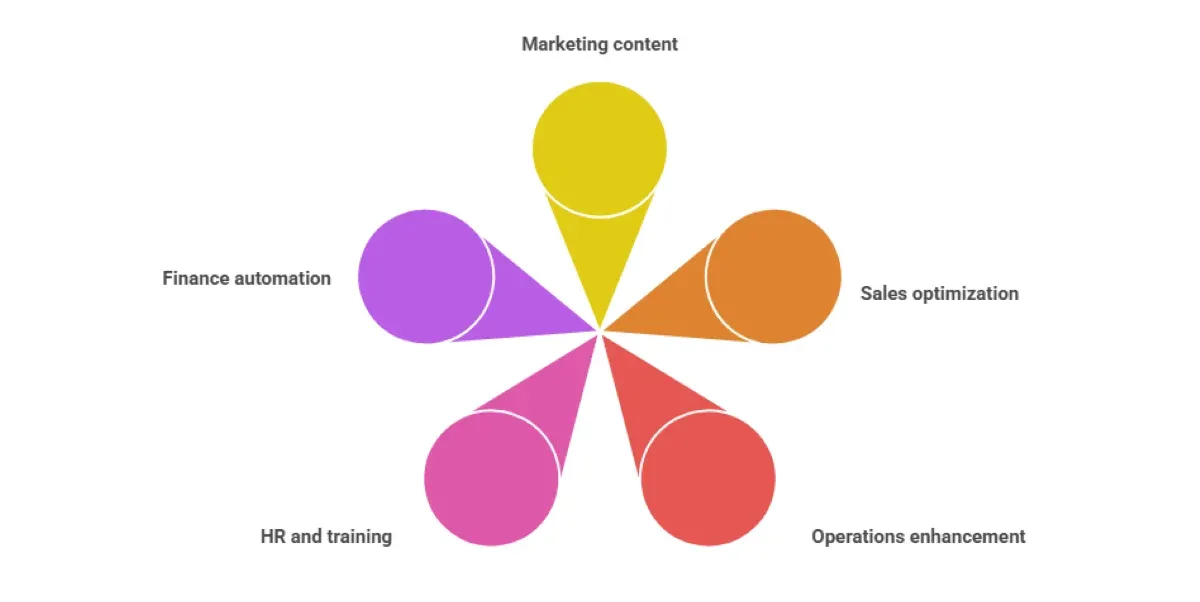
Strategic implementation across key business functions is already delivering measurable value while building organizational confidence in AI-assisted workflows.
Organizations automate content calendar planning, generate campaign variations for A/B testing, maintain brand voice consistency across channels, create social media posts, and develop email sequences while preserving creative oversight and strategic direction.
Teams streamline lead qualification processes, create personalized outreach templates based on prospect data, generate real-time objection responses, automate follow-up sequences, and develop customer onboarding materials that enhance relationship building and conversion rates.
Companies automate routine reporting generation, analyze performance trends across departments, generate actionable insights from complex datasets, create executive dashboards, and maintain operational documentation without manual data manipulation or extensive analysis overhead.
HR departments streamline employee onboarding processes, create interactive training modules, develop policy Q&A systems, automate recruitment communications, and maintain compliance documentation while improving employee experience and reducing administrative burden.
Finance teams automate expense report analysis, generate budget variance reports, maintain regulatory documentation, create financial summaries, and ensure compliance monitoring while maintaining accuracy standards and comprehensive audit trails.
Understanding investment costs versus measurable returns helps justify ChatGPT-5 implementation decisions while setting realistic expectations for productivity improvements.
Free Tier: 10 messages every 5 hours with basic GPT-5 access
ChatGPT Plus: $20 monthly for extended limits and priority access
ChatGPT Pro: $200 monthly for unlimited access and advanced features
Enterprise/Team Plans: Custom pricing for organizational deployment
Small businesses see immediate returns from basic automation tasks, while enterprises benefit from scaled implementations across departments. Each pricing tier accommodates different operational scales and budget requirements, with ROI varying based on implementation scope and organizational readiness.
Track hours saved on routine tasks, calculate salary cost reductions from automated processes, measure error rate improvements, and monitor project completion speeds to demonstrate tangible financial returns and justify ongoing investment in AI workflow automation.
Current implementations show each employee saving 2-4 hours weekly on routine tasks. At average knowledge worker salaries, this generates $5,200-10,400 annual value per employee, easily justifying subscription costs while providing measurable productivity improvements.
Organizations across industries are documenting measurable results from ChatGPT-5 deployment, providing concrete evidence of practical applications and quantifiable business value.
A regional healthcare network automated appointment reminders, pre-visit instructions, and follow-up care communications, leading to improved patient satisfaction scores and reduced administrative staff workload by approximately 30%.
A large manufacturer reduced weekly departmental reporting time from 16 hours to 6 hours per department using ChatGPT-5 assistance across production, quality control, and logistics teams, freeing staff for analysis and strategic planning.
Software companies automated personalized onboarding sequences and FAQ responses, with early adopters reporting improved new customer activation rates from baseline levels to enhanced performance within implementation periods.
Financial institutions streamlined client communication, automated routine correspondence, and enhanced customer service response quality while maintaining compliance requirements and regulatory standards.
Structured adoption planning minimizes business disruption while maximizing value demonstration and ensuring successful deployment across organizational departments.
Evaluate current workflow inefficiencies, assess team technical comfort levels, review existing tool integrations, and identify high-impact use cases before beginning deployment to ensure successful adoption and optimal resource allocation.
Start with one department, select specific measurable use cases, establish clear success metrics, gather comprehensive user feedback, and expand gradually based on demonstrated results and lessons learned during initial implementation phases.
Provide hands-on training sessions, create internal best practice guides, establish clear usage guidelines, and define boundaries between AI assistance and human judgment for optimal results while ensuring user confidence and proper utilization.
Establish data handling protocols, review privacy policies, implement access controls, ensure regulatory compliance, and create audit trails for responsible AI usage across the organization while maintaining security standards.
Tracking appropriate metrics and establishing measurement frameworks helps optimize AI usage patterns while demonstrating concrete business value to stakeholders.
Monitor hours spent on routine tasks, calculate salary cost savings from automation, measure quality improvements in automated processes, and track efficiency gains across departments to quantify business impact.
Use before-and-after comparisons for task completion times, project delivery speeds, team output volumes, and quality metrics to demonstrate measurable business improvements and operational efficiency gains from implementation.
Track error rates, customer satisfaction scores, revision requirements, and output quality to confirm that increased speed doesn't compromise work standards, professional reputation, or client relationships.
Conduct regular team feedback sessions, analyze usage patterns, review performance data, and refine implementation strategies for better long-term outcomes and sustainable growth in AI-assisted workflows.
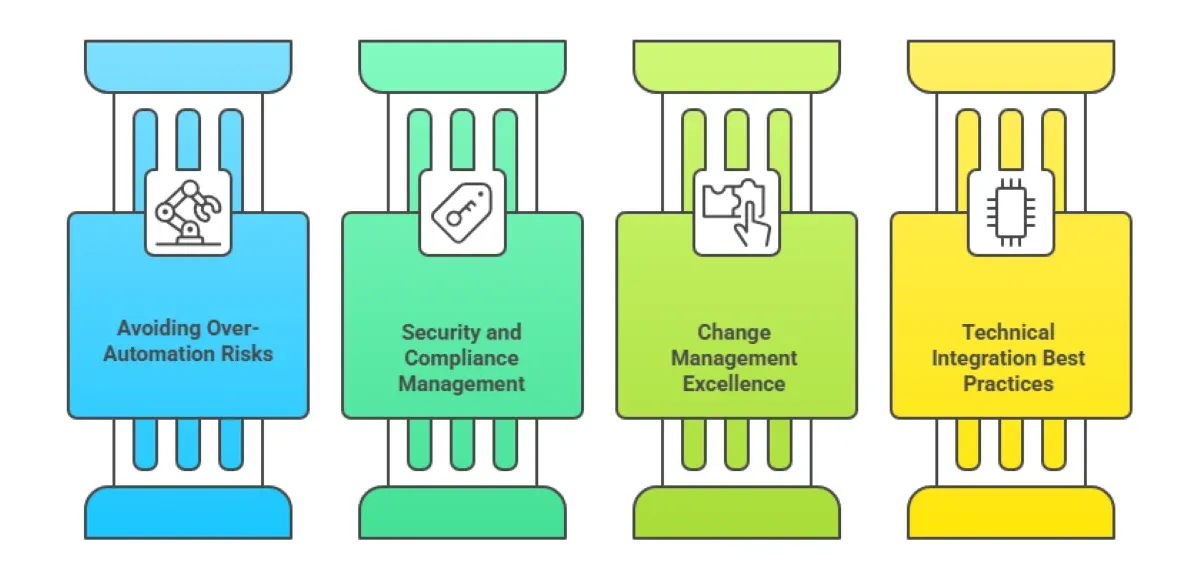
Learning from typical deployment difficulties helps ensure smoother adoption, better long-term results, and sustainable success across organizational departments.
Maintain human review for customer-facing communications, strategic decisions, sensitive matters, and complex problem-solving to preserve relationships, professional judgment, and organizational reputation throughout business operations.
Establish clear data handling protocols, review third-party integrations carefully, ensure regulatory compliance, implement access controls, and maintain comprehensive audit trails for responsible usage and risk management.
Involve team members in planning processes, provide adequate training resources, address concerns proactively, demonstrate value through incremental wins, and maintain open communication channels to ensure successful adoption.
Start with simple integrations, test thoroughly in controlled environments, plan for technical support requirements, and gradually increase complexity based on team capabilities and organizational readiness for advanced features.
Planning ahead helps businesses leverage ChatGPT-5's current capabilities while preparing for continued advancement in AI-powered workflow automation. Based on extensive industry research, five key trends will shape the next phase of ChatGPT-5 business applications.
The evolution from single ChatGPT-5 implementations to collaborative networks of specialized AI agents represents the most significant trend. McKinsey research indicates that by 2028, at least 33% of enterprise software will depend on agentic AI, with multi-agent systems enabling complex problem-solving through specialized roles.
ChatGPT-5 is enabling truly autonomous workflow management that goes beyond simple automation to dynamic process adaptation. These systems demonstrate "plan-do-check-act" loops, where AI agents autonomously plan multi-step workflows, execute stages sequentially, review outcomes, and adjust strategies based on results.
The democratization of AI workflow creation through no-code platforms represents a fundamental shift in who can implement ChatGPT-5 solutions. Gartner projects that by 2025, 70% of newly developed applications will utilize low-code or no-code technologies, up from less than 25% in 2020.
ChatGPT-5 is driving the evolution from traditional Robotic Process Automation (RPA) to Intelligent Process Automation that combines machine learning, natural language processing, and advanced analytics for dynamic decision-making.
With extensive AI expertise and proven success across Fortune 500 enterprises, Folio3 AI specializes in transforming business workflows through GPT-5-enhanced solutions that amplify our existing AI capabilities across every industry vertical.
We can combine our computer vision development services with GPT-5's extended context capabilities to automatically extract, analyze, and process complex documents, including insurance forms, medical records, legal contracts, and financial reports. Our solutions handle entire enterprise documents without losing context, delivering superior accuracy and reliability.
Our proven AI in sports analytics solutions with GPT-5's advanced reasoning can review and generate comprehensive athlete performance reports. Analyze training videos, biomechanical data, and performance metrics while generating personalized coaching recommendations, injury prevention strategies, and tactical insights for teams and individual athletes.
Our computer vision ALPR systems with GPT-5's natural language processing can generate intelligent traffic reports, parking violation summaries, and security alerts. Transform raw vehicle detection data into actionable insights for law enforcement, parking management, and urban planning authorities.
We can integrate vehicle tracking and classification capabilities with GPT-5's analytical power to create comprehensive fleet management solutions. Generate automated maintenance schedules, driver performance reports, route optimization recommendations, and predictive maintenance alerts while processing telematics data from multiple vehicle types.
We can upscale agricultural drone solutions with GPT-5's multimodal processing to automatically generate detailed analysis reports. Process aerial imagery for crop health monitoring, construction site inspection, and security surveillance while creating natural language summaries, compliance documentation, and actionable recommendations.

ChatGPT-5 offers unified routing that eliminates model confusion, built-in reasoning capabilities, and 45% fewer factual errors compared to GPT-4o. It handles complex workflows with expanded context windows and maintains memory across sessions for consistent business interactions.
Unified routing eliminates decision complexity, while Gmail/Calendar integration automates scheduling tasks. Memory improvements and safe completions handle sensitive business scenarios effectively, and the expanded context window manages complex documents without losing coherence.
Advanced API capabilities enable direct connections with CRM, ERP, and project management systems. Organizations can choose between custom integrations for maximum control or ready-made solutions for faster deployment, depending on technical resources and timeline requirements.
Yes, ChatGPT-5 manages internal reporting, training materials, and coordination while automating customer service responses, onboarding sequences, and communication management with appropriate oversight and quality controls.
Healthcare, manufacturing, financial services, and professional services show strong results. Any industry with repetitive documentation, customer communication, or data analysis tasks benefits significantly from ChatGPT-5's advanced capabilities and reliability improvements.
Safe completions maintain appropriate boundaries around confidential information. Organizations should establish data handling protocols, review integrations carefully, and ensure compliance with industry regulations while implementing proper access controls.
Begin with one department and specific, measurable use cases. Conduct readiness assessments, run pilot programs with clear success metrics, and expand gradually based on demonstrated results rather than assumptions about potential benefits.
ChatGPT-5 handles complex, context-dependent tasks that traditional automation tools cannot manage effectively. It adapts to different scenarios while maintaining human-like understanding and reasoning capabilities, providing flexibility that traditional tools lack.
Yes, ChatGPT-5 automates routine tasks while humans focus on strategy, creativity, and relationship building. Maintain human oversight for customer-facing communications and strategic decisions while leveraging AI for efficiency improvements.
Monitor time saved on routine tasks, error rate reductions, and project completion speeds. Track quality metrics and customer satisfaction to ensure automation maintains professional standards while delivering measurable efficiency improvements.