
Loading...

Your enterprise just invested millions in a GenAI platform. Six months later, you're stuck with a single vendor, skyrocketing costs, and zero flexibility to adapt. You're not alone. Gartner predicts 30% of GenAI projects will fail post-proof-of-concept due to rigid architecture decisions.
The problem isn't the technology; it's how it's built. Monolithic GenAI systems lock you into vendor ecosystems that can't scale across departments or adapt to changing business needs. Composable GenAI architecture solves this by letting you build modular, flexible AI systems that work with your existing infrastructure, not against it. This approach gives you vendor independence, cost control, and the agility to deploy AI where it matters most.
Composable GenAI architecture is a modular design approach that breaks generative AI systems into independent, interchangeable components. Instead of relying on a single vendor's all-in-one platform, you select and integrate best-of-breed tools across five core layers: LLM selection, data orchestration, API integration, observability, and governance.
Each component works independently but connects seamlessly through APIs, giving you the flexibility to swap models, scale specific capabilities, and avoid vendor lock-in while maintaining enterprise-grade security and compliance.

Composable GenAI isn't just flexible; it's the only scalable way to deploy enterprise AI without betting your entire strategy on one vendor's roadmap. It delivers control, cost visibility, and long-term adaptability across your organization.
Switch between GPT-4, Claude, or open-source models based on performance, cost, and task requirements. Run sentiment analysis on one model while using another for document generation without platform lock-in, giving you freedom to optimize every AI workflow independently.
Track spending by model, department, and specific use case in real time. Identify which AI workflows deliver measurable ROI and which drain budgets, then reallocate resources accordingly. Companies report massive cost reductions within twelve months after switching to composable architectures.
Deploy AI copilots in customer service while simultaneously building document automation for legal teams without waiting for IT to configure a monolithic system. Composable architecture lets departments move independently at their own pace, accelerating enterprise-wide AI adoption significantly.
Implement role-based access control, end-to-end data encryption, and comprehensive audit logging at every architectural layer. Different departments can run different security configurations while maintaining centralized governance oversight, which is absolutely critical for regulated industries like healthcare, finance, and government.
As new models emerge, integrate them without rearchitecting your entire stack or disrupting existing workflows. Your orchestration layer, data pipelines, and enterprise integrations remain stable even when you swap LLM providers, future-proofing your AI infrastructure against rapid technology evolution.
Monolithic GenAI platforms promise simplicity but deliver rigidity instead. They force enterprises into vendor lock-in, create integration nightmares with legacy systems, obscure true costs, and fail when scaling across departments with different requirements.
Single-vendor platforms trap enterprises in proprietary ecosystems with no negotiating power. When OpenAI raised API prices by 40% in 2024, companies with monolithic systems couldn't switch providers without complete rebuilds, forcing them to absorb cost increases.
Legacy GenAI platforms don't integrate seamlessly with existing enterprise systems like ERP, CRM, and data warehouses. Custom middleware becomes necessary, adding three to six months to deployment timelines while creating ongoing maintenance headaches that drain IT resources.
Monolithic platforms bundle pricing without transparency, making it impossible to isolate expenses by department, model, or use case. CFOs can't optimize spending or justify ROI when they can't see where AI costs actually come from or which workflows deliver value.
What works for customer service won't work for legal or finance teams. Monolithic platforms force one-size-fits-all configurations that create bottlenecks when different departments need different models, security controls, compliance frameworks, or performance requirements for their specific workflows.
Single-platform approaches lack granular access controls and comprehensive audit trails required for enterprise compliance. When HIPAA, SOC 2, or GDPR compliance is non-negotiable, monolithic systems can't provide the governance precision, role-based permissions, or detailed logging that regulated industries demand.
Composable GenAI architecture operates across five distinct layers, each serving a specific function. Together, they create a flexible, scalable system that adapts to enterprise needs without forcing you into rigid platforms or vendor ecosystems.
This layer provides access to multiple large language models, including OpenAI, Anthropic, Cohere, and open-source alternatives like LLaMA. Route different tasks to different models based on cost, accuracy, and latency requirements using a unified API that abstracts provider complexity completely.
Retrieval-Augmented Generation connects your LLMs to proprietary enterprise data stored in vector databases, data lakes, or warehouses. This layer ensures AI responses are grounded in your company's knowledge, not generic training data, eliminating hallucinations and improving accuracy for business-critical applications.
Every component exposes RESTful APIs for seamless integration with your ERP, CRM, HR systems, and custom applications. This layer handles authentication, rate limiting, data transformation, and error handling, ensuring secure, reliable connectivity across your entire technology stack without custom middleware development.
Track model performance, latency, cost per query, and token usage in real time through centralized dashboards. Set alerts for anomalies, monitor accuracy drift, debug failures quickly, and optimize resource allocation by gaining complete visibility across all AI workflows and models simultaneously.
Enforce granular access controls, data privacy policies, and compliance requirements at every architectural layer. Audit every AI interaction, encrypt data in transit and at rest, manage consent, and ensure your architecture meets SOC 2, HIPAA, or GDPR standards with comprehensive logging.
FeatureComposable GenAIMonolithic GenAIVendor flexibilityMulti-vendor, swap models as neededSingle vendor lock-inCost controlTrack spending by model and use caseBundled pricing, limited visibilityIntegration complexityAPI-first, works with existing systemsRequires vendor-specific connectorsTime to deploy new models2-3 days3-6 months (vendor roadmap dependent)Departmental customizationFull customization per business unitOne-size-fits-all configurationScalabilityModular scaling of specific componentsRigid, requires full platform upgradesGovernance precisionGranular access controls and audit trailsPlatform-level controls onlyFuture-proofingAdd new models without rearchitectingDependent on the vendor innovation cycleTotal cost of ownership (3 years)30-40% lower due to optimizationHigher due to vendor pricing power
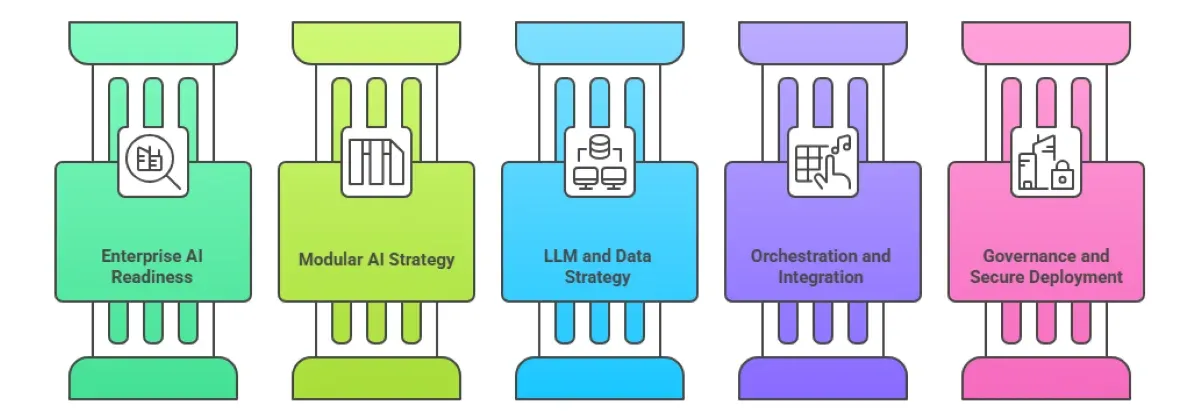
Building a composable GenAI architecture requires structured planning. Rushing implementation without assessing readiness leads to integration failures, cost overruns, and systems that don't meet enterprise requirements. Follow this proven roadmap for successful deployment.
Evaluate current data infrastructure, security posture, and technical capabilities across your organization. Identify gaps in data quality, governance frameworks, and team skills. Understanding your starting point determines how fast you can move toward composable AI and what foundational work needs completion first.
Start with high-impact use cases delivering measurable ROI within six to twelve months. Map which departments need AI capabilities first, what models they require, and how systems will integrate. Avoid the "boil the ocean" approach by prioritizing workflows with clear business value and technical feasibility.
Choose two to three LLM providers based on cost, performance, and compliance requirements for your specific use cases. Design your data architecture around RAG principles, ensuring proprietary knowledge stays secure while remaining accessible to AI systems through vector databases or hybrid retrieval approaches.
Deploy an orchestration platform that intelligently routes requests to appropriate models, manages API calls, and handles failovers automatically. Connect this layer to existing enterprise systems using API gateways and service meshes, ensuring secure, scalable communication across your entire technology stack without disrupting existing workflows.
Establish comprehensive access controls, audit logging, and compliance frameworks before going live with any production workloads. Start with a pilot in one department, validate results against success metrics, then expand gradually across business units while monitoring costs, performance, and security at every stage.
Even well-planned composable GenAI deployments face obstacles. Understanding challenges upfront and implementing proven mitigation strategies prevents costly failures and keeps AI initiatives on track toward measurable business impact and sustainable organizational adoption.
Exposing proprietary data to third-party LLMs creates serious security vulnerabilities and compliance risks. Solution: Implement data masking, use private cloud deployments or on-premises models for sensitive workloads, and enforce encryption at every layer with a zero-trust architecture that assumes breach and verifies continuously.
AI models degrade as business contexts change, leading to inaccurate outputs that undermine trust. Solution: Establish continuous evaluation pipelines that test models against ground-truth data, set performance thresholds, and trigger automated retraining or model swaps when accuracy drops below acceptable levels for business-critical applications.
Without proper monitoring, GenAI costs spiral quickly as teams over-query expensive models for tasks that don't require them. Solution: Set budget caps per department, implement rate limiting, optimize prompt engineering, and intelligently route simpler queries to cost-effective models while reserving premium models for complex tasks.
Connecting modern GenAI architecture to decades-old ERP or CRM systems creates technical debt and maintenance nightmares. Solution: Build abstraction layers using API gateways and middleware that handle data transformation, protocol translation, and error handling, isolating legacy system complexity from your AI stack and enabling gradual modernization.
Managing access controls, audit trails, and regulatory requirements across multiple models and vendors becomes overwhelming without centralization. Solution: Deploy centralized governance platforms that enforce policies consistently, automate compliance reporting, and provide real-time visibility into all AI interactions across your entire organization.
As a trusted Generative AI development partner, we deliver end-to-end solutions designed to help enterprises accelerate innovation, optimize operations, and achieve measurable business impact. From strategy to deployment, our scalable Generative AI consulting and technology services enable organizations to unlock new levels of efficiency and growth.
We design and build custom Generative AI models, fine-tuned to your data, industry, and use cases. Whether it's text, visuals, or complex datasets, our models deliver accuracy, scalability, and business-specific value.
We seamlessly embed generative AI solutions into your existing IT ecosystem. From CRM and ERP systems to proprietary platforms, we ensure smooth integration without disrupting workflows, maximizing operational efficiency.
Our experts craft optimized prompts tailored to your enterprise applications, ensuring consistent, relevant, and high-quality AI outputs. The result: better model performance and reliable results, every time.
Strengthen your internal teams with our seasoned MLOps specialists. We support your Generative AI infrastructure services by managing model deployment, monitoring, scaling, and ongoing optimization, keeping your AI systems production-ready at all times.
We automate repetitive coding tasks using AI-driven tools, accelerating software development cycles, reducing manual effort, and ensuring higher code quality, all while freeing your teams to focus on high-value initiatives.
Our Generative AI technology services help you break down data silos, process large datasets, and generate actionable insights in real time, empowering smarter, faster decision-making across every business unit.

The next evolution of composable GenAI goes beyond single-model deployments. Multi-agent systems, autonomous workflows, and regulation-driven design are reshaping how enterprises build and scale AI, making composability essential rather than optional.
Multiple specialized AI agents will collaborate autonomously; one retrieves data, another analyzes it, and a third generates reports, without human intervention. Composable architectures enable these agents to work together across different models and vendors without requiring monolithic platform lock-in, accelerating complex workflow automation significantly.
AI agents will trigger actions based on business events, automatically processing invoices, flagging compliance issues, or routing customer requests, without human intervention at every step. Composable systems make this possible by connecting AI directly to enterprise workflows through APIs, enabling true business process automation that adapts dynamically.
Expect vertical-focused AI component marketplaces where enterprises purchase pre-built, compliance-ready AI modules for healthcare, finance, or manufacturing. Composable architecture makes plug-and-play adoption seamless, accelerating time-to-value across regulated industries while reducing custom development costs by 60% and ensuring regulatory compliance from day one.
EU AI Act and similar regulations will mandate explainability, auditability, and bias monitoring across all AI systems. Composable systems with granular governance layers will meet these requirements more easily than monolithic platforms, giving compliant enterprises a competitive edge while avoiding penalties that could reach millions in fines.
As enterprises process AI workloads closer to data sources, factories, retail locations, and medical devices, composable architectures will enable hybrid deployments that run lightweight models at the edge while connecting to centralized orchestration layers in the cloud, reducing latency by 70% and improving real-time decision-making.
Composable GenAI architecture is a modular approach that lets enterprises build, scale, and customize generative AI systems using interchangeable components like LLMs, data layers, and orchestration tools without vendor lock-in.
It delivers flexibility to swap models, reduces vendor dependency, improves security with granular controls, and enables cost optimization across multiple AI platforms, giving enterprises 30-40% lower operational costs.
Yes, when built with proper governance, role-based access controls, encryption, and compliance frameworks like SOC 2, HIPAA, or GDPR, it delivers enterprise-grade security superior to monolithic platforms.
Enterprises can switch between cost-effective models for different tasks, track spending by department and use case, avoid vendor price increases, and optimize usage patterns, reducing long-term AI costs significantly.
Yes, Folio3 specializes in designing, integrating, and deploying custom composable GenAI architectures tailored to your enterprise requirements, industry compliance needs, and existing technology infrastructure for maximum ROI.