
Loading...

Fleet managers today face mounting pressure to optimize operations while reducing costs and enhancing security across their vehicle networks. Whether managing delivery trucks, waste collection fleets, or municipal vehicles, organizations discover that manual license plate monitoring creates bottlenecks, errors, and missed opportunities for operational improvement.
Custom ALPR fleet solutions emerge as the answer, transforming how businesses track, manage, and secure their fleet assets through advanced automatic license plate recognition (ALPR) technology. The global automatic license plate recognition (ALPR) market reached $6.71 billion in 2024 and is projected to reach $14.48 billion by 2032, representing a robust compound annual growth rate (CAGR) of 10.10%.
However, critical challenges arise when organizations implement custom ALPR fleet solutions. One-size-fits-all systems consistently fail to address complex operational requirements that modern fleets demand. Generic solutions often lack sophisticated integration capabilities, scalability features, and specialized functionality that enterprises need through AI in transportation technologies.

Custom ALPR fleet solutions represent specialized automatic license plate recognition systems explicitly engineered for fleet management applications across transportation industries.
These tailored platforms integrate advanced AI-powered vehicle identification technology with fleet-specific operational workflows, creating comprehensive solutions that maximize efficiency and strategic value through custom fleet management software.
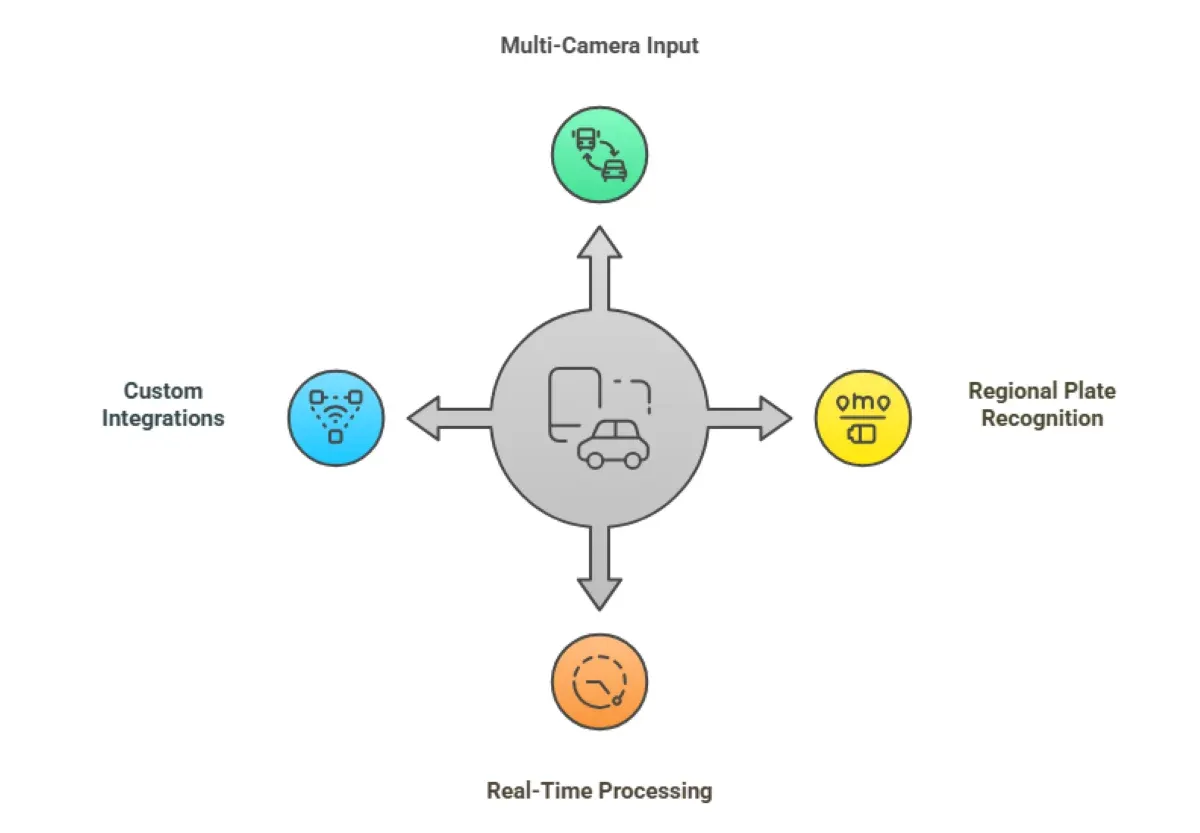
Fleet-focused ALPR solutions deliver exceptional business value through four critical customizable components that differentiate them from generic alternatives in competitive marketplaces.
Multi-camera input management enables simultaneous processing of multiple video streams across diverse fleet environments, ensuring comprehensive coverage without performance degradation or operational limitations.
Regional plate format recognition provides specialized algorithms for US, EU, and Asia-Pacific license plate variations, delivering superior accuracy across international operations and compliance requirements.
Real-time processing options allow organizations to optimize system performance based on operational requirements, balancing speed with computational resources for maximum effectiveness.
Custom integrations create seamless data flow between ALPR technology and existing enterprise platforms, eliminating operational silos through advanced AI-powered vehicle recognition approaches.
Off-the-shelf ALPR solutions are pre-built, standardized license plate recognition systems designed for broad market applications across diverse industries and environments.
These commercial products offer basic vehicle identification functionality through established platforms but lack specialized features required for complex fleet operations and requirements.
Fast deployment reduces implementation timeframes to 2-4 weeks compared to 2-3 months for custom development, enabling rapid operational activation and immediate value delivery.
Low upfront cost ranges from $5K-15K versus $25K-75K custom initial investment requirements, making solutions accessible for organizations with limited implementation budgets.
Proven reliability provides established performance records through existing user base validation and testing, offering confidence in system stability and operational effectiveness.
Feature CategoryCustom ALPR SolutionsOff-the-Shelf ToolsPerformance & Accuracy95-98% accuracy with environmental adaptation and fleet-specific optimization85-92% accuracy with limited environmental optimization capabilitiesScalabilityLinear scaling without performance degradation across unlimited fleet growthPerformance limitations emerge as processing volumes increase beyond system capacityRegional ComplianceBuilt-in GDPR, CCPA, and DOT compliance with local data residency optionsGeneric compliance frameworks are often insufficient for enterprise regulatory needsIntegration CapabilitiesDeep API integration with fleet management, ERP, and IoT systemsLimited connectivity options with rigid data formats and predefined workflowsData Ownership & SecurityComplete data control with on-premise deployment and custom security protocolsVendor-controlled data with potential access limitations and shared infrastructure

Strategic fleet applications demonstrate significant competitive advantages when organizations implement custom ALPR solutions tailored to specific operational requirements and challenges.
Waste fleet automation transforms collection operations through integrated weighbridge data and route optimization, delivering 35% operational efficiency gains through intelligent automation systems and AI vehicle management solutions.
City-wide parking enforcement enables real-time violation processing across 50,000+ daily scans with mobile officer applications and multi-jurisdiction citation management for enhanced effectiveness.
Ports & logistics optimization streamlines 24/7 operations through gate automation, cargo manifest verification, and predictive analytics for traffic flow enhancement across supply chains.
High-traffic toll zones process 100K+ vehicles daily with multi-lane recognition capabilities and dynamic pricing integration for revenue optimization through machine learning algorithms.
Manufacturing campus security provides comprehensive vehicle tracking across multi-facility operations with employee verification systems and automated access control for enhanced security protocols.
Strategic financial planning enables organizations to maximize investment value while understanding the comprehensive cost structure of ALPR implementation across operational lifecycles.
Based on industry case studies and deployment data, here's what organizations typically invest in for a 100-vehicle fleet:
Cost CategoryCustom ALPROff-the-ShelfYear 1 Setup$75,000$35,000Years 2-3 Annual$15,000 each$25,000 eachYears 4-5 Annual$8,000 each$35,000 each5-Year Total$129,000$200,000+
Why custom costs less long-term: No recurring licensing fees, reduced vendor dependency, unlimited scalability without per-vehicle charges, and lower maintenance costs after initial deployment.
Comprehensive return on investment analysis requires evaluation of both quantifiable benefits and strategic advantages that drive long-term competitive positioning and growth.
Labor cost reduction: Automated data entry reduces administrative overhead by 30-50% while eliminating manual verification tasks across fleet operations.
Accuracy improvements: 95-98% recognition accuracy eliminates costly manual verification errors and reduces false positives that cause operational delays.
Compliance savings: Automated audit trails reduce compliance management costs by 60% while preventing escalating penalties through real-time detection and reporting.
Operational efficiency: Enhanced workflow automation reduces processing time by 40-60% while improving decision-making speed through real-time data availability.
Data insights: Advanced analytics reveal operational patterns and optimization opportunities while predictive maintenance prevents costly equipment failures.
Competitive advantage: Proprietary capabilities differentiate services from competitors while enhanced service quality enables new revenue opportunities and customer retention.
Implementation complexity: Custom solutions require 2-3 months of development time versus immediate off-the-shelf deployment, potentially delaying ROI realization.
Change management: Staff resistance to new technology reduces system utilization rates while insufficient training leads to suboptimal performance and user adoption.
Technology evolution: Rapid technological advancement may require system updates, while custom solutions offer greater flexibility for incorporating emerging technologies.
Strategic evaluation criteria enable organizations to select optimal ALPR solutions that align with operational requirements while delivering maximum business value.
Organizations must evaluate current fleet size, projected growth trajectories, geographic coverage requirements, compliance obligations, and integration needs with existing systems.
What is the current vehicle count and anticipated expansion over 3-5 years to ensure scalability without performance degradation or costly system replacements?
Which regions require coverage, and what regulatory requirements (GDPR, CCPA, DOT) must the system accommodate for legal compliance and operational continuity?
How will ALPR integrate with current fleet management, ERP, and operational systems to eliminate data silos and streamline existing workflows?
Technical assessment should encompass accuracy requirements, processing capabilities, offline functionality, API flexibility, security features, and scalability potential across operational environments.
What recognition accuracy levels are needed for operational conditions, and should processing occur in real-time or batch mode based on business requirements?
Does the system require offline functionality during connectivity disruptions, and what bandwidth limitations exist across deployment locations and remote sites?
What security certifications are required, and how flexible are APIs for enterprise system integration and custom workflow automation requirements?
Organizations should evaluate the total cost of ownership, vendor support capabilities, and long-term partnership potential to ensure sustainable implementation success.
What is the total 5-year budget, including hidden costs, and how do custom versus off-the-shelf solutions compare across the complete ownership lifecycle?
Does the provider offer 24/7 technical support, comprehensive training programs, and guaranteed response times for critical issues and system failures?
How will the vendor support future growth, technology updates, and evolving operational requirements over the partnership duration and system lifecycle?
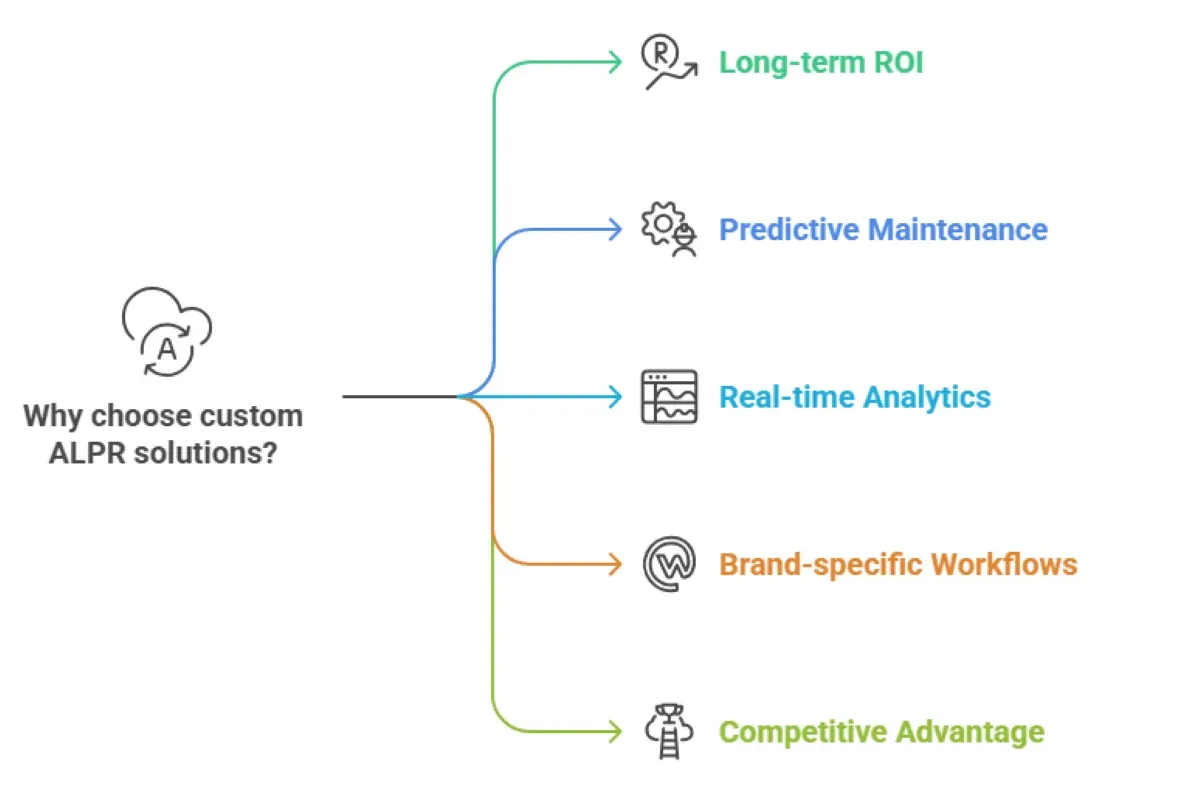
Enterprise organizations consistently choose custom ALPR implementations to achieve strategic advantages that generic solutions cannot deliver across complex operational environments.
Long-term ROI advantages compound significantly through reduced licensing fees, enhanced operational efficiency, and avoided vendor dependency, creating substantial financial benefits that increase over time.
Predictive maintenance through AI-driven insights reduces fleet downtime by 20-30% by identifying maintenance requirements before failures occur, optimizing operational continuity, and reducing emergency repair costs.
Real-time analytics enable data-driven decision making through specialized reporting and visualization capabilities tailored to business requirements and operational optimization needs.
Brand-specific workflows ensure technology adoption aligns with established processes while enhancing rather than disrupting operational efficiency and organizational effectiveness.
Competitive advantage creates sustainable market differentiation through unique technological capabilities and operational optimization strategies that competitors cannot replicate effectively.
Emerging technological advances create unprecedented opportunities for fleet optimization through intelligent automation and enhanced operational capabilities across diverse industry applications.
AI/ML integration advances deliver adaptive learning algorithms that improve recognition accuracy over time while reducing false positives through environmental condition optimization and continuous model training.
Edge computing revolution enables local data processing that reduces latency, minimizes bandwidth requirements, and ensures operational continuity during connectivity disruptions or network outages.
IoT ecosystem integration creates comprehensive vehicle identification capabilities through sensor fusion and smart infrastructure connectivity for enhanced operational intelligence and effectiveness.
Folio3 stands as a leading innovator in fleet management technology, delivering customized AI-powered solutions that transform transportation operations across industries through comprehensive expertise in artificial intelligence and computer vision.
Smart route planning utilizes live traffic data and delivery priorities while providing dynamic rerouting capabilities and geofence creation for operational efficiency and cost reduction.
GPS/ELD/OBD integration delivers accurate tracking with live dashboards for vehicle status, driver behavior monitoring, and comprehensive fuel consumption analytics for optimization and compliance reporting.
Fleet utilization reporting offers cost per mile tracking, maintenance trend analysis, and AI-powered suggestions for optimizing vehicle usage and performance through advanced vehicle tracking solutions.

{ "@context": "https://schema.org", "@type": "FAQPage", "mainEntity": [ { "@type": "Question", "name": "What is a custom ALPR fleet solution?", "acceptedAnswer": { "@type": "Answer", "text": "Custom ALPR fleet solutions are specialized automatic license plate recognition systems designed specifically for fleet management applications with tailored workflows, custom integrations, and industry-specific functionality that addresses unique operational requirements." } }, { "@type": "Question", "name": "Why do off-the-shelf ALPR tools fall short in large fleet operations?", "acceptedAnswer": { "@type": "Answer", "text": "Off-the-shelf solutions lack specialized features, advanced scalability, and deep integration capabilities required for complex fleet operations. They often struggle with processing high volumes, lack customization options, and cannot adapt to specific business workflows or compliance requirements." } }, { "@type": "Question", "name": "How do tailored ALPR systems improve accuracy and data control?", "acceptedAnswer": { "@type": "Answer", "text": "Custom systems achieve 95-98% accuracy through fleet-specific algorithm optimization, environmental adaptation, and continuous learning capabilities while maintaining complete data ownership and on-premise deployment options for enhanced security and compliance." } }, { "@type": "Question", "name": "Can custom ALPR systems integrate with IoT devices and weighbridges?", "acceptedAnswer": { "@type": "Answer", "text": "Custom ALPR solutions provide extensive integration capabilities with IoT sensors, weighbridge systems, enterprise platforms, and existing fleet management software through flexible APIs, real-time data connectivity, and custom middleware development." } }, { "@type": "Question", "name": "What industries benefit most from custom ALPR solutions?", "acceptedAnswer": { "@type": "Answer", "text": "Transportation, logistics, waste management, municipal operations, ports, manufacturing, security-focused industries, and large-scale fleet operations gain significant advantages from custom ALPR implementations due to their complex operational requirements and integration needs." } }, { "@type": "Question", "name": "How do I evaluate if my fleet needs a custom ALPR system?", "acceptedAnswer": { "@type": "Answer", "text": "Organizations with complex operational requirements, multiple system integrations, specialized compliance needs, growth projections exceeding current system capacity, or unique workflow requirements typically benefit from custom solutions rather than off-the-shelf alternatives." } }, { "@type": "Question", "name": "What features should I look for in a custom ALPR provider?", "acceptedAnswer": { "@type": "Answer", "text": "Essential capabilities include proven fleet implementation experience, comprehensive integration expertise, industry-specific security certifications, 24/7 support availability, demonstrated technical excellence, scalable architecture, and a track record of successful deployments in similar industries." } }, { "@type": "Question", "name": "Are custom ALPR systems scalable across multiple regions or cities?", "acceptedAnswer": { "@type": "Answer", "text": "Custom ALPR solutions are specifically designed for linear scalability without performance degradation across geographic expansion with regional compliance support, multi-jurisdiction functionality, and localized deployment capabilities for international operations." } }, { "@type": "Question", "name": "How do custom ALPR solutions support compliance and data privacy?", "acceptedAnswer": { "@type": "Answer", "text": "Custom implementations provide built-in compliance features for GDPR, CCPA, and DOT regulations with complete data control through on-premise deployment options, encryption protocols, audit trails, and customizable retention policies that meet specific regulatory requirements." } }, { "@type": "Question", "name": "What's the ROI of custom ALPR compared to off-the-shelf tools?", "acceptedAnswer": { "@type": "Answer", "text": "Custom ALPR solutions typically achieve 25-40% operational cost reductions with break-even within 18-24 months and compounding long-term advantages over 5+ years through reduced licensing fees, improved efficiency, and avoided vendor dependency costs." } } ] }
Custom ALPR fleet solutions are specialized automatic license plate recognition systems designed specifically for fleet management applications with tailored workflows, custom integrations, and industry-specific functionality that addresses unique operational requirements.
Off-the-shelf solutions lack specialized features, advanced scalability, and deep integration capabilities required for complex fleet operations. They often struggle with processing high volumes, lack customization options, and cannot adapt to specific business workflows or compliance requirements.
Custom systems achieve 95-98% accuracy through fleet-specific algorithm optimization, environmental adaptation, and continuous learning capabilities while maintaining complete data ownership and on-premise deployment options for enhanced security and compliance.
Custom ALPR solutions provide extensive integration capabilities with IoT sensors, weighbridge systems, enterprise platforms, and existing fleet management software through flexible APIs, real-time data connectivity, and custom middleware development.
Transportation, logistics, waste management, municipal operations, ports, manufacturing, security-focused industries, and large-scale fleet operations gain significant advantages from custom ALPR implementations due to their complex operational requirements and integration needs.
Organizations with complex operational requirements, multiple system integrations, specialized compliance needs, growth projections exceeding current system capacity, or unique workflow requirements typically benefit from custom solutions rather than off-the-shelf alternatives.
Essential capabilities include proven fleet implementation experience, comprehensive integration expertise, industry-specific security certifications, 24/7 support availability, demonstrated technical excellence, scalable architecture, and a track record of successful deployments in similar industries.
Custom ALPR solutions are specifically designed for linear scalability without performance degradation across geographic expansion with regional compliance support, multi-jurisdiction functionality, and localized deployment capabilities for international operations.
Custom implementations provide built-in compliance features for GDPR, CCPA, and DOT regulations with complete data control through on-premise deployment options, encryption protocols, audit trails, and customizable retention policies that meet specific regulatory requirements.
Custom ALPR solutions typically achieve 25-40% operational cost reductions with break-even within 18-24 months and compounding long-term advantages over 5+ years through reduced licensing fees, improved efficiency, and avoided vendor dependency costs.