
Loading...

Your factory floor generates massive amounts of data every week. Your autonomous vehicles need split-second decisions. Your medical devices handle sensitive patient information that can't leave the premises. Traditional cloud-based AI creates a fundamental problem: by the time data travels to distant servers and back, the critical moment for action has passed.
Edge generative AI solves this by deploying intelligent models directly where your data lives, like on devices, at manufacturing sites, in vehicles, and across IoT networks. Recent research shows 51% of organizations now rank performance and latency as their most important AI requirement, driving a fundamental shift from cloud-first to edge-first deployment strategies that prioritize real-time intelligence and data sovereignty.

Edge generative AI represents a fundamental paradigm shift from centralized cloud processing to distributed intelligence at data sources. This transition addresses critical limitations in latency, privacy, connectivity, and cost that cloud-centric models cannot solve, making edge deployment essential for competitive advantage rather than optional.
Cloud models struggle with exponential data growth, rising GPU costs, persistent hardware shortages, and latency requirements that mission-critical applications demand. Manufacturing facilities running AI for defect detection generate petabytes of data weekly, and transmitting this volume to centralized servers becomes both technically unsustainable and prohibitively expensive for scaled operations.
Manufacturing quality control, autonomous vehicles, AR applications, and emergency response systems demand sub-second responses that cloud architectures cannot consistently deliver. Cloud round-trips introduce delays that make real-time decision-making impossible, especially when network connectivity fluctuates, degrades, or fails during critical operations requiring immediate intelligent responses.
Healthcare, finance, defense, and regulated sectors face strict compliance requirements mandating that sensitive data remains on-premises throughout processing. Edge deployment keeps patient records, financial transactions, and proprietary information local while still enabling AI-driven insights, ensuring full compliance with GDPR, HIPAA, and industry-specific regulatory mandates without compromising analytical capabilities.
The models function independently during network outages, in remote locations with limited bandwidth, or in environments where continuous cloud connectivity cannot be guaranteed. This operational autonomy ensures continuous functionality for critical applications like medical diagnostics, industrial automation, emergency response systems, and infrastructure monitoring that cannot afford downtime or degraded performance.
Edge AI adoption has nearly caught up to data-center deployment despite being a significantly newer paradigm. Organizations increasingly recognize edge deployment as strategically essential for competitive advantage, operational efficiency, and customer experience, not merely as an interesting technological preference or niche application for specialized use cases.
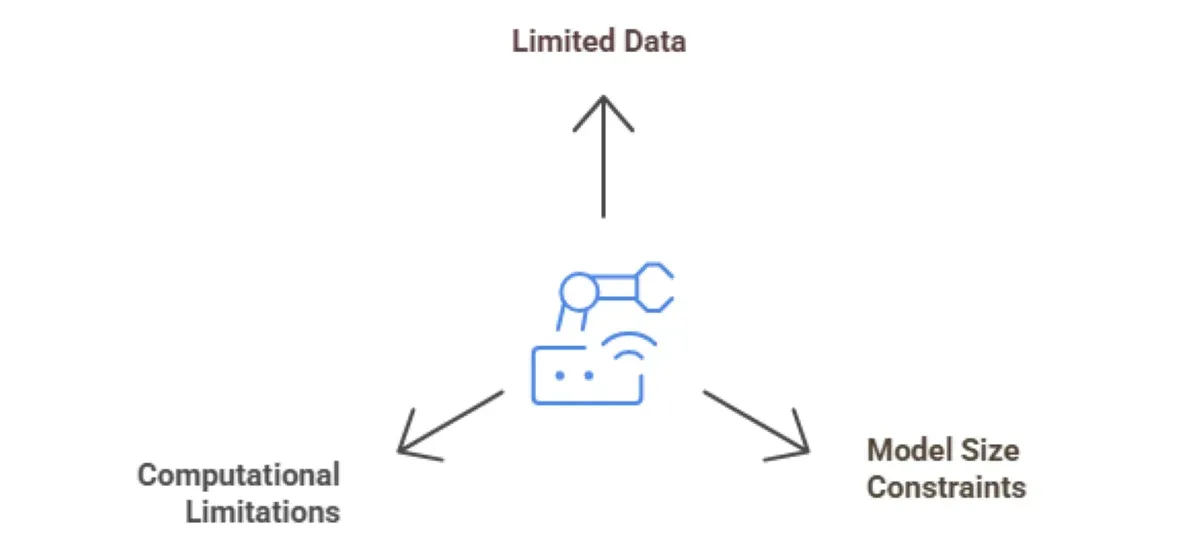
Edge generative AI deployment requires simultaneously satisfying three interdependent constraints: limited local data availability, severely restricted computational resources, and the necessity for compact yet capable models. These create compound challenges that don't appear in cloud environments where resources scale elastically, and data centralizes easily.
Edge devices observe only narrow data slices insufficient for traditional model training approaches that assume vast, centralized datasets. Personal assistants need user-specific behavioral adaptation, factory sensors require machine-specific operational patterns, yet each device holds minimal data that's prone to overfitting, noise amplification, and poor generalization when used for local training without sophisticated techniques.
Massive cloud models with billions of parameters simply don't fit within edge device memory envelopes or storage capacities. Large models require substantial RAM that dramatically exceeds the memory capabilities of most mobile devices, IoT sensors, and embedded systems, making aggressive compression through quantization, pruning, and distillation mandatory rather than optional optimization techniques.
Battery-powered devices, thermal dissipation constraints, and limited processing cores restrict sustained AI processing capabilities significantly compared to cloud infrastructure. Models must optimize for single-instance inference without cloud-scale batching advantages. Energy consumption per inference becomes absolutely critical. Excessive computational requirements drain batteries rapidly, trigger thermal throttling, and make continuous operation impossible for mobile and embedded deployments.
Edge generative AI architectures carefully balance capability requirements with resource constraints through specialized model designs, aggressive compression techniques, hardware-specific optimization, and intelligent orchestration. These approaches differ fundamentally from cloud-scale deployment strategies that prioritize maximum capability over efficiency, requiring new architectural patterns specifically designed for constrained environments.
Quantization reduces numerical precision from standard floating point to more efficient integer representations, dramatically shrinking model size and accelerating inference on specialized hardware. Knowledge distillation systematically compresses large teacher models into smaller student models that retain most capabilities while using far fewer parameters and running significantly faster on identical hardware, making sophisticated AI accessible on resource-constrained devices.
Autoregressive transformers handle sequential text generation, diffusion models create high-quality images through iterative refinement, and multimodal architectures integrate vision, language, and sensor data for comprehensive understanding. Edge deployment specifically favors unidirectional architectures over bidirectional alternatives, efficient attention mechanisms that reduce computational complexity, and models with fewer sequential dependencies that enable lower latency through increased parallelization opportunities.
Modern edge hardware capabilities span a wide spectrum from powerful edge servers with dedicated AI accelerators to resource-constrained IoT sensors with minimal processing. High-performance options include GPU-accelerated edge computing platforms for intensive local workloads, while mobile deployment leverages processors with integrated neural processing units. Hardware-aware model design maximizes each platform's specialized accelerator capabilities through optimized operator implementation and efficient memory utilization patterns.
Containerized deployments enable consistent model packaging, versioning, and deployment across heterogeneous device fleets with different operating systems and hardware configurations. Microservices architectures logically separate data preprocessing, model inference, and result postprocessing into independently scalable components. Comprehensive orchestration platforms manage fleet-wide model updates, performance monitoring, anomaly detection, resource utilization tracking, and complete lifecycle management across geographically distributed edge infrastructure installations.
Edge models must seamlessly interface with existing enterprise resource planning systems, customer relationship management platforms, manufacturing execution systems, and proprietary applications without requiring wholesale replacement. Well-designed APIs enable efficient bidirectional data flow between edge inference components and enterprise applications. Edge gateways intelligently aggregate insights from multiple distributed devices before selective synchronization with centralized cloud systems, optimizing bandwidth usage and reducing cloud processing requirements.
Small Language Models containing under one billion parameters represent the practical foundation enabling edge generative AI deployment at scale. These compact models deliver surprisingly capable performance through efficient architectures, specialized training methodologies, and targeted fine-tuning for domain-specific applications, making sophisticated language understanding and generation accessible on resource-constrained devices.
Model size directly determines deployment feasibility across different environments. Small models under one billion parameters suit smartphones and tablets with limited memory. Medium models spanning several billion parameters require high-end mobile devices or small servers. Large models with tens of billions of parameters demand server-class hardware with substantial memory. Only small models are practically deployed to true edge devices.
Quantization-aware training maintains model accuracy while systematically reducing numerical precision throughout networks, enabling aggressive compression without catastrophic performance degradation. Advanced quantization techniques enable substantial size reduction with minimal quality loss. Magnitude-based pruning systematically removes redundant weights and connections. Online distillation allows edge devices to continuously learn from more capable cloud models during connected periods, incrementally improving local capabilities over time.
Leading small models are increasingly designed from scratch specifically for efficiency rather than simply compressed from larger versions through post-training techniques. Neural architecture search methodically identifies optimal transformer variants for specific hardware constraints before training begins, rather than training massive models first, then attempting compression. This design-first approach often achieves better efficiency-capability tradeoffs than compression-focused methodologies.
Small models achieve remarkable capability on narrow, industry-specific tasks through targeted fine-tuning despite having far fewer parameters than general-purpose models. Medical domain models achieve high accuracy on clinical reasoning tasks despite their compact size. Factory-specific models learn detailed machine behavior patterns and failure modes. Financial models master regulatory compliance and risk assessment. Domain specialization allows compact models to match larger general models within specific contexts.
The fundamental goal for edge deployment isn't matching frontier model performance across all possible tasks but rather finding the optimal capability level that balances task-specific performance with strict resource efficiency requirements. Context-specific deployment enables deep personalization and rapid adaptation to local conditions and user preferences that massive cloud models serving billions of users simultaneously cannot provide, creating unique value despite smaller parameter counts.
Hybrid architectures intelligently distribute workloads between local edge processing and cloud computing resources, dynamically routing simple, frequent tasks to local models for speed and privacy while escalating complex or uncertain requests to powerful cloud systems. This approach optimizes performance, cost, and user experience by leveraging the complementary strengths of both deployment paradigms.
Systems route queries based on complexity, confidence levels, and resource requirements rather than sending everything to one location. Simple requests are processed locally for immediate response; ambiguous or high-stakes inputs escalate to cloud infrastructure with greater computational capacity. Dynamic routing adapts to network conditions, device capabilities, and task characteristics, ensuring optimal resource utilization while maintaining acceptable performance thresholds across diverse operational scenarios.
Leading implementations demonstrate practical tiered approaches where simple tasks like text correction and basic editing run on-device, intermediate complexity operations like summarization escalate to private edge servers, and highly complex generation routes to full cloud infrastructure. This three-tier model balances latency, privacy, capability, and cost, providing a proven template for organizations designing their own hybrid deployment strategies.
Advanced systems adjust computational budget during inference based on task complexity rather than allocating fixed resources for every request. Edge models allocate more compute to ambiguous inputs while maintaining efficiency for routine tasks, scaling resources dynamically instead of statically. This adaptive approach maximizes resource utilization, ensures consistent performance on challenging inputs, and minimizes energy consumption on straightforward queries that don't require intensive processing.
Edge devices handle data preprocessing, feature extraction, and initial inference, while heavy model training, knowledge updates, and complex retraining occur in cloud infrastructure. Refined models are then deployed back to edge devices, creating continuous improvement loops. This division of labor leverages cloud scalability for computationally intensive training while maintaining edge benefits for inference, combining the best aspects of both environments.
Split computing divides model layers between local devices and nearby edge servers, distributing computational load based on network conditions and device capabilities. Federated learning enables collaborative training across device fleets without centralizing sensitive data, updating global models through aggregated local insights. These approaches maintain data privacy while enabling collective intelligence, allowing organizations to improve models using distributed data without violating sovereignty requirements.
Edge generative AI enables transformative applications across manufacturing, retail, healthcare, autonomous systems, and industrial IoT, delivering real-time intelligence, privacy preservation, and operational resilience impossible with cloud-dependent architectures. These implementations demonstrate tangible business value and provide blueprints for organizations planning their own edge AI deployments.
Military edge AI implementations achieved dramatic reductions in model update times by processing data locally rather than transmitting to centralized infrastructure. Manufacturing applications use on-device anomaly detection to generate real-time alerts, repair recommendations, and synthetic training data for continuous improvement without exposing proprietary processes to external systems or experiencing cloud-induced latency delays that could halt production lines.
Edge AI enables real-time product recommendations based on in-store behavior without sending video streams to cloud infrastructure, protecting customer privacy while delivering personalized experiences. Local generative models create customized marketing content, optimize inventory placement dynamically, and generate contextual offers based on immediate shopping patterns, all while respecting strict privacy requirements and operating reliably during network disruptions.
Smart medical instruments generate real-time procedural summaries for clinicians during operations. Continuous monitoring devices create personalized health recommendations from biometric readings, all processed on-device to maintain absolute patient privacy and HIPAA compliance. Medical imaging devices embed generative models for immediate diagnostic support without data transmission, enabling faster clinical decisions while eliminating privacy risks associated with cloud processing.
On-vehicle generative models predict driving scenarios in real-time, explain decision logic to passengers for transparency and trust, and create synthetic training data during operation for continuous improvement. Advanced embodied AI systems demonstrate substantial collision rate reductions through real-time perception, reasoning, and action generation entirely within vehicle computing infrastructure without depending on unreliable network connectivity.
Industrial edge systems analyze live video feeds and IoT sensor data locally to generate real-time guidance and safety alerts for factory workers. Edge gateways synthesize machine logs into actionable maintenance predictions and operational narratives, identifying equipment degradation patterns and generating detailed failure explanations that help maintenance teams prevent costly unplanned downtime.
Successful edge generative AI deployment requires addressing hardware limitations, thermal constraints, model staleness, safety degradation from compression, and fleet management complexity through specialized techniques and architectural strategies. Understanding these challenges and their mitigations is essential for production-ready implementations that deliver consistent business value.
Edge devices face fixed memory, limited processing cores, and thermal throttling during sustained inference that cloud infrastructure never encounters. Solutions include duty cycling, where models run at scheduled intervals rather than continuously, aggressive quantization to reduce computational requirements, and hardware-aware architecture search to maximize accelerator efficiency. Careful thermal design ensures sustained operation without performance degradation from overheating.
Edge models become outdated without frequent updates, but rolling out large model updates across thousands or millions of devices presents significant logistical and bandwidth challenges. Retrieval-augmented generation pulls fresh information from local knowledge bases that update more easily than full models. Incremental updates target only changed parameters rather than replacing entire models, reducing bandwidth requirements while keeping edge intelligence current.
Aggressive compression can erode safety safeguards built into base models; heavily quantized versions may produce more toxic outputs or hallucinate more frequently than full-precision counterparts despite maintaining similar accuracy on standard benchmarks. Post-compression safety retraining specifically targets alignment and safety behaviors. Lightweight governor models monitor outputs for dangerous content. Regular safety validation ensures compressed models maintain ethical guardrails.
Edge deployments span diverse hardware with different operating systems, processor architectures, memory capacities, and accelerator types, creating complex management challenges. Standardized APIs abstract hardware differences so applications work across device types. Orchestration platforms manage staged rollouts, A/B testing, and graceful degradation across heterogeneous fleets. Device-specific model variants ensure optimal performance on each hardware configuration while maintaining behavioral consistency.
Individual devices lack sufficient data for robust training without risking overfitting to local patterns or learning harmful biases from limited examples. Federated learning aggregates insights across devices without centralizing data, enabling collaborative improvement while respecting privacy. Low-rank adaptation techniques enable lightweight personalization without full retraining, preserving base model capabilities while adapting to local contexts and user preferences efficiently.
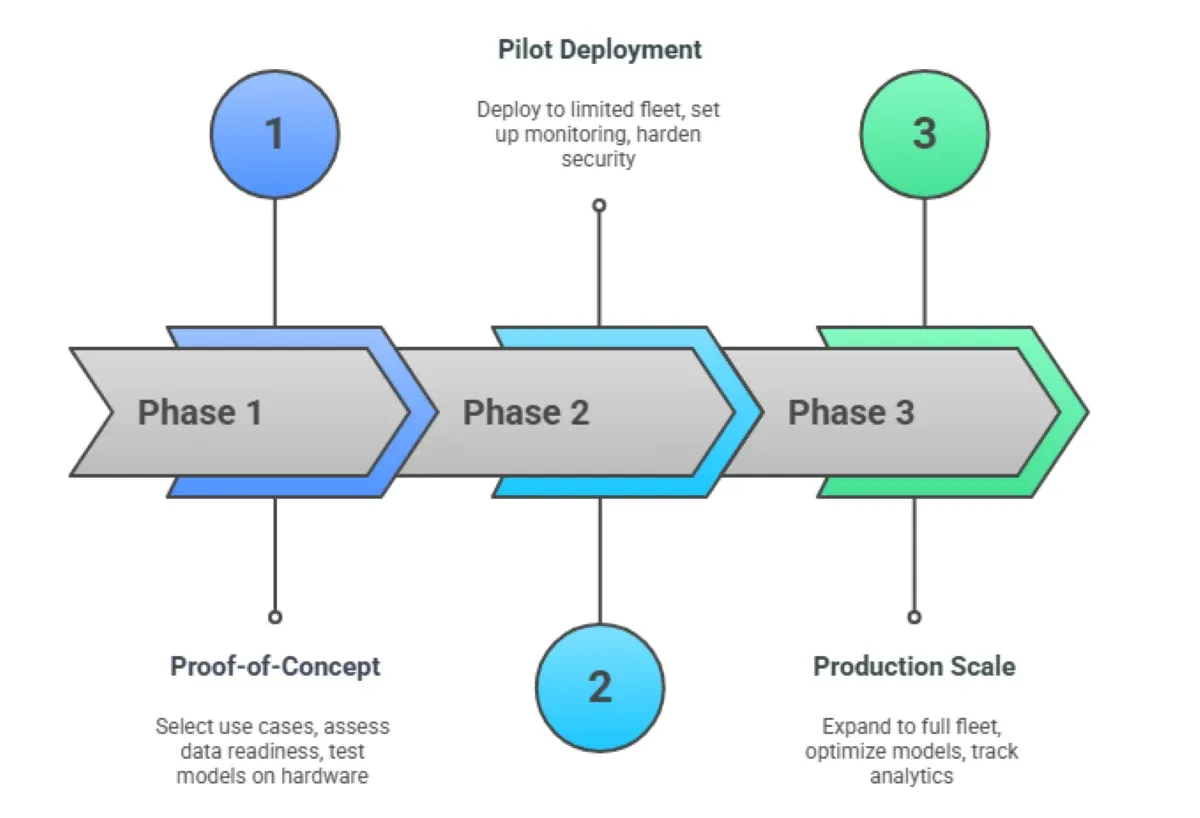
Deploying edge generative AI requires phased progression from proof-of-concept through pilot deployment to full-scale production, with careful attention to use-case selection, infrastructure preparation, security hardening, and continuous monitoring. This structured approach minimizes risk while building organizational capabilities and demonstrating value incrementally before committing to large-scale investment.
Select high-impact use cases with clear ROI metrics and measurable success criteria that align with strategic business objectives. Assess data readiness, privacy requirements, latency needs, and existing infrastructure compatibility. Test lightweight model variants on representative hardware under realistic conditions. Establish baseline performance metrics and success thresholds for pilot expansion, ensuring chosen use cases demonstrate clear value.
Deploy to a limited device fleet with a comprehensive monitoring infrastructure tracking performance, errors, resource utilization, and business outcomes. Implement security hardening, including model encryption, secure boot processes, and access controls. Establish update pipelines for model versioning and rollback capabilities. Test edge-cloud synchronization mechanisms and fallback procedures under various network conditions, including degraded connectivity and complete outages.
Expand to the full device fleet with staged rollouts that monitor for issues before broad deployment. Implement model operations practices for lifecycle management, drift detection, automated retraining triggers, and performance optimization. Deploy analytics dashboards tracking latency, accuracy, resource utilization, and business KPIs across distributed infrastructure. Establish processes for continuous improvement based on production telemetry and user feedback.
Folio3 partners with enterprises to build complete generative AI solutions from initial strategy through production deployment. Our team brings deep expertise in edge-optimized model development, hybrid architecture design, and industry-specific implementations that deliver measurable results. We handle the complexity of edge deployment so you can focus on business outcomes.
We develop custom generative AI models optimized for edge deployment, incorporating quantization, distillation, and hardware-aware design from the start. Our models are fine-tuned to your specific data, operational constraints, and industry requirements—whether you need compact language models for mobile devices, vision systems for manufacturing floors, or multimodal models for healthcare applications.
Our integration services embed edge generative AI into your existing technology stack without disrupting operations. We connect edge models with your ERP, CRM, manufacturing execution systems, and proprietary platforms, establishing seamless data flows between distributed edge devices and centralized enterprise systems while maintaining security and compliance standards.
We design and optimize prompts specifically for edge-deployed models where context windows and processing capabilities differ from cloud environments. Our prompt engineering ensures your edge models deliver consistent, relevant outputs despite resource constraints, maximizing performance from compact models through carefully structured inputs and response formatting.
Our MLOps specialists extend your team with expertise in edge-specific challenges, including fleet management, over-the-air updates, federated learning orchestration, and distributed monitoring. We establish robust deployment pipelines, implement drift detection for edge models, and manage the unique complexities of maintaining AI systems across thousands of distributed devices.
We implement AI-driven development tools that accelerate your edge AI initiatives, automating model optimization workflows, generating device-specific deployment configurations, and creating monitoring dashboards. This automation reduces manual effort in managing heterogeneous edge fleets while ensuring consistency across diverse hardware platforms and deployment environments.
Edge generative AI is evolving toward federated learning across device fleets, self-learning models, multi-agent collaboration, and embedded experiences in AR and VR environments. This shift is transforming edge devices from passive endpoints into autonomous intelligent systems. Organizations must prepare now for these emerging capabilities that will redefine competitive advantage.
Device fleets will collaboratively train generative models without centralizing data, enabling collective intelligence while maintaining privacy. Healthcare networks will share medical imaging insights through federated diffusion models without exposing patient data. Smart home devices will coordinate through distributed language models, continuously improving through aggregated experience while keeping personal information local and secure.
Future edge models will continuously learn from user interactions and local data streams without requiring explicit retraining cycles or cloud connectivity. Lightweight online learning techniques enable perpetual adaptation without catastrophic forgetting of base capabilities. Models personalize deeply to individual contexts, user preferences, and operational environments while maintaining safety boundaries and ethical guidelines through carefully designed adaptation constraints.
Multiple specialized small models will collaborate on-device or across local networks to solve complex tasks beyond individual model capabilities. Household devices coordinate through dialogue, like refrigerators, fitness trackers, and calendar systems, working together for personalized recommendations. Factory floor robots share generative planners for coordinated task execution, adapting to changing conditions through collective problem-solving without centralized orchestration.
Next-generation robots will carry compact foundation models integrating vision, language, and motor control into unified systems for physical world interaction. These embodied models enable natural language interaction with machines, real-time decision explanation for transparency and trust, and adaptive behavior that learns from experience, transforming robotics from rigid programmed automation into flexible intelligent collaboration.
Augmented reality glasses will run local generative models for real-time scene description, language translation overlays, and contextual information generation without cloud latency. Recent demonstrations show real-time video stylization and 3D object generation running entirely on mobile hardware, previewing immersive spatial computing experiences where digital content seamlessly integrates with physical environments through on-device intelligence.
{ "@context": "https://schema.org", "@type": "FAQPage", "mainEntity": [ { "@type": "Question", "name": "What is edge-based generative AI, and how is it different from cloud generative AI?", "acceptedAnswer": { "@type": "Answer", "text": "Edge-based generative AI runs models directly on local devices such as smartphones, sensors, and edge servers, processing data where it is generated. Cloud generative AI relies on centralized servers, requiring data transfer and causing latency, bandwidth costs, and privacy exposure. Edge deployments eliminate these issues by offering faster, private, and cost-efficient on-device processing." } }, { "@type": "Question", "name": "What kinds of generative models can run at the edge?", "acceptedAnswer": { "@type": "Answer", "text": "Lightweight language models under one billion parameters, optimized vision models, compressed diffusion models, and domain-specific multimodal models can run on the edge. Techniques like quantization and distillation make compact models performant within mobile, embedded, and IoT hardware constraints." } }, { "@type": "Question", "name": "What are the biggest benefits of deploying generative AI models on edge devices?", "acceptedAnswer": { "@type": "Answer", "text": "Edge deployments offer ultra-low latency, enhanced privacy by keeping data local, uninterrupted offline operation, and reduced cloud compute and bandwidth costs. They also improve energy efficiency and enable highly personalized, contextualized models tailored to specific user or device environments." } }, { "@type": "Question", "name": "Which industry use-cases are best suited for edge generative AI?", "acceptedAnswer": { "@type": "Answer", "text": "Industries requiring real-time response or handling sensitive data benefit most, including manufacturing quality inspection, healthcare diagnostics, autonomous vehicles, retail personalization, and industrial IoT. High-volume local data tasks such as continuous video analysis are ideal for edge processing." } }, { "@type": "Question", "name": "What hardware and software infrastructure is required for edge generative AI?", "acceptedAnswer": { "@type": "Answer", "text": "Hardware may include GPU-enabled edge devices, NPUs in smartphones, or industrial edge servers depending on workload. Software needs containerization frameworks, model optimization tools, orchestration for device fleet management, and middleware enabling synchronization between edge and cloud in hybrid environments." } }, { "@type": "Question", "name": "What are the main challenges when implementing generative AI at the edge, and how can they be addressed?", "acceptedAnswer": { "@type": "Answer", "text": "Challenges include limited computation capacity, model compression impacts on safety, heterogeneous device environments, and insufficient training data. Solutions involve quantization-aware training, safety validation post-model compression, federated learning, standardized APIs, and hybrid architectures that distribute tasks between edge and cloud intelligently." } }, { "@type": "Question", "name": "How do businesses measure ROI for edge generative AI deployments?", "acceptedAnswer": { "@type": "Answer", "text": "ROI is measured through latency reduction, bandwidth and cloud cost savings, energy efficiency improvements, decreased hardware dependence, better defect detection in manufacturing, increased retail conversion rates, and higher operational uptime during outages." } }, { "@type": "Question", "name": "How does a hybrid edge-cloud architecture fit into a generative AI strategy?", "acceptedAnswer": { "@type": "Answer", "text": "Hybrid architectures assign real-time, high-frequency tasks to edge devices for speed and privacy while routing complex or uncertain queries to cloud models. Edge handles inference and preprocessing; cloud manages heavy training, updates, and large-scale reasoning—balancing performance, cost, and model power." } }, { "@type": "Question", "name": "Why choose Folio3 AI for edge generative AI solutions?", "acceptedAnswer": { "@type": "Answer", "text": "Folio3 AI provides full-lifecycle edge AI solutions including strategy, custom model development, optimization, hardware deployment, and ongoing monitoring. With expertise across manufacturing, healthcare, retail, and industrial operations, Folio3 integrates generative AI, computer vision, and edge analytics into scalable real-world systems." } }, { "@type": "Question", "name": "What is the future of generative AI at the edge?", "acceptedAnswer": { "@type": "Answer", "text": "Future advancements include federated learning across devices, continuously improving on-device models, multi-agent collaboration, robotics powered by embodied generative intelligence, and AR interfaces running local multimodal models—enabling highly personalized real-time AI experiences without relying on the cloud." } } ] }
Edge-based generative AI deploys models directly on local devices like smartphones, sensors, and edge servers where data originates, processing requests without requiring cloud connectivity. Cloud generative AI runs on centralized servers, requiring data transmission and introducing latency, privacy risks, and bandwidth costs that edge deployment eliminates through local processing.
Small language models under one billion parameters, compressed vision models, lightweight diffusion models, and specialized multimodal models can run on edge devices. Through quantization and distillation, compact models from major AI research labs deliver capable performance within mobile and IoT hardware constraints while maintaining acceptable accuracy for domain-specific applications.
Edge deployment delivers sub-second latency for real-time applications, preserves data privacy by keeping sensitive information local, ensures operational continuity during network outages, and reduces costs by eliminating cloud compute and bandwidth expenses. Organizations also achieve better energy efficiency and enable personalized models for specific contexts that are unavailable with shared cloud infrastructure.
Manufacturing quality control, healthcare diagnostics, retail personalization, autonomous vehicles, and industrial IoT benefit most from edge generative AI. Any application requiring real-time response, strict privacy compliance, offline operation capability, or processing large local data volumes like continuous video streams represents an ideal candidate for edge deployment rather than cloud processing.
Hardware requirements vary by use case, from powerful edge computing platforms with GPU acceleration to mobile processors with integrated neural processing units, depending on performance needs. Software requirements include containerization platforms, model optimization frameworks, orchestration tools for fleet management, and edge-cloud synchronization middleware for hybrid architectures, balancing local and remote processing.
Key challenges include limited compute resources, model compression potentially degrading safety, device heterogeneity across fleets, and data scarcity for training. Solutions involve quantization-aware training, post-compression safety validation, federated learning for collaborative training across devices, standardized APIs for device diversity, and hybrid architectures that leverage cloud resources for complex tasks.
Track latency reduction percentages, hardware cost savings from reduced infrastructure requirements, energy consumption decreases, bandwidth cost elimination, defect detection improvements in manufacturing, conversion rate uplifts in retail, and operational continuity gains during network outages. Successful implementations demonstrate substantial hardware reductions and dramatically faster processing as representative metrics for business case justification.
Hybrid architectures route simple, frequent tasks to edge models for speed and privacy while escalating complex or uncertain requests to powerful cloud models when additional capability is needed. Edge handles preprocessing and real-time inference; cloud manages heavy training, knowledge updates, and model refinement, creating an optimal balance between performance, cost, and capability.
Folio3 delivers end-to-end edge AI expertise from strategy and custom model development through hardware deployment and lifecycle management. Our industry-specific solutions combine generative AI, computer vision, and edge analytics with proven deployment experience across manufacturing, retail, healthcare, and industrial sectors, providing comprehensive support throughout your edge AI journey.
The future includes federated learning across device fleets, enabling collective intelligence without centralizing data, continuously adapting on-device models that learn from user interactions, multi-agent collaboration between specialized models, embodied AI in robotics for physical world interaction, and AR experiences powered by local generative models transforming edge devices into autonomous intelligent systems.