
Loading...

You've launched AI pilots, invested in tools, and hired data scientists. Yet most of your AI projects remain stuck at the proof-of-concept stage. The frustration is real. Budgets are spent, teams are working hard, but results aren't scaling. Here's what research reveals: organizations in the first two stages of AI maturity perform below their industry average financially, according to MIT's Center for Information Systems Research.
The gap between AI success and failure comes down to maturity. An enterprise AI maturity assessment reveals exactly where you stand today. It identifies what's blocking your progress and provides a clear roadmap to scale AI effectively across your organization.
An enterprise AI maturity assessment is a structured evaluation measuring your organization's readiness to adopt and scale AI solutions. It examines five areas: data infrastructure, technology readiness, organizational capabilities, process automation, and business alignment. The assessment scores your current state and identifies specific gaps.
For example, a manufacturing company might discover that data silos prevent predictive maintenance models from working. A healthcare provider might find that teams lack the skills to deploy AI systems. The result is a baseline score and an actionable roadmap showing how to progress from experimentation to enterprise-wide AI transformation.

Enterprise AI maturity assessments follow a systematic methodology that evaluates your current capabilities against industry benchmarks. The process identifies technical, organizational, and strategic gaps blocking AI success. A comprehensive evaluation typically takes two to six weeks, depending on company size and complexity.
Existing AI capabilities are mapped across data, infrastructure, talent, processes, and governance.
Stakeholder interviews reveal organizational readiness and cultural barriers.
Technical audits examine data quality, system integration, and model performance.
Workflow analysis identifies automation opportunities and bottlenecks.
This phase documents what AI initiatives exist, how they operate, and what results they deliver currently.
Your optimal AI maturity level is defined based on business objectives, industry standards, and strategic goals, which determine required capabilities. A retail company needs a different infrastructure than a logistics firm. Success metrics are established upfront as expected outcomes, timelines, and resource requirements are documented. This creates a clear vision of where you need to be.
Specific barriers preventing target maturity are identified and prioritized systematically.
Technical gaps include legacy systems, data silos, and infrastructure limitations.
Organizational gaps cover skill shortages, training needs, and change resistance. S
trategic gaps involve unclear ROI models and misaligned priorities.
Each gap receives a severity rating. Remediation complexity is assessed for realistic planning.
A phased action plan is created with timelines, milestones, and resource requirements. Complex transformation is broken into manageable quarterly goals, and high-impact, low-effort initiatives are prioritized first to build momentum. Each phase includes success criteria and dependencies, and risk mitigation strategies address potential obstacles. Investment estimates support budget planning and stakeholder approval.
Organizations receive numerical scores across each pillar, typically rated one to five. Scores are compared against industry benchmarks and competitive standards. This quantitative assessment enables progress tracking over time and helps justify investments with data-backed recommendations. This scoring provides an objective measurement for continuous improvement.
AI maturity determines whether AI investments generate sustainable value or become costly experiments. It directly affects deployment speed, risk exposure, and an organization’s ability to compete effectively. Understanding maturity helps leaders set realistic expectations and allocate budgets strategically across teams and initiatives.
Organizations with higher AI maturity deploy solutions three to five times faster than less mature peers. Established data pipelines, MLOps practices, and cross-functional workflows reduce rework and misalignment. As a result, projects move from pilot to production in months rather than years, accelerating return on investment.
Most AI failures stem from organizational gaps rather than technical limitations. Mature enterprises mitigate these risks through clear ownership, strong governance, and stakeholder alignment. Consistent data quality processes and proactive change management significantly improve project success rates.
Advanced AI maturity enables companies to use AI as a strategic differentiator rather than a basic efficiency tool. Organizations develop proprietary models that embed unique business knowledge and power differentiated products. Faster, data-driven decision-making enhances market responsiveness and creates compounding competitive advantages.
Mature AI adoption delivers measurable operational improvements across the enterprise. Manual work is reduced by 30–40% as repetitive tasks are systematically automated, while prediction accuracy improves through better data and monitoring. Teams are freed to focus on higher-value strategic work, directly boosting profitability.
Higher AI maturity brings structured governance and responsible AI practices. Continuous monitoring detects bias, model drift, and compliance issues early, reducing legal and regulatory risk. Ethical oversight and accountability frameworks protect both brand reputation and long-term business resilience.
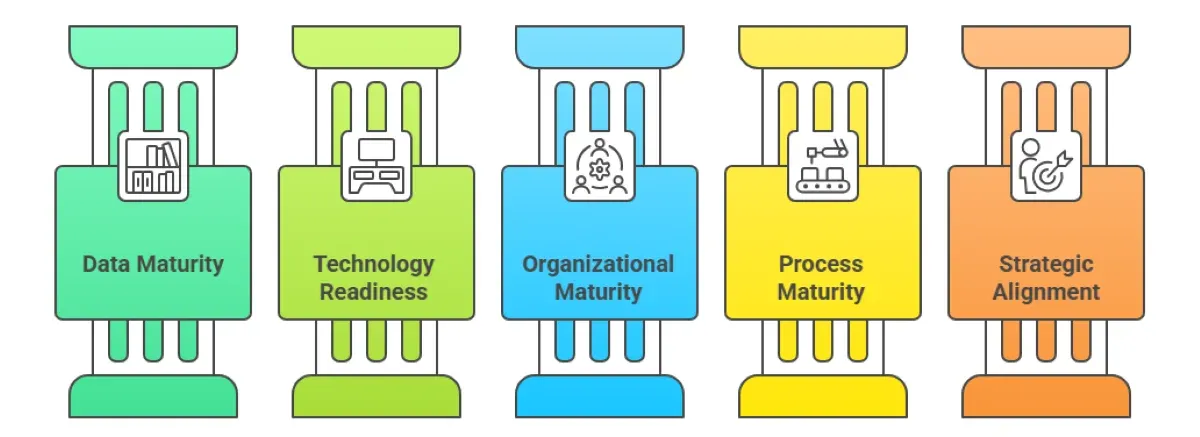
A comprehensive framework evaluates interconnected capabilities, determining AI success. Each pillar must reach adequate maturity; weakness in one area limits overall effectiveness. Assessment across all five provides a complete readiness picture.
This pillar assesses data availability, quality, governance, and pipeline infrastructure. Key indicators include centralized storage, automated quality monitoring, and comprehensive cataloging. Real-time processing supports time-sensitive applications, role-based access ensures security, and lineage tracking provides transparency. Compliance with regulations like GDPR or HIPAA is verified. Data readiness fundamentally determines AI feasibility.
Cloud architecture, MLOps capabilities, and model lifecycle management are evaluated, and mature organizations operate on scalable platforms like AWS, Azure, or GCP. Containerized deployments enable flexibility as automated testing ensures quality, monitoring systems detect model drift early, and version control maintains integrity. Moreover, API frameworks support integration, and infrastructure determines what AI solutions are technically possible.
AI leadership, talent depth, training programs, and change management are examined. Dedicated teams have clear mandates and authority, and cross-functional collaboration breaks silos with company-wide literacy programs that span technical and business roles. Champions drive adoption within departments, with executives who understand and sponsor initiatives actively. Culture embraces experimentation and organizational readiness determines adoption success.
Current automation levels, AI-first design, and KPI tracking are assessed. Integration into core workflows indicates process sophistication, impact measurement uses quantitative metrics, and continuous optimization leverages performance data. Best practices are documented and shared with successful approaches that scale across departments. Process maturity determines whether AI delivers sustained value.
Use-case prioritization, budget allocation, and ROI modeling are evaluated. Initiatives tie directly to revenue or cost KPIs, investment frameworks include stage-gate reviews, and portfolio management balances opportunities. Performance reviews compare results against projections, with strategies that adapt based on business value.
Strong executive sponsorship provides the authority and momentum needed to scale AI initiatives. Leadership commitment ensures budgets align with strategic priorities, while governance structures balance innovation with risk management. Without visible executive support, even technically sound AI efforts struggle to progress beyond pilots.
Responsible AI must be embedded from the start to ensure ethical, compliant, and trustworthy outcomes. Governance mechanisms such as ethics reviews, bias detection, and accountability frameworks reduce legal and reputational risk. Transparency and ongoing audits help maintain trust as systems evolve.
High-quality, well-governed data is the foundation of all successful AI programs. Unified data strategies, modern architectures, and automated quality pipelines ensure reliability, accessibility, and reuse. Clear ownership and governance models balance innovation with security and compliance.
AI maturity requires developing both technical expertise and business understanding across the organization. Training programs build AI literacy, while cross-functional collaboration ensures solutions deliver real business value. A culture that encourages experimentation and continuous learning sustains long-term progress.
Clear metrics and ownership are essential to translate AI initiatives into measurable results. Performance scorecards track both technical outcomes and business value against expectations. Regular reviews ensure accountability and enable continuous improvement based on real data.
AI adoption succeeds only when people understand and trust the technology. Proactive communication positions AI as an enabler rather than a threat, while training and support drive effective use. Ongoing feedback and visible wins build confidence and accelerate adoption.
AI maturity is an ongoing process that requires regular assessment and refinement. Feedback loops, progress reviews, and innovation pipelines help organizations adapt as technologies and needs evolve. Continuous improvement ensures AI capabilities remain competitive and aligned with business goals.
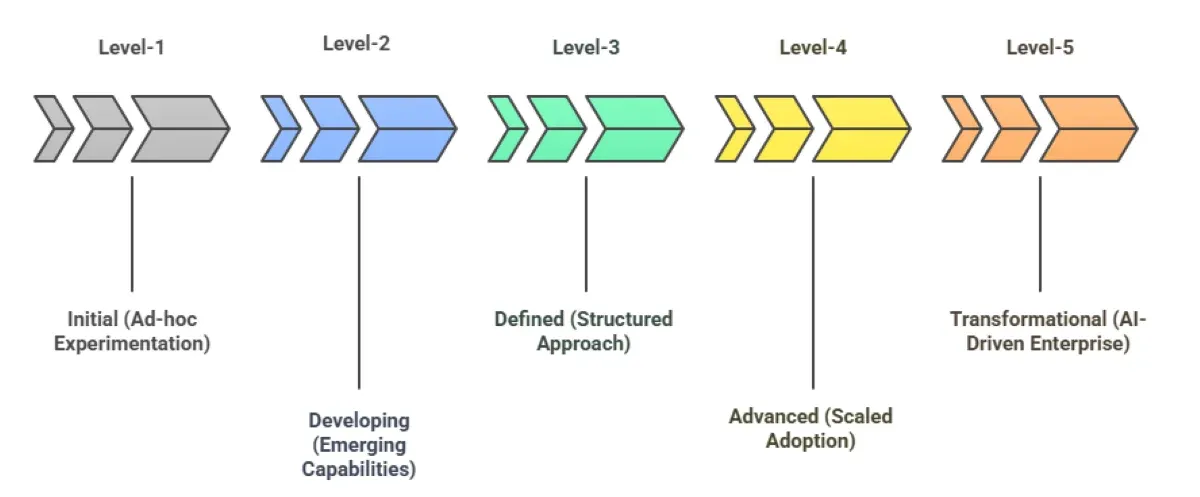
Understanding an organization’s AI maturity stage sets realistic expectations for transformation and investment. Each level builds systematically on prior capabilities, and skipping stages creates unstable foundations. Progression through a level typically requires eighteen to thirty-six months, depending on scale and complexity.
Organizations run isolated AI pilots without a cohesive strategy or governance framework. Data is poorly managed, teams operate in silos, and executive understanding of AI remains limited. Most initiatives fail to scale beyond proof-of-concept, resulting in sporadic and non-repeatable success.
Departments begin adopting off-the-shelf AI tools and establishing basic data pipelines. Teams start building AI skills, but efforts remain fragmented and lack enterprise standards. Limited coordination across departments makes scaling difficult and inconsistent.
AI is integrated into key workflows under formal governance and standardized MLOps practices. Centralized data platforms enable cross-functional collaboration and repeatable success. However, optimization is uneven across the organization, and some silos still persist.
AI is deployed across most departments with mature infrastructure and systematic ROI tracking. Proprietary models support AI-first processes, and optimization is driven by data and performance metrics. While adoption is broad, human oversight remains significant and limits full autonomy.
AI underpins strategic decision-making and powers autonomous operations across the enterprise. Continuous innovation enables AI-powered products and services that create new revenue streams. Deeply embedded AI capabilities fundamentally drive competitive advantage throughout the organization.
AI maturity requirements vary significantly by industry due to differences in regulation, data sensitivity, and operational complexity. While generic maturity frameworks provide structure, they must be adapted to sector-specific constraints and risk profiles. Successful organizations align AI progression with industry realities rather than forcing uniform approaches.
AI maturity in healthcare is heavily shaped by regulatory compliance, particularly HIPAA and patient privacy requirements. Models must undergo rigorous clinical validation and meet high standards for explainability before deployment. Organizations must carefully balance innovation speed with safety, trust, and regulatory obligations.
Manufacturing AI maturity depends on effective integration between operational technology (OT) and IT systems. High-quality sensor data, edge computing, and real-time analytics enable predictive maintenance and operational optimization. Close collaboration between production teams and data scientists is essential, with safety remaining a top priority.
In retail, AI maturity is driven by customer data quality and personalization capabilities. High transaction volumes require robust data pipelines and low-latency infrastructure to support real-time recommendations. Privacy-compliant platforms and continuous experimentation help organizations stay competitive in fast-moving markets.
AI maturity in logistics hinges on end-to-end data integration across fleets, warehouses, and inventory systems. Real-time processing enables dynamic routing, demand forecasting, and rapid response to disruptions. Advanced automation and visibility significantly improve operational efficiency and resilience.
Financial services face some of the most stringent AI maturity requirements due to regulatory and risk constraints. Explainability, model validation, and data lineage tracking are mandatory for compliance and decision transparency. As a result, governance and monitoring practices are typically more advanced than in other industries.
A systematic checklist ensures comprehensive evaluation across all dimensions. Missing any category creates blind spots, leading to implementation failures.
The central data lake or warehouse is operational.
Data quality scores exceed 95% with automated monitoring.
A comprehensive data catalog with lineage tracking exists.
Real-time pipelines support time-sensitive applications.
Compliance frameworks (GDPR, HIPAA, SOC2) are implemented.
Role-based access controls protect sensitive information.
Data governance policies are documented and enforced.
Cloud-native architecture with containerization is deployed.
MLOps pipelines automate the training and deployment of models.
API-first design enables cross-system integration.
Model monitoring detects drift and performance degradation.
Production-grade security controls are implemented.
Version control manages both data and models.
Scalability testing validates enterprise load handling.
Dedicated AI leadership with executive sponsorship exists.
Skills assessment across teams is completed.
Training programs for both technical and business users are in operation.
AI champions are identified in key departments.
The change management plan addresses resistance.
Cross-functional collaboration mechanisms are established.
Budget allocation supports AI strategic priorities.
The current automation percentage is quantified.
Standard AI workflow tools are adopted enterprise-wide.
KPIs are defined and tracked for initiatives.
Cross-departmental collaboration occurs regularly.
Continuous improvement processes optimize AI systems.
Best practices are documented and accessible.
Successful approaches scale to other departments.
AI initiatives map to revenue or cost KPIs.
ROI projection models exist for each use case.
The AI Governance committee has decision authority.
Budget process tied to strategic value.
Executive reviews assess portfolio performance regularly.
Metrics compare actual results against projections.
Strategy adjusts based on demonstrated business value.
Not all AI opportunities are viable at every maturity stage, making prioritization essential. Focusing on use cases aligned with current capabilities increases success rates and prevents wasted investment. Strategic alignment between ambition and readiness is critical for sustainable progress.
Potential use cases should be evaluated based on business impact versus implementation effort. High-impact, low-effort initiatives deliver quick wins that build momentum and confidence. High-effort or low-impact opportunities should be delayed or deprioritized until maturity improves.
Early-stage organizations should focus on rules-based automation and basic analytics, while mid-maturity firms can adopt NLP and computer vision. Advanced enterprises are positioned to deploy autonomous systems and multi-agent workflows. Attempting advanced use cases prematurely almost always leads to failure.
Viable use cases depend on the existence, accessibility, and quality of required data. Predictive and recommendation systems demand rich, reliable historical and real-time data streams. Without sufficient data readiness, even technically simple initiatives will fail.
Infrastructure readiness, team capabilities, and system compatibility must be assessed realistically. Real-time inference, edge deployment, and complex integrations require higher technical maturity than batch analytics. Organizations should prioritize use cases that align with their strongest technical foundations.
Use cases should be balanced between short-term wins and long-term strategic investments. Less mature organizations benefit from projects delivering value within three to six months, while mature enterprises can sustain longer ROI horizons. Aligning timelines with organizational patience prevents frustration and abandonment.
Many AI initiatives fail not during pilots, but when scaling to production. Understanding these challenges early allows organizations to plan proactively. Scaling requires significantly different capabilities than experimentation.
Pilots often rely on manually curated datasets, while production demands automated, governed pipelines. Scaling requires reliable ETL processes, quality enforcement, and support for real-time data where needed. Pipeline maturity fundamentally determines whether scaling is feasible.
AI solutions must integrate with legacy enterprise systems that were not designed for modern analytics. APIs, middleware, and data translation layers are often required to bridge these gaps. In some cases, infrastructure modernization becomes a prerequisite for AI success.
Models that perform well on small datasets often fail under production-scale loads. Cloud auto-scaling, load balancing, and caching are required to handle peak demand reliably. Infrastructure planning must account for performance, availability, and geographic distribution.
Production AI systems require continuous monitoring for drift, bias, and performance degradation. Automated retraining, A/B testing, and champion–challenger frameworks enable safe evolution. Without governance and monitoring, failures go undetected until a business impact occurs.
Successful pilots do not guarantee user adoption at scale. Employees may distrust AI decisions or fear job displacement, creating resistance to change. Transparent communication, training, and user involvement improve trust and acceptance.
Many organizations encounter similar obstacles regardless of industry. Recognizing these gaps early enables targeted remediation. Addressing them systematically accelerates maturity progression.
Departments often maintain isolated data systems with incompatible formats and duplicate records. This fragmentation prevents unified customer and operational insights. Enterprise AI requires integrated, shared data foundations.
Without governance, AI models proliferate without standards, documentation, or accountability. Bias, compliance risks, and operational inconsistencies increase rapidly. Formal governance frameworks ensure responsible and coordinated AI adoption.
AI talent shortages extend beyond data science to data engineering, MLOps, and AI product management. Organizations cannot rely solely on hiring to close these gaps. Upskilling programs and strategic partnerships are essential.
AI initiatives often fail due to vague or undefined objectives. Measurable KPIs enable accountability and demonstrate real business value. Clear success criteria are required before implementation begins.
AI platforms provide tools, not turnkey solutions. Integration, customization, and optimization require strong internal capabilities. Over-reliance on vendors limits flexibility and long-term competitiveness.
AI maturity assessments often fail due to preventable mistakes. These errors reduce credibility and limit impact. Avoiding them improves assessment effectiveness.
Assessments completed without leadership commitment rarely lead to action. Executive sponsorship ensures findings influence strategy and investment decisions. Leaders must be involved from the outset and committed to follow-through.
Evaluating infrastructure without addressing culture, processes, and change management misses critical barriers. Organizational readiness determines adoption success more than technical sophistication. Holistic assessments deliver more accurate insights.
AI capabilities evolve rapidly, making static assessments quickly obsolete. Regular check-ins and annual reassessments maintain relevance and momentum. Continuous measurement supports sustained progress.
Generic assessments overlook regulatory, operational, and integration realities unique to each sector. Healthcare, manufacturing, retail, and finance face fundamentally different constraints. Industry context must shape assessment priorities.
Folio3 AI delivers custom solutions addressing your unique business challenges. With 15+ years of experience across industries, we transform complex requirements into intelligent, scalable systems that drive measurable business results.
We analyze your business requirements and design optimal AI strategies that maximize ROI. Our consultants identify opportunities, assess feasibility, and create development roadmaps aligned with your objectives and resources.
Extract actionable insights from visual data using advanced computer vision technology. We build custom models for image recognition, object detection, and video analysis that enhance decision-making and operational efficiency.
Transform workflows and customer experiences with generative AI solutions. We develop custom models for content creation, data synthesis, and automated processes that accelerate innovation and improve engagement.
Reduce operational costs through custom LLM development and optimization. Our solutions automate complex language tasks, enhance communication systems, and streamline information processing at scale for enterprise applications.
Build robust NLP applications using superior algorithms that understand and process human language. We create solutions for sentiment analysis, text classification, chatbots, and information extraction tailored to your needs.
An AI maturity assessment evaluates an organization's readiness to adopt and scale AI solutions. It examines data, technology, processes, people, and strategy systematically. Enterprises understand their current state and build transformation roadmaps.
AI maturity ensures organizations have proper data, talent, workflows, and infrastructure. Mature companies achieve faster ROI and reduce implementation risks. They scale AI across departments more effectively.
Major components include data maturity, infrastructure readiness, organizational capability, process automation, and business alignment. Each area requires evaluation to determine overall readiness.
Typically two to six weeks, depending on company size and complexity. The number of departments involved affects the timeline. Consulting partners like Folio3 streamline the process with pre-built templates.
Industries with high data volume and automation opportunities benefit most. Healthcare, retail, manufacturing, logistics, financial services, and e-commerce see significant value. Data-intensive sectors gain competitive advantages.
Companies can use structured assessment guides or professional consulting services. Folio3's AI maturity scoring model evaluates data readiness, infrastructure, workflows, and strategic alignment. Benchmarking against industry standards provides context.
Yes. Enterprises with higher AI maturity see significantly stronger ROI. They scale solutions faster and reduce integration issues. Structured data pipelines and proven processes accelerate value realization.
Folio3 provides end-to-end consulting, including maturity assessment and roadmap creation. We offer data engineering, custom AI development, and MLOps setup. Ongoing optimization ensures sustained improvement.