
Loading...
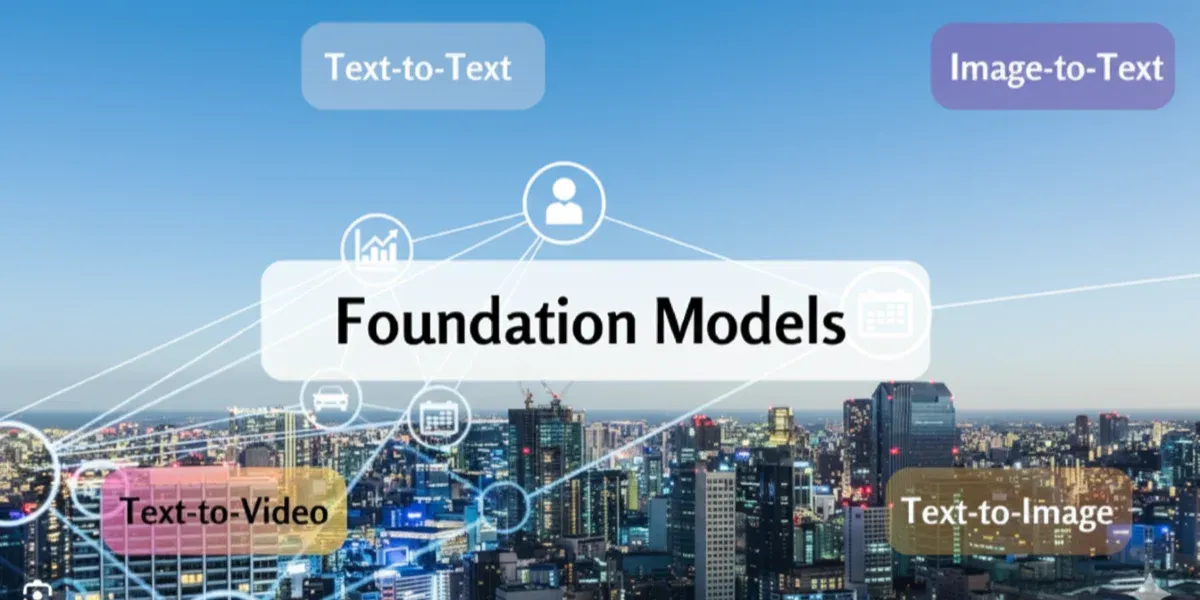
Foundation models power enterprise AI solutions, reducing operational costs by 30–40% through automation and intelligent decision-making.
Pre-trained models eliminate the need to build AI from scratch, accelerating deployment from months to weeks.
Multimodal capabilities enable enterprises to process text, images, video, and audio through a single unified system.
Fine-tuning foundation models with proprietary data creates competitive advantages while maintaining data sovereignty.
Agentic AI, powered by foundation models, autonomously handles complex multi-step workflows without constant human supervision.
Your competitors are processing customer inquiries in seconds while your team takes hours. They're extracting insights from years of documents in minutes while your analysts spend weeks. They're making data-driven decisions in real-time while you're still waiting for reports. The gap isn't better people or bigger budgets; it's foundation models enterprise AI that's already reshaping how leading organizations operate. Venture capitalists poured $192.7 billion into AI startups in 2025, marking the first year where more than half of all venture capital went into this technology.
That massive investment isn't speculative; it's a response to proven returns. Companies that deployed foundation models in 2024 now report 30-40% cost reductions and efficiency gains their boards barely believed possible. This guide cuts through the hype to show you exactly what foundation models are, why they matter now, and how to implement them before the competitive gap becomes insurmountable.
Foundation models deliver transformative value by providing pre-trained AI systems that adapt to multiple business functions. These versatile systems eliminate the need for custom development for each application.
Foundation models eliminate months of training time by leveraging pre-learned patterns from vast datasets. Businesses can deploy AI solutions in weeks rather than the traditional 6-12 month development cycles.
Organizations avoid the massive computational expenses of training models from scratch. They pay only for fine-tuning and inference costs while benefiting from continuously improving base models maintained by providers.
A single foundation model handles diverse tasks from customer service conversations to document analysis and predictive analytics. This approach replaces the need for multiple specialized AI systems across departments.
Foundation models adapt to new use cases through fine-tuning rather than ground-up development. This enables rapid expansion from pilot departments to enterprise-wide deployment without architectural changes.
These models process emails, documents, images, videos, and audio recordings that traditional systems cannot analyze. They unlock insights from 80% of enterprise data that previously remained inaccessible.
Foundation models are large-scale AI systems pre-trained on massive datasets that provide a versatile base for multiple business applications. Unlike traditional AI that requires training a separate model for each specific task, foundation models learn general patterns and relationships that transfer across different domains.
These models use transformer architecture to understand context and meaning in data, whether processing customer emails, analyzing financial reports, or identifying objects in surveillance footage. The pre-training process equips them with broad knowledge that businesses then customize through fine-tuning with their proprietary data. This approach dramatically reduces the time, cost, and technical expertise required to deploy sophisticated AI capabilities across enterprise operations.

Foundation models represent a fundamental shift in how enterprises implement AI. They enable organizations to move from custom-built solutions to adaptable systems that scale across the entire organization.
Organizations using foundation models deploy new AI capabilities in weeks rather than months. They respond to market changes and customer needs while competitors remain locked in lengthy development cycles.
Foundation models require smaller datasets for fine-tuning than traditional AI.Companies can leverage their proprietary data for competitive differentiation without needing millions of labeled examples.
The same foundation model that powers customer service today can be repurposed for fraud detection tomorrow. This provides flexibility that custom-built AI systems cannot match without expensive redevelopment.
Enterprises reduce complexity and costs by replacing dozens of point solutions with unified foundation model platforms. This simplifies procurement, integration, and maintenance across multiple functions.
Foundation model providers continuously improve base capabilities. This automatically enhances downstream applications without requiring enterprises to rebuild their systems or retrain models from scratch.
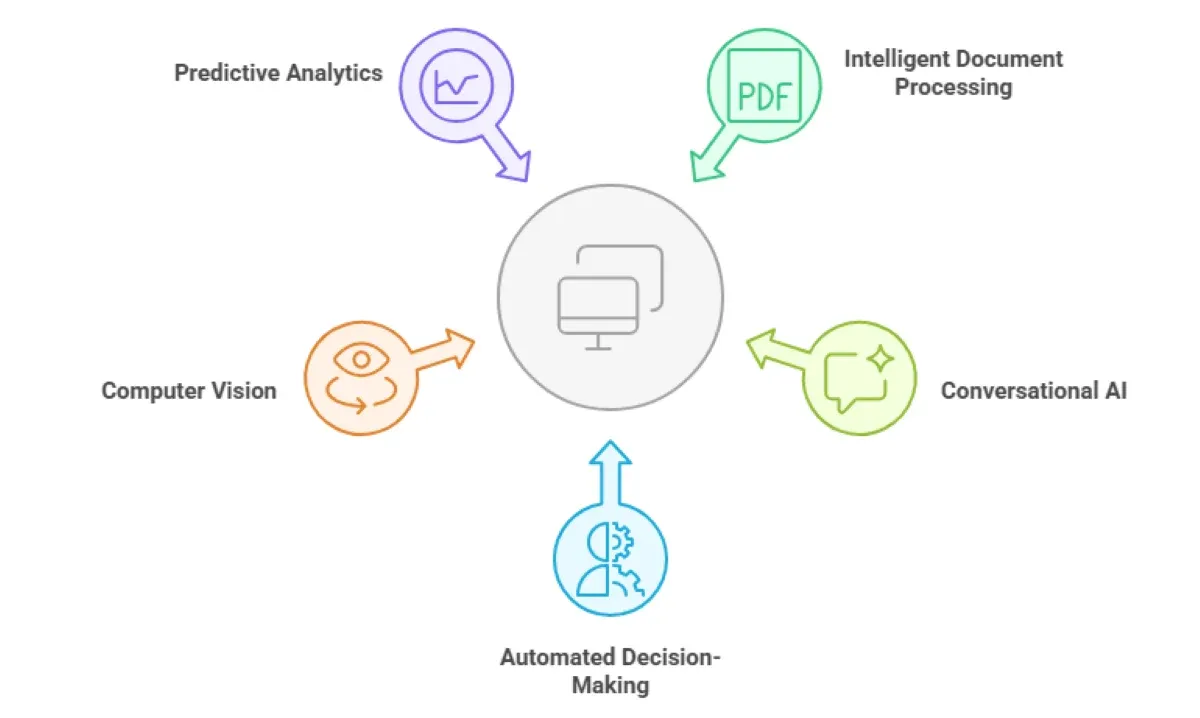
Foundation models fundamentally change how enterprises execute daily operations. They automate complex tasks that previously required human expertise and judgment.
Foundation models analyze contracts, invoices, research papers, and regulatory filings to extract structured information. They identify risks and surface insights that would take human analysts weeks to compile manually.
Advanced language understanding enables AI systems to handle nuanced customer inquiries and resolve complex support tickets. These systems provide employees with instant access to company knowledge without rigid scripts.
AI agents powered by foundation models execute multi-step processes autonomously, from approving expense reports to routing service requests. They make decisions based on company policies without human intervention.
Foundation models process visual data from manufacturing lines, security cameras, and inspection systems. They detect defects, identify safety violations, and monitor asset conditions in real-time.
These models analyze historical patterns and current trends to forecast demand and identify revenue opportunities. They surface anomalies that signal operational issues before they impact business performance.
Foundation models deliver measurable business outcomes across industries. Early adopters report significant efficiency gains and cost reductions within the first year of deployment.
Banks use foundation models to analyze transaction patterns and customer communications. They reduce fraud investigation time by 60% while identifying suspicious activities that rule-based systems miss entirely.
Medical organizations deploy foundation models to transcribe physician notes and extract patient history from unstructured records. These systems surface relevant research, saving clinicians 2-3 hours daily on administrative tasks.
Foundation models analyze images from production lines to identify defects with 95% accuracy. They reduce quality control costs by 40% while catching issues that human inspectors overlook during high-volume shifts.
Retailers use foundation models to analyze customer behavior across channels. They generate personalized recommendations that increase conversion rates by 25% while optimizing stock levels based on predicted demand.
Law firms and corporate legal teams deploy foundation models to review contracts and identify non-standard clauses. They monitor regulatory changes, completing due diligence 70% faster than manual review processes.
Organizations encounter several significant obstacles when implementing foundation models. These challenges require strategic planning and ongoing management to address effectively.
Foundation models require clean, well-structured data for effective fine-tuning. Enterprises must invest in data governance, cleansing pipelines, and quality assurance processes before deployment.
Pre-trained models can inherit biases from training data. This potentially produces discriminatory outcomes in hiring, lending, or customer service applications that expose companies to legal and reputational damage.
Foundation models process sensitive business information and customer data. This creates attack vectors for data extraction, model manipulation, and unauthorized access that traditional security measures may not address.
Connecting foundation models to existing enterprise software, databases, and workflows requires significant integration work. Organizations often need API development and sometimes architectural changes to core business systems.
Enterprises struggle to find professionals who understand both foundation model capabilities and business domain expertise. Employees may resist AI adoption without proper training and change management support.
Selecting the optimal foundation model strategy requires evaluating multiple factors, from cost structure to data sovereignty. Organizations must base decisions on their specific requirements and constraints.
Open-source models like Llama and Mistral offer customization and cost advantages for enterprises with technical expertise. Proprietary models from OpenAI and Anthropic provide superior performance with managed services.
Most enterprises benefit from fine-tuning pre-trained models rather than building from scratch. Custom development makes sense only for organizations with unique data advantages or highly specialized domain requirements.
Cloud deployment offers faster implementation and automatic scaling. On-premise hosting provides data sovereignty and compliance advantages for regulated industries like healthcare and financial services.
General-purpose models handle diverse tasks efficiently for most organizations. Domain-specific models pre-trained on industry data deliver superior performance for specialized applications like medical diagnosis.
API-based access minimizes infrastructure costs and provides automatic updates. Owning and hosting models offer greater control, predictable pricing, and independence from vendor service reliability.
Successful foundation model implementation follows a structured approach. This balances speed to value with risk management and organizational readiness.
Organizations evaluate business processes for AI suitability. They prioritize high-impact use cases with clear success metrics, available data, and stakeholder support to ensure initial deployments demonstrate tangible value.
Teams collect relevant data, clean and label datasets, and then fine-tune foundation models on company-specific examples. This adapts general capabilities to organizational terminology, policies, and domain requirements.
Enterprises deploy foundation models in controlled environments with limited user groups. They establish performance benchmarks, gather feedback, and identify integration issues before full-scale rollout.
IT teams connect foundation models to production systems through APIs. They implement monitoring dashboards, establish fallback procedures, and configure security controls to protect sensitive data and ensure reliability.
Organizations train employees on AI capabilities and limitations. They develop usage guidelines, provide ongoing support resources, and create feedback mechanisms to drive adoption and continuous improvement.
Maintaining foundation model performance and compliance requires robust operational frameworks. These systems monitor quality, manage costs, and adapt to changing business needs.
Continuous monitoring tracks prediction accuracy, response times, and user satisfaction. Systems alert teams to performance degradation and trigger retraining when model quality falls below acceptable thresholds.
Organizations regularly update models with new data, customer feedback, and business rule changes. This maintains accuracy and relevance as markets evolve and enterprise requirements shift.
MLOps platforms track model versions, training configurations, and performance metrics. This enables teams to reproduce results, compare approaches, and roll back deployments when issues arise.
Governance systems document model decisions and maintain data lineage. They provide explainability for regulatory audits in industries where AI recommendations impact customer rights and business outcomes.
Organizations monitor inference costs and optimize model size and architecture. They implement caching strategies and balance performance against expenses to maintain sustainable economics as usage scales.
Quantifying foundation model value requires tracking metrics that connect AI performance to business outcomes. Organizations should focus beyond technical accuracy measures alone.
Organizations measure the percentage of tasks completed without human intervention and time savings per process. This demonstrates how foundation models reduce manual work and accelerate business operations.
Finance teams track reductions in labor costs, operational expenses, and error remediation. They calculate the total cost of ownership, including infrastructure, licensing, and maintenance expenses.
Quality assurance monitors error rates, customer satisfaction scores, and compliance violations. This verifies that foundation models maintain or improve upon human performance levels.
Adoption metrics track active users, usage frequency, and feature utilization. Satisfaction surveys measure employee confidence in AI recommendations and perceived value from automation.
Project management measures deployment timelines and time from concept to production. They assess the speed of expanding to new use cases to evaluate organizational AI capability maturity.
Folio3 AI delivers comprehensive generative AI integration services designed to transform business operations. From fine-tuning foundation models to embedding intelligent workflows, we enable autonomous systems, real-time decision-making, and scalable AI-driven automation.
We embed LLM-powered orchestration, reinforcement learning agents, and adaptive AI pipelines into business workflows. This automates complex decision-making, optimizes resource allocation, and enhances process intelligence for next-generation efficiency.
We specialize in fine-tuning foundation models using transfer learning and meta-learning techniques for industry-specific applications. Our approach delivers hyper-personalized solutions with domain-specific accuracy and continuous learning capabilities that evolve alongside business requirements.
Our AI-native semantic search engines leverage vectorized embeddings and knowledge graph-based systems to revolutionize information retrieval. We enable context-aware search, real-time data extraction, and intelligent query resolution for data-driven decision-making at scale.
Folio3 integrates AI into enterprise ecosystems, enabling autonomous intelligence and real-time decision augmentation. Our cognitive process automation and AI-driven architectures ensure seamless interoperability across applications while delivering operational agility and scalable adoption.
We engineer domain-specific, high-fidelity generative AI applications incorporating neural architecture search, transformer-based models, and multimodal AI. Our solutions drive content synthesis, advanced simulations, and AI-powered automation tailored to specific business objectives.

Foundation models are large-scale AI systems pre-trained on vast datasets that adapt to multiple tasks through fine-tuning, unlike traditional AI, which requires training separate models for each specific application. For example, a traditional model trained to classify customer emails cannot analyze financial documents without complete retraining, whereas foundation models adapt to new tasks with minimal additional training.
Organizations that deployed foundation models in 2024-2025 now report 30-40% cost reductions and significant efficiency gains, establishing clear business cases for investment. Companies delaying adoption risk a competitive disadvantage as early adopters use AI-driven insights and automation to capture market share.
Foundation models serve as the underlying technology that powers generative AI applications, providing the pre-trained systems that enable content creation capabilities. Models like GPT, Claude, and Llama are foundation models that organizations fine-tune for specific generative tasks like marketing content creation or customer communications.
Enterprises deploy foundation models for document processing, conversational AI, automated decision-making, computer vision for quality control, and predictive analytics across multiple industries. The versatility of foundation models enables organizations to address multiple use cases with a single underlying technology platform.
Foundation model costs vary significantly based on deployment approach, from $5,000-$50,000 monthly for API-based access to $500,000+ for custom on-premise implementations. Most enterprises start with API access for initial deployments, transitioning to hosted models as usage scales and cost predictability become critical.
Effective fine-tuning typically requires 500-10,000 high-quality examples of inputs and desired outputs specific to your business context, representing actual scenarios the model will encounter. Data quality matters more than quantity, with well-curated examples producing better results than large volumes of inconsistent data.
Most enterprises should start with third-party foundation models from providers like OpenAI, Anthropic, or open-source options like Llama rather than building custom models. Organizations should build custom models only when proprietary data provides a competitive advantage that third-party models cannot capture through fine-tuning.
Foundation models introduce data privacy risks when processing sensitive information and can produce biased outputs that create legal liability. Organizations must implement governance frameworks that document model decisions, maintain audit trails, and establish human oversight for high-stakes applications.
Enterprise deployments typically require 12-16 weeks from initial assessment to production launch for first use cases, with subsequent deployments taking 4-8 weeks as teams develop expertise. Organizations requiring significant integration work or regulatory approval may need 6-9 months for initial deployments.
Foundation model ROI measurement emphasizes business outcomes like cost savings, efficiency gains, and revenue impact rather than technical metrics like model accuracy. ROI calculations should include both direct benefits from automation and indirect value from faster deployment of subsequent AI capabilities.