
Loading...

You're not alone if GDPR compliance keeps you up at night while your team explores generative AI. Every B2B leader faces this tension between innovation and regulation. The stakes are real: according to recent enforcement data, GDPR violations resulted in €2.92 billion in fines across the EU in 2023, with data processing failures accounting for the majority.
As GDPR generative AI deployments accelerate across enterprises, understanding compliance requirements isn't optional; it's essential for protecting your business, maintaining customer trust, and avoiding penalties that could reach 4% of your global annual turnover.
GDPR governs personal data collection, processing, and storage across your business operations. When generative AI enters your workflows, every model interaction becomes a potential data processing event requiring strict compliance oversight and documented legal justification.
GDPR applies whenever AI systems process personal data, like names, emails, IP addresses, or any information identifying individuals. B2B deployments handling customer, employee, or partner data fall under strict regulatory scrutiny, requiring a documented legal basis for every processing activity.
Lawfulness and transparency, purpose limitation, data minimization, accuracy, storage limitation, and integrity form the compliance foundation. Your AI systems must demonstrate adherence to each principle through technical and organizational measures that supervisory authorities can verify during audits.
Article 6 establishes lawful processing grounds, including legitimate interest. Article 22 restricts automated decision-making affecting individuals. Articles 15-17 grant data subject rights to access, correction, and deletion. Articles 24-25 mandate accountability and privacy by design. Chapter V governs cross-border transfers outside EU jurisdiction.
B2B operations involve processing employee data, business contact information, and customer records daily. While some B2B data receives less protection than consumer data, GDPR still applies when processing identifiable natural persons' information, regardless of commercial context or business relationships.
You must maintain detailed records of processing activities, demonstrate compliance through comprehensive documentation, implement appropriate security measures, and appoint a Data Protection Officer if processing large-scale sensitive data or conducting systematic monitoring of individuals' behavior patterns.

Generative AI creates unique compliance challenges that traditional software doesn't present. Understanding these risks helps you build defensible deployment strategies before regulators investigate your operations, potentially saving millions in fines and protecting your business reputation.
AI systems often obscure how personal data flows through training and inference pipelines, making transparency difficult. When individuals request data access, correction, or deletion, your AI architecture must support these rights without compromising model integrity or business operations.
Health information, racial data, political opinions, and biometric identifiers receive heightened GDPR protection requiring explicit justification. Generative AI models trained on or generating special category data require explicit consent or substantial public interest justification that withstands regulatory scrutiny.
Article 22 restricts fully automated decisions with legal or significant effects on individuals' rights. If your AI system makes hiring decisions, credit assessments, or contract determinations without human oversight, you're violating GDPR unless specific exceptions apply to your use case.
Transferring personal data outside the EU triggers Chapter V requirements and additional compliance obligations. Using US-based AI providers necessitates Standard Contractual Clauses, adequacy decisions, or Data Privacy Framework certification for lawful international transfers protecting EU citizens' data.
GDPR mandates informing data subjects about automated processing affecting their personal information. Black-box AI models make explaining processing logic difficult for technical and business teams. You must provide meaningful information about AI decision-making processes in privacy notices and individual requests.
When your AI system generates incorrect customer responses or exposes personal data through security failures, determining liability becomes critical for legal and financial protection. GDPR places primary responsibility squarely on data controllers, typically your organization, regardless of vendor relationships.
Your company bears ultimate responsibility for GDPR compliance regardless of AI vendor relationships or third-party processing arrangements. If your chatbot promises unauthorized warranty terms or your AI agent discloses customer data, your organization faces regulatory action, potential litigation, and reputational damage.
Employees using AI systems must understand compliance obligations and organizational policies governing approved tools. If staff members input sensitive data into non-approved AI tools or fail to review AI outputs before customer communication, both employee and employer face consequences under GDPR accountability principles.
AI vendors process data on your behalf, making them data processors under GDPR Article 28. While they face compliance obligations, you remain the data controller responsible for vendor selection, ongoing oversight, and ensuring appropriate Data Processing Agreements exist with clear terms.
GDPR violations trigger administrative fines reaching €20 million or 4% of worldwide annual revenue, whichever amount is higher. Serious infringements include processing without a legal basis, violating data subject rights, or unauthorized international transfers. Recent enforcement shows regulators are increasing penalties significantly.
Consider a customer service AI that fabricates product specifications, leading to contract disputes and customer complaints. Or an HR AI system making discriminatory hiring recommendations without human oversight. In both scenarios, your organization faces legal liability, regulatory fines, and lasting reputational damage.
The EU AI Act introduces additional compliance layers beyond GDPR requirements for organizations deploying artificial intelligence. Understanding how your generative AI systems fit within risk classifications determines your regulatory obligations, deployment constraints, and market access across European jurisdictions.
The AI Act categorizes systems into unacceptable, high, limited, and minimal risk tiers with different requirements. Each tier carries distinct obligations, from outright prohibition to transparency requirements. Your classification determines compliance complexity, documentation burden, and market access throughout the European Union.
Systems exploiting vulnerable groups, social scoring mechanisms, real-time biometric identification in public spaces, and subliminal manipulation techniques face EU-wide prohibition. Certain generative AI applications may trigger these restrictions depending on design, deployment context, and intended use cases affecting individuals.
High-risk systems, including employment tools, credit scoring, and critical infrastructure management, require conformity assessments, technical documentation, human oversight, accuracy requirements, and registration in EU databases before market placement. Many enterprise generative AI deployments fall into this category.
Limited-risk systems like chatbots require transparency obligations; users must know they're interacting with AI systems. Minimal-risk applications face no specific AI Act requirements but remain subject to GDPR and sector-specific regulations governing data protection, consumer rights, and business practices.
Most enterprise generative AI deployments fall into limited or high-risk categories depending on use cases. Customer-facing chatbots, content generation tools, and document analysis systems typically require transparency disclosures. HR screening or automated decision systems trigger high-risk obligations requiring extensive compliance measures.
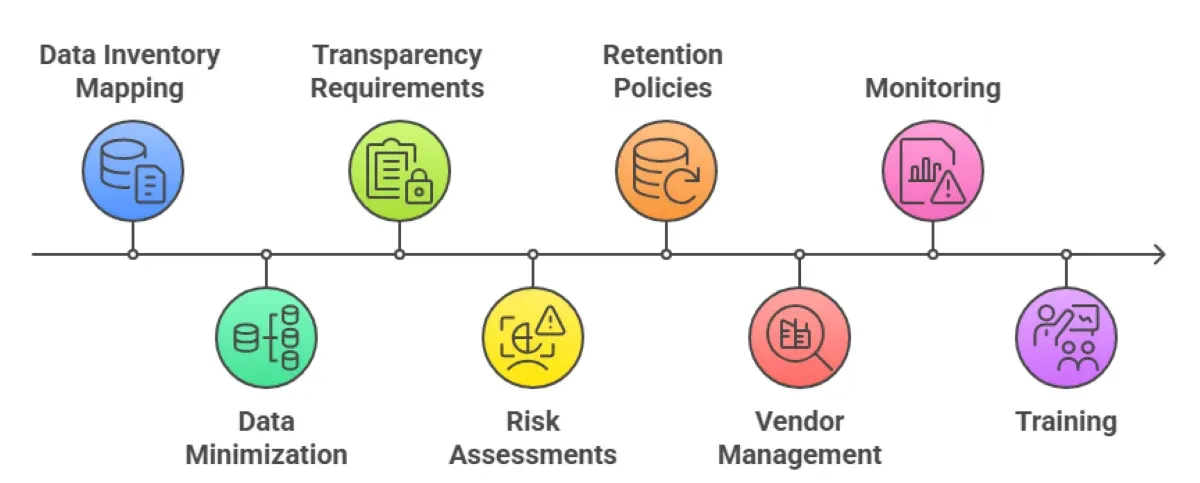
Follow this systematic approach to build GDPR-compliant generative AI deployments across your organization. Each step addresses specific regulatory requirements while maintaining operational flexibility for your B2B applications, ensuring both compliance and business value from AI investments.
Document all personal data flowing through AI systems, like training datasets, fine-tuning inputs, inference queries, and generated outputs across systems. Create comprehensive data flow diagrams showing where data originates, how it's processed, where it's stored, and who has access under your security protocols.
Collect only necessary personal data for AI functionality and legitimate business purposes, nothing more. Implement pseudonymization techniques, replacing direct identifiers with tokens. Use synthetic data for training when possible. Apply differential privacy methods to protect individual data points from identification.
Update privacy notices explaining AI usage, processing purposes, data categories involved, and data subject rights individuals can exercise. Inform customers when AI systems process their data. Provide clear explanations of automated decision-making processes when applicable to their personal information or business interactions.
Conduct Data Protection Impact Assessments for high-risk AI processing, especially large-scale personal data processing, special category data, or systematic monitoring. Document risks, mitigation measures, necessity assessments, and proportionality justifications for regulatory review during investigations or audits.
Establish retention schedules limiting how long personal data remains in AI systems and associated infrastructure. Implement technical capabilities enabling data deletion from training datasets and model outputs. Maintain comprehensive audit trails documenting the data lifecycle from collection through deletion.
Audit AI vendors' GDPR compliance before engagement and throughout your business relationship. Execute Data Processing Agreements specifying processing scope, security measures, subprocessor lists, and audit rights. Ensure vendors support data subject rights and breach notification requirements in their service agreements.
Implement continuous monitoring to detect unauthorized data access, model drift affecting accuracy, or bias in AI outputs impacting individuals. Establish incident response procedures, including breach notification within 72 hours to supervisory authorities when required, with clear escalation paths for serious incidents.
Train staff on GDPR obligations, approved AI tools, data handling procedures, and escalation paths for compliance concerns. Implement human-in-the-loop controls for high-risk decisions affecting individuals. Establish clear accountability for reviewing AI outputs before external communication with customers or partners.
Where you host AI infrastructure directly impacts GDPR compliance complexity and regulatory risk exposure. Geographic location, vendor relationships, and technical architecture all influence your regulatory posture, data protection obligations, and ability to respond effectively to supervisory authority inquiries.
Hosting within EU borders simplifies compliance by keeping personal data under GDPR jurisdiction without transfer complications. EU data centers eliminate cross-border transfer concerns entirely. Many enterprises choose EU-based cloud providers or co-location facilities, ensuring data sovereignty and simplified regulatory relationships.
US-based AI hosting requires transfer mechanisms under GDPR Chapter V and additional documentation proving adequacy. The EU-US Data Privacy Framework provides adequacy for certified US companies meeting specific requirements. Verify vendor certification status and implement supplementary measures if relying on the framework for lawful transfers.
On-premise infrastructure gives complete control over data processing, security measures, and access controls throughout the infrastructure stack. Financial services, healthcare, and government organizations often choose on-premise deployments despite higher costs for sensitive AI applications requiring maximum security and regulatory certainty.
Hybrid architectures balance compliance, performance, and cost by processing sensitive data on-premise while using cloud resources for non-personal data workloads. This approach suits organizations with varied data sensitivity levels across different business units, geographies, or customer segments requiring flexible solutions.
Beyond GDPR, national laws may impose additional data localization requirements affecting deployment decisions. German companies face BDSG requirements, adding specific obligations. French organizations navigate specific sector regulations. Understanding multi-jurisdictional compliance prevents costly architectural changes requiring complete infrastructure redesigns.
Your AI vendor relationships create legal obligations under GDPR Article 28, requiring formal contractual arrangements. Proper contracts and ongoing oversight ensure vendors process data lawfully while protecting your organization from liability, regulatory investigations, and potential fines reaching millions of euros.
Data Processing Agreements must specify processing purposes, data types, processing duration, data subject rights support, security measures, subprocessor provisions, and audit rights. Generic DPAs often miss AI-specific considerations requiring customization for model training, inference logs, and output retention, affecting compliance posture.
Request detailed Technical and Organizational Measures documentation from AI vendors covering access controls, encryption standards, employee training, incident response procedures, and physical security. Verify measures match your risk assessments and regulatory obligations under GDPR accountability principles requiring controller oversight of processors.
AI vendors often use subprocessors, like cloud providers, API services, or development partners, for various processing activities. Your DPA must require vendor disclosure of all subprocessors, notification of changes, and your right to object to specific subprocessors before they process your organization's personal data.
Negotiate audit rights allowing you to verify vendor GDPR compliance through on-site inspections, documentation reviews, or third-party certifications. Schedule regular compliance reviews, especially after vendor infrastructure or policy changes that could affect security, data handling, or compliance with your processing instructions.
When AI vendors transfer data outside the EU, Standard Contractual Clauses provide GDPR-compliant transfer mechanisms approved by regulators. Ensure vendors execute appropriate SCCs and implement supplementary measures addressing surveillance risks per Schrems II requirements, protecting EU citizens' fundamental rights.
GDPR grants individuals specific rights over their personal data that your organization must support. Your AI architecture must support these rights technically and procedurally, even when data is embedded in model weights, making deletion or correction technically challenging for development teams.
When individuals request access to their data, you must provide information about AI processing, data categories involved, processing purposes, and logic involved in automated decisions. Technical systems should make retrieving this information straightforward. Response timelines are strict, typically one month from receiving valid requests.
Deletion requests pose technical challenges when personal data influences model training or system behavior. Document whether deletion requires model retraining, implement data deletion from training datasets, and maintain records proving deletion occurred. Some situations may require full model retraining.
Correcting inaccurate personal data in AI systems requires updating source datasets and potentially retraining models with corrected information. Establish procedures identifying where corrected data exists and propagating changes throughout AI pipelines. Document correction processes for regulatory compliance and audit trails.
When AI makes significant automated decisions affecting individuals, GDPR grants explanation rights requiring meaningful information. Implement explainability tools providing meaningful information about decision logic, significance, and consequences in understandable language. Technical explanations alone don't satisfy legal requirements; human-readable explanations are mandatory.
Create standardized procedures for handling data subject requests within GDPR's one-month deadline, with a possible two-month extension for complex requests. Designate responsible personnel, implement request tracking systems, and test procedures regularly, ensuring they work when requests arrive. Document all responses for potential regulatory review.
Applying compliance frameworks to specific use cases demonstrates how GDPR principles translate into operational requirements for real business applications. These scenarios reflect common B2B generative AI applications across industries, showing how the eight-step checklist applies to actual deployments you might implement.
AI-powered customer support processes inquiries containing personal data like names, account details, and service histories. Implement transparency notices, human escalation paths, data retention limits, secure hosting, and audit trails documenting all customer interactions. Regular review ensures ongoing compliance as systems evolve.
Generative AI creating marketing materials may process customer testimonials, demographic data, or usage patterns for personalization. Ensure lawful processing basis, implement data minimization, anonymize inputs when possible, and maintain creation records. Clear policies govern what customer data feeds content generation systems.
Multi-national AI agent deployments involve cross-border data transfers requiring Standard Contractual Clauses, adequacy assessments, or Data Privacy Framework certification. Central governance with local compliance oversight balances efficiency and regulatory requirements. Different jurisdictions may require separate instances or data residency.
AI analyzing business documents often encounters personal data in contracts, NDAs, or procurement files processed daily. Classification systems, role-based access controls, and retention policies protect sensitive information. Automated redaction helps but requires human verification.
Work through the eight-step compliance checklist for every use case before deployment begins. Document legal basis, conduct DPIAs for high-risk scenarios, establish data subject rights procedures, and implement appropriate technical and organizational measures. Different scenarios require different emphasis across the eight steps.
Even well-intentioned AI deployments fall into compliance traps that trigger regulatory investigations and fines. Recognizing these common mistakes helps you build stronger governance frameworks from the start, avoiding expensive retrofitting or complete system redesigns required to achieve compliance after deployment.
Organizations often assume "business purposes" justify processing personal data for AI training without proper analysis. GDPR requires specific lawful grounds, consent, contract necessity, legitimate interest with balancing, or legal obligation. Document your legal basis clearly before any training begins. Supervisory authorities scrutinize this closely.
Inputting customer data into ChatGPT, Claude, or other public AI services without proper controls creates immediate GDPR violations. Establish approved AI tools, implement technical restrictions blocking unauthorized services, and train employees on acceptable use. Many organizations discover violations only during audits.
Many organizations deploy AI without conducting required Data Protection Impact Assessments before processing begins. High-risk processing—large-scale sensitive data, systematic monitoring, or automated decisions—mandates DPIAs before processing. Supervisory authorities view missing DPIAs as serious compliance failures, indicating inadequate governance.
GDPR accountability requires documenting how AI systems make decisions and process personal data throughout the lifecycle. Missing documentation prevents responding to data subject requests, conducting audits, or defending regulatory investigations. Maintain comprehensive processing records from design through decommissioning.
AI systems generate inference logs capturing queries and responses containing personal data requiring protection. These logs contain personal data requiring protection, retention limits, and data subject rights support. Many organizations overlook logs until a data breach or an audit occurs, discovering years of unmanaged personal data.
The regulatory environment governing AI continues to change rapidly across multiple jurisdictions worldwide. Staying ahead of upcoming requirements helps you make strategic decisions, avoiding costly compliance retrofitting, system redesigns, or complete deployment changes that waste time and resources while delaying business value.
The AI Act enters force progressively through 2027, with different provisions activating at different times. The prohibited practices ban takes effect in 2025. High-risk system requirements apply from 2026. General-purpose AI obligations activate in 2027. Plan compliance efforts matching the regulatory timeline to avoid rushed implementations.
Post-Brexit UK maintains GDPR principles but introduces modifications through Data Protection Act amendments, creating new requirements. UK-EU data transfers require adequacy or alternative mechanisms. Monitor UK regulatory developments if serving British markets. Divergence creates compliance complexity for organizations operating in both jurisdictions.
California, Colorado, and other states enact AI-specific regulations complementing data privacy laws already in effect. Federal AI legislation progresses slowly, but major proposals exist. US operations require tracking multiple jurisdictions' divergent requirements. State-by-state compliance creates significant operational challenges for national deployments.
Regulatory proposals increasingly require AI-generated content watermarking, disclosure mechanisms, and transparency reports to regulatory authorities. Industry standards like C2PA gain adoption from major platforms. Early implementation prepares you for likely mandates. Transparency is becoming table stakes.
Despite jurisdictional differences, global regulations converge around fairness, transparency, accountability, and human oversight principles protecting individuals. Building systems respecting these universal principles simplifies multi-jurisdiction compliance. Design once, deploy globally, becomes possible with proper architecture.
Conduct an inventory of all generative AI systems processing personal data
Review and update privacy notices covering AI processing activities
Execute Data Processing Agreements with all AI vendors
Perform DPIAs for high-risk AI deployments
Implement data subject rights fulfillment procedures
Establish employee training programs on GDPR and AI
Document the legal basis for all AI data processing
Set up monitoring and incident response protocols
Review data retention and deletion capabilities
Assess cross-border data transfer mechanisms
Achieving GDPR compliance while deploying powerful generative AI requires technical expertise, legal knowledge, and operational experience that most organizations lack internally. Folio3 AI provides comprehensive support, ensuring your AI initiatives meet regulatory requirements while delivering business value.
We design and build custom Generative AI models with built-in compliance, fine-tuned to your data, industry, and use cases. Whether it's text, visuals, or complex datasets, our models deliver accuracy, scalability, and business-specific value while incorporating privacy-by-design principles, data minimization techniques, and documented processing controls.
We embed Generative AI solutions into your existing IT systems while preserving data governance controls and compliance frameworks. From CRM and ERP systems to proprietary platforms, we ensure smooth integration without disrupting workflows, boosting operational efficiency while maintaining access controls, audit trails, retention policies, and regulatory compliance.
Our experts craft targeted prompts tailored to your enterprise applications, ensuring consistent, relevant, and high-quality AI outputs that respect data protection principles. The result: better model performance and reliable results that prevent unauthorized data disclosure, maintain appropriate processing boundaries, and generate compliant outputs every time.
Strengthen your internal teams with our seasoned MLOps specialists who ensure ongoing compliance throughout AI lifecycles and operations. We support your Generative AI infrastructure services by managing model deployment, compliance monitoring, scaling, and ongoing governance work, keeping your AI systems production-ready while meeting regulatory requirements.
We automate repetitive coding tasks using AI-driven tools with embedded security and compliance controls throughout development processes. Our approach reduces manual effort and ensures higher code quality with built-in privacy protections, automated compliance testing, comprehensive documentation, and secure development practices, freeing teams for high-value initiatives.

{ "@context": "https://schema.org", "@type": "FAQPage", "mainEntity": [ { "@type": "Question", "name": "What is generative AI, and why does GDPR matter?", "acceptedAnswer": { "@type": "Answer", "text": "Generative AI creates new content such as text, images, or code. GDPR matters because these systems may process personal data, requiring lawful grounds, transparency, privacy safeguards, and accountability to avoid violations or fines." } }, { "@type": "Question", "name": "Which GDPR articles apply when deploying generative AI in a B2B context?", "acceptedAnswer": { "@type": "Answer", "text": "Key GDPR articles include Article 6 for lawful processing, Article 22 on automated decision-making, and Articles 15–17 covering data subject rights. Chapter V governs international data transfers, while Articles 24–25 require privacy by design and default." } }, { "@type": "Question", "name": "How can B2B companies minimize GDPR risk when using generative AI?", "acceptedAnswer": { "@type": "Answer", "text": "B2B companies should implement data minimization, conduct Data Protection Impact Assessments, maintain strong access controls, and sign Data Processing Agreements with vendors. Additional safeguards include employee training, human oversight, transparent privacy notices, and clear retention policies." } }, { "@type": "Question", "name": "Does using a large-language model (LLM) hosted by a third party pose GDPR issues?", "acceptedAnswer": { "@type": "Answer", "text": "Yes. Third-party LLMs may store personal data in logs, create cross-border data transfer challenges, and introduce unclear retention or processing risks. Companies must audit vendor compliance, enforce contractual safeguards, and consider EU-hosted or on-premise models for sensitive workflows." } }, { "@type": "Question", "name": "How does working with a solutions partner like Folio3 AI help with GDPR compliance?", "acceptedAnswer": { "@type": "Answer", "text": "Folio3 AI incorporates GDPR controls into system design, provides governance frameworks, supports DPIAs, and builds privacy-by-design architectures. Ongoing MLOps ensures continued compliance as regulations evolve and your AI systems scale." } }, { "@type": "Question", "name": "What is the future regulatory environment for generative AI and GDPR?", "acceptedAnswer": { "@type": "Answer", "text": "The EU AI Act introduces risk classifications, transparency obligations, and stricter oversight for high-risk AI systems. Combined with GDPR, businesses will face tighter requirements around data usage, human oversight, auditing, and model explainability for generative AI deployments." } } ] }
Generative AI creates new content like text, images, or code. GDPR matters because these systems process personal data, requiring lawful grounds, transparency, and accountability to avoid fines.
Article 6 covers lawful processing, Article 22 restricts automated decisions, and Articles 15-17 grant data rights. Chapter V governs international transfers, while Articles 24-25 mandate privacy by design.
Implement data minimization, conduct DPIAs, and execute vendor Data Processing Agreements. Train employees, establish human oversight, and maintain transparent privacy notices with clear retention schedules.
Yes. Third-party LLMs may retain personal data in training logs and trigger cross-border transfer requirements. Audit vendor compliance, execute proper DPAs, and consider EU-hosted alternatives for sensitive data.
Folio3 AI embeds compliance controls during design, provides data governance frameworks, and supports DPIAs. Our ongoing MLOps ensures compliance as regulations change and your AI deployments scale.
The EU AI Act adds requirements beyond GDPR for high-risk systems. Global regulations are converging around transparency and accountability, requiring B2B firms to address multiple jurisdictions simultaneously.