
Loading...

You've been there; it's 2 AM, your deployment just crashed, and users are flooding support channels. What if you could see it coming hours before it happened? That's exactly what GenAI predicts deployment failures technology does. By analyzing patterns in your deployment data, AI deployment failure prediction catches problems before they reach production.
The numbers tell a stark story: 95% of GenAI pilot programs fail to deliver ROI, according to MIT research analyzing 150 enterprise leaders and 300 public deployments. But the 5% that succeed use predictive analytics CI/CD pipelines to catch failures early, reducing incidents by 30-50% while accelerating release velocity. This guide shows you how to join that successful minority.
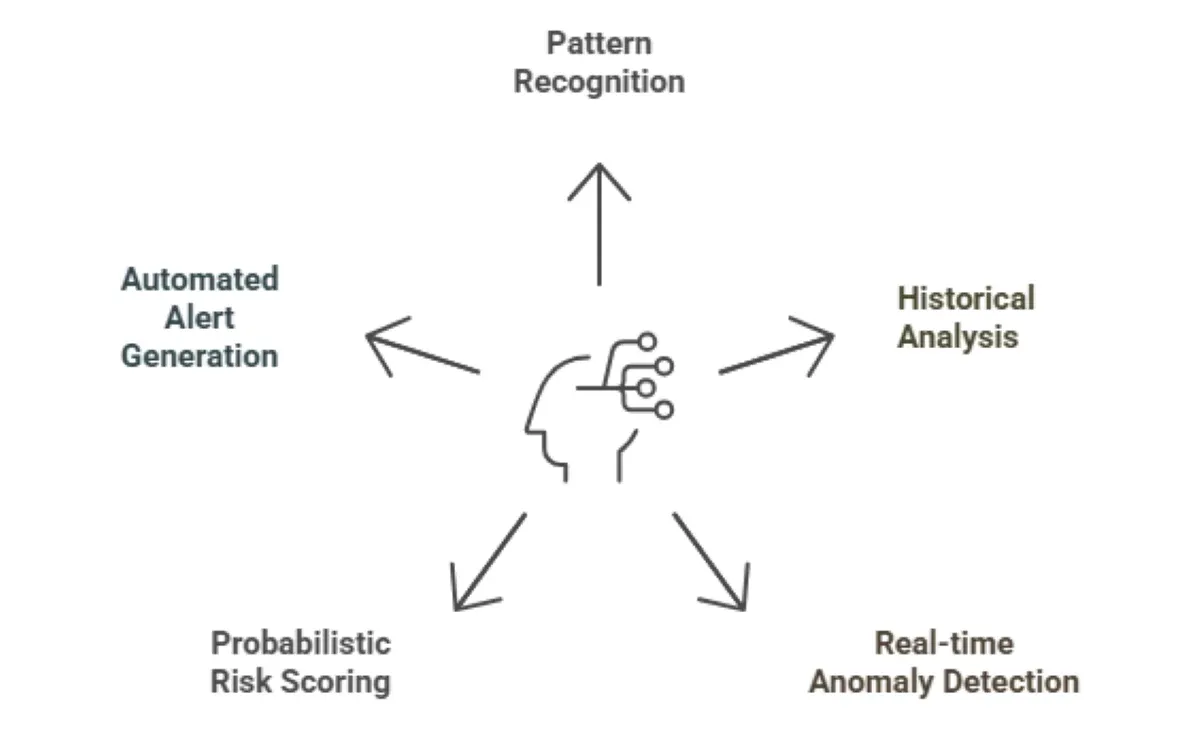
GenAI deployment failures before they happen become reality through intelligent automation. Predictive maintenance software deployment analyzes historical patterns, infrastructure metrics, and code changes to forecast problems before they impact production environments, giving teams critical time to intervene and prevent disasters.
AI models scan thousands of past deployments to identify subtle failure signatures invisible to humans. They detect complex correlations between code changes, test results, infrastructure state, and production incidents automatically. Patterns that seem random to engineers become predictive signals your AI-powered DevOps system acts on automatically before problems escalate.
Your deployment history contains definitive answers to future problems waiting to happen predictably. GenAI predicts deployment failures by correlating CPU spikes with memory leaks, configuration changes with timeout errors, and team activity patterns with deployment success rates. Past failures automatically transform into accurate future predictions through statistical learning algorithms.
AI continuously monitors live deployment metrics against learned baselines from thousands of successful releases. Unusual CPU usage patterns, unexpected latency spikes, or error rate jumps trigger immediate alerts. Automated deployment testing happens in milliseconds, giving you precious time to prevent cascading failures before users notice performance degradation or service interruptions.
Not all deployment risks carry equal weight or business consequences for operations. AI deployment failure prediction assigns probability scores to each deployment based on multiple critical factors: code complexity, test coverage, infrastructure load, deployment timing, and historical team performance metrics. High-risk deployments automatically receive extra scrutiny and validation gates.
When risk thresholds breach acceptable limits, AI-powered deployment monitoring triggers targeted alerts with full context instead of generic notifications. No more alert fatigue from false positives that train teams to ignore warnings entirely. Each notification includes failure probability percentages, affected components, and specific recommended actions; actionable intelligence for rapid response.
Machine learning deployment failures drain your budget, damage your reputation, and burn out your team. Understanding these costs helps you build a stronger business case for AI-powered deployment monitoring solutions that prevent expensive outages before they impact customers and revenue streams.
Every minute of downtime costs enterprises thousands in lost revenue and productivity. High-traffic platforms lose $300,000 per hour during outages, according to industry research. Hidden costs include overtime pay, emergency resource allocation, and delayed feature releases that compound losses across quarters and affect annual projections.
Failed deployments erode user confidence immediately and permanently in your platform. Research shows 32% of customers abandon services after experiencing one bad incident or outage. Recovery takes months of perfect execution, while competitors actively capitalize on your instability. Trust lost today becomes revenue lost tomorrow.
Your engineers waste most of their time firefighting incidents instead of building innovative features. Context switching between emergency fixes and planned work kills momentum and team morale. Burnout follows quickly when teams remain stuck in reactive mode, unable to plan strategically or focus on innovation.
One failed deployment triggers dominoes that topple across your entire organization's operations. Sales teams can't close deals with prospects, marketing campaigns pause mid-flight, losing momentum, and support channels get overwhelmed with complaints and tickets. Executive confidence erodes rapidly, and critical operations grind to a halt while everyone waits for engineers.
While you're fixing broken deployments, competitors ship faster and capture market share aggressively. Critical market windows close permanently, and opportunities disappear. Customers migrate to more reliable alternatives without hesitation. Your release velocity drops below industry standards dramatically. Each failure widens the gap between you and faster-moving rivals.
Sophisticated AI techniques power accurate deployment governance AI across diverse environments. These methodologies analyze structured and unstructured data types to catch critical issues that traditional threshold-based monitoring systems consistently miss, enabling proactive intervention strategies.
Different algorithms serve different prediction needs effectively in CI/CD pipeline optimization. Random Forests handle structured log data with categorical variables efficiently. XGBoost excels at binary failure classification with imbalanced datasets. LSTMs capture complex time-series patterns and temporal dependencies. Your specific data characteristics and infrastructure complexity determine optimal model choice for maximum accuracy and reliability.
Raw metrics need careful transformation into predictive signals that machine learning deployment failures models can interpret accurately. Rolling averages smooth random noise and reveal true performance trends. Rate-of-change calculations catch gradual deterioration patterns early. Combined features like "CPU-high + fan-low = overheating risk" create powerful compound predictors that no single isolated metric can reveal effectively.
Deployment metrics unfold sequentially over time with complex interdependencies requiring specialized analysis. LSTM neural networks learn these temporal dependencies automatically, understanding that slow response times followed by memory spikes predict crashes hours later. Time becomes a predictive feature itself for predictive analytics CI/CD pipelines, not just a passive timestamp for event logging.
Modern distributed systems have incredibly complex service dependencies spanning hundreds of microservice architectures. Graph neural networks map these intricate relationships accurately for software deployment automation, predicting how failures propagate through your architecture topology. If service A fails unexpectedly, GNNs forecast precisely which downstream services will cascade next in the failure chain.
Not all critical failures resemble past failures you've already experienced and labeled historically. Isolation Forest algorithms detect completely novel anomalies without requiring labeled training data from previous incidents. They spot unprecedented patterns that supervised machine learning deployment failures models miss entirely, catching zero-day deployment issues automatically without prior examples or training.

Your CI/CD pipeline optimization becomes significantly smarter when AI predicts which builds will fail before execution. Predictive analytics CI/CD pipelines accelerate release cycles while simultaneously maintaining high stability and quality standards across all environments, reducing risk and increasing velocity simultaneously.
AI analyzes historical build logs, test patterns, and code changes to forecast pipeline success probability before execution starts. High-risk pipelines get flagged immediately for human review and validation. Teams investigate potential issues before wasting expensive compute resources on doomed builds. AI deployment failure prediction accuracy improves continuously with each completed build cycle and outcome.
Not all tests are equally valuable for catching critical bugs in automated deployment testing. AI ranks tests by failure probability and potential business impact severity automatically. Critical tests run first to fail fast and save time. Flaky tests get isolated and deprioritized automatically. Your test suite becomes both faster and more effective, simultaneously at catching real production-impacting issues.
GenAI predicts deployment failures while identifying performance bottlenecks in your build process automatically. Parallel execution opportunities, cache optimization points, and redundant steps become instantly visible through analytics. Builds accelerate by 33% on average while maintaining quality standards rigorously. Resource utilization improves dramatically without requiring manual tuning efforts or infrastructure changes.
Before production deployment, AI-powered deployment monitoring evaluates risk across multiple critical dimensions simultaneously: code changes, infrastructure state, traffic patterns, and team availability. High-risk deployment windows trigger automatic delays or additional validation steps. Lower-risk deployments proceed immediately, accelerating overall velocity safely with confidence.
When post-deployment metrics deviate significantly from AI predictions, software deployment automation initiates automatic rollbacks without manual intervention required. No human decision-making is required during critical incidents or failures. Systems self-heal before user impact becomes visible or measurable in analytics. Mean time to recovery drops from hours to mere minutes automatically through intelligent automation.
AIOps deployment automation and MLOps failure detection provide complementary capabilities for deployment prediction that work better together. Understanding their distinct roles and integration points helps you architect effective solutions that leverage both approaches' unique strengths for comprehensive coverage.
AIOps deployment automation platforms continuously monitor IT infrastructure using AI-powered analytics and intelligent automation. They correlate events across logs, metrics, and distributed traces automatically. Alert noise is reduced by 80% through intelligent filtering and deduplication. Root cause analysis becomes automatic and accurate without manual investigation. Operations teams shift from reactive firefighting to proactive prevention strategies.
MLOps failure detection ensures your prediction models stay accurate over time as systems evolve continuously. Automated retraining pipelines update models with fresh deployment data regularly. Version control tracks model evolution and performance metrics systematically. Performance monitoring detects drift before accuracy degrades noticeably. Models improve continuously without manual intervention or data scientist involvement required.
AIOps deployment automation feeds real-time infrastructure signals to MLOps prediction models for enhanced accuracy. MLOps predictions inform AIOps automation decisions and remediation strategies intelligently. Unified observability platforms connect both systems seamlessly through APIs. Data flows bidirectionally, creating a comprehensive intelligence layer that neither system achieves alone through isolated operation.
Effective AI deployment failure prediction requires coordinated data flow across multiple heterogeneous sources. Pipelines collect deployment metrics, infrastructure telemetry, and application logs automatically without manual configuration. ETL processes normalize disparate formats into unified schemas for analysis. Real-time streams feed models for immediate predictions while batch processes train them overnight on historical data.
Your deployment environment evolves constantly with new services and changing patterns requiring adaptation. Models must adapt automatically to maintain accuracy through MLOps failure detection. Feedback loops capture prediction accuracy against actual outcomes systematically. A/B testing compares model versions objectively using statistical methods. Champion-challenger frameworks ensure only proven improvements reach production environments safely.
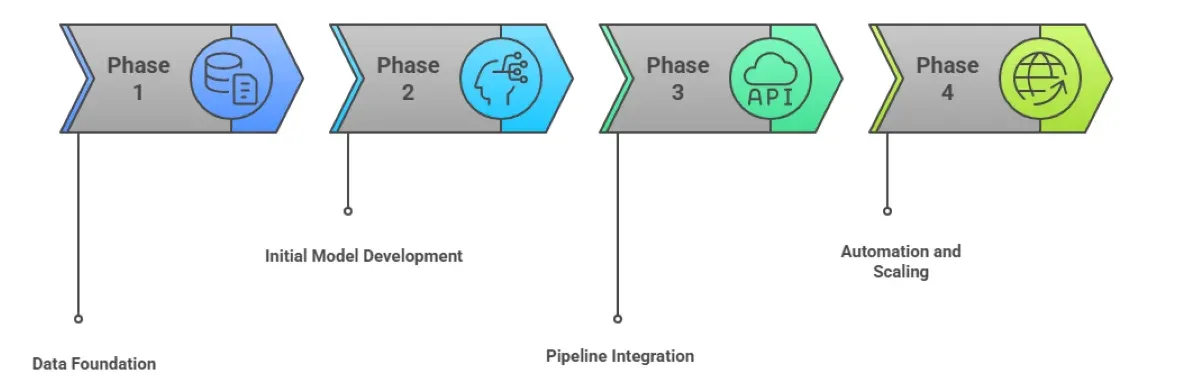
Implementation requires methodical progression through four distinct phases for the deployment governance of AI. Each phase builds capability while delivering immediate value to stakeholders incrementally. Start small, prove value early, then scale systematically across your organization with confidence gained from initial successes.
Start by centralizing logs, metrics, and traces in unified storage for predictive maintenance software deployment. Implement structured logging across all services for consistency and searchability. Deploy agents to collect infrastructure telemetry automatically without manual configuration. Establish baseline metrics for normal operation patterns through statistical analysis. Clean, high-quality data beats fancy algorithms every single time.
Begin with simple algorithms trained on high-quality historical data for AI deployment failure prediction. Train models to predict common failure patterns you've seen before repeatedly. Validate accuracy against historical deployments rigorously using holdout datasets. Iterate quickly to improve performance incrementally. Early wins build stakeholder confidence for larger investments and expanded scope.
Integrate prediction APIs into your CI/CD pipeline optimization workflow at key decision points strategically. Configure risk thresholds that balance safety and deployment velocity appropriately. Create dashboards showing prediction accuracy and business impact clearly. Train teams on interpreting AI recommendations before enforcing automation that blocks deployments entirely. Start with advisory mode first.
Expand software deployment automation to lower-risk scenarios first, building confidence gradually through success. Implement auto-rollbacks for obvious failures with clear signals automatically. Scale infrastructure to handle prediction load across all environments globally. Add sophisticated models for complex failure modes incrementally. Measure ROI continuously to justify continued investment and resource allocation.
Your tool stack determines AI-powered deployment monitoring capabilities and integration ease significantly. Select platforms that integrate well with existing systems and match your team's technical sophistication level for faster adoption, lower training costs, and higher ROI.
XGBoost and LightGBM excel at structured deployment data with categorical features for machine learning deployment failures. TensorFlow and PyTorch handle deep learning for complex pattern recognition tasks. Scikit-learn provides accessible entry points for teams new to machine learning concepts. Cloud platforms like Azure ML simplify infrastructure management and scaling automatically without DevOps overhead.
Datadog, Dynatrace, and New Relic offer AI-powered DevOps monitoring with predictive capabilities built in. Splunk excels at log analysis and correlation across heterogeneous sources. Prometheus plus Grafana provides open-source flexibility and customization options. Choose platforms with robust API access for custom model integration and data export capabilities for advanced analytics.
Jenkins X, GitLab CI, and GitHub Actions support automated deployment testing through predictive plugins and extensions. Harness provides native AI deployment verification and risk assessment automatically. CircleCI offers intelligent test splitting and optimization based on historical patterns. Tool choice depends heavily on your existing DevOps ecosystem and team preferences for consistency.
Moogsoft and BigPanda specialize in alert correlation and noise reduction for AIOps deployment automation. PagerDuty AIOps automates incident management and response workflows intelligently. ServiceNow integrates with enterprise ITSM systems seamlessly for unified operations. Evaluate based on your infrastructure complexity, team size, and existing tool investments to minimize integration friction.
FastAPI builds lightweight prediction APIs with automatic documentation for AI deployment failure prediction. Docker and Kubernetes deploy models at scale across environments consistently. Airflow orchestrates complex training pipelines with dependencies and scheduling. Cloud functions provide serverless inference without infrastructure management overhead. Balance build versus buy based on specific requirements carefully.
Quantify value through metrics that matter to both technical teams and business stakeholders clearly. Track improvements over time and adjust strategies based on measurable outcomes across multiple dimensions for deployment, governance, AI effectiveness, and ROI justification.
Deployment frequency increases significantly as predictive analytics CI/CD pipelines reduce the fear of releases dramatically. Lead time shrinks when teams catch issues early in pipelines automatically. Change failure rate drops with better risk assessment and validation gates. MTTR decreases through automated recovery and rollback mechanisms. Track all four DORA metrics consistently for benchmarking progress.
Too many false alarms quickly kill trust in AI deployment failure prediction systems permanently. Target false positive rates consistently below 10% for credibility with operations teams. Balance sensitivity versus specificity based on deployment criticality and business impact carefully. Tune thresholds based on actual outcomes iteratively. Monitor alert fatigue indicators continuously through response rate tracking.
Track production incidents month-over-month to measure GenAI predict deployment failures prevention effectiveness accurately. Successful prediction systems reduce incidents by 30-50% within six months of implementation. Categorize prevented versus actual incidents for accurate attribution and ROI calculation. Calculate cost savings from avoided outages precisely. Share wins publicly to build organizational support.
Measure how quickly teams resolve flagged issues versus unflagged unexpected ones with AI-powered deployment monitoring. Prediction should accelerate resolution through better context and recommended actions provided. Track the mean time to detection separately from the mean time to resolution. Both metrics should improve steadily as the system matures and teams gain experience with predictions.
Convert technical metrics to business value that executives understand immediately for deployment governance and AI justification. Calculate revenue protected by preventing outages before users notice disruptions. Measure developer hours saved on firefighting versus building innovative features. Quantify customer churn reduction from improved reliability and uptime. Build comprehensive ROI models justifying continued investment in prediction capabilities.
Every organization faces predictable obstacles when adopting predictive maintenance software deployment systems. Anticipate these challenges early and plan specific mitigation strategies to smooth adoption and maximize success rates across teams, reducing friction and accelerating time to value.
Poor data quality yields poor predictions regardless of algorithm sophistication in machine learning deployment failures. Invest heavily in data infrastructure before building models extensively. Standardize logging formats across all services for consistency. Fill historical gaps systematically through data archaeology. Implement automated data validation checks continuously. Clean, comprehensive data beats sophisticated algorithms every time consistently.
Models trained on biased data perpetuate and amplify existing problems systematically in AI deployment failure prediction. Audit training data for representation gaps across service types thoroughly. Test predictions across different deployment scenarios systematically and rigorously. Monitor for systematic prediction errors affecting specific teams disproportionately. Implement fairness metrics alongside traditional accuracy measures for comprehensive evaluation.
Excessive alerts train teams to ignore notifications entirely, destroying AI-powered deployment monitoring effectiveness. Start with high-confidence predictions only to build trust initially. Gradually expand coverage as accuracy improves and confidence grows organically. Provide clear action items with each alert, not just vague warnings. Measure response rates to gauge alert quality perception among teams.
Your teams need new capabilities to work effectively with predictive analytics CI/CD pipelines successfully. Provide comprehensive ML literacy training for operations staff regularly. Cross-train operations teams on data science basics and model interpretation techniques. Bring data scientists into deployment discussions early in projects. Foster collaboration between previously siloed groups through shared goals and metrics.
Resistance comes from fear of automation replacing jobs and reducing control in software deployment automation. Frame prediction as augmentation, not replacement of human expertise and judgment. Start with advisory mode before full automation implementation. Celebrate successes publicly and address failures transparently with teams. Build trust gradually through demonstrated value and consistent communication.
Emerging technologies will make GenAI deployment failures before they happen prediction more accurate and automated over the coming years. Stay ahead by tracking these developments and planning adoption strategies that position your organization competitively for next-generation capabilities.
Next-generation software deployment automation systems will detect, predict, and remediate without any human intervention required. AI will automatically apply fixes, allocate resources, and optimize configurations based on predictions intelligently. Human oversight shifts from hands-on execution to governance and strategy only. True autonomous operations become reality within five years across industries.
Large language models will analyze complex logs and generate human-readable explanations of failures for AI-powered DevOps. GenAI will suggest specific fixes in natural language that junior engineers understand immediately. Documentation generation becomes automatic from incident data without manual writing. Knowledge bases self-update from every resolved issue, creating organizational learning loops continuously.
Future GNNs will model entire enterprise architectures with thousands of interdependencies for deployment governance AI. They'll predict cascade failures across hundreds of interdependent services accurately in real-time. Topology awareness enables system-wide optimization that current point-solution tools can't achieve alone. Architecture becomes a predictive feature itself, informing deployment strategies dynamically.
Companies will share anonymized failure patterns while protecting proprietary information and competitive advantages through GenAI project failure rates analysis. Collective intelligence improves predictions industry-wide through aggregated learning across enterprises. Rare failure modes become predictable through cross-company data sharing. Privacy-preserving techniques enable collaboration without exposing sensitive operational details.
Quantum algorithms may revolutionize AI deployment failure prediction through exponentially faster pattern-matching capabilities. Complex optimization problems that take hours today could be completed in seconds with quantum processors. Adoption timelines remain uncertain but extremely promising for prediction tasks requiring massive parallelization. Early experiments show orders-of-magnitude performance improvements over classical computing approaches.
As a trusted Generative AI development partner, we deliver end-to-end solutions designed to help enterprises accelerate innovation, optimize operations, and achieve measurable business impact. From strategy to deployment, our scalable Generative AI consulting and technology services enable organizations to unlock new levels of efficiency and growth through intelligent automation and predictive capabilities.
We design and build custom Generative AI models, fine-tuned to your data, industry, and use cases specifically. Whether it's text, visuals, or complex datasets, our models deliver accuracy, scalability, and business-specific value that directly address your unique challenges and accelerate time to market with production-ready solutions that scale.
We seamlessly embed Generative AI solutions into your existing IT ecosystem without disruption to operations. From CRM and ERP systems to proprietary platforms, we ensure smooth integration without disrupting workflows—maximizing operational efficiency while minimizing change management overhead and maintaining business continuity throughout the entire implementation process and beyond.
Our experts craft optimized prompts tailored to your enterprise applications and specific use cases. We ensure consistent, relevant, and high-quality AI outputs that meet business requirements precisely. The result: better model performance and reliable results, every time, with reduced hallucinations and improved accuracy that drives measurable business outcomes consistently.
Strengthen your internal teams with our seasoned MLOps specialists who bring years of hands-on experience. We support your Generative AI infrastructure services by managing model deployment, monitoring, scaling, and ongoing optimization, keeping your AI systems production-ready at all times with minimal downtime or performance degradation through proactive maintenance and continuous improvement.
We automate repetitive coding tasks using AI-driven tools that learn from your codebase patterns. Accelerating software development cycles, reducing manual effort, and ensuring higher code quality—all while freeing your teams to focus on high-value initiatives that drive business innovation and competitive advantage in your market through strategic feature development.
Our Generative AI technology services help you break down data silos and unlock hidden insights. Process large datasets and generate actionable insights in real time, empowering smarter, faster decision-making across every business unit with data-driven strategies that improve outcomes and accelerate growth initiatives while reducing operational costs significantly.

GenAI deployment failure prediction uses machine learning algorithms to analyze historical deployment data, code changes, infrastructure metrics, and test results to forecast which deployments will fail before they reach production. The system assigns risk scores and triggers alerts when failure probability exceeds acceptable thresholds.
Accuracy varies by implementation quality and data availability, but mature systems achieve 85-90% precision in predicting deployment failures. False positive rates typically range from 5-10% after proper tuning. Accuracy improves continuously as models train on more deployment outcomes.
Essential data sources include historical deployment logs, build and test results, infrastructure metrics (CPU, memory, network), code repository data, configuration files, user traffic patterns, and incident reports. More comprehensive data yields more accurate predictions.
Basic implementations take 2-3 months for data infrastructure and initial models. Full production deployment with automation typically requires 6-9 months. However, you'll see value from improved visibility and manual predictions within the first month.
No, AI augments human expertise rather than replacing it. Predictions provide data-driven insights that inform human decisions. High-risk deployments still benefit from manual review, while AI handles routine monitoring and low-risk scenarios automatically.
AIOps focuses on IT infrastructure monitoring and incident response using AI. MLOps manages the lifecycle of machine learning models themselves. Both work together, AIOps provides operational insights while MLOps ensures prediction models remain accurate over time.
Yes, even small teams gain value from predictive deployment monitoring. Start with simple anomaly detection and gradually add sophistication. Cloud-based tools lower infrastructure barriers. Open-source frameworks provide accessible entry points without massive investment.
Unsupervised learning algorithms like Isolation Forest detect novel anomalies without prior examples. Systems flag unusual patterns even when they don't match known failure signatures. These detections trigger human investigation and model retraining with new failure types.
Organizations typically see a 30-50% reduction in production incidents, a 40% decrease in mean time to recovery, and a 20-30% improvement in deployment frequency. ROI calculations show positive returns within 6-12 months when factoring in prevented downtime costs.
Begin by centralizing your logs and metrics in a unified platform. Establish baseline performance metrics. Start with simple anomaly detection on historical data. Validate predictions against known incidents. Gradually expand automation as accuracy improves and stakeholder confidence builds.