

Loading...
Generative artificial intelligence (GenAI) is changing industries worldwide, with manufacturing becoming one of the most promising areas for AI adoption. As global supply chains face major disruptions and manufacturers struggle with widespread labor shortages, generative AI offers practical solutions. From predictive maintenance to personalized mass production, this technology redefines how products are designed, manufactured, and delivered.
In this article, we will explore the top use cases and benefits of generative AI in manufacturing and provide insights into how industry leaders use this technology to gain competitive advantages and improve operational efficiency in today's dynamic marketplace.
Generative AI in manufacturing incorporates advanced AI systems that go beyond traditional data analysis and automation to create new solutions, designs, and working approaches. Unlike conventional AI, which primarily analyzes data or makes predictions, Gen AI actively creates innovative product designs, optimizes production workflows, and enhances decision-making throughout the manufacturing process.
These systems analyze large amounts of historical and present data, identify patterns, and incorporate user feedback to continuously improve their performance. This is Gen AI, acting as a smart digital assistant capable of not only interpreting complex manufacturing data but also providing actionable insights.
When discussing the frameworks of "smart factories" or Industry 4.0, generative AI is a key component of connected, flexible, and highly automated manufacturing systems. It autonomously supports real-time monitoring and adjusts production without human intervention, helping manufacturers achieve greater efficiency and responsiveness in their operations.
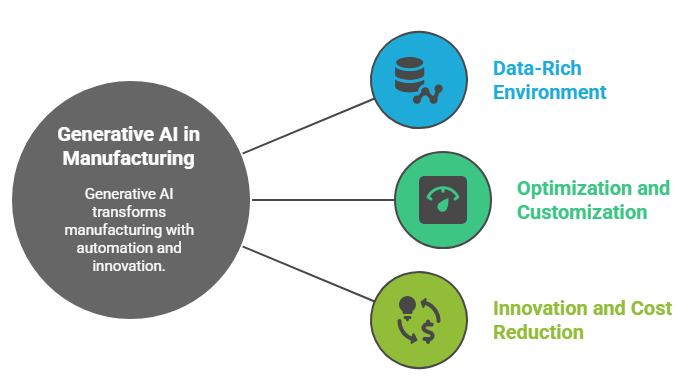
Manufacturing environments present unique opportunities for generative AI implementation due to their inherent characteristics and operational demands. Here's what makes manufacturing facilities ideal for AI transformation and what manufacturers can expect from implementing these advanced systems.
Manufacturing generates massive datasets from sensors, quality control systems, and production logs, providing ideal training material for AI models that can automate repetitive design tasks, documentation processes, and quality assessments across production lines.
Modern manufacturing demands immediate optimization of resources, customized product variants, and predictive insights to prevent failures, requiring AI systems that can generate optimal configurations, predict maintenance needs, and customize products at scale.
Competitive pressures demand rapid product development and cost minimization, where generative AI accelerates design iterations, reduces prototyping costs, and enables manufacturers to bring innovative products to market faster than traditional methods.
Explore more about Generative AI for Marketing: Application & Best Practices
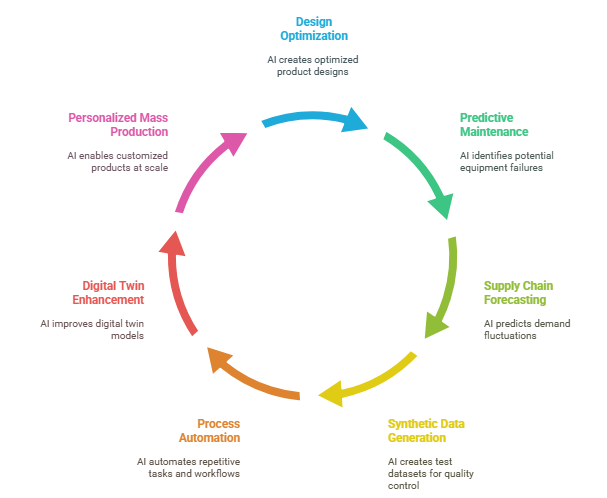
Generative AI applications in manufacturing span across design, operations, and supply chain management, offering transformative solutions for industry challenges.
Generative design represents one of the most impactful applications where AI creates optimized product architectures based on specified constraints and performance requirements.
Generative algorithms analyze performance requirements, material properties, and manufacturing limitations to propose multiple design alternatives that human engineers might not consider, optimizing for weight, strength, cost, and manufacturability simultaneously.
AI-generated designs undergo virtual testing before physical prototyping, reducing the number of physical iterations required and minimizing material waste while accelerating the product development timeline from months to weeks.
Airbus partnered with Autodesk to redesign aircraft cabin partitions using generative AI. The AI system analyzed structural requirements, weight constraints, and safety regulations to create partition designs that were 45% lighter than traditional versions while maintaining the same strength. This weight reduction translates to significant fuel savings over the aircraft's lifetime.
Predictive maintenance uses generative AI to identify subtle patterns in equipment data that indicate potential failures before they occur.
Machine learning models analyze vibration, temperature, sound, and operational data to generate predictive patterns that identify equipment anomalies weeks or months before traditional monitoring systems, enabling proactive maintenance scheduling.
Predictive maintenance increases productivity by 25%, reduces breakdowns by 70%, and lowers maintenance costs by 25%, extending equipment lifespan through optimized maintenance intervals and early intervention strategies.
US Steel implemented Google Cloud's generative AI at its Minnesota iron ore facility to transform maintenance operations. The system continuously monitors massive mining equipment, including conveyor belts, crushers, and hauling trucks, analyzing vibration patterns, temperature fluctuations, and operational data to predict potential failures weeks in advance, dramatically reducing unplanned downtime.
Generative AI transforms supply chain management by creating sophisticated models that simulate various scenarios and predict demand fluctuations with accuracy.
AI systems analyze historical sales data, economic indicators, seasonal patterns, and external factors to generate multiple demand scenarios, enabling manufacturers to prepare for various market conditions and adjust production accordingly.
Learn more about Generative AI for Logistics – Use Cases and Benefits
Machine learning algorithms generate optimal inventory levels by considering lead times, storage costs, and demand variability, reducing carrying costs while ensuring product availability through intelligent just-in-time manufacturing strategies.
The semiconductor shortage that began in 2020 highlighted how AI-powered supply chain systems helped manufacturers navigate unprecedented disruptions. Research shows that companies using data analytics and AI were better positioned to manage supply chain issues during the crisis. These AI systems analyzed real-time data to predict unexpected events like weather conditions, transportation bottlenecks, and labor strikes, helping manufacturers anticipate problems and reroute shipments around disruptions.
Synthetic data generation addresses the problem of insufficient real-world data for training robust quality control systems in manufacturing environments.
Generative models create realistic synthetic defect images and sensor data that supplement limited real-world samples, enabling quality control systems to recognize rare defects and edge cases without waiting for actual failures.
AI-generated datasets provide a balanced representation of all defect types, improving model training effectiveness and reducing false positives in automated quality inspection systems by up to 40% compared to models trained solely on limited real data.
Siemens uses synthetic data generation with NVIDIA Omniverse Replicator to accelerate AI model development for quality control from months to days. Their Motion Control Business Unit produces inverters, drive controllers, and motors. It uses AI-enabled computer vision for defect detection across more than 30,000 customers worldwide, enabling automated visual inspection without requiring vision experts.
Generative AI streamlines manufacturing processes by automating documentation creation and suggesting synchronized workflow improvements based on operational data analysis.
AI systems automatically generate standard operating procedures, maintenance manuals, and compliance documentation from production data and best practices, reducing manual documentation time while ensuring consistency and accuracy.
Read more about how Generative AI Enhances Productivity
Intelligent systems monitor production metrics and generate optimization recommendations for line balancing, resource allocation, and process parameters, improving overall equipment effectiveness and reducing bottlenecks in manufacturing workflows.
Pharmaceutical manufacturers are implementing AI-powered batch recipe optimization systems to automatically adjust mixing parameters, monitor batch consistency, and generate compliance reports. These AI systems analyze process data from sensors, instruments, and process controls to identify abnormalities and predict deviations, enabling quick corrective action while maintaining product quality.
Generative AI enhances digital twin capabilities by creating more sophisticated virtual models that can simulate complex scenarios and accurately predict system behavior.
AI algorithms generate realistic operational scenarios, failure modes, and environmental conditions that digital twins can simulate, providing manufacturers with testing environments that mirror real world complexities and variabilities.
Enhanced digital twins powered by generative AI can run thousands of simulation scenarios simultaneously, predicting optimal operating conditions, maintenance schedules, and production adjustments before implementing changes in physical systems.
Siemens pioneered digital twin usage at their Amberg Electronics Plant in Germany, creating virtual replicas of entire production processes that resulted in a 30% increase in manufacturing volume adjustment capability, a 20% boost in productivity, and a 40% enhancement in space efficiency through AI-enhanced simulation and optimization capabilities.
Generative AI enables manufacturers to offer customized products at scale while maintaining efficiency and cost-effectiveness through intelligent automation and optimization.
AI systems generate personalized product configurations based on customer preferences and requirements, automatically calculating pricing and production timelines while ensuring manufacturing feasibility and profitability for each custom order.
Machine learning algorithms analyze customer behavior, preferences, and usage patterns to generate product variations that meet specific needs, enabling mass customization without the traditional complexity and cost penalties.
In consumer electronics, companies like Samsung are implementing personalized AI features across their product ecosystem, creating device configurations that adapt to individual user behaviors and preferences.
Implementing generative AI in manufacturing delivers measurable benefits across multiple operational dimensions, transforming traditional production paradigms.
Generative AI accelerates product development cycles by automating design iterations, reducing prototyping time, and enabling parallel development processes. For complex products, this cuts time to market from years to months.
AI optimization reduces material waste by up to 30%, minimizes energy consumption through intelligent process control, and reduces labor costs through automation, delivering significant cost savings across manufacturing operations.
Generative algorithms explore design spaces beyond human imagination, generating novel solutions and innovative approaches that drive breakthrough products and new manufacturing processes and accelerate research and development timelines.
AI-powered systems eliminate human error in critical processes, predict safety hazards before they occur, and ensure consistent quality standards, reducing workplace accidents and product defects.
Despite numerous benefits, manufacturers face obstacles when implementing generative AI technologies that require careful planning and strategic approaches.
Manufacturing data contains valuable intellectual property and trade secrets, requiring robust security measures and careful vendor selection when implementing cloud-based AI solutions. Companies must balance AI benefits with data protection requirements and consider on-premises or hybrid deployment models.
Most manufacturing facilities operate legacy equipment and software systems not designed for AI integration. Successful implementation requires significant investment in system upgrades, API development, and middleware solutions to connect AI platforms with existing infrastructure.
Manufacturing employees need new skills to work effectively with AI systems, requiring training programs, change management initiatives, and cultural shifts toward human-AI collaboration. Organizations must invest in upskilling programs and address employee concerns about job displacement.
Folio3 AI delivers artificial intelligence solutions specifically designed for manufacturing environments, combining computer vision, predictive analytics, and custom AI development services.
Advanced AI algorithms analyze equipment data to predict maintenance needs and calculate remaining useful life of components, preventing unexpected downtime while optimizing maintenance schedules for maximum operational efficiency and cost savings.
Computer vision-based systems automate quality assurance processes through visual inspection. They detect defects and faults in production lines while ensuring consistent quality standards and reducing manual inspection requirements.
Tailored AI solutions integrate seamlessly with existing manufacturing systems, providing spontaneous insights, continuous model training, and analytical support for data-driven decision making across all operational levels and manufacturing processes.
Explore this about how to Integrate AI Into Your App: Experts Insight
Implementing generative AI requires strategic planning, careful assessment, and phased deployment approaches tailored to manufacturing environments and organizational capabilities.
Evaluate existing systems, data infrastructure, and integration capabilities to identify gaps and requirements for AI implementation, ensuring compatibility with current operations while planning for future scalability and expansion.
Focus on processes with repetitive tasks, data-rich environments, and clear ROI potential, such as quality control, predictive maintenance, or design optimization, where AI can deliver immediate and measurable benefits.
Partner with AI development specialists to create tailored solutions that address specific manufacturing needs and integrate seamlessly with existing workflows.
Explore Folio3's AI Manufacturing Solutions to accelerate your AI transformation journey.
{ "@context": "https://schema.org", "@type": "FAQPage", "mainEntity": [ { "@type": "Question", "name": "What are the top Generative AI use cases in manufacturing?", "acceptedAnswer": { "@type": "Answer", "text": "Generative AI is used in design optimization, predictive maintenance, demand forecasting, quality control, and automated production planning. Folio3 helps manufacturers integrate custom AI solutions tailored to each stage of production to maximize efficiency and output." } }, { "@type": "Question", "name": "How does Generative AI improve product design and prototyping?", "acceptedAnswer": { "@type": "Answer", "text": "Generative AI quickly creates multiple design variations based on performance goals and material limits. Folio3’s AI-driven modeling tools help companies accelerate prototyping, reduce material waste, and bring products to market faster." } }, { "@type": "Question", "name": "Can Generative AI optimize manufacturing workflows?", "acceptedAnswer": { "@type": "Answer", "text": "Yes. It identifies inefficiencies, predicts downtime, and automates repetitive processes. Folio3 customizes workflow AI systems that streamline production, enhance resource utilization, and minimize human error." } }, { "@type": "Question", "name": "What AI tools are best for improving manufacturing processes?", "acceptedAnswer": { "@type": "Answer", "text": "Folio3 uses a mix of generative AI platforms like AWS AI, Azure AI, and custom-built ML models to support predictive analytics, robotics automation, and digital twin creation for manufacturing ecosystems." } }, { "@type": "Question", "name": "How can Generative AI reduce costs in industrial production?", "acceptedAnswer": { "@type": "Answer", "text": "By automating design, forecasting failures, and optimizing production schedules, manufacturers cut downtime and material costs. Folio3’s tailored AI systems typically help clients reduce operational expenses by up to 30%." } }, { "@type": "Question", "name": "Which Generative AI platforms offer the best ROI for manufacturers?", "acceptedAnswer": { "@type": "Answer", "text": "Platforms like OpenAI, NVIDIA Omniverse, and Folio3’s proprietary AI frameworks offer the highest ROI due to scalability and industry-specific customization." } }, { "@type": "Question", "name": "How is Generative AI used for predictive maintenance?", "acceptedAnswer": { "@type": "Answer", "text": "Generative AI predicts machine failures by simulating wear and stress scenarios. Folio3 integrates AI-driven predictive maintenance into existing IoT systems, minimizing unplanned downtime." } }, { "@type": "Question", "name": "What role does Generative AI play in supply chain management?", "acceptedAnswer": { "@type": "Answer", "text": "It enhances demand prediction, logistics planning, and supplier evaluation. Folio3’s AI models analyze global supply data to ensure resilience and reduce bottlenecks." } }, { "@type": "Question", "name": "Are there any real-world examples of Generative AI in manufacturing?", "acceptedAnswer": { "@type": "Answer", "text": "Yes, many. For instance, Folio3 has helped automotive clients use AI-driven 3D modeling for part design and aerospace manufacturers to automate material testing simulations." } }, { "@type": "Question", "name": "How can businesses get started with Generative AI integration?", "acceptedAnswer": { "@type": "Answer", "text": "Start by identifying key challenges where automation can drive impact. Folio3 provides end-to-end AI consulting—from use-case discovery to model deployment—to ensure seamless integration within existing manufacturing systems." } } ] }
Generative AI is used in design optimization, predictive maintenance, demand forecasting, quality control, and automated production planning. Folio3 helps manufacturers integrate custom AI solutions tailored to each stage of production to maximize efficiency and output.
Generative AI quickly creates multiple design variations based on performance goals and material limits. Folio3’s AI-driven modeling tools help companies accelerate prototyping, reduce material waste, and bring products to market faster.
Yes. It identifies inefficiencies, predicts downtime, and automates repetitive processes. Folio3 customizes workflow AI systems that streamline production, enhance resource utilization, and minimize human error.
Folio3 uses a mix of generative AI platforms like AWS AI, Azure AI, and custom-built ML models to support predictive analytics, robotics automation, and digital twin creation for manufacturing ecosystems.
By automating design, forecasting failures, and optimizing production schedules, manufacturers cut downtime and material costs. Folio3’s tailored AI systems typically help clients reduce operational expenses by up to 30%.
Platforms like OpenAI, NVIDIA Omniverse, and Folio3’s proprietary AI frameworks offer the highest ROI due to scalability and industry-specific customization.
Generative AI predicts machine failures by simulating wear and stress scenarios. Folio3 integrates AI-driven predictive maintenance into existing IoT systems, minimizing unplanned downtime.
It enhances demand prediction, logistics planning, and supplier evaluation. Folio3’s AI models analyze global supply data to ensure resilience and reduce bottlenecks.
Yes, many. For instance, Folio3 has helped automotive clients use AI-driven 3D modeling for part design and aerospace manufacturers to automate material testing simulations.
Start by identifying key challenges where automation can drive impact. Folio3 provides end-to-end AI consulting, from use-case discovery to model deployment, to ensure seamless integration within existing manufacturing systems.
Generative AI represents a powerful force in manufacturing, offering opportunities to optimize operations, accelerate innovation, and reduce costs. From generative design and predictive maintenance to supply chain optimization and personalized mass production, AI applications are reshaping how manufacturers approach traditional problems.
While implementation requires careful planning and investment in workforce development, early adopters are already realizing competitive advantages through improved efficiency, faster market time, and enhanced product quality.