
Loading...
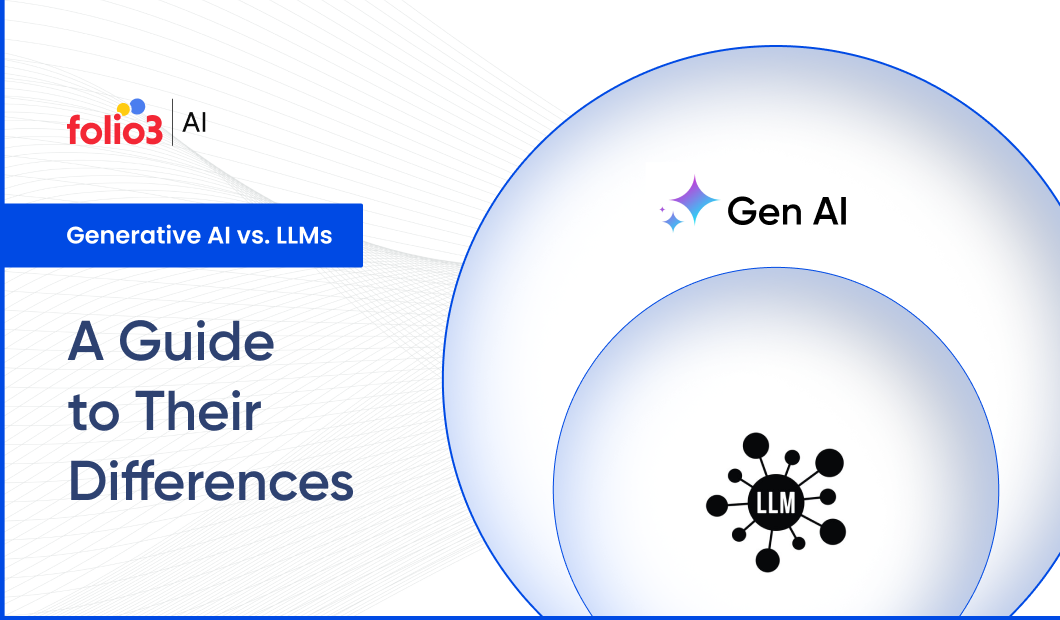
Understanding the distinction between LLMs and generative AI has become critical for businesses making strategic technology investments. According to industry analyses, the global generative AI market is projected to exceed $200 billion by 2030, while the LLM market specifically is expected to reach USD 36.1 billion by 2030, growing at a compound annual rate of 33.2%..
While these terms are often used interchangeably, they represent different capabilities and serve distinct purposes in artificial intelligence applications. Understanding their differences helps organizations make strategic technology investments and implementation decisions.
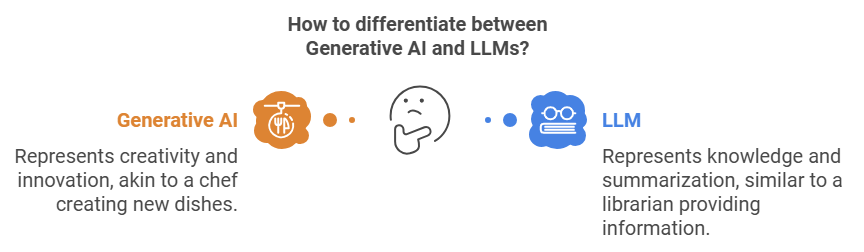
Generative AI is like a multi-talented creative studio that can produce various types of content, like text, images, music, videos, and 3D models. If you provide this studio with a concept, they'll create original content across any medium you need.
Large Language Models, traditionally, were like a specialized writing team that excels at language-based tasks. However, by 2025, modern LLMs will have evolved into multimodal systems that can understand and generate not just text, but also process images, audio, and other data types.
In essence:
Generative AI: A broad category encompassing all AI systems that create new content across multiple modalities
LLM: A specialized type of generative AI focused primarily on language understanding and generation, though modern versions often include multimodal capabilities
Understanding the distinctions between LLM and generative AI helps businesses make informed decisions about which technology best serves their needs. This guide explores
AspectGenerative AILarge Language Model (LLM)DefinitionA comprehensive category of AI techniques generating various content forms, including text, images, music, video, 3D models, and code.A specialized generative AI model designed to process and generate language, with modern versions including multimodal capabilities.Core technologyDiverse architectures, including GANs, VAEs, diffusion models, and Transformers, are each optimized for specific content types.Primarily Transformer-based architectures with self-attention mechanisms, optimized for language understanding and generation.Content generationCreates diverse media: realistic images, videos, music compositions, 3D models, code, and text across specialized models.Excels at text generation, reasoning, and language tasks; modern versions can process images and audio but generate primarily text-based outputs.Training dataRequires domain-specific datasets: images for visual models, audio for music generation, and code repositories for programming models.Trained on massive text corpora from books, articles, websites, and code repositories; multimodal models include image-text pairs.Primary applicationsVisual content creation, drug discovery, product design, artistic expression, video production, music composition, and 3D asset generation.Natural language processing, conversational AI, content writing, code generation, analysis, reasoning, question-answering, summarization.StrengthsSpecialized excellence in specific creative domains with high-quality outputs for targeted tasks; photorealistic generation; creative versatility.Superior language understanding, complex reasoning, contextual awareness, and integration of language with other modalities; strong at planning and analysis.Typical output timeVaries widely: 5-30 seconds for images, 2-10 minutes for videos, near-instant for audio samples.Near real-time text generation (1-3 seconds for most responses); immediate for short responses.Cost per generation$0.01-$0.50 per image, $0.50-$5 per video clip, variable for other media.$0.001-$0.05 per query, depending on model size and context length.LimitationsDomain-specific expertise; may produce unrealistic outputs when trained on limited data; requires substantial computational resources for video.Can generate plausible but incorrect information; knowledge cutoff limitations; reasoning challenges in specialized domains; hallucination risk.User expertise requiredModerate to high; prompt engineering critical for quality outputs; often requires iteration and refinement.Low to moderate; conversational interface accessible to general users; prompt engineering improves results, but is not always necessary.
Generative AI is a comprehensive category of artificial intelligence focused on creating new, original content, including text, images, audio, video, code, and 3D models. Unlike traditional AI systems that classify, predict, or analyze existing data, generative AI leverages probabilistic models and neural networks to produce entirely new outputs based on learned patterns from training data.
According to research from leading AI institutions, generative AI systems have advanced significantly since 2022, with improvements in output quality, processing speed, and accessibility. Industry reports indicate that over 60% of enterprises are now experimenting with or deploying generative AI solutions across various business functions.
Modern generative AI systems employ various architectures:
Transformers: For text and sequence-based generation.
GANs (Generative Adversarial Networks): For realistic image synthesis.
VAEs (Variational Autoencoders): For controlled content generation with variations.
Diffusion models: For high-quality image and video creation.
These technologies enable content creation that ranges from photorealistic images to coherent long-form text, functional code, and complex 3D models suitable for industrial applications.
LLMs are a specialized subset of generative AI designed to process and generate human-like language. Built primarily on Transformer architectures with self-attention mechanisms, LLMs are trained on massive text datasets, often containing hundreds of billions to trillions of tokens, to understand context, generate natural language responses, answer questions, and perform complex reasoning tasks.
By late 2025, modern LLMs will have evolved beyond text-only processing. Contemporary models like Claude Sonnet 4.5, GPT-4o, and Gemini 2.0 are multimodal systems capable of understanding and processing images, audio, and other data types alongside text. These models can now handle context windows exceeding 200,000 tokens, enabling them to process entire books, large codebases, and comprehensive business documents in a single interaction.
Key LLM characteristics:
Scale: Trained on diverse internet text, books, academic papers, and code repositories.
Context understanding: Advanced comprehension of nuance, intent, and semantic relationships.
Reasoning capabilities: Improved logical inference, mathematical problem-solving, and multi-step analysis.
Adaptability: Fine-tuning for domain-specific applications in healthcare, finance, legal, and technical fields.
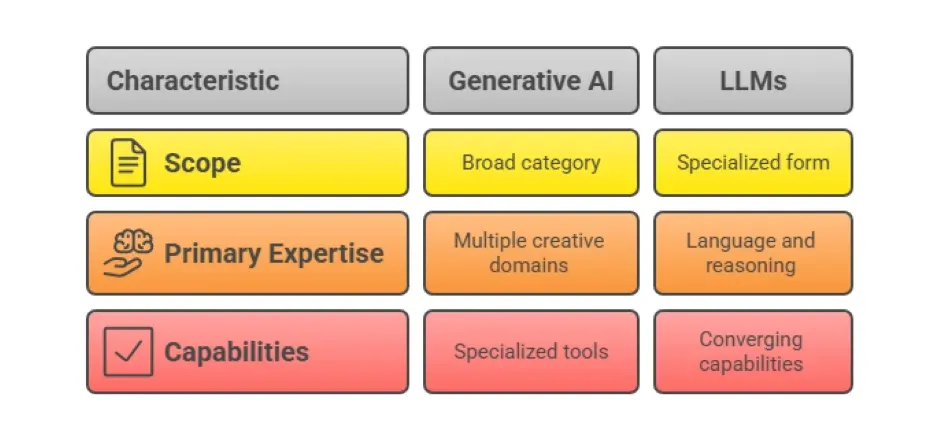
Here’s a more in-depth explanation of the differences between Generative AI and LLM that make them stand out;
Large Language Models (LLMs), such as Claude 4, GPT-4o, and Gemini 2.0, represent a specialized branch of generative AI that excels at language-based tasks. While modern LLMs have expanded to include multimodal capabilities (processing images, audio, and documents), their primary expertise lies in understanding, generating, and reasoning with natural language.
According to usage data from major AI platforms, LLMs handle approximately 70-80% of enterprise AI queries, with language-based tasks dominating applications in customer service, content creation, and business analysis. However, they represent only one segment of the broader generative AI ecosystem.
Generative AI encompasses all artificial intelligence systems designed to create new content based on learned patterns from vast datasets. These systems can generate diverse forms of media, text, images, audio, video, 3D models, and code, making them valuable across content creation, design, entertainment, scientific research, and product development.
Research indicates that the generative AI ecosystem now includes over 50 distinct model architectures, each optimized for specific content types and use cases. This diversity enables specialized solutions for industries ranging from pharmaceutical research to automotive design.
LLMs differ from other generative models specifically designed for:
Visual content: Midjourney, DALL-E 3, Stable Diffusion 3
Audio generation: ElevenLabs, Suno AI
Video creation: Runway Gen-3, Pika Labs
3D modeling: Specialized architectures for CAD and gaming assets
Historically, LLMs were limited to text-based inputs and outputs, excelling at tasks like content generation, language translation, summarization, and question-answering.
By 2025, the distinction has blurred considerably. Modern LLMs like Claude Sonnet 4.5, GPT-4o, and Gemini 2.0 are multimodal systems capable of processing text, images, and visually rich documents.
These models can:
Analyze charts, graphs, and infographics
Extract information from screenshots and documents
Understand spatial relationships in images
Generate code from UI mockups
Interpret medical imaging alongside patient records
However, generative AI as a broader category still encompasses specialized tools with distinct capabilities beyond language models:
Models like Midjourney v6, DALL-E 3, and Stable Diffusion 3 create photorealistic images, artwork, and designs from text prompts.
Platforms like Runway Gen-3, Pika Labs, and emerging tools create video content from text descriptions.
Systems like ElevenLabs for voice synthesis and Suno AI for music generation create professional-quality audio content.
Specialized models generate three-dimensional assets for gaming, product design, and virtual environments.
While LLMs excel at code generation, specialized models optimized specifically for programming tasks demonstrate higher accuracy.
While LLMs can now handle multiple modalities, dedicated generative AI tools often provide superior results for specific creative tasks, making them the preferred choice for industries like marketing, entertainment, product design, and media production.
By 2025, both generative AI and LLMs will have become integral to countless applications, though their trajectories have led to significant overlap and convergence.
Modern LLMs have grown dramatically in capability. Models like Claude Sonnet 4.5 demonstrate sophisticated reasoning, complex problem-solving, and a nuanced understanding of context. Industry benchmarks show that current-generation LLMs achieve:
85%+ accuracy on complex reasoning tasks (MMLU, Big-Bench)
Context windows exceeding 200,000 tokens (approximately 150,000 words)
Response times under 2 seconds for most queries
Multimodal understanding comparable to human-level performance on many vision-language tasks
Simultaneously, generative AI tools have expanded beyond individual models to comprehensive platforms. Systems like Midjourney, DALL-E 3, and Runway Gen-3 allow users to generate high-quality visual and video content from simple text prompts. Industry data indicates:
Image generation quality has improved dramatically since 2022, with users consistently rating outputs as more photorealistic and aligned with prompts.
Video generation has progressed from brief clips to longer sequences with improved narrative coherence and temporal consistency.
Processing times have decreased substantially, enabling near-real-time generation for many applications.
Cost per generation has dropped significantly, democratizing access to creative AI tools for smaller businesses and independent creators.
Companies like OpenAI, Anthropic, Google, and Meta continue developing systems that generate increasingly complex multimedia content, including advanced 3D models and photorealistic videos. These capabilities now extend to interactive simulations that support product design, entertainment, virtual reality, and training applications.
While both LLMs and generative AI may utilize Transformer architectures, their underlying designs and training methodologies often differ based on their intended outputs.
Beyond Transformers, generative AI employs diverse architectures optimized for specific content types:
Consists of generator and discriminator networks that compete to create increasingly realistic images and audio. GANs remain popular for specific applications like face generation, image-to-image translation, and high-resolution artwork, despite being complemented by newer diffusion approaches.
Compress data into latent spaces to generate diverse outputs with controlled variations, ideal for image and video synthesis where attribute manipulation is important. VAEs enable smooth interpolation between different outputs and controlled generation.
Iteratively refine random noise into high-quality images through learned denoising processes. This approach currently powers many state-of-the-art image generation systems, including Midjourney and Stable Diffusion, achieving superior photorealism and prompt adherence compared to earlier GAN-based approaches.
Custom designs for video (temporal transformers), 3D generation (neural radiance fields), and audio (WaveNet derivatives) optimized for specific creative tasks with domain-appropriate inductive biases.
Built primarily on Transformer architectures with self-attention mechanisms, LLMs learn linguistic patterns, context, and semantic relationships through several key innovations:
Models are trained on diverse text corpora containing hundreds of billions to trillions of tokens, enabling broad knowledge and language understanding across domains.
Human evaluators rate model outputs, and these preferences train reward models that guide the LLM toward more helpful, harmless, and honest responses.
Advanced alignment techniques where models learn from principles and self-critique, improving safety and reducing harmful outputs without extensive human labeling.
Architectural innovations enable processing of 200,000+ token contexts through techniques like sparse attention, memory layers, and efficient attention patterns.
Vision encoders, audio processors, and fusion mechanisms allow modern LLMs to process and reason about multiple data types while maintaining language-centric capabilities.

Despite significant advances, both approaches face unique challenges that developers and users must navigate.
Maintaining consistent quality across generated content, especially in video and complex visual scenes, remains challenging. Studies show that video generation still exhibits temporal inconsistencies in approximately 20-30% of outputs, particularly in scenes with complex motion or multiple subjects.
High-quality content generation demands substantial processing power and energy. Industry data indicates that generating a single high-resolution image requires computational resources equivalent to charging a smartphone, while video generation can consume 100x more energy, limiting accessibility and raising environmental concerns.
AI-generated creative content may lack the subtle emotional depth and intentionality of human-created works. Surveys of creative professionals indicate that while 78% use generative AI as a tool, only 15% consider AI-generated content suitable as final deliverables without significant human refinement.
LLMs can generate plausible-sounding but factually incorrect information with high confidence. Research indicates that even advanced models hallucinate in 3-10% of responses involving factual claims, depending on topic familiarity and prompt specificity.
Training data has temporal limits, making LLMs less reliable for recent events without retrieval-augmented generation (RAG) mechanisms or integrated search capabilities. Most LLMs have knowledge cutoffs between 6 and 18 months before their release date.
While improved, LLMs still struggle with complex mathematical reasoning, multi-step logic requiring symbolic manipulation, and certain abstract problems. Benchmark studies show that even advanced models achieve only 60-75% accuracy on graduate-level STEM problems.
Yes, LLMs are definitely a subset of generative AI. Both generate new outputs based on learned patterns from training data. The key distinction lies in specialization and scope.
LLMs are specialized generative AI systems optimized for natural language understanding, generation, and reasoning. Their core expertise centers on language-based tasks, writing, translation, summarization, conversation, and complex reasoning expressed through text. Modern LLMs have expanded to multimodal capabilities, but language remains their primary domain and architectural focus.
Broader generative AI encompasses models specifically designed for non-language content creation, visual art, music composition, video production, 3D modeling, and other creative domains where language is secondary or absent entirely.
The relationship can be understood hierarchically:
Generative AI (parent category): All AI systems that create new content LLMs (specialized subset): Language-focused generative systems
Image generators (specialized subset): Visual content creation systems
Audio generators (specialized subset): Sound and music creation systems
Video generators (specialized subset): Moving image creation systems
3D generators (specialized subset): Three-dimensional asset creation
As of late 2025, both generative AI and LLMs have achieved milestones and continue evolving rapidly. Industry investment in generative AI exceeded $50 billion in 2024, with projections for continued growth as adoption accelerates across enterprise sectors.
Advanced systems seamlessly combine text, image, video, and audio generation within unified frameworks. Examples include Adobe Firefly integrating across Creative Suite, allowing designers to generate, edit, and refine content across multiple formats within a single workflow.
Faster processing enables live content creation for gaming, virtual production, and interactive applications. Latency for image generation has decreased from 15-30 seconds to 2-5 seconds, enabling interactive creative sessions and real-time game asset generation.
Industry-specific generative models tailored for healthcare imaging, architectural visualization, drug discovery, and manufacturing design. Medical imaging models now assist radiologists by generating comparison images and highlighting anomalies with accuracy approaching specialist-level performance.
Models demonstrate improved capability for multi-step problem-solving, mathematical reasoning, and complex analysis. Benchmark performance on reasoning tasks has improved by 40-60% compared to 2023 models, with frontier models approaching human expert performance on many standardized tests.
LLMs increasingly function as autonomous agents that can plan, use tools, execute workflows, and interact with external systems. Agent frameworks enable LLMs to break down complex tasks, use APIs and databases, verify their own outputs, and iterate toward solutions with minimal human guidance.
Models handle 200,000+ token context windows (approximately 150,000 words or 500+ pages), enabling processing of entire books, large codebases, and comprehensive documents. Some experimental models demonstrate effective context handling up to 1 million tokens.
Understanding how organizations deploy these technologies provides practical context for decision-making.
Companies like Intercom and Zendesk integrate LLMs to handle 60-80% of routine support queries, reducing response times from hours to seconds while maintaining customer satisfaction scores. Financial services firms report handling 3-5x more inquiries with the same support team size.
Marketing teams use LLMs for drafting blog posts, social media content, email campaigns, and product descriptions. Content production timelines compress from weeks to days, though human editing remains essential for brand voice and accuracy.
Platforms like GitHub Copilot and Cursor accelerate development by 25-40% according to internal studies. Developers report spending less time on boilerplate code and more time on architectural decisions and complex problem-solving.
Brands use image generation for rapid concept development, A/B testing creative variants, and localizing campaigns. Heinz generated brand-aligned creative assets for social campaigns, reducing production costs by 70% while increasing output volume.
Automotive and consumer electronics companies generate 3D models and design variations for rapid prototyping. Design iteration cycles compress from weeks to days in early conceptual phases.
Video game studios use generative AI for texture generation, environment assets, and concept art. Film production companies experiment with storyboarding and pre-visualization using AI-generated imagery.
Understanding the distinction between generative AI and LLMs enables businesses and technology professionals to make strategic decisions aligned with specific needs.
✓ Advanced natural language understanding and generation - Writing, editing, translation, summarization.✓ Complex reasoning, analysis, and decision-support - Data interpretation, strategic planning, problem diagnosis.✓ Conversational AI and customer service automation - Chatbots, virtual assistants, support systems.✓ Document processing and information extraction - Contract analysis, research synthesis, compliance review.✓ Code generation and software development assistance - Programming support, debugging, and documentation.✓ Multi-step problem-solving and planning - Project management, workflow optimization, task decomposition.✓ Integration with business workflows and databases - CRM systems, knowledge bases, enterprise applications.
Cost consideration: LLM API costs typically range from $0.001-$0.05 per query, making them economical for high-volume applications.
✓ High-quality image generation - Marketing materials, product photography, concept art.✓ Video content creation - Advertising, social media, explainer videos, trailers.✓ Music composition and audio synthesis - Background music, sound effects, voiceovers.✓ 3D model generation - Product design, gaming assets, architectural visualization.✓ Photorealistic rendering and visual effects - Film production, real estate visualization.✓ Domain-specific creative content - Fashion design, industrial design, graphic art.
Cost consideration: Image generation costs $0.01-$0.50 per image, video generation $0.50-$5 per clip. Budget accordingly for creative projects.
✓ Multimodal content creation - Campaigns combining text, images, and video.✓ End-to-end workflows - Concept to finished asset with minimal manual intervention.✓ AI systems with reasoning and execution - Planning followed by appropriate content generation.✓ Comprehensive automation - Spanning language and visual domains.✓ Iterative refinement workflows - Conversational editing and improvement of generated content.
Generative AI creates new content across multiple formats, such as text, images, video, audio, and code. LLMs are a specialized subset focused on language understanding and generation. Key distinction: Generative AI = broad category; LLMs = language-optimized systems with expanding multimodal features. Both generate new content but serve different primary purposes.
Generative AI is used for content creation, marketing materials, product design, drug discovery, video production, music composition, 3D modeling, code generation, and creative automation. Industries including healthcare, entertainment, advertising, manufacturing, and education deploy generative AI to accelerate creative processes and reduce production costs by 40-70%.
Yes, LLMs are a specialized subset of generative AI focused on language tasks, including text generation, summarization, translation, question-answering, and reasoning. They share generative AI's core capability of creating new outputs from learned patterns, but are optimized specifically for language understanding and generation rather than visual or audio content.
Use specialized generative AI tools for visual content, video, music, or 3D modeling where quality and domain expertise matter most. Use LLMs for language-heavy tasks requiring reasoning, analysis, conversation, or decision support. Modern multimodal LLMs handle many combined use cases, but specialized tools often deliver superior results for specific creative domains.
Yes. Modern AI platforms integrate LLMs with specialized generative models for comprehensive capabilities. LLMs provide reasoning, planning, and conversational interfaces while specialized models generate images, videos, or audio. Examples include ChatGPT + DALL-E, Adobe Firefly integration, and Anthropic's extended capabilities combining language with tool use.
All major industries leverage these technologies: Healthcare (65% adoption for documentation, imaging analysis), finance (automated reporting, risk analysis), education (personalized learning, content creation), entertainment (asset generation, scriptwriting), customer service (80% of Fortune 500 use AI chatbots), software development (25-40% productivity gains), manufacturing (design optimization, quality control).
Traditional AI classifies, predicts, and analyzes existing data (e.g., spam filters, fraud detection, recommendation systems). Generative AI actively creates new outputs—text, images, designs, code—from learned patterns. Traditional AI answers "what is this?" while generative AI answers "create something new based on this pattern."
LLMs are specifically optimized for conversational AI due to deep language training, contextual understanding, reasoning capabilities, and multi-turn dialogue management. While LLMs are a type of generative AI, they're the superior choice for chatbots and virtual assistants. Specialized generative AI tools focus on non-conversational creative tasks like image or music generation.
The future shows continued convergence: LLMs integrate deeper into generative AI platforms as reasoning engines; specialized models improve quality and expand modalities. Expect agentic AI systems combining language reasoning with multimodal content generation, industry-specific fine-tuning, 1M+ token contexts, real-time generation, improved factual accuracy, and seamless human-AI collaboration across creative and analytical tasks. Industry analysts project the combined market exceeding $200B by 2030.