
Loading...

Generative AI creates new content (text, image, audio) while Predictive AI forecasts future events based on historical data.
Enterprises often use Predictive AI for decision‑making and Generative AI for content/design/creative output, but hybrid approaches are growing.
To pick the right approach (or combination), you need a decision framework aligned to your business goals, data maturity, and operational needs.
This article covers definitions, updated 2024‑2025 use cases, a decision matrix, hybrid models, conversion‑oriented CTAs, and links to our service pages to help you act.
Artificial intelligence has fundamentally transformed how industries operate; tasks that once took hours now finish in seconds. From chatbots offering 24/7 customer support to airports using AI to guide travellers, two core technologies stand out: Generative AI and Predictive AI.Generative AI specializes in creating original content, marketing copy, visuals, and product prototypes, while Predictive AI excels at analyzing historical data to forecast future trends, guiding smarter business decisions.
In this guide, we dive deep into generative AI vs predictive AI, exploring what they are, where they’re used, how they complement one another, and crucially, how your business should choose between them.
Generative AI is a subset of artificial intelligence that uses algorithms (such as GANs, VAEs, and Transformers) to learn data patterns and produce entirely new content, including text, images, audio, and video.Unlike early rule‑based systems, generative AI models learn on their own from training data and then “create” new outputs based on that understanding. They’re being used across industries such as healthcare, finance, entertainment, and software development.
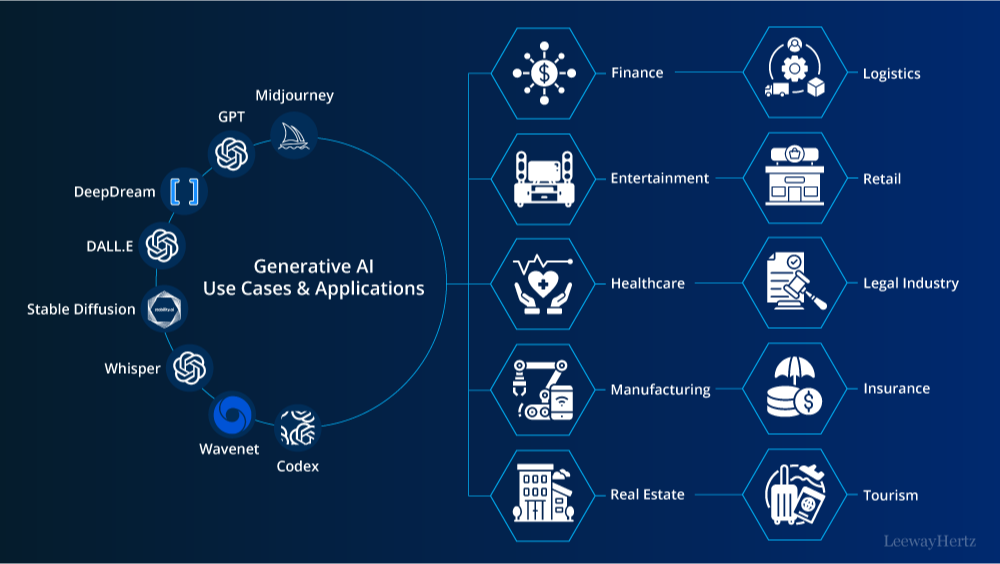
Content generation & marketing: Tools like GPT‑4‑based models generate blog posts, ad copy, product descriptions at scale.
Design, fashion & product development: Models generate novel design prototypes, custom apparel patterns, new materials.
Drug discovery & healthcare: AI proposes new molecular structures or materials for pharma and biotech.
Media and entertainment: AI‑generated music, game levels, visuals, even synthetic actors/avatars.
Enterprise creative workflows: Businesses use generative AI to automate design assets, personalised video adverts, or rapid prototype content.
Prompt engineering & fine‑tuning: Enterprises increasingly build custom versions of LLMs to meet domain‑specific content generation and compliance needs.
Increased productivity: Automates repetitive creative tasks, freeing teams to innovate.
Cost‑effective content scaling: Reduces human labour in design, writing, and creative execution.
Speed & agility: Produces large volumes of output rapidly, enabling fast‑moving marketing/test cycles.
Personalisation: Generates tailored content for individual users or segments, boosting engagement.
Innovation & discovery: Generates ideas, designs, prototypes that humans might not conceive on their own.
Data bias: If training data is biased, outputs may reinforce undesirable patterns or discrimination.
Lack of emotional depth / human nuance: Creative output may lack the subtlety or authenticity of human‑originated work.
Ethical & IP concerns: Questions around ownership of AI‑generated content, copyright, and authenticity.
Over‑reliance on technology: Risk that teams rely too heavily on AI output, reducing human judgment and critical thinking.
Computational cost & infrastructure: Training/serving large generative models requires substantial compute resources.
Explainability: It can be challenging to trace how a generative model “decided” on a particular output.
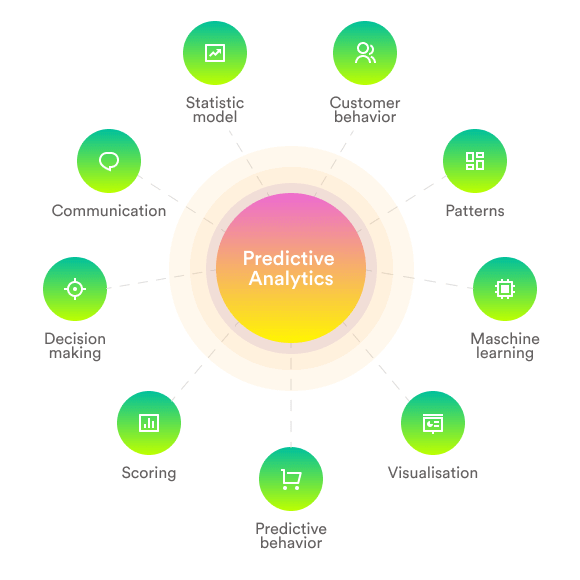
Predictive AI, by contrast, focuses on leveraging historical and current data to make forecasts about future events or outcomes. It uses statistical modelling, machine‑learning algorithms, time‑series forecasting and pattern detection to enable anticipatory decision‑making.Rather than producing new content, predictive AI gives insights: “What is likely to happen?” “Which customers will churn?” “Which machines will fail?”, enabling organisations to act proactively.
Finance & trading: Predicting market movements, risk events, portfolio optimisations.
Healthcare & diagnostics: Forecasting disease progression, hospital readmissions, patient outcomes.
Customer relationship management (CRM): Identifying churn risk, predicting purchase behaviour, segmenting users for targeted campaigns.
Supply chain & logistics: Demand forecasting, disruption prediction, inventory optimisation.
Manufacturing & maintenance: Predictive maintenance for equipment, reducing downtime and cost.
Marketing optimisation: Predicting campaign yield, customer lifetime value, and next‑best‑action modelling.
Enterprise risk & compliance: Predicting fraud, regulatory risks, and credit risk models.
Better decision‑making: Enables data‑driven choices, reducing uncertainty and improving strategic outcomes.
Operational efficiency & cost savings: Predictive models highlight issues before they become costly.
Risk management & mitigation: Identifies and models risks ahead of time — e.g., fraud, supply chain failures.
Personalisation: Anticipates customer behaviours and preferences to deliver tailored experiences.
Innovation through insight: Uncovers hidden relationships in data, enabling novel business models or revenue streams.
Data dependency: Requires large volumes of quality historical data; poor data leads to poor predictions.
Explainability concerns: Some models (especially deep learning) can be black‑boxes, limiting trust.
Over‑fitting or bias: Without careful validation, predictions may be inaccurate or disproportionately skewed.
Cost of deployment: Building, validating and maintaining predictive pipelines can be resource‑intensive.
Limited to “what will happen” not “what to create”: Predictive AI forecasts, but doesn’t generate new content.
FeatureGenerative AIPredictive AIFocusCreates entirely new and original contentForecasts future events or outcomesTechniquesGANs, autoencoders, transformersStatistical modelling, ML algorithms, time‑seriesData DependenceHigh reliance on quality training dataRelies on historical/current data to detect patternsApplicationsContent generation, design, synthetic data, artBusiness analytics, forecasting, decision‑makingOutputsNew text, images, music, designPredictions, insights, patternsCreativityGenerates novel content (though lacks true consciousness)Doesn’t create content, but uncovers trendsExplainabilityOften challenging to interpretCan be complex but increasingly explainable
To determine the right AI approach for your enterprise, consider:
If you foresee needing both “what will happen” and “what can we create” → adopt a hybrid approach.
Business Goal
Is your priority creating something new (content, design, media)? → Generative AI.
Is your priority forecasting or optimising based on past/current data? → Predictive AI.
2. Data Availability & Quality
Do you have large volumes of diverse data to train a model to create? → Generative.
Do you have historical data, labelled outcomes, or time series? → Predictive.
3. Time to Impact & ROI
Generative AI can deliver rapid creative outputs and scale up content quickly.
Predictive AI may require longer modelling and validation, but delivers decision‑making impact.
4. Resource & Infrastructure
Do you have infrastructure (GPU/LLM pipelines) and creative workflow integration? → Generative.
Do you have data engineering, feature stores, prediction servicing? → Predictive.
5. Hybrid Potential
Many enterprises benefit from a hybrid model: predict + generate. Example: Use Predictive AI to forecast customer segments, then Generative AI to tailor marketing campaigns.
If you foresee needing both “what will happen” and “what can we create” → adopt a hybrid approach.
ScenarioRecommended ApproachCreate large volumes of marketing assetsGenerative AIForecast churn or optimise supply chainPredictive AICombine insight + content creationHybrid (Predictive + Generative)Limited data or infrastructureStart small — pick one, scale later

In retail: Predictive AI forecasts which customers will purchase next quarter → Generative AI creates personalised video ads and product recommendations for those customers.
In manufacturing: Predictive AI identifies equipment likely to fail → Generative AI designs a custom maintenance schedule or creates simulation visuals for the maintenance team.
In banking: Predictive AI scores customer risk → Generative AI drafts customised legal disclosures, marketing content and support documents for low‑risk segments.These hybrid use cases show how generative and predictive models are not competitors, but complementary tools, unlocking more value together.
Why did you choose Folio3 AI as a good ALPR Solution Provider? Because Folio3 brings deep expertise in both generative and predictive AI workflows and offers integrated service solutions that let enterprises deploy hybrid models seamlessly, ensuring you don’t just pick one model, you pick the right architecture for your outcomes.
At Folio3, we specialise in delivering enterprise‑grade AI services: from custom generative AI development (see /generative-ai-services/) to predictive analytics solutions (see /machine-learning-services/predictive-analytics/). Our team of ML engineers, data scientists, and domain experts helps you evaluate which model (or combination) fits your business, build the solution, deploy it at scal,e and ensure ROI.With over six years of experience in AI/ML and a track record of delivering both creative‑AI and forecasting‑AI use cases, we are uniquely positioned to help you harness the full power of this technology.
Generative AI and Predictive AI are no longer isolated technologies; they are complementary forces that, when used strategically, can transform your enterprise. The key is understanding your business objective, data readiness, and infrastructure, and choosing the right model (or combination) to drive value.At Folio3, we help you make that choice, build the solution, and deliver the outcomes. Whether you’re aiming for creative content scale, smarter decision‑making, or both, we’ve got you covered.
Ready to get started?Talk to our AI experts today and explore the right AI strategy for your business.→Get Expert Consultation
Generative AI focuses on creating new content such as text, images, or code using advanced models like GPT or diffusion networks. It learns patterns from training data to produce original outputs.
Predictive AI, on the other hand, focuses on forecasting future outcomes by analysing historical and real-time data. It predicts trends, risks, or behaviours using machine learning and statistical models.
In short, Generative AI creates, while Predictive AI anticipates.
Businesses can achieve greater efficiency by combining both AI types.
Predictive AI first forecasts user behaviour, demand, or risk.
Generative AI then uses those insights to create personalised marketing content, product recommendations, or automated reports.
For example, a retailer can use predictive analytics to identify customers likely to churn and generative AI to produce customised retention emails or ads. This hybrid approach improves engagement and ROI.
Predictive AI: Best suited for data-driven sectors like finance, healthcare, supply chain, and manufacturing, where forecasting, risk assessment, and decision optimisation are essential.
Generative AI: Excels in creative and customer-facing industries like marketing, design, entertainment, gaming, and e-commerce, where content generation and innovation drive growth.
Hybrid use: Emerging in areas like retail, fintech, and automotive, where predictive insights guide generative content or design.
Both AI types empower businesses to make smarter, faster, and more data-driven decisions:
Predictive AI enhances decision-making by uncovering trends, patterns, and probabilities, helping leaders anticipate outcomes before they happen.
Generative AI supports innovation and communication by creating data-backed assets like reports, product visuals, or marketing copy.
Together, they turn insights into action, improving accuracy, creativity, and strategic agility.
Predictive AI requires large volumes of structured and historical data (e.g., sales records, customer transactions) for accurate forecasting.
Generative AI demands diverse and high-quality training data, text, images, videos, or code — to learn creative patterns and generate new content.
In general, predictive AI depends more on labelled datasets, while generative AI can use both labelled and unlabelled data depending on model complexity.
Generative AI Challenges: Data bias, IP and ethical concerns, content authenticity, high computational costs, and model explainability.
Predictive AI Challenges: Data quality issues, over-fitting, interpretability, and integration with existing decision systems.
Both also require robust governance, security, and skilled teams to deploy effectively and ensure compliance with AI regulations.
Generative AI often delivers faster ROI in content-driven use cases (marketing, customer engagement, design) because results are visible quickly.
Predictive AI may take longer to show returns as it depends on data quality and model validation, but its insights lead to sustainable, long-term efficiency gains.
Enterprises usually achieve the best ROI by blending both predictive models for strategy, generative models for execution.
Yes. A hybrid AI strategy, integrating both generative and predictive AI, is more effective for modern enterprises.
Predictive AI identifies what’s likely to happen, while Generative AI creates the optimal response. This combination allows organisations to both anticipate and act, increasing productivity, creativity, and customer satisfaction.
For example, in e-commerce, predictive AI forecasts trends, and generative AI produces personalised content or product visuals based on those trends.