
Loading...
In today's fast-paced business world, using artificial intelligence (AI) can give companies a real edge. Businesses are always looking for smarter ways to improve how they operate, serve customers, and make decisions. With AI becoming more common, a big question for B2B companies is whether to use ready-made AI tools or invest in custom-built solutions.
For example, businesses often struggle with making the right choice, especially when a significant majority, about 60% of organizations, report challenges in scaling AI initiatives, due to issues like data quality or lack of talent. Understanding the differences between these two approaches to AI, from general-purpose models to specifically designed systems, is crucial for any business looking to truly benefit from this technology.
AspectGeneric AI ModelsCustom AI SolutionsInitial InvestmentLower upfront costs, subscription-based pricingHigher initial investment in developmentTime to DeployQuick deployment (hours to days)Longer timeline (a few months to a year+)Performance & AccuracyGeneral performance may lack precision for specialized tasksHigh precision, trained on proprietary data for targeted problemsData RequirementsPre-trained on public dataRequires relevant, high-quality business-specific dataCustomizationLimited to general capabilitiesFully tailored to specific business needsIntegrationBasic API integration may create workflow gapsDeep integration with existing systems and processesScalabilityLimited scaling capabilitiesBuilt for growth, scales with business needsData SecurityData is often sent to third-party servicesGreater control, built within the company infrastructureComplianceMay raise privacy concernsEasier compliance with industry regulationsOwnershipLicense-based use, no IP ownershipFull ownership of technology and IPCompetitive AdvantageMinimal, available to all competitorsSignificant, provides exclusive insights and capabilitiesBest ForStandardized tasks, pilot projects, and budget constraintsComplex problems, proprietary processes, strategic advantagesROI TimelineImmediate but limited long-term valueHigher long-term ROI through sustained competitive advantagesTechnical Expertise NeededMinimalRequires specialized AI teams or partnersMaintenanceManaged by the providerRequires continuous monitoring and optimization
Generic AI models, often called off-the-shelf or general-purpose AI, are widely available tools designed to perform a range of common tasks across different industries. These models are typically pre-trained on vast amounts of public data and offer a straightforward way for businesses to begin using AI without needing deep technical expertise or large initial investments. They provide a quick entry point for companies exploring the potential of AI for their daily operations.
Examples include chatbots that answer common questions or programs that write simple content. These models are ready to use right away.
Using generic AI models offers several clear benefits for companies.
They are often easier to set up, require less initial money, and can be used quickly, allowing businesses to see immediate results. T
his makes them a great starting point for smaller companies or those new to AI, as they lower the barrier to entry.
They also do not require specialized AI teams to get started.
Generic AI finds many uses in business-to-business settings.
Companies use these tools for basic customer service through chatbots that handle routine inquiries.
They also help with simple data analysis, generating quick summaries, or drafting emails and reports.
Other uses include translating documents or organizing information, freeing up employees for more complex work.
While useful, generic AI models have significant limitations when it comes to unique business challenges.
They cannot often truly understand specific industry jargon, unique customer behaviors, or proprietary data sets.
Their outputs can be too general, not precise enough for complex decision-making, and integrating them deeply into existing custom systems can be difficult.
They might not fully address highly specialized business problems or provide a true competitive advantage.
Generic AI is a smart choice for businesses with limited budgets or for those just starting to explore AI's potential. It's ideal for non-critical tasks, like handling frequently asked questions or automating basic data entry. These models are also perfect for pilot projects, allowing companies to test AI's impact without a big commitment. Small businesses can greatly benefit from their accessibility.
Custom AI is technology built or heavily modified to solve a business's exact problems. It uses a company's own data and rules to learn and make decisions that are highly relevant to its operations. Unlike generic models, custom AI is built from the ground up, or heavily adapted, to address very specific operational needs, market demands, or customer behaviors. This tailored approach allows businesses to unlock deeper insights and achieve more precise outcomes than off-the-shelf tools can offer.
This means the AI understands the unique ways a business works, making its suggestions and actions far more accurate and helpful. It's like having a tailor-made suit instead of one off the rack.
Creating custom AI involves several key steps.
It starts with clearly understanding the business problem, then gathering and preparing unique company data.
Next, AI experts design and train a specific model using this data.
After training, the AI is put into action, and its performance is continuously monitored and improved.
For B2B companies, custom AI offers significant benefits that generic tools cannot match.
It provides very precise solutions, leading to better decision-making and improved efficiency.
By solving specific problems, custom AI can give a business a unique edge over competitors.
It also ensures data remains private and secure, meeting strict industry regulations, while allowing for seamless growth alongside the business.
Custom AI is particularly good at tackling problems that are too complex or specific for general AI tools.
It can understand niche industry terms, analyze proprietary data patterns, and automate workflows unique to a company's operations.
This makes it possible to solve highly specialized issues, such as predicting equipment failures in a specific factory setting or optimizing a complex supply chain.
Many businesses are using custom AI to solve complex problems.
Manufacturing companies use it for predictive maintenance, anticipating when machines will break down before they happen.
Banks employ custom AI for advanced fraud detection, identifying unusual transaction patterns specific to their customers.
Retailers use it to personalize marketing campaigns to individual business clients, while logistics firms optimize their supply chains with tailored routing algorithms.

Understanding the core distinctions between generic and custom AI is essential for making an informed decision that aligns with a business's strategic goals. These differences span various aspects, from how they are acquired and integrated to their long-term impact on a company's operations and competitive standing. Each approach carries distinct implications for cost, performance, security, and scalability.
Generic AI typically involves lower upfront costs, often based on subscriptions, making it budget-friendly for initial use. However, its long-term value might be limited due to its inability to perfectly fit specific needs. Custom AI requires a larger initial investment in development, but it can deliver a significantly higher return on investment over time by solving unique, high-value business problems, leading to greater efficiency and growth.
Generic AI, being broad in its application, offers general performance that might not be highly accurate for specialized tasks, as it's not trained on specific business data. Custom AI, conversely, is built and trained with proprietary data, leading to much higher precision and relevance for targeted problems. This means custom solutions can provide more reliable insights and automation for critical business functions.
When using generic AI, businesses often need to send their data to a third-party service, which can raise privacy and security concerns, especially with sensitive information. Custom AI solutions, built within a company's own infrastructure or with secure, dedicated environments, offer much greater control over data. This ensures better security and easier compliance with industry-specific regulations and data protection laws.
Generic AI tools usually offer basic integration through APIs, which might not deeply connect with complex existing business systems. This can limit their usefulness and create workflow gaps. Custom AI is designed for deep integration, ensuring it works seamlessly with all existing software and processes. It's also built with future growth in mind, easily scaling up as a business expands and its needs evolve.
With generic AI, businesses essentially license the use of a tool, without owning the underlying technology or any insights derived from it. Custom AI development means a business owns the unique solution it creates, including its intellectual property. This ownership can be a significant competitive advantage, as the company controls the technology and can further develop it, ensuring its solutions remain exclusive and tailored.
Deciding whether to use a generic AI model depends heavily on your business's immediate needs, available resources, and strategic goals. While custom solutions offer deep tailoring, generic AI provides a practical entry point for many companies, especially those with simpler requirements or limited experience with artificial intelligence. It's about finding the right tool for the right job at the right time.
For businesses with tight budgets or limited technical staff, generic AI is often the most sensible option. It avoids the high development costs and need for specialized AI teams that custom solutions demand. Subscription models make costs predictable, and the plug-and-play nature means less internal effort is needed for setup and maintenance. It's an accessible way to start benefiting from AI.
If your business is just beginning to explore what AI can do, generic models are an excellent starting point. They allow companies to test the waters and understand AI's potential without a large commitment. This low-risk approach helps teams learn how AI works, identify practical applications, and see initial results before considering more complex, tailor-made solutions.
Generic AI tools can be deployed very quickly, sometimes in a matter of hours or days, unlike custom solutions that take months. This speed means businesses can achieve immediate impacts, such as automating basic customer inquiries or generating simple content fast. When rapid results are needed for straightforward tasks, off-the-shelf AI provides an agile solution.
Generic AI is perfect for tasks that are common across many businesses and don't require unique insights. Examples include basic data entry, simple content generation, initial customer support, or organizing general information. These are problems where a broad solution is sufficient, and the nuances of a specific business don't heavily influence the desired outcome.
Businesses can use generic AI as a learning tool. It allows employees to interact with AI, understand its strengths and weaknesses, and identify areas where more advanced, custom solutions might be beneficial. This hands-on experience helps build internal AI literacy and fosters an innovation culture without demanding a significant investment in specialized development.
While generic AI serves as a good entry point, custom AI solutions often become essential for businesses looking to truly transform their operations and gain a substantial edge. The investment in tailor-made AI is justified by its capacity to solve deeply ingrained problems, leverage unique data, and provide unparalleled accuracy and security that general tools simply cannot offer.
Custom AI is a powerful tool for businesses aiming to stand out. By creating AI that solves unique problems or optimizes proprietary processes, companies can gain exclusive insights and efficiencies that competitors cannot easily replicate. This could mean faster product development, more accurate market predictions, or a highly personalized customer experience, all leading to a stronger market position.
Many core business challenges are too intricate or specific for generic AI to handle effectively. Custom AI is designed to tackle these exact problems, whether it's optimizing a highly specialized manufacturing process, detecting very specific types of fraud in financial transactions, or developing a unique recommendation system for a niche B2B marketplace. It directly addresses the most valuable pain points.
A business's unique data is one of its most valuable assets. Custom AI allows companies to fully unlock the power of this proprietary information, training models on specific customer behaviors, operational histories, or market trends. This leads to insights and automations that are highly relevant and accurate, turning exclusive data into a significant source of value and strategic advantage.
In many B2B sectors, data security and regulatory compliance are paramount. Custom AI solutions can be built with strict security protocols and compliance frameworks from the start, ensuring sensitive business and customer data is protected. This level of control is often not possible with generic AI tools that operate on shared infrastructure or process data externally, minimizing risks and building trust.
While the upfront cost of custom AI might be higher, its ability to precisely solve critical business problems often leads to a much greater return on investment over time. By driving efficiency, enabling new revenue streams, and providing sustained competitive advantages, custom AI becomes a long-term strategic asset. It grows and adapts with the business, delivering continuous value and fostering innovation.
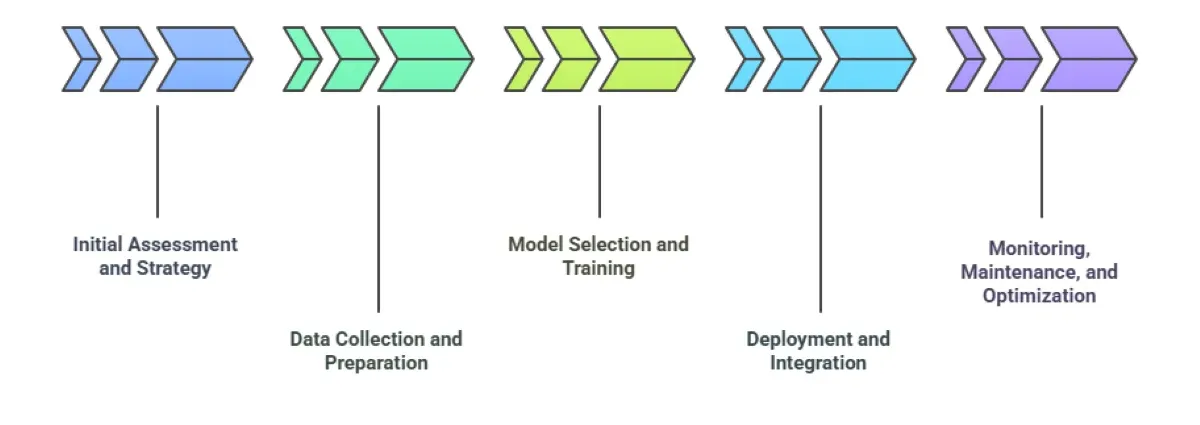
To start working on a custom AI project is a structured process that requires careful planning, specialized expertise, and continuous collaboration. It's not just about coding; it's about deeply understanding a business, its data, and its strategic goals to build an AI solution that truly delivers measurable impact. This journey ensures the AI is not just effective but also sustainable and scalable.
The first step in creating custom AI is to clearly define the business problem to be solved and the goals for the AI. This involves working closely with business leaders to understand their challenges, identify potential AI applications, and assess the feasibility of a solution. This phase sets the strategic direction, outlining expected outcomes and how success will be measured.
Data is the fuel for any AI. For custom AI, this means carefully gathering and preparing unique business data. This critical step involves sourcing relevant information, cleaning it to remove errors, and often labeling it so the AI can learn effectively. High-quality, relevant data is essential for building an accurate and impactful AI model, shaping its ability to learn and make decisions.
After data preparation, AI experts select the most suitable algorithms and train the AI model using the prepared data. This is an iterative process where the model learns to identify patterns and make predictions. It involves repeated testing, tweaking parameters, and refining the model until it achieves the desired level of accuracy and performance for the specific business task.
Once the custom AI model is trained and validated, it needs to be put into action within the business's existing systems. This involves deploying the AI solution and integrating it seamlessly with current software, workflows, and databases. Successful integration ensures the AI works smoothly with daily operations, providing insights or automating tasks without disruption.
AI models are not a "set it and forget it" solution. After deployment, custom AI requires continuous monitoring to ensure it performs as expected and delivers accurate results. Over time, as new data becomes available or business needs change, the model needs regular maintenance, updates, and further optimization. This ongoing care ensures the AI remains effective and valuable long-term.
While custom AI offers significant benefits, businesses often have legitimate concerns regarding its implementation. These concerns typically revolve around cost, time, complexity, and data readiness. Addressing these proactively with a clear strategy and the right partners is crucial for a successful AI journey and for maximizing the return on investment.
The perception of high development costs for custom AI can be daunting. However, businesses can manage these costs by starting with smaller, impactful projects and scaling up gradually. Working with experienced AI partners who can define clear project scopes, deliver tangible milestones, and focus on specific, high-value problems helps ensure a cost-effective approach.
Developing custom AI takes time and requires dedicated resources, which can be a concern for busy businesses. Strategic planning, setting realistic timelines, and leveraging external AI expertise can help. By clearly defining project phases and allocating necessary internal or external personnel, companies can ensure the project stays on track without overwhelming existing teams.
The technical aspects of AI development can seem overwhelming to businesses without in-house AI expertise. Partnering with a specialized AI development firm addresses this directly. Such partners bring the necessary technical skills, platform knowledge, and best practices, allowing businesses to benefit from custom AI without needing to build an extensive internal AI team from scratch.
Many businesses worry if they have enough "good" data for custom AI. This concern is valid, as quality data is crucial. Addressing it involves conducting a thorough data audit, identifying existing data sources, and creating strategies for data collection and preparation. AI experts can guide businesses through this process, sometimes even helping to build synthetic data or augment existing datasets.
Businesses often fear their custom AI solution might become outdated quickly. To prevent this, custom AI should be built with scalability and flexibility in mind. Using modular designs, open standards, and models that can be continuously updated with new data helps future-proof the investment. Choosing a partner with a long-term vision ensures the AI evolves with the business.
Successfully bringing AI into a B2B environment goes beyond just implementing technology; it requires a strategic approach that aligns AI initiatives with overarching business objectives. This integration means fostering an AI-ready culture, starting with manageable projects, and continuously measuring the impact to ensure the technology delivers real, measurable value.
For AI to be truly valuable, it must directly support a company's main business goals. Instead of adopting AI for its own sake, businesses should identify specific challenges or opportunities that AI can address. This means asking: "What problem are we trying to solve?" and "How will AI help us achieve our strategic objectives, like increasing sales or reducing costs?"
Bringing AI into a business also means preparing the people. This involves educating employees about AI, training them on new tools, and managing the changes it brings to their daily work. Fostering a culture where employees see AI as a helpful tool rather than a threat ensures smoother adoption and maximizes the technology's potential benefits across the organization.
A smart way to integrate AI is to begin with small, focused projects that have clear, achievable goals. These pilot projects allow businesses to test AI's effectiveness, learn from early results, and make adjustments. Once successful, the AI solutions can be gradually expanded to other areas of the business, building confidence and demonstrating value incrementally.
To ensure AI investments are worthwhile, businesses must define clear metrics for success and continuously track the AI's performance. This means measuring things like efficiency gains, cost reductions, revenue increases, or improvements in customer satisfaction. Regularly evaluating these metrics helps demonstrate the return on investment (ROI) and guides future AI strategy.
Selecting the right AI development partner is a critical decision. A good partner should not only have strong technical expertise but also a deep understanding of your industry and business needs. They should be collaborative, transparent, and committed to long-term support, helping you navigate the complexities of AI implementation and ensuring your solutions deliver sustained value.
Folio3 AI specializes in developing tailored generative AI solutions designed specifically for your business challenges and objectives. We combine deep technical expertise with industry knowledge to deliver secure, scalable, and high-performance AI systems that integrate seamlessly into your operations.
We build custom generative AI models trained on your proprietary data and fine-tuned to your specific use cases. Our approach ensures higher accuracy, relevance, and performance compared to generic solutions, delivering true competitive advantage.
Our team ensures your custom generative AI solutions integrate smoothly with existing enterprise systems, workflows, and databases. We minimize disruption while maximizing value, enabling AI to work naturally within your established technology ecosystem.
We optimize AI interactions through expert prompt engineering, ensuring your generative AI delivers consistent, accurate, and contextually appropriate responses. This maximizes model effectiveness and enhances user experience across all applications.
We provide comprehensive MLOps support to monitor, maintain, and continuously optimize your generative AI solutions. Our ongoing management ensures models remain accurate, efficient, and aligned with evolving business needs over time.
We prioritize data security and regulatory compliance throughout development and deployment. Our custom solutions are built with strict protocols to protect sensitive information, meet industry standards, and maintain trust with your stakeholders.

No, custom AI is not just for big businesses. While it involves a larger initial investment, businesses of all sizes can benefit if they have specific, high-value problems that generic AI cannot solve. Small and medium businesses can start with focused custom projects that offer clear returns, scaling up as their needs and budgets allow.
The time it takes to develop a custom AI solution varies greatly depending on the project's complexity, the amount and quality of data available, and the specific goals. Simple custom solutions might take a few months, while more intricate projects involving advanced models and extensive data can take six months to a year or more. A clear plan and expert guidance help manage timelines effectively.
Yes, many businesses find a hybrid approach to be most effective. Generic AI tools can handle common, simpler tasks like basic customer support or initial data sorting. Meanwhile, custom AI can be deployed for highly specialized or strategic functions, leveraging the strengths of both approaches to create a comprehensive and efficient AI ecosystem within the business.
Custom AI thrives on relevant, high-quality data specific to your business operations. This can include customer transaction records, operational logs, sensor data, sales figures, marketing campaign results, and even unstructured data like customer feedback or industry reports. The more specific and clean your data, the more accurate and useful your custom AI will be.
The best way to decide is by evaluating your business problems. If your challenges are unique, require deep integration with existing systems, demand high accuracy, or involve sensitive proprietary data, custom AI is likely the better choice. If your needs are simpler, involve common tasks, and you have budget constraints, generic AI might be a good starting point to explore AI's potential.