
Loading...
You've probably heard the buzz about GPT-5.1, but here's what you actually need to know: this isn't just another AI update with a fancy version number. When OpenAI released GPT-5.1 in November 2025, they addressed the biggest complaints developers and businesses had with GPT-5, including inconsistent reasoning, sluggish responses, and tone that felt robotic. The results speak for themselves.
Balyasny Asset Management found that GPT-5.1 outperformed both GPT-4.1 and GPT-5 in their full evaluation suite while running 2- 3x faster than GPT-5. For enterprises trying to deploy AI that actually works in production environments, GPT-5.1 represents a shift from "impressive demo" to "reliable workhorse."
Whether you're automating customer support, generating content, or building agentic workflows, understanding what makes GPT-5.1 different could determine whether your AI investment pays off or becomes another expensive experiment collecting dust.
GPT-5.1 isn't completely new from the ground up. It's a refined version of GPT-5 that fixes critical usability issues. The model introduces adaptive intelligence that adjusts to task complexity automatically. It delivers faster responses on simple queries while allocating deeper analysis for complex problems.
GPT-5.1 splits into two distinct variants: GPT-5.1 Instant for everyday tasks with warmth and speed, and GPT-5.1 Thinking for complex problems requiring deeper reasoning. This dual approach allows seamless access to appropriate intelligence levels. Users don't need to manually switch between different model configurations, improving efficiency across diverse use cases.
The intelligent routing system analyzes each request within milliseconds. It automatically directs queries to the most appropriate model variant. Quick, straightforward queries go to Instant for rapid processing. The multi-step complex problems route to the Thinking model for thorough analysis. Users don't need to select models manually, improving experience and cost efficiency.
OpenAI tuned GPT-5.1 to be warmer and more conversational by default, reflecting user feedback that AI should be "enjoyable to talk to". The model now feels significantly more natural in everyday interactions. It successfully reduces the robotic feel users complained about in GPT-5. The change makes AI assistance more approachable in professional and casual contexts.
The model now answers the actual question asked without deviation. It shows significant improvements in following formatting constraints accurately. Word count limits and structural requirements are respected precisely. The model doesn't add unnecessary information or stray from instructions. This reduces frustrating iterations and makes it more predictable for critical business applications.

The technical improvements in GPT-5.1 extend beyond surface-level changes. Key innovations include adaptive reasoning, extended 24-hour caching, and improved token efficiency. These create measurable performance gains that impact production deployments. The changes reduce operational costs while improving response quality and speed.
GPT-5.1 Thinking is roughly twice as fast on the easiest tasks and about twice as slow on the hardest ones compared to GPT-5. The model dynamically allocates computational effort based on assessed problem complexity. Simple queries receive answers in seconds. Complex problems requiring multi-step reasoning receive thorough, deep analysis. This optimization improves both speed and quality.
Extended caching allows prompts to remain active in the cache for up to 24 hours rather than minutes, with cached input tokens 90% cheaper. This reduces operational costs for applications with repeated prompts. Customer support chatbots and coding assistants benefit enormously. They maintain conversation context across extended sessions without repeatedly paying full token costs.
GPT-5.1 consistently used about half as many tokens as leading competitors at similar or better quality across tool-heavy reasoning tasks. This 50% efficiency improvement translates directly to lower API costs for enterprise deployments. The model processes queries more efficiently without sacrificing output quality. Businesses deploying at scale experience noticeably faster response times. Applications requiring high-volume processing benefit most from these efficiency gains.
OpenAI introduced an apply_patch tool specifically designed to edit code with greater reliability. They also added a shell tool that executes shell commands directly. These enable more sophisticated automation scenarios. GPT-5.1 can now autonomously execute tasks rather than just suggesting solutions. This reduces the need for manual human implementation significantly.
Developers can set the reasoning_effort parameter to five distinct levels. Options include 'none', 'minimal', 'low', 'medium', or 'high'. This provides fine-grained control over the balance between speed, cost, and quality. Developers optimize performance based on each use case. Simple tasks get faster responses while complex scenarios receive deeper analysis.
Feature/CapabilityGPT-5.1Claude 4.5 SonnetGemini 3 ProContext Window (Input)400K tokens200K tokens2M tokensContext Window (Output)128K tokens64K tokens128K tokensReasoning ModeAdaptive (Instant/Thinking)Standard reasoningAdvanced reasoningCoding BenchmarksSWE-bench: 74.9%Strong performanceCompetitive performanceSpeed Optimization2x faster on simple tasksConsistent speedVaries by taskTool Calling20% improvement over GPT-5Excellent tool useStrong tool integrationTone CustomizationMultiple personality presetsNaturally conversationalProfessional defaultToken Efficiency50% fewer tokensStandard efficiencyStandard efficiencySafety Focus2.1% deception rateConstitutional AI focusGoogle safety standardsPricing (Input)$1.25/1M tokens$3/1M tokens$1.25/1M tokensBest ForEnterprise coding, automationSafety-critical appsMultimodal, large documents
Benchmark scores provide objective evidence of where GPT-5.1 excels across major evaluation categories. The model demonstrates exceptional strength in software coding tasks and mathematics. Real-world software engineering challenges show substantial improvements. Performance surpasses both previous model versions and current competitor offerings.
On SWE-bench Verified, GPT-5 scores 74.9%, up from o3's 69.1%, while using 22% fewer output tokens and 45% fewer tool calls. This benchmark measures the ability to solve real-world GitHub issues and covers diverse programming challenges and languages. GPT-5.1 demonstrates exceptional practical software engineering capabilities beyond theoretical performance metrics.
GPT-5.1 Instant shows significant improvements on the AIME 2025 math contest problems. These problems are designed for top high school students. Adaptive reasoning enables it to approach GPT-5 Thinking's performance on complex multi-step problems. It simultaneously maintains faster response times for simpler mathematical queries. The system intelligently assesses and adapts to problem difficulty.
The model demonstrates notably enhanced performance on demanding algorithmic challenges. It correctly identifies when to allocate additional thinking time. Complex algorithms and advanced data structure implementations are handled effectively. Sophisticated optimization techniques separate expert programmers from beginners. GPT-5.1 shows competitive-level programming capabilities consistently.
On Aider polyglot code editing evaluation, GPT-5 sets a new record of 88%, representing a one-third reduction in error rate compared to o3. This benchmark tests the ability to write precise code as exact diffs. Multiple programming languages are covered, including Python, JavaScript, Java, and C++. The results demonstrate versatility and accuracy in code generation.
Sierra reported that GPT-5.1 in "no reasoning" mode showed a 20% improvement on low-latency tool calling performance compared to GPT-5 minimal reasoning. This improvement matters for production applications requiring rapid API integrations. External service connections and multi-step workflows demand both speed and reliability. Enterprise environments particularly benefit where milliseconds impact user experience directly.
Major enterprise customers and technology platforms offer valuable real-world insights that go beyond benchmarks. When you see GPT-5.1 in actual production environments, the results tell a different story than test scores. Companies across industries report substantial efficiency gains with measurable business impact. The improvements show up in faster processing, lower costs, and better output quality.
Leading cloud providers like Microsoft integrated GPT-5.1 into their AI platforms shortly after OpenAI's release. Enterprise customers gained immediate access through existing cloud infrastructure. Production workloads at scale now run with advanced AI capabilities across global operations. The rapid adoption reflects strong confidence in the model's readiness for mission-critical enterprise deployments.
Financial institutions testing GPT-5.1 found it outperformed both GPT-4.1 and GPT-5 in comprehensive evaluation suites while running 2- 3x faster, using half as many tokens. Investment firms handling complex financial analysis saw immediate benefits. Market data processing and multi-step analytical workflows showed consistent quality improvements. The operational cost reductions hit the bottom line in ways CFOs notice.
Insurance operations reported their AI agents run 50% faster on GPT-5.1 while exceeding the accuracy of GPT-5 and other leading models. Claims that used to take hours now process in minutes. Customer service teams handle more cases without adding headcount. Policyholders get faster responses while satisfaction scores climb steadily.
Development tool providers reported that GPT-5.1 delivers noticeably snappier responses and adapts reasoning depth to tasks, reducing overthinking and improving overall developer experience. Engineers notice the difference immediately when writing code. Simple tasks happen fast without unnecessary processing. Complex problems still get the thorough analysis they need. Developers spend less time waiting and more time building.
Terminal applications are making GPT-5.1 the default for users, citing impressive intelligence gains while being a far more responsive model. Companies building developer tools trust GPT-5.1 enough to make it the default option. Engineers working in command-line environments all day appreciate the responsiveness. The model handles both quick commands and complex debugging sessions effectively.
The GPT-5.1 API provides developers with exceptionally granular control over detailed model behavior through multiple sophisticated parameters and flexible integration options, enabling highly fine-tuned implementations that effectively balance competing performance requirements, strict cost constraints, and demanding quality expectations for production deployments that must reliably serve thousands or millions of users daily without degradation or failure.
Developers can use GPT-5.1 without reasoning by setting reasoning_effort to 'none', making the model behave like a non-reasoning model for latency-sensitive use cases. This powerful flexibility provides developers with a crucial ability to precisely optimize for maximum response speed when deep reasoning capabilities aren't necessary for specific tasks like simple classification, basic formatting, or straightforward content retrieval, where microseconds matter for user experience.
GPT-5.1 supports strict JSON mode as a native built-in feature where developers explicitly define detailed schemas, and the model follows them with exceptional precision without adding any conversational filler or explanatory text, making this capability absolutely crucial for systematically chaining AI calls together in complex backend workflows where downstream systems expect precisely structured data formats and any deviation causes integration failures or processing errors.
GPT-5.1 with no reasoning mode demonstrates substantially better parallel tool calling capabilities, which dramatically increases end-to-end task completion speed for complex multi-step workflows requiring multiple API calls to external services, enabling the model to execute several different functions simultaneously rather than sequentially processing them one after another, thereby reducing total processing time by significant margins that users notice and appreciate.
The API now comprehensively supports web search functionality across billions of indexed pages, enabling developers to build sophisticated applications that intelligently combine GPT-5.1's powerful reasoning capabilities with real-time information retrieval from the internet, allowing the model to provide current, accurate information well beyond its static training data cutoff and addressing one of the most significant limitations of traditional language models.
API users conveniently access GPT-5.1 Instant via the gpt-5.1-chat-latest identifier and GPT-5.1 Thinking via the gpt-5.1 identifier, with completely identical pricing to GPT-5 across all available service tiers, allowing developers to strategically choose the most appropriate model variant based on their specific performance requirements, latency constraints, and quality expectations without facing different pricing structures that complicate budgeting and cost management.
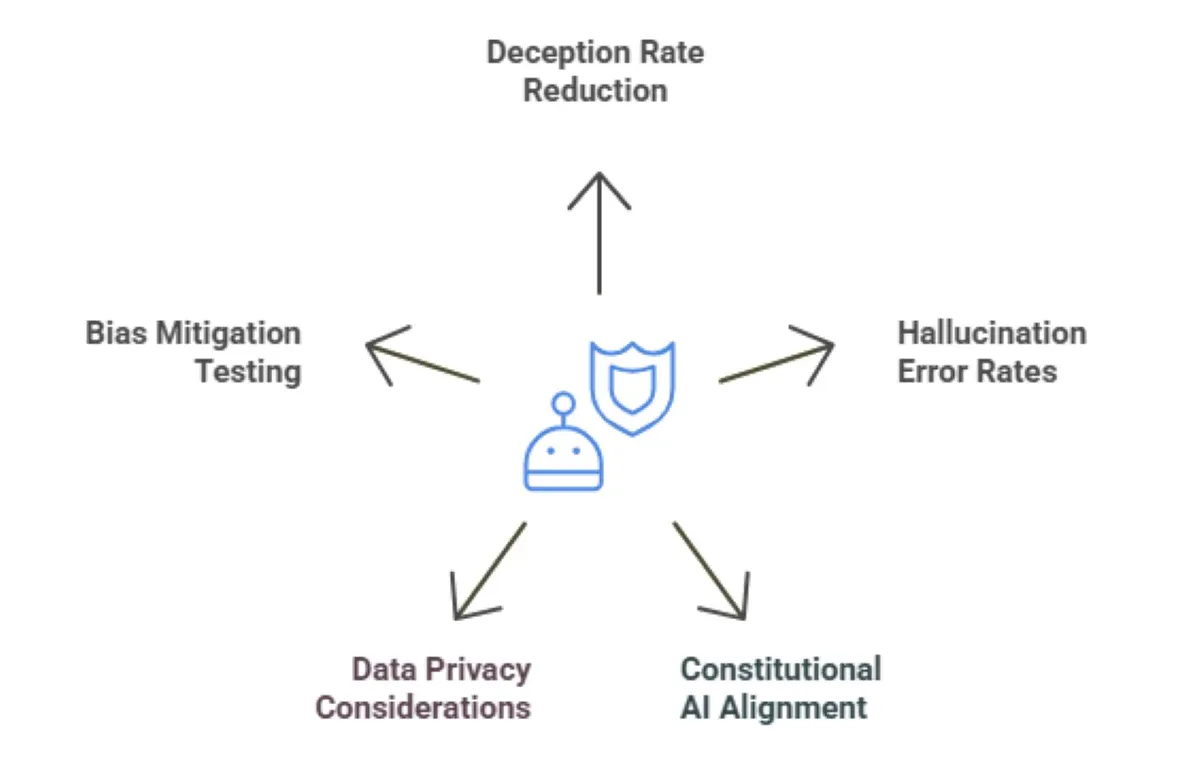
Enterprise AI deployment absolutely demands rigorous safety standards across multiple critical dimensions. Deception prevention, hallucination reduction, and harmful content filtering are essential. GPT-5.1 introduces substantial measurable improvements, reducing deception rates and minimizing hallucinations.
On conversations representative of real ChatGPT traffic, GPT-5 reduced deception rates from 4.8% for o3 to 2.1% when using reasoning mode. This substantial improvement means the model better recognizes when specific tasks genuinely can't be completed. It clearly communicates actual limitations honestly. Fabricating information or claiming false capabilities happens far less frequently. Users rely less on potentially false information.
GPT-5 with thinking mode maintains remarkably low hallucination rates under 1% on open-source prompts. Just 1.6% hallucination occurs on tough medical cases in rigorous HealthBench evaluations. The model suits high-stakes applications where factual accuracy is absolutely critical. Healthcare diagnostics, legal analysis, and financial advising require this level of precision. Serious consequences from errors are minimized.
The model demonstrates substantially improved alignment with user intent across diverse scenarios. Inappropriate requests are refused with high compliance rates. Helpful, honest, and harmless responses are provided in challenging edge cases. The model remains genuinely useful for legitimate business purposes. Harmful applications are prevented while maintaining this delicate balance. Countless scenarios and contexts are handled appropriately.
Enterprise deployments require extremely careful evaluation of comprehensive data handling policies. Specific API data retention periods and fine-tuning data security measures matter. Strict compliance with GDPR requirements and HIPAA regulations is essential. Industry-specific rules adequately protect sensitive information throughout the entire AI lifecycle. Protection spans initial data collection through model training, deployment, usage, and eventual deletion.
Folio3 implements systematic, comprehensive bias testing across diverse demographic groups. Various industry domains and numerous use cases are evaluated. Sophisticated fine-tuning techniques and careful prompt engineering ensure demonstrably fair outputs. Regular audits identify and correct biases that might affect decision-making. Customer-facing applications avoid causing serious harm, damage to brand reputation, or legal liability.
GPT-5.1 maintains completely identical pricing to GPT-5 while delivering substantially superior token efficiency. Effective cost reductions per task result from improved performance characteristics. Faster processing speeds and better resource utilization collectively benefit high-volume enterprise deployments.
GPT-5.1 costs exactly $1.25 per million input tokens. Output tokens cost precisely $10.00 per million on the Standard service tier. Cached input is priced at just $0.125 per million tokens. This represents a 90% discount on cached tokens. The pricing structure remains exactly the same as GPT-5 without any increases.
Enterprise testing shows GPT-5.1 used approximately half as many tokens as leading competitors at similar or better quality levels. Organizations running complex tasks requiring sophisticated reasoning see the efficiency gains immediately. This dramatic improvement translates directly to substantially lower costs for high-volume operations.
The 24-hour prompt caching feature enables a 90% cost reduction on cached tokens. Follow-up requests are particularly for multi-turn conversations. Extended coding sessions and knowledge retrieval workflows leverage repeated patterns. Common queries allow organizations to reduce API costs substantially.
Running 2-3x faster than GPT-5 on real-world tasks substantially reduces overall compute time. User wait times decrease significantly, and better user experience results through faster responses. Lower operational expenses come through reduced infrastructure costs. Higher throughput capacity enables more concurrent users on the same infrastructure without expensive server upgrades.
At precisely $1.25 per million input tokens, GPT-5.1 offers the absolute lowest pricing among frontier models. Claude 4.5 costs significantly more at $3 per million. Gemini 3 Pro matches GPT-5.1's pricing structure exactly.
Folio3 AI specializes in custom ChatGPT integration and is experienced in delivering comprehensive enterprise-grade solutions with deep domain expertise, robust security, compliance frameworks, and scalable architecture.
Folio3's deep expertise across different industries enables highly customized ChatGPT implementations. We systematically address industry-specific challenges with comprehensive compliance requirements and specialized terminology.
Our experienced team handles complete integration processes from initial planning through final deployment. We connect all models of ChatGPT, including GPT-5.1, to your databases, customer relationship management platforms, knowledge bases, and business logic.
Beyond initial deployment, Folio3 provides continuous monitoring services and proactive performance optimization adjustments. We deliver regular fine-tuning updates and responsive technical support. This ensures your GPT-5.1 implementation consistently delivers sustained business value.

GPT-5.1 is a refined version of GPT-5 featuring two distinct operating modes. Instant and Thinking modes serve different needs. Adaptive reasoning intelligently adjusts thinking time based on task complexity. Instruction has improved significantly. Conversational tone became warmer. Token efficiency increased substantially. Pricing structure remains exactly the same as GPT-5.
Yes, GPT-5.1 is specifically designed for enterprise applications. Early adopters report significantly faster performance with better accuracy compared to previous models. Comprehensive tone customization features enable brand-aligned customer support. Improved reasoning supports reliable content generation across various business use cases. Organizations see measurable improvements.
Integration occurs through OpenAI's API using specific model identifiers. Developers access GPT-5.1 Instant via gpt-5.1-chat-latest. Thinking mode uses the GPT-5.1 identifier. Businesses connect GPT-5.1 to existing databases and CRMs. API orchestration, middleware, and custom development handle the technical integration smoothly.
Key risks include potential hallucinations, though significantly reduced to 1.6% in medical cases. Data privacy concerns require robust compliance frameworks. Integration complexity with legacy systems needs careful management. Cost management matters for high-volume usage. GPT-5.1 has a 400K input token limit. Extremely large documents require chunking strategies.
GPT-5.1 delivers strong performance out of the box for general use cases. Domain-specific applications often benefit from fine-tuning on industry terminology. Company-specific processes and brand voice need customization. The decision depends on use case complexity. The level of specialization required for your particular application matters.
Healthcare benefits through clinical documentation and diagnostic assistance. Financial services use it for analysis and reporting. Retail and e-commerce leverage personalized recommendations and support. Software development improves with code generation and debugging. Logistics gains process optimization. Professional services automate document work and research.
GPT-5.1 leads in coding benchmarks with 74.9% on SWE-bench. It offers competitive pricing at $1.25 per million input tokens. Adaptive reasoning sets it apart from Claude and Gemini. However, Claude 4.5 excels in safety-critical applications. Gemini 3 Pro offers larger context windows.
There is no pricing difference whatsoever between the two models. Both cost exactly $1.25 per million input tokens. Output tokens are $10.00 per million. However, GPT-5.1 delivers a better effective cost-per-task. Improved token efficiency and faster completion times reduce infrastructure costs substantially.