
Loading...

You've probably heard the buzz around GPT and generative AI transforming business operations. But here's what most companies get wrong: they treat GPT AI vs traditional AI as an either-or decision when the smartest approach often combines both. AI adoption in businesses has accelerated dramatically. According to McKinsey's November 2025 State of AI report, 88% of organizations now report regular AI use in at least one business function, up from 78% just one year ago.
Traditional AI systems excel at specific, structured tasks like fraud detection or inventory forecasting. GPT AI handles unstructured data, understands context, and generates human-like responses. Most businesses need both working together, not one replacing the other. This guide breaks down the real differences and shows you when to use each approach.
AspectTraditional AIGPT AIPrimary objectiveClassification and predictionContent generation and reasoningTraining approachSupervised learning with labeled dataSelf-supervised learning on massive text corporaData requirementsStructured, domain-specific datasetsUnstructured text and multimodal dataOutput typePredicted labels, scores, or categoriesText, code, summaries, dialogues, translationsFlexibilityTask-specific, requires retrainingMulti-task capable, adaptable via promptsExplainabilityOften more transparent and auditableLess explainable, black box architectureUse casesFraud detection, forecasting, risk scoringCustomer support, content creation, code generationData volume neededThousands to millions of labeled examplesBillions of tokens for pre-trainingAdaptabilityLimited to trained scenariosHandles novel situations through contextCost structureLower training costs for specific tasksHigh initial training, lower fine-tuning costs
Traditional AI encompasses rule-based systems, classical machine learning algorithms like decision trees, support vector machines, and logistic regression, plus statistical models designed for specific tasks. These systems require structured data, extensive feature engineering, and domain expertise to build. They excel at predictable, repeatable tasks with clear inputs and outputs.
Traditional AI powers credit scoring models, fraud detection systems, predictive maintenance alerts, and analytics dashboards across industries. The decision-making logic follows explicit rules or learned patterns from labeled training data, making outcomes more transparent and auditable than modern deep learning approaches.
GPT AI refers to generative pre-trained transformer models; large language models trained on massive text datasets to understand and generate human-like content. Unlike traditional AI, GPT models learn through self-supervised training on billions of words, developing broad language understanding without task-specific programming.
They can generate text, write code, summarize documents, answer questions, and perform reasoning tasks across domains. GPT-4, Claude, and similar models represent this category. The "pre-trained" aspect means they acquire general knowledge first, then adapt to specific tasks through fine-tuning or prompt engineering, eliminating the need for extensive labeled datasets for each new application.
Read More: OpenAI vs Generative AI: Which One to Use?
GPT models use self-supervised learning, training on vast unlabeled text corpora to predict next words in sequences. This approach eliminates the need for manually labeled datasets, allowing the model to develop broad language understanding and contextual reasoning across multiple domains without task-specific training.
Unlike traditional AI that classifies or predicts, GPT generates original content, like writing articles, creating code, drafting emails, or composing reports. This generative ability enables creative applications beyond pattern recognition, making GPT suitable for open-ended tasks where multiple valid outputs exist rather than single correct answers.
GPT processes entire sequences simultaneously through attention mechanisms, grasping long-range dependencies and nuanced context. It understands references, maintains conversation threads, and adapts responses based on surrounding information; capabilities that surpass traditional models limited to predefined features and local pattern recognition.
Traditional AI models are built for singular, well-defined objectives like spam detection or price prediction. Each model requires separate development, training data, and deployment. You cannot easily repurpose a fraud detection model for inventory forecasting. Each task demands its own tailored solution and labeled dataset.
Classical machine learning thrives on structured, tabular data with clear features and labels. These models need feature engineering, manually selecting and transforming input variables that matter. They struggle with unstructured text, images, or complex relationships that don't fit neatly into rows and columns.
Traditional models often provide clear decision paths. Decision trees show exact branching logic, logistic regression reveals feature weights, and rule-based systems explicitly state their reasoning. This transparency matters for regulated industries requiring auditable AI decisions, compliance documentation, and the ability to explain outcomes to stakeholders.

GPT's transformer architecture processes information fundamentally differently from traditional AI. While classical models analyze handcrafted features through rigid algorithms, GPT uses attention mechanisms to weigh relationships between all words in context. This enables nuanced understanding across long documents, maintaining coherence that traditional sequential models cannot match.
Self-attention allows GPT to focus on relevant parts of the input text regardless of position. Each word attends to every other word, creating rich contextual representations. This mechanism captures dependencies that traditional recurrent networks miss, enabling GPT to understand pronouns, references, and complex sentence structures across paragraphs.
GPT undergoes initial pre-training on billions of text tokens, learning general language patterns, facts, and reasoning. Afterward, fine-tuning adapts the model to specific tasks with relatively small datasets. Traditional AI skips pre-training entirely, requiring large labeled datasets from scratch for each application.
GPT predicts the next token in a sequence using probabilistic calculations across its neural network layers. This autoregressive approach generates coherent, contextually appropriate text one token at a time. Traditional AI makes single-shot predictions or classifications rather than generating sequential, creative outputs.
GPT stacks multiple transformer layers, each refining representations from the previous layer. Early layers capture syntax and grammar; deeper layers understand semantics and reasoning. Traditional neural networks use simpler architectures with fully connected or convolutional layers that don't achieve GPT's contextual depth.
As GPT models grow larger, they exhibit emergent abilities not explicitly trained—like few-shot learning, chain-of-thought reasoning, and cross-lingual transfer. Traditional AI lacks this scaling phenomenon; simply adding parameters doesn't unlock fundamentally new capabilities without corresponding training data and architectural changes.
GPT AI is reshaping how enterprises handle unstructured information, automate knowledge work, and engage customers. From Fortune 500 companies to startups, organizations are deploying GPT for tasks that previously required extensive human intervention, achieving efficiency gains while improving output quality and consistency.
GPT powers conversational AI that handles complex customer inquiries, understands intent, and generates helpful responses without scripted flows. It escalates appropriately to human agents, maintains context across conversations, and provides 24/7 support. Companies report a reduction in support ticket volume while improving customer satisfaction scores.
GPT extracts insights from contracts, regulatory filings, and legal documents, summarizing key points and flagging compliance issues. It processes thousands of pages in minutes, identifying risks and obligations that manual review might miss. Financial services and healthcare firms use GPT to accelerate due diligence and regulatory reporting.
GPT assists developers by generating boilerplate code, suggesting functions, debugging errors, and explaining complex logic. Tools like GitHub Copilot have demonstrated 55% faster task completion rates. Enterprises adopt GPT to accelerate software development, reduce technical debt, and help junior developers learn faster through intelligent code suggestions.
GPT transforms how employees access institutional knowledge. It summarizes lengthy reports, meeting transcripts, and research papers into concise overviews. When integrated with enterprise search, GPT provides natural language answers from internal documentation, reducing time spent hunting for information across siloed systems and improving decision-making speed.
GPT generates product descriptions, email campaigns, blog posts, and ad copy at scale while maintaining brand voice. It personalizes content based on customer segments, A/B tests variations, and adapts messaging across channels. Marketing teams report 3-5x content output increases, freeing creative resources for strategy rather than execution.
Despite GPT's capabilities, traditional AI remains superior for many enterprise applications. Structured prediction tasks, regulatory requirements, and resource constraints often make classical machine learning the smarter choice. Understanding when to deploy traditional AI versus GPT prevents costly misallocations and ensures optimal system performance.
Credit decisions, medical diagnoses, and insurance underwriting demand transparent, auditable logic that regulators and stakeholders can scrutinize. Traditional models like logistic regression and decision trees provide clear feature importance and decision paths. GPT's black-box nature fails compliance requirements in regulated industries where you must explain every decision.
Sales forecasting, demand planning, and financial modeling work best with traditional time-series models and regression algorithms. These tasks use tabular data,
sales figures, inventory levels, and economic indicators, where GPT offers no advantage. Classical models train faster, require less compute, and deliver superior accuracy on structured numerical prediction tasks.
Manufacturing monitoring, fraud detection, and trading systems need millisecond response times. Traditional AI models are lightweight, run on edge devices, and deliver instant predictions. GPT's large parameter count creates latency and requires expensive GPU infrastructure, making it impractical for real-time operational systems processing thousands of transactions per second.
When you have 500-5,000 labeled examples, traditional machine learning outperforms GPT. Classical algorithms excel at learning from small datasets through careful feature engineering. GPT requires massive pre-training investment and struggles to generalize from tiny domain-specific datasets without extensive fine-tuning that traditional models don't need.
Processing millions of daily transactions with GPT becomes prohibitively expensive. Traditional models cost pennies per thousand predictions; GPT costs orders of magnitude more. For high-volume, repetitive tasks like spam filtering, basic classification, or rule-based decisioning, traditional AI delivers comparable results at a fraction of the operational cost.
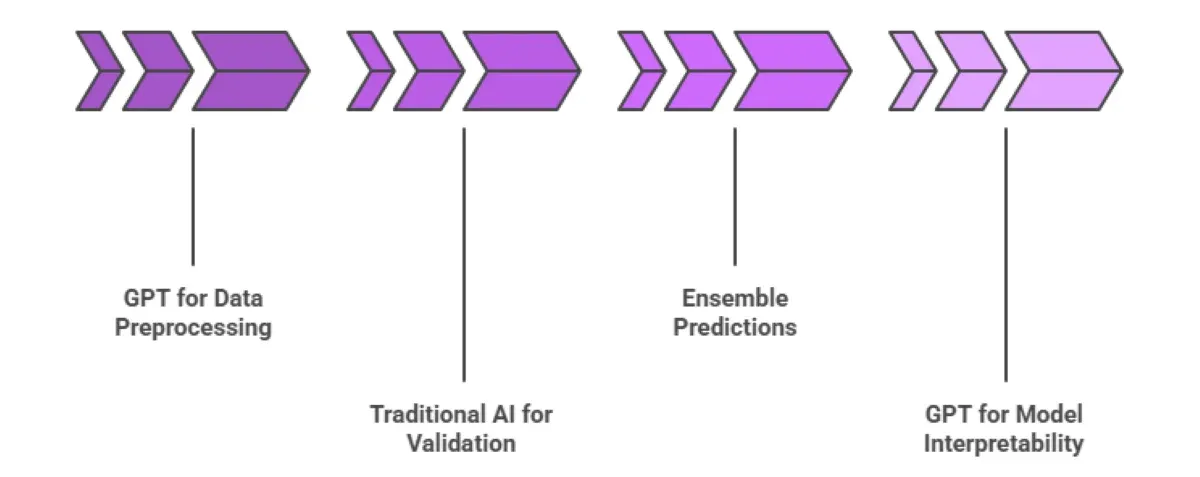
The most sophisticated enterprises don't choose between GPT and traditional AI; they architect systems leveraging both. Hybrid approaches use GPT for unstructured understanding and generation while employing traditional AI for structured predictions, creating powerful workflows that exceed what either technology achieves alone.
Use GPT to extract structured information from unstructured sources—parsing emails, summarizing customer feedback, or categorizing support tickets. Feed this structured output into traditional machine learning models for classification or prediction. This combination automates feature engineering that previously required manual effort, improving traditional AI accuracy with richer inputs.
Let GPT generate initial outputs, then validate them with traditional rule-based systems or classifiers. For compliance-critical applications, traditional AI can flag GPT responses violating business rules, ensure factual accuracy, or verify regulatory adherence. This layered approach captures GPT's flexibility while maintaining necessary controls.
Build systems where GPT provides one prediction dimension and traditional models contribute others. For fraud detection, traditional models analyze transaction patterns while GPT assesses communication content for social engineering indicators. Ensemble the predictions for superior accuracy that single-model approaches cannot match.
Use GPT to explain traditional AI predictions in natural language. After a random forest model makes a credit decision, GPT translates feature importance and decision logic into customer-friendly explanations. This bridges the gap between traditional AI's explainability and the communication clarity customers expect.
Deploying GPT AI in enterprise environments introduces complexities beyond traditional AI projects. Data governance, security, cost management, and integration with legacy systems require careful planning. Organizations rushing into GPT implementations without addressing these challenges face project failures, budget overruns, and compliance violations.
GPT models trained on public data may inadvertently memorize sensitive information. Enterprise implementations must ensure customer data, trade secrets, and regulated information don't leak through model outputs. Organizations need private deployments, data filtering pipelines, and output monitoring to prevent inadvertent disclosure of confidential information through generated content.
GPT generates plausible-sounding but factually incorrect information, a phenomenon called hallucination. For enterprise use, you cannot deploy GPT without validation mechanisms. Implement retrieval-augmented generation (RAG) to ground responses in verified documents, use confidence scoring, and establish human review workflows for high-stakes outputs.
GPT inference costs can exceed $100,000 monthly for high-volume applications. Token limits, API rate restrictions, and GPU requirements strain budgets. Enterprises need cost monitoring dashboards, prompt optimization to reduce token usage, caching strategies for common queries, and hybrid architectures that reserve expensive GPT calls for complex tasks.
Most enterprises run on decades-old ERP, CRM, and database systems never designed for AI integration. Connecting GPT requires APIs, data pipelines, authentication layers, and middleware. You'll face data format inconsistencies, system latency issues, and the challenge of maintaining backward compatibility while introducing cutting-edge AI capabilities.
Financial services, healthcare, and government sectors face strict AI governance requirements. GPT's probabilistic outputs complicate compliance documentation. You need audit trails showing how decisions were made, bias testing across demographic groups, model versioning, and the ability to explain AI-generated outcomes to regulators who expect deterministic, traceable logic.
Folio3 AI specializes in custom AI development that bridges GPT capabilities with enterprise realities. We don't just deploy off-the-shelf models; we architect solutions combining GPT with your existing systems, traditional AI assets, and business processes. Our approach ensures AI delivers measurable ROI while meeting security, compliance, and performance requirements.
We assess your current infrastructure, identify high-value AI use cases, and create phased implementation roadmaps. Our team evaluates whether GPT, traditional AI, or hybrid approaches fit each application. We prioritize projects by ROI potential, technical feasibility, and alignment with business objectives, ensuring you invest in AI that drives actual business outcomes.
Folio3 AI fine-tunes GPT models on your proprietary data, creating AI that understands your industry terminology, business rules, and domain knowledge. We handle data preparation, hyperparameter optimization, and evaluation metrics specific to your use cases. Our custom models outperform generic GPT implementations while maintaining security through private deployments.
We build connectors between GPT and your ERP, CRM, databases, and legacy applications. Our integration architecture handles authentication, data transformation, error handling, and scalability. Whether you use SAP, Salesforce, Oracle, or custom systems, we ensure GPT augments existing workflows without requiring wholesale platform replacement.

Traditional AI classifies and predicts using labeled data for specific tasks. GPT generates content and understands language through self-supervised learning on massive text, adapting to multiple tasks without retraining.
No. Traditional AI remains superior for structured predictions, real-time systems, explainable decisions, and cost-sensitive applications. GPT excels at language tasks. Hybrid approaches combining both deliver the best results.
GPT excels at automating knowledge work with unstructured text—customer support, content creation, document processing. Traditional AI suits repetitive, rule-based processes better. Optimal automation combines both approaches strategically.
Traditional AI costs less for high-volume transactions. GPT becomes cost-effective when replacing expensive human labor on complex tasks like document review or advanced customer support automation.
Yes, when properly implemented. Private deployments, on-premise hosting, data encryption, and compliance frameworks enable GPT to meet GDPR, HIPAA, and industry regulations. Implementation architecture determines compliance.
Folio3 AI provides strategic consulting, custom model fine-tuning, enterprise system integration, compliance frameworks, and ongoing optimization. We bridge GPT with your ERP, CRM, and legacy systems securely.
GPT is largely a black box with billions of parameters. However, techniques like attention visualization, prompt engineering, and hybrid architectures with traditional AI add transparency for compliance requirements.
Hybrid approaches work best. Use traditional AI for common queries; GPT for complex interactions. This combines cost-efficiency with intelligent, personalized customer experiences while managing compliance and risks.