
Loading...
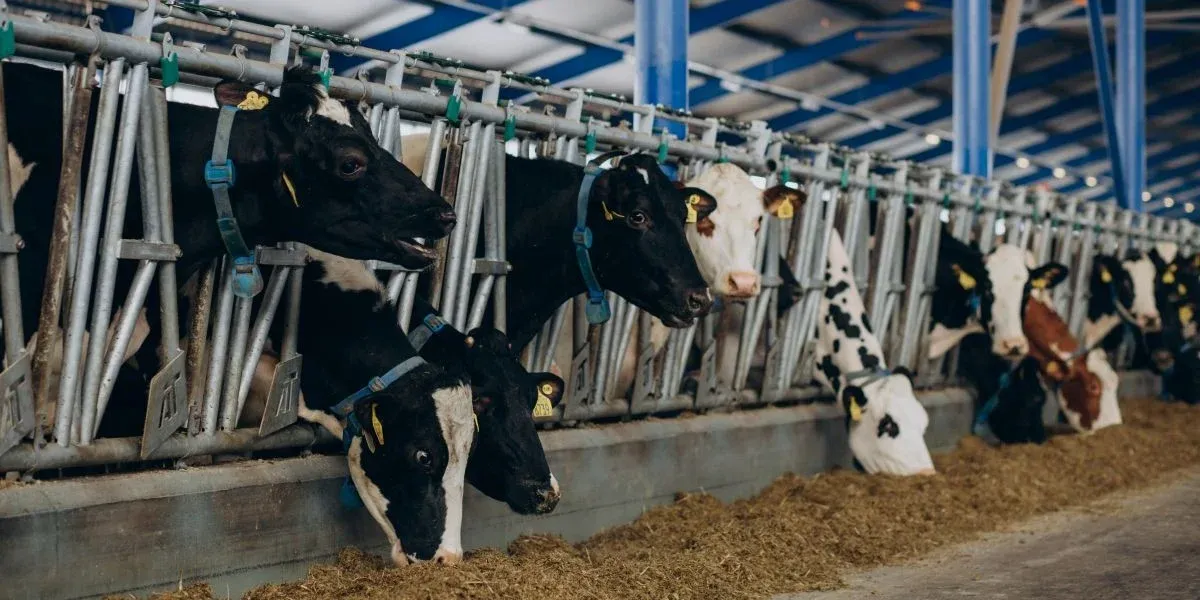
For ranch owners, counting cattle is one of those essential but time-consuming chores that always seems to demand more effort than expected. Walking through pastures, squinting through dust, and trying to keep track of moving animals while hoping you didn't miss any behind that tree or in the far corner. It's exhausting work that eats up hours every week, yet AI enhances cattle counting accuracy, making the process faster, easier, and far more reliable.
The benefits of AI cattle counting are changing this reality for livestock operations across the United States. Modern ranches are discovering they can reduce counting time by up to 95% while achieving accuracy rates that surpass human counting. Furthermore, Folio3's AI-powered livestock solutions are helping ranchers move from manual headcounts to automated systems that work around the clock, delivering precise data when you need it most.

These five key advantages are reshaping how livestock operations manage their herds and bottom lines effectively.
AI cattle counting systems deliver consistently higher precision than traditional manual counting methods, eliminating human error and environmental factors that compromise accuracy. This reliability transforms inventory management and operational decision-making for ranch operations.
AI systems maintain identical precision levels whether processing the first count or the tenth of the day, eliminating fatigue-related errors.
Instance segmentation technology prevents double-counting when animals cluster together at feeding stations, ensuring accurate headcounts in situations.
Advanced algorithms eliminate human error and environmental factors that compromise accuracy, transforming inventory management and operational decision-making.
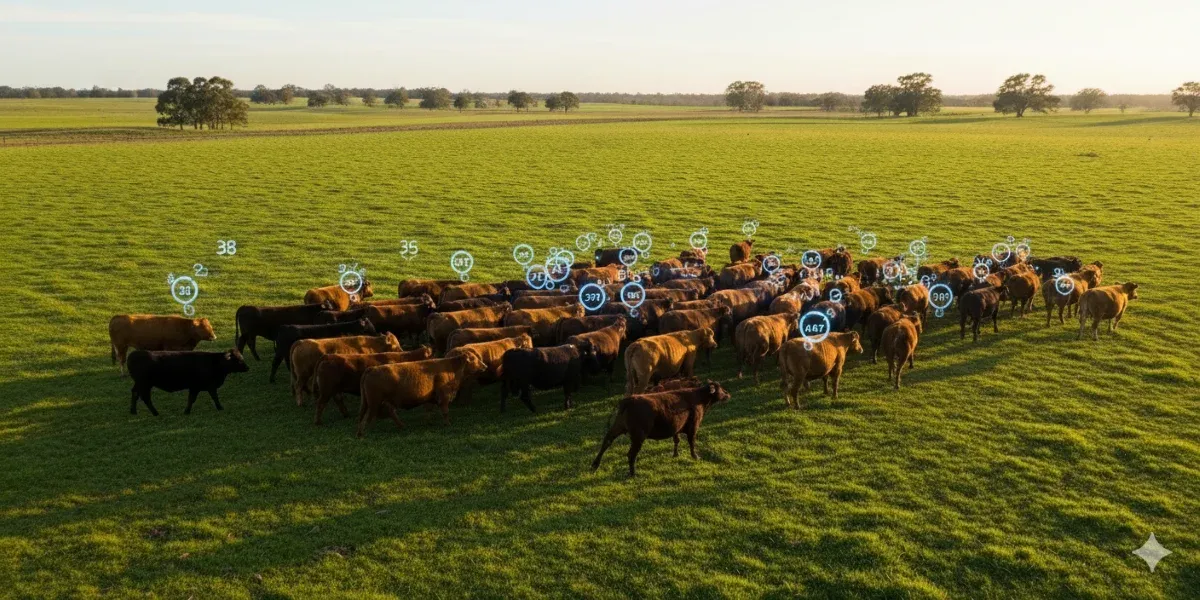
Automated cattle counting systems dramatically reduce the time required for herd management tasks, allowing ranch staff to focus on higher-value activities while maintaining superior oversight capabilities compared to traditional methods.
Fixed camera installations provide round-the-clock surveillance without requiring staff presence or overtime costs, capturing detailed animal movement data.
Real-time data flows directly into existing farm management systems, generating automated reports and instant alerts without manual delays.
Automated systems free up valuable staff resources, allowing ranch personnel to focus on higher-value activities while maintaining oversight.
Investment in AI cattle counting systems generates measurable returns through multiple cost savings channels and operational improvements. Financial benefits typically exceed initial technology costs within the first year of implementation for most operations.
Large operations experience significant annual savings through stray prevention alone, plus reduced labor costs and improved feed efficiency.
Early health intervention capabilities substantially reduce veterinary treatment costs through early detection of lameness, illness, and behavioral changes.
Financial benefits typically exceed initial technology costs within the first year of implementation for most ranch operations nationwide.
AI cattle counting systems extend beyond basic headcount functions to provide valuable insights into individual animal health status and overall herd wellness patterns that improve both animal welfare and operational profitability.
Systems continuously track individual animal behaviors, flagging concerns related to lameness, social isolation, or feeding irregularities impacting welfare.
Integrated thermal sensors detect elevated body temperatures indicating heat stress, allowing immediate intervention with shade, water, or cooling.
Automated documentation for compliance standards while providing early detection capabilities improves both animal welfare and operational profitability significantly.
AI counting systems provide ranch managers with actionable insights that optimize land use, resource allocation, and long-term planning decisions. Data-driven management replaces guesswork with concrete information about herd behavior and pasture utilization patterns.
Accurate real-time headcounts enable precise feed planning, water source management, and supplement distribution, reducing waste while ensuring nutrition.
Historical data analysis helps forecast feeding needs, identify seasonal movement patterns, and plan rotational grazing schedules.
Data-driven management replaces guesswork with concrete information about herd behavior and pasture utilization patterns for better decisions.
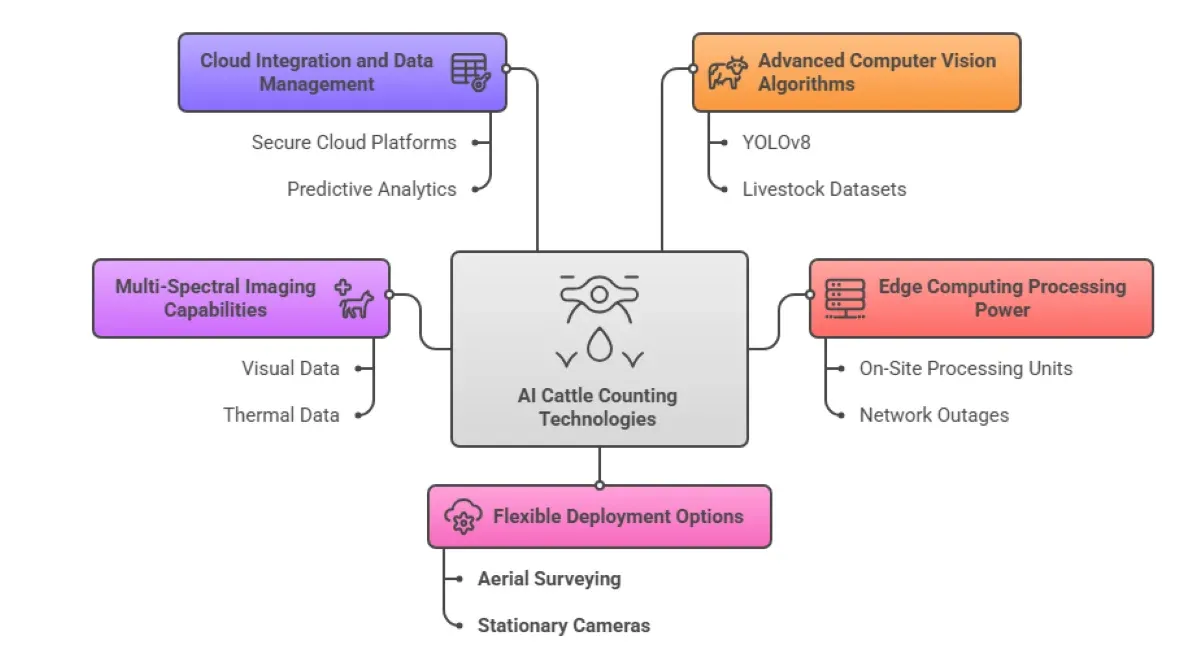
Modern AI cattle counting relies on sophisticated technologies working together to deliver accurate, reliable results across various ranch environments and operational conditions. Understanding these technologies helps ranch managers select appropriate solutions for their specific needs.
YOLOv8 and similar object detection algorithms trained specifically on livestock datasets distinguish cattle from background elements like rocks, vegetation, and farm equipment with high precision. These machine learning models continuously improve through training on diverse ranch environments and cattle breed variations.
On-site processing units handle data immediately without requiring constant internet connectivity, ensuring system reliability in remote ranch locations with limited bandwidth while maintaining functionality during network outages. Edge computing reduces latency and provides instant results for time-critical cattle management decisions.
Aerial surveying covers extensive pastures quickly, while stationary cameras monitor high-traffic areas like gates, feeding stations, and water sources continuously, providing flexible deployment options for different operations. Drone systems work best for large open ranges, while fixed cameras excel in controlled environments like feedlots.
Advanced camera systems capture visual and thermal data simultaneously, providing comprehensive information about animal health status alongside basic counting data through multi-spectral imaging capabilities. Thermal sensors detect heat stress and illness, while standard cameras provide detailed visual identification of individual animals.
Processed data uploads to secure cloud platforms for long-term storage, trend analysis, and integration with other ranch management tools when connectivity allows, ensuring data backup and accessibility. Cloud storage enables historical analysis and supports predictive analytics for better operational planning.
AI cattle counting systems adapt to various operational scenarios, from small family ranches to large commercial livestock facilities. Different applications demonstrate the versatility and scalability of modern AI counting solutions across diverse ranch environments.
Commercial feedlotsmprocessing thousands of head daily use AI systems to maintain accurate inventory during high-volume intake and shipping periods, reducing labor costs while ensuring precise records. Automated counting speeds up processing times and reduces bottlenecks during peak operations.
Major beef producers have implemented AI counting across extensive operations spanning multiple properties, demonstrating scalability for large ranch operations with multi-location deployment capabilities. Centralized monitoring provides unified oversight across geographically dispersed ranch locations.
Load-in and load-out verification prevents billing disputes and ensures accurate documentation for livestock transportation and sales transactions, providing immediate confirmation of animal numbers during loading processes. Real-time counting eliminates delays and reduces disputes between buyers, sellers, and transport companies.
Automated timestamped records satisfy traceability requirements and simplify audit processes for organic, grass-fed, and export certification programs while reducing paperwork and ensuring regulatory compliance. Digital documentation supports premium market access and certification maintenance.
Family ranches benefit from the same technology scaled to their specific needs, often starting with single paddock monitoring before expanding to full ranch coverage through scalable solutions. Entry-level systems provide immediate value while allowing gradual expansion as operations grow.
Our AI-powered cattle counting platform utilizes advanced technology combined with practical implementation to provide immediate value and long-term operational improvements.
Our system uses AI-powered computer vision and existing camera infrastructure to automatically count cattle moving through gates, chutes, and loading zones without requiring wearable devices or continuous manual oversight. Advanced algorithms work in various lighting conditions and weather environments for consistent performance.
Purpose-built for load-in and load-out points, our solution detects and logs every animal entering or exiting designated areas with precision timing during livestock transportation, auction check-ins, and pen transfers. Real-time processing provides immediate headcount confirmation for faster operational decisions.
Operators access intuitive, cloud-based dashboards displaying real-time headcounts, movement events, and system alerts from any connected device, flagging anomalies including overcounts, undercounts, and irregular movement patterns. Mobile accessibility enables ranch management from anywhere with internet connectivity.
Every count receives automatic timestamping and digital recording, creating traceable documentation of cattle movement for each load, pen, or sales transaction while supporting regulatory compliance requirements. Digital records eliminate paperwork and provide audit-ready documentation for certification programs.
Our solution connects seamlessly with current ranch infrastructure, including RFID tag systems, auction software, transport tracking platforms, and ERP solutions, through robust API support for real-time data synchronization. Integration eliminates duplicate data entry and ensures consistent information across all ranch management systems.
{ "@context": "https://schema.org", "@type": "FAQPage", "mainEntity": [ { "@type": "Question", "name": "What benefits does AI-based cattle counting offer over manual methods?", "acceptedAnswer": { "@type": "Answer", "text": "AI cattle counting provides superior accuracy compared to human counting, reduces counting time significantly, eliminates weather dependencies, and works continuously without fatigue or breaks affecting performance." } }, { "@type": "Question", "name": "How accurate is drone plus AI cattle counting for large herds?", "acceptedAnswer": { "@type": "Answer", "text": "Drone-based AI systems maintain accuracy rates above 99% even for herds exceeding 1,000 head, with the ability to distinguish individual animals across large pasture areas reliably throughout various conditions." } }, { "@type": "Question", "name": "What accuracy can we expect using YOLOv8 or similar models?", "acceptedAnswer": { "@type": "Answer", "text": "YOLOv8 and comparable deep learning models achieve accuracy rates between 96% and 99.5% when trained on livestock-specific datasets, depending on environmental conditions and implementation quality across different ranch environments." } }, { "@type": "Question", "name": "What ROI can farms expect from implementing AI cattle counting systems?", "acceptedAnswer": { "@type": "Answer", "text": "Most operations see full ROI within the first year through labor savings, stray prevention, and early health intervention, with substantial annual savings for larger operations." } }, { "@type": "Question", "name": "Can AI counting systems monitor animal health or detect strays?", "acceptedAnswer": { "@type": "Answer", "text": "Yes, AI systems detect health issues through gait analysis, behavioral changes, and thermal imaging while providing immediate alerts when animals leave designated areas or exhibit unusual movement patterns." } }, { "@type": "Question", "name": "Does Folio3's cattle counting integrate with farm management tools?", "acceptedAnswer": { "@type": "Answer", "text": "Our solution connects seamlessly with existing farm management software, ERP systems, and livestock tracking platforms through APIs, enabling real-time data synchronization without manual entry requirements or duplicate record keeping." } }, { "@type": "Question", "name": "How much training and infrastructure are needed for AI counting solutions?", "acceptedAnswer": { "@type": "Answer", "text": "Minimal training is required since systems operate automatically once configured for specific ranch conditions. Many operations can use existing camera infrastructure, with cloud-based processing eliminating significant on-site computing requirements." } }, { "@type": "Question", "name": "Are cattle-counting AI solutions scalable across different farm sizes?", "acceptedAnswer": { "@type": "Answer", "text": "AI counting systems scale from small family ranches to operations managing hundreds of thousands of head across multiple properties, with flexible deployment options matching specific operational needs and budget constraints." } }, { "@type": "Question", "name": "Can AI assist with biometric livestock identification via muzzle scanning?", "acceptedAnswer": { "@type": "Answer", "text": "Advanced AI systems perform individual animal identification through muzzle pattern recognition, ear tag detection, and other biometric features, enabling tracking of specific animals within herds for health and management purposes." } } ] }
AI cattle counting provides superior accuracy compared to human counting, reduces counting time significantly, eliminates weather dependencies, and works continuously without fatigue or breaks affecting performance.
Drone-based AI systems maintain accuracy rates above 99% even for herds exceeding 1,000 head, with the ability to distinguish individual animals across large pasture areas reliably throughout various conditions.
YOLOv8 and comparable deep learning models achieve accuracy rates between 96% and 99.5% when trained on livestock-specific datasets, depending on environmental conditions and implementation quality across different ranch environments.
Most operations see full ROI within the first year through labor savings, stray prevention, and early health intervention, with substantial annual savings for larger operations.
Yes, AI systems detect health issues through gait analysis, behavioral changes, and thermal imaging while providing immediate alerts when animals leave designated areas or exhibit unusual movement patterns.
Our solution connects seamlessly with existing farm management software, ERP systems, and livestock tracking platforms through APIs, enabling real-time data synchronization without manual entry requirements or duplicate record keeping.
Minimal training is required since systems operate automatically once configured for specific ranch conditions. Many operations can use existing camera infrastructure, with cloud-based processing eliminating significant on-site computing requirements.
AI counting systems scale from small family ranches to operations managing hundreds of thousands of head across multiple properties, with flexible deployment options matching specific operational needs and budget constraints.
Advanced AI systems perform individual animal identification through muzzle pattern recognition, ear tag detection, and other biometric features, enabling tracking of specific animals within herds for health and management purposes.
Modern AI systems maintain accuracy in various weather conditions and lighting situations through thermal imaging, infrared capabilities, and algorithms specifically trained for challenging environmental conditions that affect traditional counting methods.