
Loading...

Your legal team just flagged a potential GDPR violation in your new AI chatbot. Why? Because engineers used customer data for model training without explicit consent, you're now facing regulatory scrutiny. This scenario plays out daily across enterprises rushing to deploy generative AI without adequate consent frameworks.
Research shows that 81% of organizations express concern about the security implications of generative AI, yet many lack structured approaches to managing consent-related risks. Understanding how enterprises can reduce consent-related risks in generative AI isn't just about compliance; it's about building sustainable AI systems that protect both your organization and the individuals whose data powers these technologies. The gap between AI innovation speed and consent governance maturity creates vulnerabilities that threaten brand reputation, operational continuity, and legal standing.

Reducing consent-related risks requires integrated approaches spanning governance frameworks, technical safeguards, and organizational culture. These strategies work together to establish clear consent boundaries, enforce them through automated controls, and maintain compliance as your AI systems evolve and scale.
Define consent policies specific to generative AI covering training data requirements, output usage restrictions, and user interaction standards. Create cross-functional teams uniting legal, AI engineering, IT security, and business stakeholders with clear decision authority for consent matters.
Track data provenance documenting consent status throughout collection, storage, processing, and deletion phases. Deploy automated controls preventing unconsented data from entering training pipelines through verification at ingestion points, ensuring only properly authorized information powers your models.
Build user-facing systems with transparent disclosure mechanisms explaining AI interaction, data usage, and retention policies. Implement granular consent controls offering opt-in and opt-out choices for different processing activities, ensuring users maintain control over their information.
Implement monitoring infrastructure continuously scanning AI outputs for consent violations, including personal information disclosure, copyrighted content reproduction, and unauthorized likeness generation. Maintain a comprehensive audit trail, logging all model interactions and policy enforcement actions.
Educate data scientists, engineers, and business stakeholders through role-specific training programs on consent requirements. Integrate consent checkpoints into AI project lifecycles from initial scoping through ongoing operations, creating a culture where teams proactively identify and address risks.
Organizations face consent risks when personal information, copyrighted content, or proprietary data flows into generative AI systems without proper permissions. This occurs with training data scraped from public sources, customer interactions captured beyond stated purposes, and model outputs reproducing protected content.
Multiple frameworks now govern generative AI consent requirements differently across jurisdictions. GDPR demands explicit consent for personal data processing with special automated decision-making provisions. The EU AI Act adds transparency requirements for AI interactions, while the CCPA grants opt-out rights for data sales.
Most generative models train on massive datasets collected before AI-specific consent mechanisms existed, leaving organizations without documentation proving individuals authorized AI training uses. This historical gap creates retrospective compliance challenges as regulations tighten and demand explicit authorization for new processing purposes.
Generative AI produces unique consent challenges through its outputs. Models inadvertently reproduce training data verbatim, generate content impersonating real individuals, or create derivative works from copyrighted material. Unlike traditional databases, generative systems create novel combinations, potentially violating original consent terms.
Consent challenges multiply when organizations integrate third-party APIs, deploy AI agents across partner ecosystems, or allow model outputs for reuse in downstream applications. Data originally consented for one purpose flows through multiple systems, each introducing new obligations that organizations struggle to track.
Read more: How to Implement Generative AI Ethics in Modern Enterprise
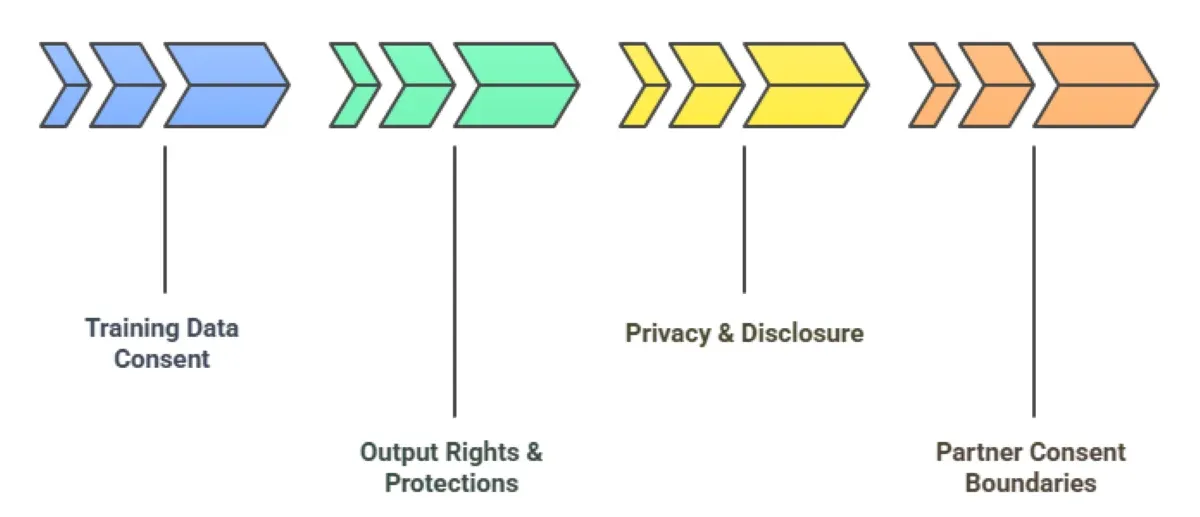
Enterprise consent risk in generative AI rests on four foundational areas spanning the complete AI lifecycle. Each pillar presents distinct consent challenges requiring specialized governance approaches from initial data collection through final output distribution and reuse.
Organizations must verify that all data used for model training, including personal information, copyrighted content, or proprietary datasets, was collected with appropriate AI-use permissions. This requires auditing data provenance, documenting consent records, and implementing controls preventing unconsented data from entering training pipelines.
Generative AI outputs can infringe individual rights by reproducing personal data, generating deepfakes, or creating content mimicking copyrighted works. Organizations need detection mechanisms to identify when outputs violate consent boundaries, including systems that catch personal information disclosure and intellectual property replication.
When end-users interact with generative AI systems, organizations must provide clear disclosure about AI engagement, explain input usage, and offer meaningful consent choices. This addresses informed consent at interaction points, ensuring users understand data capture, retention policies, and potential output reuse.
Model outputs often flow beyond initial deployment into partner systems, third-party applications, or public-facing platforms. Organizations must establish consent boundaries for output reuse, implement tracking mechanisms following data through ecosystem partners, and create contractual frameworks extending consent obligations.
Technical safeguards form the operational backbone of consent-safe generative AI deployments, preventing unauthorized data access, detecting consent violations in real-time, and creating audit trails demonstrating compliance with consent obligations throughout the AI lifecycle.
LLM firewalls monitor prompts, retrieve data, and model responses to enforce consent boundaries effectively. Prompt firewalls detect attempts to extract training data or manipulate models into disclosing protected information. Retrieval firewalls validate that accessed data matches user permissions, while response firewalls scan outputs for violations before user delivery.
Data poisoning occurs when malicious actors subtly alter digital content to disrupt AI training and processing, potentially causing models to violate consent boundaries through corrupted outputs. Prevention strategies include employee training on poisoning tactics, restricting data scraping to authorized sources, and validating content integrity before incorporation.
Prompt injection attacks manipulate generative AI systems into ignoring consent restrictions or disclosing protected data without authorization. Defense strategies include input validation, detecting malicious prompts, context isolation, preventing prompt-based privilege escalation, and output filtering, catching unauthorized disclosure attempts regardless of trigger method.
AI hallucinations create consent risks when models fabricate information about real individuals or generate false attributions without a basis. Organizations need monitoring systems that detect factual inconsistencies, implement confidence scoring for generated content, and establish human review processes for outputs referencing specific people or organizations.
Research demonstrates that exfiltration attacks can extract training data from generative models, potentially exposing information that individuals consented to use only within specific contexts. Protection measures include query rate limiting, anomaly detection for suspicious access patterns, and architectural controls minimizing memorization of sensitive training data.
Digital watermarking technologies embed traceable signatures in AI-generated content, enabling organizations to track output usage and detect consent boundary violations effectively. Watermarking supports accountability by proving content provenance, facilitating takedown requests when outputs violate consent terms, and providing audit evidence during compliance investigations.
Organizations deploying generative AI without robust consent frameworks face cascading costs across legal, operational, and strategic dimensions. These expenses far exceed investments required for proactive consent management, often manifesting when remediation becomes exponentially more complex and expensive.
GDPR violations trigger fines up to €20 million or 4% of global annual revenue, whichever proves higher. New regulatory acts, like the EU AI Act, introduce additional penalties for high-risk AI systems failing transparency and consent requirements. Beyond statutory fines, organizations face litigation costs from class-action lawsuits, intellectual property disputes, and individual claims.
Public disclosure of consent violations erodes customer trust in ways that persist long after regulatory penalties are paid. News coverage of AI systems misusing personal data, generating offensive content, or violating individual rights creates lasting brand damage that survives the immediate crisis period and affects customer acquisition costs.
Consent violations often require pulling AI systems offline, retraining models on properly consented datasets, and implementing governance controls retrospectively. These remediation efforts consume engineering resources, delay product roadmaps, and create opportunity costs as competitors advance with mature consent frameworks already deployed.
Organizations suffering high-profile consent violations often impose restrictive AI policies, stifling future innovation completely. Risk-averse legal teams may block promising AI initiatives entirely, fearing repeat violations. This paralysis prevents organizations from capturing generative AI's productivity benefits while competitors with consent frameworks deploy confidently.
Organizations frequently operate under flawed assumptions about consent requirements in generative AI contexts. These misconceptions create dangerous blind spots in governance strategies, leaving enterprises vulnerable to violations they mistakenly believe they've addressed through inadequate controls.
Many organizations assume publicly accessible data, which is scraped from websites, social media, or open repositories, can freely train AI models without explicit consent. However, GDPR applies regardless of the collection source, requiring a lawful basis for processing, and public availability doesn't constitute consent for AI training purposes.
Organizations often repurpose data consented for one purpose, like newsletter subscriptions to train AI models, assuming original consent suffices for new uses. However, GDPR's purpose limitation principle requires specific consent for materially different processing activities beyond what individuals authorized initially.
While synthetic data reduces some consent burdens by creating artificial datasets resembling real patterns, it doesn't eliminate risks. Poorly generated synthetic data may preserve identifiable patterns from source datasets, and organizations must still document how synthetic data was created and verify source data consent.
Some organizations treat AI-generated content as entirely new creations exempt from consent obligations altogether. However, outputs reproducing training data, generating individual likenesses, or creating derivative works from copyrighted material remain subject to consent and intellectual property constraints requiring organizational accountability.
Advanced technical safeguards create false confidence that consent requirements are satisfied through engineering alone without administrative records. However, regulations require documented consent records proving individuals provided informed consent for specified processing activities, not just technical barriers preventing unauthorized access.
Consent requirements for generative AI vary significantly across jurisdictions, each imposing distinct obligations that multinational enterprises must navigate simultaneously. Understanding these regional differences enables organizations to build consent frameworks satisfying the most stringent requirements while maintaining operational flexibility.
US consent requirements fragment across state laws, with California's CCPA/CPRA leading regulatory stringency nationwide. CCPA grants consumers the right to opt out of personal information sales, including data sold or shared for AI training purposes. Virginia's CDPA and Colorado's CPA impose similar requirements with variations.
The EU requires explicit consent for personal data processing with special automated decision-making provisions. GDPR's data minimization and purpose limitation principles restrict training data collection to the necessary amounts for specified purposes. The EU AI Act adds transparency requirements mandating disclosure when users interact with systems.
UK GDPR largely mirrors EU requirements while diverging on specific interpretations through ICO guidance published separately. The UK emphasizes accountability principles requiring organizations to demonstrate compliance through documentation and governance processes, with the ICO issuing specific guidance on AI and data protection, clarifying requirements.
China's Personal Information Protection Law requires explicit consent for sensitive personal information processing with additional cross-border transfer requirements. Singapore's PDPA and Australia's Privacy Act apply to AI systems processing personal data, though specific AI guidance remains less developed than European frameworks currently.
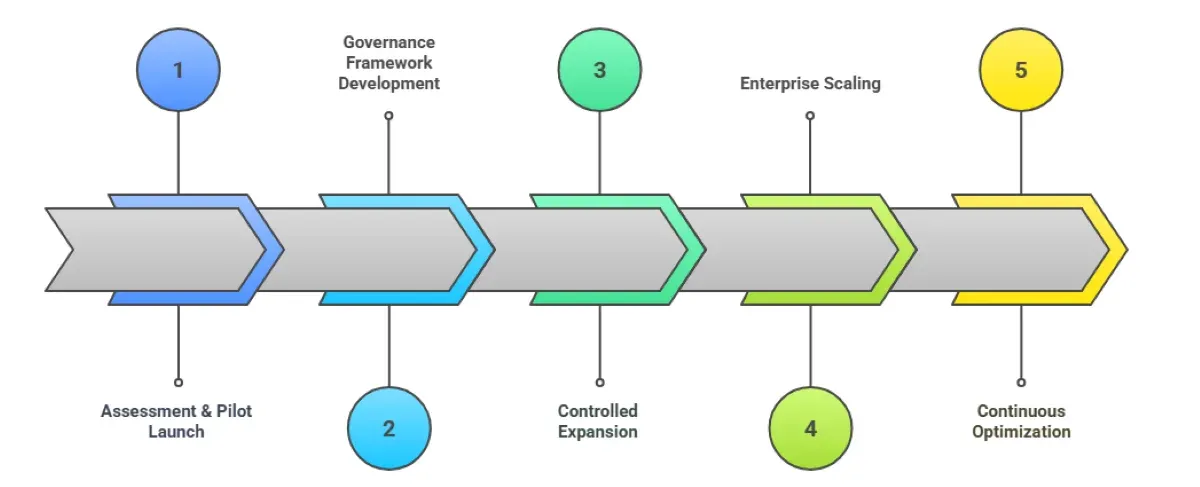
Successful consent-safe generative AI requires phased implementation, proving governance value through pilots before scaling across enterprise operations. This progression balances innovation speed with risk management maturity, allowing organizations to refine approaches based on real-world experience.
Begin with a comprehensive consent risk assessment identifying current AI initiatives, data sources, consent documentation gaps, and regulatory obligations. Select low-risk pilot use cases like internal productivity tools with employee consent to test governance frameworks and establish baseline metrics.
Develop organization-wide consent policies covering training data requirements, user interaction standards, output usage restrictions, and third-party obligations comprehensively. Create cross-functional governance committees with defined decision rights and escalation paths, implementing core technology infrastructure, including consent management platforms.
Roll out governance frameworks to 3-5 additional use cases spanning different business functions and risk profiles, testing framework robustness across varied scenarios. Collect feedback from implementation teams to refine policies and streamline processes, begin organizational training programs, and ensure all stakeholders understand requirements.
Expand consent frameworks to all active generative AI initiatives while establishing mandatory governance checkpoints for new project organization-wide. Integrate consent verification into standard AI development workflows through automated policy-as-code implementations, deploying enterprise-wide monitoring dashboards providing leadership visibility.
Establish regular audit cycles reviewing consent documentation, testing control effectiveness, and identifying emerging risks from new AI capabilities or regulatory changes. Implement feedback loops capturing lessons from incidents and near-misses, benchmarking consent maturity against industry standards while evolving frameworks proactively.
The regulatory and technical environment for generative AI consent continues evolving rapidly, requiring forward-looking strategies anticipating future requirements rather than merely satisfying today's minimum standards. Organizations building adaptable consent frameworks position themselves for competitive advantage as compliance becomes a market differentiator.
Multiple jurisdictions are developing AI-specific regulations, substantially expanding consent requirements in the coming years. The EU AI Act enters enforcement in 2025 with transparency obligations for AI-generated content. Organizations should establish regulatory monitoring functions tracking legislative developments and adapting frameworks proactively.
Emerging technical capabilities will transform consent management possibilities significantly. Federated learning enables model training across distributed datasets without centralizing personal information. Homomorphic encryption allows computations on encrypted data without accessing the content directly. Differential privacy provides mathematical guarantees limiting individual disclosure.
Future consent frameworks will require comprehensive tracking of how AI-generated content flows through systems, gets modified, and impacts individuals downstream. Content provenance technologies embedding cryptographic signatures enable verification of content authenticity and consent status, while blockchain-based audit trails create immutable records.
As regulations increasingly require explanation of automated decisions, organizations need AI systems to articulate why specific consent determinations were made. Explainable AI techniques reveal which data influenced model outputs, helping demonstrate consent compliance during audits and regulatory investigations when explanations become mandatory.
Forward-looking organizations recognize that demonstrable consent-safe AI becomes a marketing advantage in privacy-conscious markets where customers prefer providers that prove responsible data handling. Organizations achieving third-party consent certifications, publishing transparency reports, and submitting to independent audits differentiate themselves from competitors.
Folio3 AI delivers comprehensive generative AI development services built on consent-safe foundations, ensuring your AI initiatives meet regulatory requirements while driving business value. Our end-to-end approach integrates governance controls throughout the AI lifecycle, protecting your organization from consent-related risks.
We design and build custom generative AI models fine-tuned to your data, industry, and use cases while verifying that all training data meets consent requirements. Our development process includes provenance tracking, consent documentation, and compliance validation, ensuring models deliver business value within regulatory boundaries.
We seamlessly embed generative AI solutions into your existing IT ecosystem with built-in consent verification mechanisms. Our integration approach ensures AI systems respect data permissions across CRM, ERP, and proprietary platforms, maintaining consent boundaries without disrupting workflows or compromising operational efficiency.
Our experts craft optimized prompts tailored to your enterprise applications while embedding consent checks that prevent unauthorized data disclosure. We design prompt strategies ensuring AI outputs remain within permitted data boundaries, delivering consistent, compliant, and high-quality results aligned with your consent obligations.
We strengthen your internal teams with MLOps specialists who manage model deployment, monitoring, and scaling while tracking consent compliance throughout operations. Our infrastructure services include real-time consent violation detection, audit trail maintenance, and governance reporting, ensuring your AI systems remain production-ready and compliant.
Through our specialized generative AI consulting services, we help you define AI adoption roadmaps that prioritize consent management from inception. We align AI initiatives with business objectives and regulatory requirements, establishing governance frameworks that transform consent obligations into competitive advantages rather than compliance burdens.

Consent-related risks include legal penalties for unauthorized data processing, brand damage from misusing customer information, operational disruption requiring model retraining, and compliance failures across jurisdictions. Organizations face challenges with historical data collected before AI-specific consent mechanisms existed, creating gaps that regulations now require addressing retroactively.
Organizations should implement data provenance tracking, documenting source, collection method, consent status, and permitted uses for all training data. Technical controls must prevent unconsented data from entering training pipelines through automated verification at ingestion points, while regular audits verify documentation accuracy and identify remediation gaps.
Organizations need documented consent policies, cross-functional governance committees, data inventory with consent status, user disclosure mechanisms, technical controls including LLM firewalls and output monitoring, incident response procedures, and comprehensive audit trails. These controls should integrate into AI development workflows through automated policy enforcement rather than manual compliance checks.
Companies should deploy real-time monitoring systems scanning outputs for personal information disclosure, copyrighted content reproduction, and consent boundary violations using pattern recognition and anomaly detection. Audit trails must log all generated content for retrospective investigation, while human review processes validate high-risk outputs and alert mechanisms notify security teams of violations.
GDPR governs EU consent requirements for personal data processing with automated decision-making provisions, while the EU AI Act adds transparency requirements. CCPA/CPRA provides California residents with opt-out rights for data sales, including AI training, with similar requirements in Virginia and Colorado. China's PIPL requires explicit consent for sensitive information, while sector-specific regulations like HIPAA and PCI DSS add obligations.
Training phase consent verifies data was collected with AI development authorization, requiring documentation of sources and consent records obtained once per dataset. Deployment phase consent addresses user interactions with live systems, requiring transparent AI disclosure and granular consent choices obtained continuously as users engage, with both phases demanding distinct technical controls and governance processes.
Organizational culture determines whether consent becomes a fundamental principle or a compliance checkbox shaping AI development decisions. Training programs educate stakeholders on consent requirements, enabling proactive risk identification through embedded behaviors like project lifecycle checkpoints and escalation norms, while role-specific training addresses distinct responsibilities from legal to engineering functions.
Enterprise AI partners like Folio3 AI provide specialized expertise in consent-safe architecture, designing systems with embedded governance controls from inception rather than retrofitting compliance later. Partners offer technology solutions, including deployment frameworks, monitoring systems, and audit infrastructure, plus consulting for risk assessment and regulatory mapping, accelerating implementation through proven frameworks and ongoing optimization services.