
Loading...

Your AI project's success hinges on one factor: data quality. Yet 68% of data leaders lack confidence in their training datasets. If you're developing custom AI models for your enterprise, you've likely encountered this problem firsthand. Real-world data is expensive to collect, difficult to annotate, and often restricted by privacy regulations. Synthetic data offers a way forward.
By generating artificial training data that mirrors real-world patterns, you can accelerate model development, improve accuracy, and overcome data scarcity without compromising compliance. This guide breaks down when and how enterprises use synthetic data to improve model training.
Synthetic data is artificially generated information created through algorithms, generative models, or simulation techniques to replicate the statistical properties of real-world data. Unlike actual data collected from operations or customers, synthetic data is produced programmatically to match specific patterns, distributions, and characteristics needed for AI model training. It maintains the utility of real data while eliminating privacy risks and data scarcity limitations.
Modern synthetic data generation leverages techniques like generative adversarial networks, statistical modeling, and large language models to create datasets that are indistinguishable from authentic data in their structure and behavior.
You're facing data challenges that slow AI development and increase costs. Synthetic data addresses five critical gaps in traditional training approaches, helping you build accurate models faster while maintaining compliance.
Your niche use cases often lack sufficient real-world examples for effective training. Manufacturing defect detection, rare disease diagnosis, or specialized equipment monitoring requires thousands of examples that don't exist in your historical data. Synthetic generation creates the volume you need.
Manual data collection and annotation can delay projects by months. Cleaning 100,000 samples takes 80-160 hours, while annotation requires 300-850 hours. Synthetic data reduces this timeline significantly, letting you iterate faster and reach production sooner.
Purchasing third-party datasets, hiring annotation teams, and maintaining data collection infrastructure consume substantial budgets. Synthetic generation eliminates these expenses while providing higher-quality, purpose-built datasets tailored to your specific model requirements.
Your customer data contains personally identifiable information subject to GDPR, CCPA, and HIPAA regulations. Synthetic data lets you train models on realistic patterns without exposing actual customer information, reducing legal risk and simplifying compliance workflows.
Real-world data often contains imbalances that bias your models. Fraud detection systems see far more legitimate transactions than fraudulent ones. Synthetic generation creates balanced datasets that improve model performance across all scenarios you need to address.
Traditional data preparation creates bottlenecks that prevent AI initiatives from delivering ROI. Understanding these limitations helps you identify where synthetic approaches provide the most value.
Your models must handle rare scenarios, but real data rarely captures these events. Equipment failures, security breaches, or unusual customer behaviors appear infrequently. Training on limited examples produces models that fail when encountering uncommon situations in production.
Supervised learning requires labeled examples, but annotation is slow and expensive. Subject matter experts must review each data point, creating dependencies that delay projects. Annotation quality varies between reviewers, introducing inconsistencies that affect model accuracy.
Healthcare, finance, and telecommunications data contain sensitive information you can't freely use for training. Even anonymization techniques risk re-identification. These constraints limit your ability to leverage existing data for AI development, particularly for cross-border projects.
Your business environment changes constantly. Customer preferences shift, market conditions evolve, and operational patterns transform. Training data collected months ago may not reflect current realities, causing models to underperform when deployed against fresh data.
Merging data from multiple systems introduces quality issues. Different formats, missing values, measurement errors, and conflicting information require extensive cleaning. These inconsistencies reduce model accuracy and require significant preprocessing effort before training can begin.
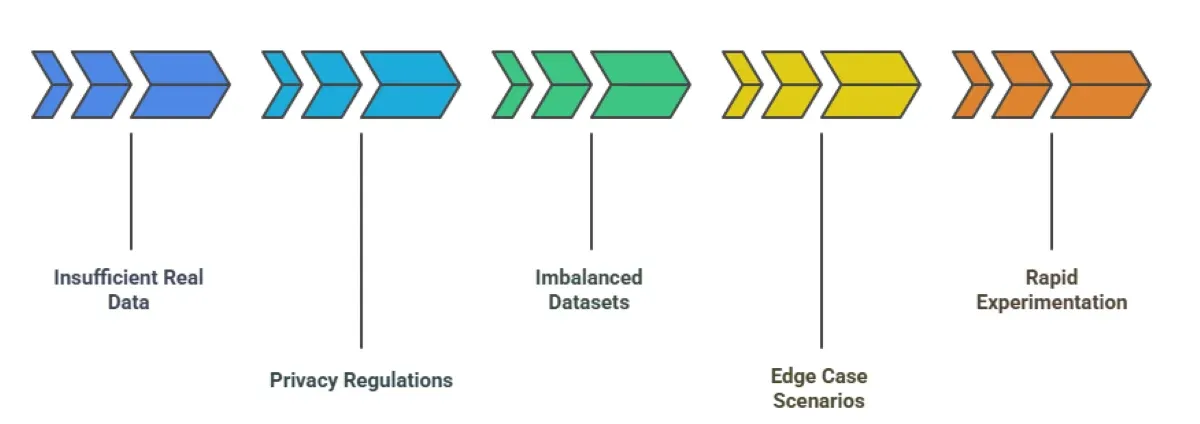
Knowing when to generate synthetic data versus collecting real data determines project success. Five scenarios consistently benefit from synthetic approaches.
You're building models for new products, emerging markets, or novel use cases where historical data doesn't exist. Synthetic generation creates the foundation needed to start development while you begin collecting real-world data in parallel.
Financial transactions, medical records, or customer communications contain protected information. Synthetic alternatives let you develop and test models without accessing sensitive data, streamlining compliance reviews and reducing security risks throughout the development lifecycle.
Your fraud detection, quality control, or anomaly detection systems need balanced training sets. Real data contains 1,000 normal examples for every anomalous case. Synthetic generation creates balanced datasets that improve model sensitivity to rare events.
Production environments expose models to variations that your historical data doesn't capture. Different lighting conditions, varied accents, or unusual user behaviors require testing across scenarios. Synthetic data generates these edge cases systematically.
Your data science teams need rapid experimentation. Waiting weeks for new data collection delays hypothesis testing. Synthetic generation provides immediate datasets for each iteration, letting teams test approaches and refine models without waiting for real-world data collection.
Different generation techniques serve different purposes. Selecting the right method depends on your data type, model architecture, and quality requirements.
GANs use two neural networks competing against each other to create synthetic data indistinguishable from real examples. The generator creates samples while the discriminator evaluates authenticity. This approach excels at producing images, sensor readings, and time-series data.
Traditional statistical methods create synthetic data by analyzing real data distributions and generating new samples matching those patterns. These techniques work well for structured datasets, financial transactions, and scenarios where maintaining specific statistical properties is critical.
When you understand the underlying rules governing your data, rule-based systems generate synthetic examples efficiently. Manufacturing processes, business logic, and regulatory compliance scenarios benefit from this approach, which ensures that generated data follows known constraints.
Advanced language models generate synthetic training data for smaller, specialized models. A larger teacher model creates diverse examples that train smaller student models. This knowledge transfer reduces computational costs while maintaining accuracy for specific tasks.
Physics engines, business process simulators, and digital twins create synthetic data by modeling real-world systems. Autonomous vehicle training, supply chain optimization, and equipment maintenance prediction leverage simulation to generate scenarios difficult to capture in reality.
Implementing synthetic data generation requires understanding the technical workflow. Five key steps transform your requirements into production-ready training datasets.
You specify what patterns, distributions, and characteristics your synthetic data must match. This includes statistical properties from real data, business rules, and constraints ensuring generated examples remain realistic and relevant to your use case.
Small amounts of real data guide synthetic generation. These seed examples teach generation algorithms the patterns, relationships, and nuances that synthetic data should replicate. Quality seed data directly impacts the usefulness of generated outputs.
Generation algorithms produce thousands or millions of synthetic examples based on your parameters. Modern systems leverage cloud infrastructure to parallelize this process, creating large datasets in hours rather than the months required for manual collection.
Generated data undergoes automated quality checks. Statistical tests verify that synthetic examples match real-world distributions. Business rule validation ensures that the generated data remains logically consistent. Low-quality examples are filtered before training begins.
Synthetic data flows directly into your existing training infrastructure. Data versioning tracks which synthetic datasets were trained with which model versions. This integration ensures that synthetic data enhances rather than complicates your development workflow.
Pre-trained models require customization for your specific use cases. Synthetic data accelerates fine-tuning while reducing the real data needed for specialization.
Your industry uses specialized language that general models don't understand. Synthetic examples incorporating your terminology, acronyms, and jargon teach models to communicate effectively in your business context without exposing proprietary information.
Fine-tuning requires examples demonstrating how models should handle your unique tasks. Synthetic generation creates diverse scenarios showing correct responses to customer queries, document analysis tasks, or decision-making situations specific to your operations.
Real data rarely captures unusual situations that your model must handle. Synthetic generation systematically creates edge cases, unusual inputs, and challenging scenarios that improve model resilience when encountering unexpected situations in production.
Your models must follow company policies, regulatory requirements, and ethical guidelines. Synthetic data demonstrating correct behavior in policy-relevant situations teaches models to make compliant decisions aligned with your organizational standards.
As your business evolves, models require updates reflecting new patterns. Synthetic data enables rapid fine-tuning when launching new products, entering new markets, or adapting to changing customer behaviors without waiting for sufficient real-world examples.
Regulatory compliance and data privacy concerns limit AI development. Synthetic data provides paths to compliant model training across regulated industries.
Synthetic generation creates training data containing no actual customer information. Generated examples maintain realistic patterns without connecting to real individuals, eliminating PII exposure risks and simplifying privacy impact assessments.
Data protection regulations grant individuals rights over their personal data. Synthetic data isn't personal data under these regulations because it doesn't relate to identifiable people. This distinction streamlines compliance reviews for AI projects.
International projects face restrictions on moving data between jurisdictions. Synthetic data generated in one region can train models in another without triggering data transfer regulations, enabling global AI development from regional data sources.
Privacy regulations require collecting only necessary data. Synthetic generation lets you create exactly the data needed for training without collecting excess real information, aligning AI projects with data minimization requirements.
Sharing real customer data with vendors, partners, or researchers creates liability. Synthetic datasets enable collaboration without data sharing agreements, security audits, or contractual restrictions that slow vendor relationships and limit innovation.
FactorSynthetic dataReal dataBest use caseData scarcity, privacy restrictions, rapid prototyping, edge case testingFinal validation, capturing true patterns, and regulatory approval processesCostLower ongoing costs, higher initial setupHigher collection and annotation costsTime to availabilityHours to days for generationWeeks to months for collectionPrivacy riskMinimal, no actual PIIHigh, requires anonymizationRegulatory complexitySimplified complianceAn extensive legal review is requiredData volume scalabilityUnlimited generation capacityLimited by real-world availabilityPattern accuracyMatches seed data patternsCaptures true real-world complexityEdge case coverageSystematically generatedRare in historical dataBias potentialInherits seed data biasesContains real-world biasesValidation confidenceRequires real data verificationDirect representation of realityIdeal ratio70-80% synthetic for training20-30% real for validation
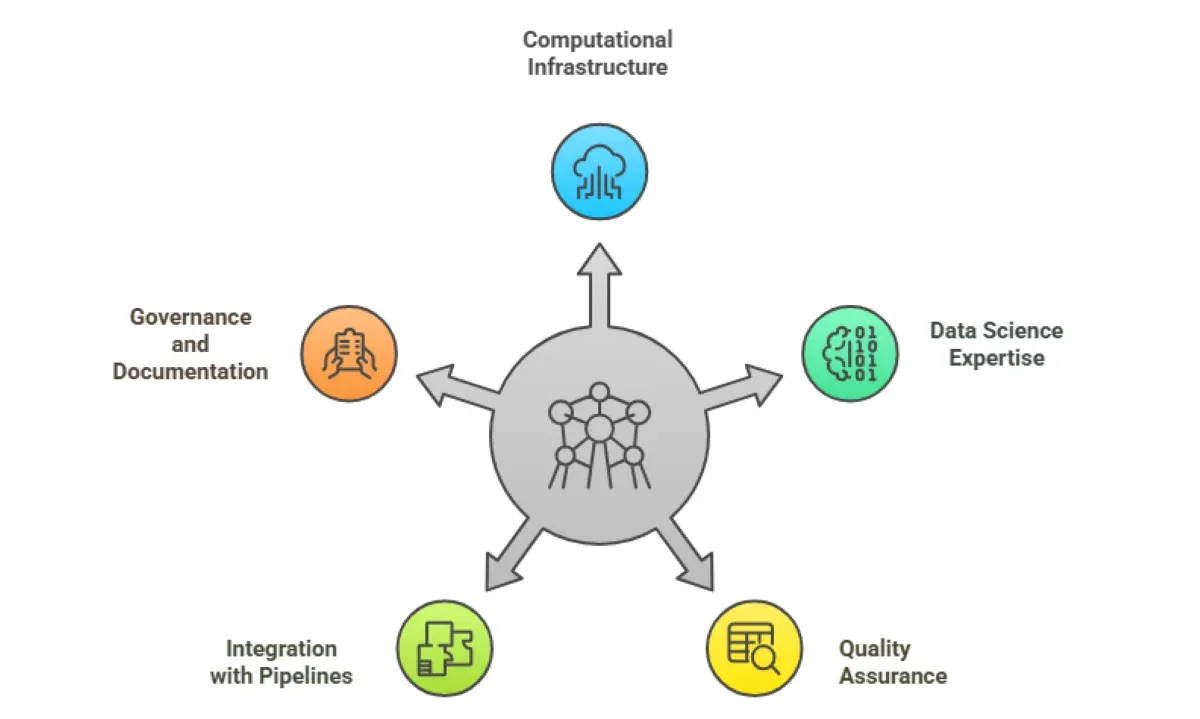
Building production-ready synthetic data pipelines requires specific infrastructure, expertise, and tooling. Five technical capabilities determine implementation success.
Synthetic data generation demands significant processing power. Cloud GPU instances, distributed computing frameworks, and efficient storage systems handle the computational load required to generate millions of examples at production scale.
Your teams need skills in generative models, statistical analysis, and domain knowledge. Understanding when to apply GANs versus statistical methods versus simulation requires expertise that combines data science with deep business understanding.
Automated testing verifies that synthetic data maintains the required statistical properties. Validation pipelines compare generated data against real samples, check for distribution drift, and ensure business rules are satisfied before training begins.
Synthetic generation must fit into your current infrastructure. Data versioning systems track synthetic dataset lineage. Training pipelines seamlessly incorporate synthetic and real data. Monitoring systems detect quality degradation over time.
Production of synthetic data requires documentation explaining generation methods, assumptions, and limitations. Governance processes determine who approves synthetic datasets, how quality is assessed, and when regeneration is necessary as business requirements evolve.
Understanding the economics of synthetic data helps you budget effectively and demonstrate ROI. Five cost factors influence total investment.
Building synthetic generation capabilities requires upfront investment in infrastructure, tooling, and expertise. Cloud computing resources, software licenses, and data science talent represent the primary initial expenses before generating your first synthetic dataset.
Running generation algorithms consumes compute resources. Updating generation parameters as business needs evolve requires data science time. Storage costs accumulate as you maintain multiple dataset versions for different model iterations and use cases.
Manual data collection, annotation teams, and third-party data purchases often exceed synthetic generation costs. A Seekr analysis found organizations using synthetic data spend 9x less than those relying on traditional methods while achieving faster deployment.
Reducing time to production delivers measurable value. If synthetic data accelerates deployment by three months, the revenue from earlier launch often exceeds total generation costs. Faster iteration also reduces opportunity costs from delayed projects.
Synthetic generation costs scale predictably with volume. Doubling the dataset size roughly doubles compute costs. This linear scaling contrasts with manual collection, where costs increase exponentially as you pursue harder-to-find examples.
Folio3 AI delivers custom synthetic data generation solutions that accelerate your AI development while protecting privacy. With 15+ years of enterprise AI experience and proven implementations across Fortune 500 clients, we build synthetic data pipelines tailored to your industry requirements.
We design generation algorithms specific to your business needs, whether for ALPR systems, livestock monitoring, or fleet management. Our solutions replicate your real-world data patterns without exposing sensitive customer information or operational data.
Our team understands the unique data requirements across healthcare, transportation, agriculture, and manufacturing. We've built synthetic datasets for autonomous vehicles, medical diagnosis, sports analytics, and supply chain optimization across multiple regulated industries.
We handle the complete synthetic data pipeline from seed data analysis through generation, validation, and integration with your existing ML infrastructure. Our certified ML engineers ensure seamless deployment into your training workflows without disrupting current operations.
We implement synthetic generation that eliminates PII while maintaining statistical accuracy for model training. Our approach ensures GDPR and CCPA compliance, enabling you to develop AI solutions without privacy risks or regulatory complications.
Our cloud-based generation infrastructure scales from proof-of-concept to production volumes. We deploy automated quality validation, version control, and continuous generation capabilities that support iterative model development and ongoing AI improvement initiatives.
Synthetic data is artificially generated information created through algorithms to replicate real-world data patterns. It's used to train AI models when real data is scarce, expensive, or restricted by privacy regulations.
Models trained on properly generated synthetic data achieve comparable accuracy to those trained on real data. The key is ensuring synthetic generation captures true patterns from quality seed data and validating outputs with real-world testing.
No. While synthetic data excels for initial training and fine-tuning, you should always validate models with real-world data before deployment. A typical approach uses 70-80% synthetic data for training and 20-30% real data for validation.
Synthetic data contains no actual customer information, eliminating PII exposure risks. This simplifies GDPR and CCPA compliance, enables cross-border development, and allows third-party collaboration without data sharing agreements.
Modern systems generate synthetic datasets in hours to days, compared to weeks or months for manual collection and annotation. Exact timelines depend on data complexity, volume requirements, and available computational resources.
Healthcare, finance, telecommunications, and manufacturing see significant benefits due to privacy regulations, data scarcity in specialized domains, and the need for edge case coverage that real data rarely captures.
Synthetic data can inherit biases from the seed data used for generation. Careful seed data selection, diversity in generation parameters, and bias testing help mitigate this risk. Proper implementation often reduces bias compared to imbalanced real datasets.
Initial setup requires investment in infrastructure and expertise, but ongoing costs are typically 9x lower than traditional data collection. ROI comes from faster deployment, reduced annotation expenses, and the elimination of third-party data purchases.
Use statistical tests comparing synthetic and real data distributions, automated business rule checks, and expert review of sample outputs. Always validate final model performance against real-world data before production deployment.
Yes. Synthetic data helps meet regulatory requirements by eliminating PII and simplifying compliance reviews. However, regulatory approval processes often still require real data validation, so synthetic data supplements rather than fully replace traditional approaches.