
Loading...

Businesses across every sector are investing in artificial intelligence to drive growth and efficiency. AI development costs in 2026 range from $10,000 for simple automation tools to over $1 million for enterprise-grade systems. Understanding what drives these numbers determines whether your investment delivers transformative results.
From startups launching their first chatbot to enterprises building sophisticated machine learing platforms, organizations must make informed decisions about AI spending. The right investment strategy, coupled with clear objectives and proper planning, ensures your AI initiative generates measurable returns today. This guide breaks down AI costs across different business sizes, solution types, and implementation approaches.
Understanding AI costs requires breaking down investments by project complexity. Basic automation starts affordably, while advanced enterprise solutions demand substantial capital. Your specific requirements, from simple chatbots to complex predictive systems, directly determine your budget allocation and implementation timeline.
Basic rule-based systems and chatbots start around $10,000. These handle straightforward tasks like customer inquiries or appointment scheduling without requiring extensive customization or complex infrastructure investments.
Mid-range solutions incorporating machine learning cost between $50,000 - $150,000. These include sentiment analysis tools, recommendation engines, and basic predictive analytics for business applications.
Sophisticated deep learning implementations range from $150,000 to $400,000. These projects involve custom model training, extensive data processing, and integration with complex enterprise systems.
Large-scale AI transformations exceed $400,000, often reaching millions. These comprehensive systems require cutting-edge research, specialized hardware, extensive testing, and integration across multiple business units.
The minimum viable product version of an AI solution typically costs at least $50,000. This covers core functionality testing before full-scale deployment and helps validate concepts before major investments.

Company size fundamentally shapes AI investment strategies and pricing structures. Smaller organizations prioritize affordable, scalable solutions while enterprises focus on comprehensive, custom-built systems. Each tier faces unique challenges in balancing capability requirements against budget constraints.
Startups typically allocate $5,000 to $50,000 for initial AI implementations. They leverage pre-built APIs, cloud services, and open-source tools to minimize upfront costs while testing market viability.
Small businesses invest $20,000 to $100,000 in AI solutions. They focus on targeted applications like customer service automation, basic analytics, or marketing optimization that deliver immediate ROI.
Mid-sized companies budget $100,000 to $500,000 for AI initiatives. These organizations balance custom development needs with off-the-shelf solutions, often building hybrid systems that scale with growth.
About 34% of companies that are already investing in AI plan to spend $10 million or more on the technology next year. Large enterprises deploy comprehensive AI strategies across multiple departments.
Growth phase companies face expanding costs as usage increases. Cloud-based solutions offer flexibility but can become expensive at scale, requiring strategic decisions about transitioning to on-premise infrastructure.
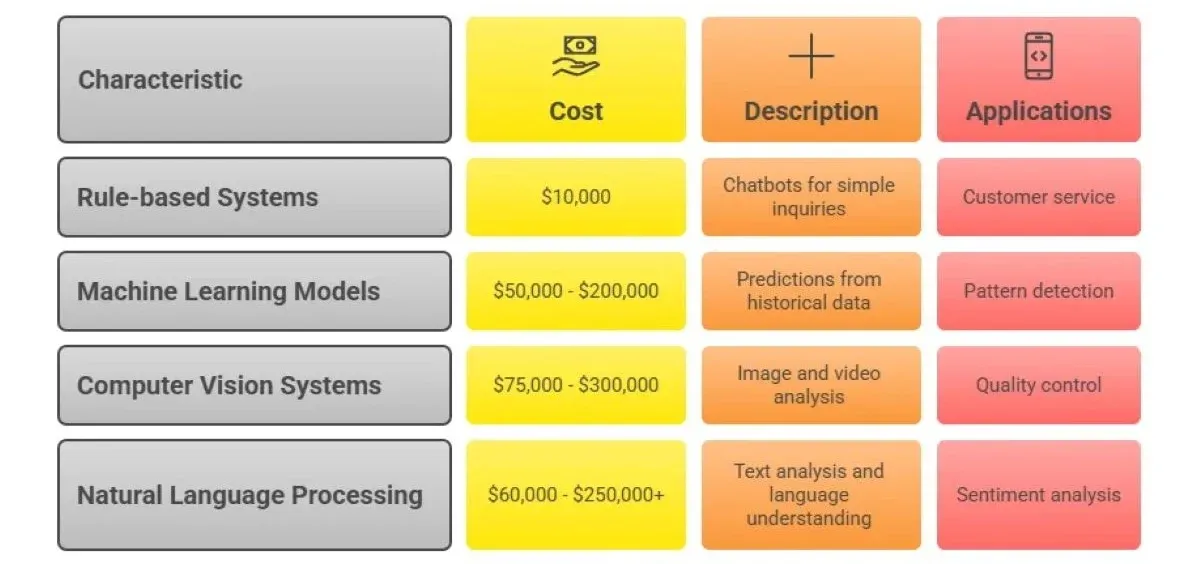
Different AI technologies carry distinct price tags based on their complexity and resource requirements. From straightforward automation to cutting-edge generative systems, each category serves specific business needs with corresponding investment levels and implementation timelines.
Rule-based chatbots designed for straightforward customer inquiries start around $10,000. These systems follow predefined logic trees without requiring machine learning capabilities, making them the most affordable entry point.
Traditional ML implementations cost $50,000 to $200,000. These systems learn from historical data to make predictions, classify information, or detect patterns across various business applications.
Image and video analysis solutions range from $75,000 to $300,000. These applications power quality control, security surveillance, facial recognition, and visual inspection systems across industries.
NLP solutions for text analysis and language understanding cost starting around $60,000 and easily exceed $250,000. These handle sentiment analysis, document processing, translation services, and conversational AI applications.
Advanced generative AI tools using large language models require substantial investments. These systems create content, generate code, or produce images, demanding significant computational resources and ongoing operational costs.
Multiple variables determine final AI project expenses beyond initial quotes. Technical complexity, data requirements, and talent availability create cost variations even among similar projects. Understanding these drivers helps organizations budget accurately and avoid unexpected expenditures.
High-quality training data is essential but expensive to acquire. Organizations spend significantly on data collection, cleaning, labeling, and storage. Poor data quality increases costs through extended development cycles and reduced model performance.
Deep learning models require substantially more resources than simpler approaches. The sophistication of algorithms directly impacts computational needs, development time, and the expertise level required from your technical team.
Connecting AI systems with existing enterprise software adds significant costs. Legacy system compatibility, API development, and workflow modifications require extensive technical resources and careful planning throughout implementation.
AI workloads are computationally intensive, often requiring specialized hardware such as GPUs or TPUs to train and deploy models effectively. Hardware choices dramatically affect both initial and ongoing expenses.
Even a small AI development team can cost a business upwards of $400,000 per year in technology development costs alone. Specialized skills command premium salaries in competitive markets.
Organizations frequently underestimate expenses beyond development fees. These concealed costs emerge during deployment and operation, often catching businesses unprepared. Recognizing these factors early prevents budget overruns and ensures sustainable AI adoption across your organization.
83% percent of senior business leaders said their organization's AI adoption would be faster if they had a stronger data infrastructure in place. Legacy system modifications require substantial unplanned investments.
Maintenance and upgrades can add another 15-20% annually to the initial cost of AI implementation. Models degrade over time, requiring continuous retraining, monitoring, and performance optimization.
Implementing encryption, access controls, and regulatory compliance measures adds unexpected costs. Organizations handling sensitive data must invest heavily in protecting AI systems from cybersecurity threats and meeting legal requirements.
Employee adoption requires comprehensive training programs. Resistance to new workflows, skills gaps, and productivity dips during transition periods create indirect costs that impact overall project success and ROI.
Forrester predicts that 75% of technology leaders will face moderate to severe technical debt by 2026. Rushed implementations and fragmented systems create long-term inefficiencies requiring costly remediation.
Different sectors face unique AI implementation challenges and cost structures. Regulatory requirements, data sensitivity, and use case complexity create significant pricing variations. Industry context determines both investment levels and expected returns on AI initiatives.
Healthcare applications can range from $20,000 to $50,000 for basic tools. Diagnostic systems, medical imaging analysis, and patient monitoring require strict regulatory compliance, driving costs higher for advanced implementations.
Fintech applications may reach between $50,000 - $150,000. Fraud detection, algorithmic trading, and risk assessment systems demand robust security measures and real-time processing capabilities, increasing overall expenses.
Predictive maintenance systems and quality control applications range widely in cost. Computer vision for defect detection and supply chain optimization requires specialized sensors, integration with production equipment, and custom model development.
Recommendation engines, inventory optimization, and personalized marketing tools vary from affordable pre-built solutions to expensive custom systems. Dynamic pricing algorithms and customer analytics drive significant competitive advantages.
Document processing, contract analysis, and automated reporti ng tools serve legal, consulting, and accounting firms. These solutions reduce manual labor while requiring domain-specific training data and industry expertise.
Organizations face critical decisions between developing proprietary AI systems and purchasing existing platforms. Each approach carries distinct advantages, costs, and strategic implications. The right choice depends on your specific requirements, budget constraints, and long-term business objectives.
Ready-made solutions deploy quickly but may require workarounds for specific needs. Custom development takes longer but delivers precisely what your business requires. Timeline pressures significantly influence the build-versus-buy decision.
Pre-built platforms involve ongoing subscription fees without ownership. Custom solutions require maintenance but eliminate vendor dependency. Total cost of ownership calculations must account for multi-year expenses and strategic flexibility.
Many organizations combine purchased platforms with custom components. This strategy balances cost efficiency with specific needs, leveraging proven technologies while developing proprietary capabilities in strategic areas.
Running AI systems demands substantial ongoing investments beyond initial development. Computational resources, storage requirements, and system management create continuous expense streams. Infrastructure choices between cloud and on-premise solutions fundamentally shape operational budgets.
Cloud platforms offer flexibility with pay-as-you-go pricing, but costs escalate with heavy usage. Organizations spend thousands monthly on GPU instances, storage, and data transfer fees, depending on model complexity and usage patterns.
Building internal infrastructure requires substantial upfront capital for servers, GPUs, and networking equipment. Organizations gain cost predictability and control but face depreciation, maintenance expenses, and the risk of overcapacity or rapid obsolescence.
Massive datasets require expensive storage solutions. Organizations balance performance needs against cost, utilizing tiered storage strategies that keep active data on fast systems while archiving historical information more economically.
AI workloads consume significant electricity. Training large models and running inference at scale generate substantial power bills. Energy efficiency becomes increasingly important as AI deployments grow across your organization.
Effective AI operations require specialized monitoring platforms. These tools track performance, identify issues, and optimize resource utilization, adding subscription costs but preventing expensive downtime and performance degradation.
Effective AI budgeting requires comprehensive planning beyond development costs. Organizations must account for infrastructure, talent, data preparation, and ongoing operations. Strategic budget allocation across project phases ensures resource availability when needed and prevents mid-project funding gaps.
Discovery phases involving feasibility studies, requirements gathering, and strategy development typically run $5,000 to $25,000. These investments prevent expensive mistakes by validating concepts before major commitments.
Core development consumes the largest budget portion. Allocate resources for data preparation, model training, testing, and iteration cycles. Buffer for unexpected technical challenges and requirement changes discovered during development.
Determine cloud versus on-premise strategies early. Cloud deployments require operational expense budgets, while on-premise investments need capital allocation. Factor in growth projections to avoid expensive mid-project infrastructure changes.
The average salary for an AI engineer in the U.S. can range between $90,000 and $150,000 per year. Decide whether to hire internally, outsource development, or utilize hybrid approaches based on strategic importance.
Set aside 20-30% contingency for unforeseen challenges. Plan for scaling costs as usage grows. Successful pilot projects often expand rapidly, requiring additional resources that weren't initially budgeted or anticipated.
Folio3 AI delivers end-to-end custom AI solutions tailored to your specific needs, from strategic consulting through deployment and optimization, ensuring your investment delivers measurable results.
Utilize computer vision techniques to extract meaningful data from images and surroundings for face recognition, biometrics, transportation, and other use cases. Our solutions transform visual information into actionable business intelligence.
Our team collaborates closely with you to integrate AI applications smoothly into your operational framework. We guarantee seamless transitions with minimal disruption, ensuring your existing systems work harmoniously with new AI capabilities.
Boost language model performance and efficiency with our expert LLM fine-tuning services tailored to your specific business needs. Our AI specialists optimize models for enhanced performance, accuracy, and efficiency across various applications.
Derive essential insights from your data and drive informed decision-making. From statistics to machine learning, our analysts enable businesses to grasp complex data intricacies and enhance strategies through comprehensive analysis.
Find the best machine learning engineers to handle your AI and ML needs. Thanks to flexible engagement and quick resource allocation choices, we provide the agility you need when selecting a technology partner.

{ "@context": "https://schema.org", "@type": "FAQPage", "mainEntity": [ { "@type": "Question", "name": "What is the average cost to implement AI in a business?", "acceptedAnswer": { "@type": "Answer", "text": "AI implementation costs vary dramatically based on complexity and scope. Simple automation projects start around $10,000, while moderate solutions range from $50,000 to $150,000. Advanced enterprise implementations can exceed $400,000 and reach into millions for comprehensive transformations." } }, { "@type": "Question", "name": "How much does it cost to build a custom AI solution versus buying off-the-shelf?", "acceptedAnswer": { "@type": "Answer", "text": "Off-the-shelf AI platforms typically cost a few hundred to several thousand dollars monthly through subscription models. Custom development requires a minimum of $50,000 for MVP versions, scaling to hundreds of thousands for sophisticated systems, but provides complete control and customization." } }, { "@type": "Question", "name": "What hidden costs should I expect when implementing AI?", "acceptedAnswer": { "@type": "Answer", "text": "Hidden costs include data infrastructure upgrades, ongoing maintenance adding 15-20% annually to initial costs, security and compliance measures, employee training programs, and technical debt from rushed implementations. Organizations frequently underestimate these expenses when budgeting AI projects." } }, { "@type": "Question", "name": "How long does it take to see ROI from AI investments?", "acceptedAnswer": { "@type": "Answer", "text": "Most organizations achieve satisfactory ROI within two to four years, significantly longer than typical technology investments. However, the timeline varies based on project complexity, implementation quality, and whether organizations prioritize productivity gains over immediate profitability metrics." } }, { "@type": "Question", "name": "Is cloud-based or on-premise infrastructure more cost-effective for AI?", "acceptedAnswer": { "@type": "Answer", "text": "Cloud platforms offer lower upfront costs and flexibility, but can become expensive with heavy usage. On-premise infrastructure requires substantial initial capital investment but provides predictable long-term costs. The right choice depends on usage patterns, scale requirements, and strategic priorities." } }, { "@type": "Question", "name": "What factors most significantly impact AI development costs?", "acceptedAnswer": { "@type": "Answer", "text": "Key cost drivers include data quality and availability, model complexity, integration requirements with existing systems, computational infrastructure needs, and talent acquisition. Inadequate spending in these areas often leads to project delays, failures, or budget overruns." } }, { "@type": "Question", "name": "How much should different-sized companies budget for AI?", "acceptedAnswer": { "@type": "Answer", "text": "Startups typically allocate $5,000-$50,000, small businesses $20,000-$100,000, mid-market companies $100,000-$500,000, and enterprises frequently invest $10 million or more annually. Budgets should align with company size, strategic objectives, and expected implementation scope." } }, { "@type": "Question", "name": "What industries have the highest AI implementation costs?", "acceptedAnswer": { "@type": "Answer", "text": "Healthcare and financial services face higher costs due to strict regulatory requirements, security needs, and compliance measures. Healthcare applications range from $20,000-$50,000 for basic tools, while fintech solutions reach $50,000-$150,000, with advanced systems costing significantly more." } }, { "@type": "Question", "name": "Can small businesses afford to implement AI?", "acceptedAnswer": { "@type": "Answer", "text": "Yes, small businesses can start with affordable solutions like pre-built chatbots, cloud-based APIs, and open-source tools requiring minimal investment. Beginning with targeted applications that deliver immediate value helps small businesses prove ROI before expanding into more sophisticated AI solutions." } }, { "@type": "Question", "name": "What percentage of my budget should I allocate to AI maintenance?", "acceptedAnswer": { "@type": "Answer", "text": "Plan for 15-20% of initial implementation costs annually for maintenance, updates, and optimization. Successful organizations budget for continuous model retraining, performance monitoring, security updates, and system improvements to prevent performance degradation and maintain competitive advantages." } } ] }
AI implementation costs vary dramatically based on complexity and scope. Simple automation projects start around $10,000, while moderate solutions range from $50,000 to $150,000. Advanced enterprise implementations can exceed $400,000 and reach into millions for comprehensive transformations.
Off-the-shelf AI platforms typically cost a few hundred to several thousand dollars monthly through subscription models. Custom development requires $50,000 minimum for MVP versions, scaling up to hundreds of thousands for sophisticated systems, but provides complete control and customization.
Hidden costs include data infrastructure upgrades, ongoing maintenance, adding 15-20% annually to initial costs, security and compliance measures, employee training programs, and technical debt from rushed implementations. Organizations frequently underestimate these expenses when budgeting AI projects.
Most organizations achieve satisfactory ROI within two to four years, significantly longer than typical technology investments. However, the timeline varies based on project complexity, implementation quality, and whether organizations prioritize productivity gains over immediate profitability metrics.
Cloud platforms offer lower upfront costs and flexibility, but can become expensive with heavy usage. On-premise infrastructure requires substantial initial capital investment but provides predictable long-term costs. The right choice depends on usage patterns, scale requirements, and strategic priorities.
Key cost drivers include data quality and availability, model complexity, integration requirements with existing systems, computational infrastructure needs, and talent acquisition. Organizations spending inadequately on any of these areas often face project delays and budget overruns.
Startups typically allocate $5,000-$50,000, small businesses $20,000-$100,000, mid-market companies $100,000-$500,000, and enterprises frequently invest $10 million or more annually. Budget appropriately based on your company size, strategic objectives, and expected implementation scope.
Healthcare and financial services face higher costs due to strict regulatory requirements, security needs, and compliance measures. Healthcare applications range $20,000-$50,000 for basic tools, while fintech solutions reach $50,000-$150,000, with advanced systems costing significantly more.
Yes, small businesses can start with affordable solutions like pre-built chatbots, cloud-based APIs, and open-source tools requiring minimal investment. Beginning with targeted applications delivering immediate value helps small businesses prove ROI before expanding to more sophisticated implementations.
Plan for 15-20% of initial implementation costs annually for maintenance, updates, and optimization. Successful organizations budget for continuous model retraining, performance monitoring, security updates, and system improvements to prevent degradation and maintain competitive advantages