
Loading...

Your organization handles sensitive data daily, like patient records, financial transactions, legal documents, and proprietary research. When 83% of organizations report experiencing at least one cloud data breach in the past 18 months, sending this information to public NLP APIs isn't just risky; it's potentially catastrophic. Private NLP models solve this problem by keeping your data entirely within your infrastructure, giving you complete control over training, inference, and compliance.
The challenge isn't whether you need private NLP; it's how to build it right. For enterprises in regulated industries like healthcare, finance, legal, and government, private NLP has become the only viable path forward to extract value from sensitive text data while maintaining security.
A private NLP model is a natural language processing system that's trained, deployed, and operated entirely within your controlled infrastructure, whether on-premises data centers, dedicated private cloud environments, or isolated cloud instances with strict security perimeters. Unlike public NLP APIs from providers like OpenAI, Google, or AWS, private models never send your data outside your security boundary.
You maintain complete ownership of the training data, model weights, inference pipeline, and all intermediate outputs. This architecture proves essential for organizations in regulated industries, including healthcare, finance, legal, defense, and government, that handle sensitive intellectual property, personally identifiable information, or data subject to strict compliance requirements like HIPAA, FedRAMP, or SOC2.
Public NLP services offer convenience and quick deployment, but they expose organizations to data breaches, compliance violations, and intellectual property theft that can cost millions in regulatory fines and irreparably destroy customer trust overnight.
HIPAA violations now carry penalties up to $1.5 million annually per violation category, while CCPA fines reach $7,500 per intentional violation. When you send data to external APIs, you're betting your entire compliance posture on someone else's infrastructure and security controls.
Your customer support tickets, internal documents, and employee communications reveal competitive advantages and proprietary business processes. Public NLP providers may use your data for model training, potentially leaking your hard-won insights to competitors through their improved general-purpose models and shared infrastructure.
Most public NLP APIs retain your data for model improvement, even if only temporarily, creating serious audit trail problems, data residency compliance issues, and regulatory gaps your security team cannot verify or control after data leaves your protected environment.
Modern security frameworks assume breach scenarios and mandate that sensitive data never leaves controlled environments under any circumstances. Public APIs fundamentally break this model by design. Private NLP aligns perfectly with zero-trust principles by eliminating all external data transmission and maintaining complete control.
Processing millions of documents through public APIs creates variable costs that spike unpredictably during high-usage periods, making budgeting nearly impossible. Private models require higher upfront infrastructure investment but deliver predictable operational costs, typically breaking even financially beyond 10 million monthly API calls.
FactorPublic NLP ModelsPrivate NLP ModelsData ControlProvider retains/processes your dataComplete data ownership and controlComplianceShared responsibility, audit gapsFull compliance control, complete audit trailsCustomizationLimited fine-tuning optionsUnlimited customization with proprietary dataSetup TimeMinutes (API key)Weeks to months (infrastructure + training)Upfront CostLow (pay-per-use)High (infrastructure, training, personnel)Operational CostVariable, scales with usagePredictable, fixed infrastructure costsData ResidencyProvider's data centersYour specified location (full control)LatencyNetwork-dependent, variableOptimized for your infrastructureVendor Lock-inHigh (API dependencies)Low (you own the model)Security RiskData transmitted externallyData never leaves your environmentPerformanceGeneral-purpose trainingDomain-optimized, proprietary patternsIP ProtectionPotentially exposedFully protected, never shared
Private NLP isn't necessary for every use case or organization, but certain situations make it absolutely non-negotiable from both regulatory and competitive perspectives. If your organization operates in any of these scenarios, public APIs pose unacceptable regulatory, security, and competitive risks.
HIPAA requires extremely strict controls over PHI transmission, storage, and processing at every stage of the data lifecycle. Clinical notes, lab results, diagnostic reports, and patient communications trigger mandatory breach notifications and million-dollar regulatory penalties if exposed through external APIs, making private deployment the only compliant option.
Banks, investment firms, and insurance companies process highly sensitive data regulated by GLBA, SEC rules, and state-specific financial privacy laws with severe penalties. Transaction patterns, account details, investment strategies, and customer communications are both heavily regulated and competitively sensitive, absolutely preventing external processing through public APIs.
Attorney-client privilege dies instantly the moment privileged communications touch any third-party systems outside the firm's direct control. Contract analysis, litigation discovery, and confidential legal research require private NLP infrastructure to maintain privilege protections and avoid malpractice claims potentially worth millions in damages.
FedRAMP High authorization levels and classified information environments explicitly prohibit external data transmission under any circumstances by federal regulation. Intelligence analysis, defense communications, classified document processing, and national security applications require completely air-gapped private NLP systems meeting stringent government security certifications and operating exclusively on government-controlled infrastructure.
Pharmaceutical research data, manufacturing processes, product development plans, competitive market strategies, and R&D breakthroughs lose their entire competitive value the moment competitors access them. Private NLP ensures your R&D documents, internal strategic communications, and competitive planning never inadvertently feed external intelligence gathering or competitor analysis.
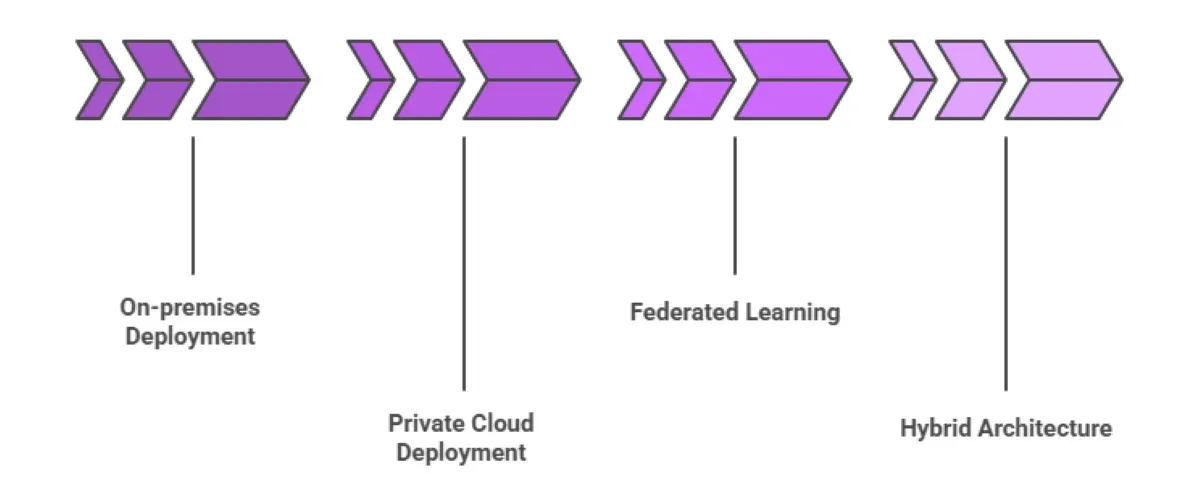
Building effective private NLP requires carefully choosing the right architectural approach for your specific security requirements, performance needs, and operational capabilities. Each deployment approach offers fundamentally different trade-offs between control, implementation complexity, and ongoing operational costs for enterprise organizations.
Deploy NLP models entirely on your own hardware in your company-controlled data center for maximum security control and complete air-gap compliance capabilities. This approach requires significant upfront capital investment in GPU servers, high-speed networking, enterprise storage systems, and specialized cooling infrastructure, but meets the strictest data residency and security requirements.
Use dedicated cloud infrastructure like AWS GovCloud, Azure Government, or Google Confidential Computing with strict network isolation, comprehensive encryption, and rigorous access controls throughout. This approach combines cloud operational convenience with private security control, ensuring your data never touches shared multi-tenant infrastructure or leaves your virtual private cloud environment.
Train sophisticated NLP models without ever centralizing sensitive data by having each geographic location train locally, sharing only encrypted model updates, never raw data, with central coordination. This enables hospitals to collaborate on diagnostic models or banks to detect fraud patterns without ever exposing actual patient records or transaction details.
Process sensitive data locally on edge devices or private regional servers, sending only anonymized, aggregated outputs to central systems for coordination and analysis. This architecture minimizes sensitive data transmission across networks while still enabling centralized model updates, making it ideal for distributed organizations with multiple geographic locations.
Private NLP requires far more than just deploying a model; you need a complete end-to-end architecture handling secure data ingestion, distributed training, comprehensive versioning, real-time monitoring, and secure inference at production scale. Each architectural component must maintain security controls while delivering enterprise-grade performance, reliability, and compliance.
Build encrypted data pipelines that sanitize, tokenize, and prepare text while maintaining comprehensive audit logs tracking every transformation and access event. Implement automated data quality checks, PII detection with redaction, and automatic compliance verification before any data reaches model training or inference within your security perimeter.
Set up GPU clusters for model training with comprehensive experiment tracking, automated hyperparameter management, and fully reproducible builds across environments. Use MLflow or Kubeflow to version control datasets, training code, and model weights with complete rollback capabilities, enabling you to reproduce any previous model version exactly.
Centralize model management with enterprise registries that track complete lineage, performance metrics across versions, and approval workflows with role-based permissions. Automate deployment to staging and production environments with automated validation gates while maintaining strictly separated development, testing, and production inference environments to prevent cross-contamination.
Implement comprehensive monitoring for model performance metrics, prediction latency, input data quality, and statistical concept drift over time. Set up automated alerts for accuracy degradation, unusual input patterns indicating attacks, infrastructure issues, security events, and access patterns for compliance auditing and forensic analysis.
Enforce strict least-privilege access policies to models, training data, and infrastructure using enterprise identity providers, automated API key rotation, and certificate-based authentication throughout. Manage encryption keys, database credentials, and API tokens through secure vaults like HashiCorp Vault, implementing comprehensive audit logging for all access attempts.
Manual deployment processes don't scale for enterprise private NLP implementations requiring frequent updates and multiple environments. Comprehensive automation, rigorous testing, and governance maintain reliability and security while enabling rapid iteration across development, staging, and production environments without compromising compliance.
Automate complete model builds from code commits through comprehensive testing to production deployment using industry-standard tools. Use Jenkins, GitLab CI, or GitHub Actions to automatically trigger training runs on data updates, execute validation tests, and deploy approved models automatically while maintaining complete audit trails.
Deploy new model versions to small user percentages first, comprehensively monitoring for errors, performance degradation, or unexpected behavior before full rollout to production. Maintain two complete production environments, routing traffic gradually to new versions while keeping old versions running and ready for instant rollback if issues emerge.
Run multiple model versions simultaneously in production, routing requests randomly to measure statistically significant performance differences across versions. Compare accuracy, latency, resource utilization, and user outcomes to make rigorous data-driven decisions about which model version to promote to full production deployment.
Set up automated pipelines that retrain models weekly, monthly, or automatically when drift detection signals statistically significant degradation from baseline performance. Automate data collection, labeling workflows, and comprehensive model validation to maintain accuracy without manual intervention, ensuring models stay current across evolving deployment cycles.
Define all infrastructure components like servers, networks, databases, and security configurations as version-controlled code using Terraform, CloudFormation, or Ansible for complete reproducibility. Enable instant recreation of entire environments from code, ensuring development environments match production exactly for consistent deployments and eliminating configuration drift between environments.
Deploying private NLP infrastructure addresses many fundamental compliance requirements, but organizations still need to implement specific technical controls, comprehensive documentation, and rigorous processes to successfully pass regulatory audits. Each regulation imposes unique requirements for data handling, security controls, and operational procedures that must be meticulously implemented.
Implement comprehensive business associate agreements, encryption at rest and in transit, detailed access logging, automatic logoff procedures, and breach notification procedures meeting federal requirements. Document risk assessments, conduct regular security reviews, maintain HIPAA training records for all personnel accessing PHI, and implement technical safeguards meeting Security Rule requirements.
Establish comprehensive controls for security, availability, processing integrity, confidentiality, and privacy across your entire NLP infrastructure and operations. Document policies, implement automated monitoring with alerting, conduct regular third-party penetration testing, and maintain detailed audit logs verifying controls operate effectively over sustained time periods.
Meet comprehensive NIST 800-53 security controls appropriate for your specific authorization level (Low, Moderate, or High) with complete documentation and evidence. Implement continuous monitoring, incident response procedures, and system boundary definitions while working with third-party assessors to achieve and maintain authorization to operate government systems.
Implement data minimization, purpose limitation, and comprehensive consent management, enabling all data subject rights, including access, deletion, and portability across systems. Document complete data flows, maintain detailed processing records, and conduct data protection impact assessments for all high-risk processing operations involving personal data.
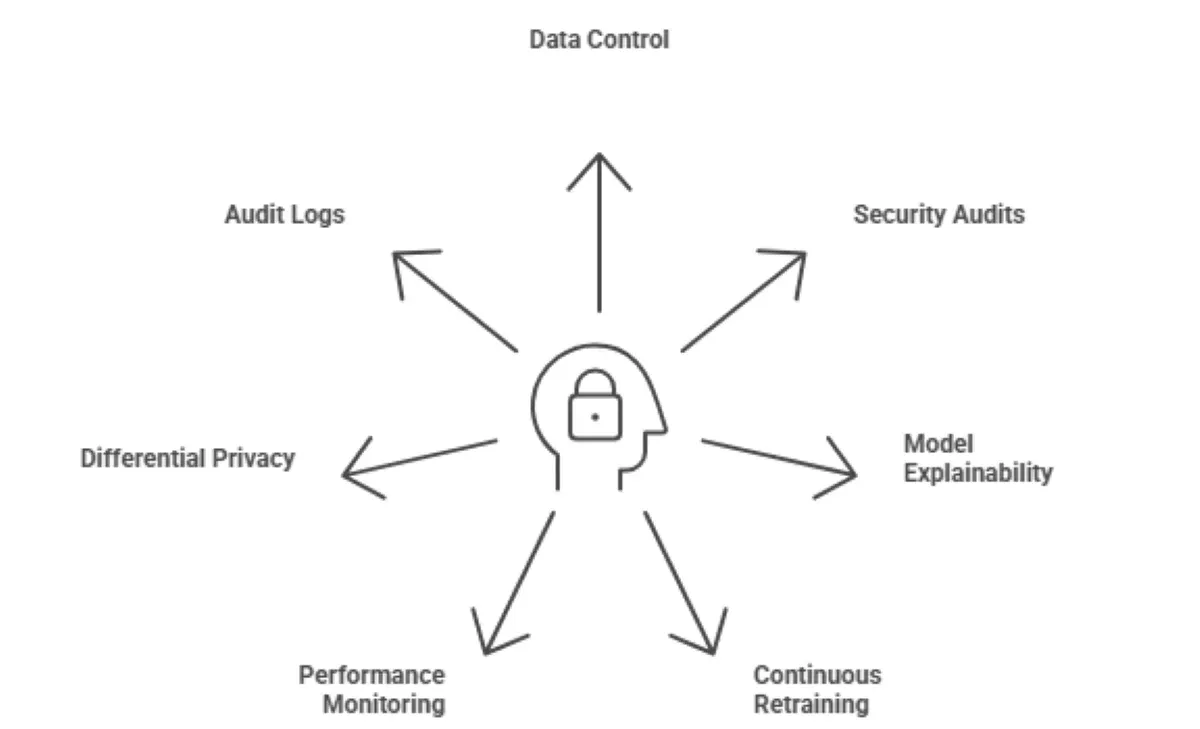
Building private NLP infrastructure is just the starting point for long-term success. These proven practices ensure your models remain secure, accurate, and performant throughout their entire lifecycle while maintaining strict compliance and protecting your organization's most sensitive data assets.
Never export training data, model weights, embeddings, or intermediate artifacts outside your established security perimeter under any circumstances. Implement comprehensive data loss prevention controls that automatically block unauthorized transfers while using encrypted storage with key management for all datasets, model files, and processing artifacts.
Schedule quarterly security reviews of your entire NLP infrastructure, including models, APIs, and data pipelines, and hire independent external red teams to attempt breaches. Comprehensively test access controls, encryption implementations, API security, and potential data leakage paths while immediately remediating all findings according to severity.
Use SHAP, LIME, or similar explainability tools to understand individual model decisions and overall behavior patterns while actively monitoring for bias in predictions across demographic groups. Document model behavior comprehensively and maintain transparency in prediction generation processes for regulatory compliance requirements and internal governance.
Set up fully automated pipelines that retrain models as new labeled data becomes available from production systems or changing business conditions. Monitor performance metrics continuously and automatically trigger retraining when accuracy degrades beyond acceptable thresholds while maintaining historical performance data to track model evolution over time.
Track input data distributions over time using statistical methods and automatically alert when new production data differs significantly from original training distributions. Measure prediction confidence levels continuously and automatically flag inputs where the model is uncertain for human review, preventing silent failures.
Add carefully controlled noise during training to mathematically prevent individual records from being inferred from model behavior or extracted through attacks. Implement gradient clipping, privacy budgets, and formal privacy guarantees when training on highly sensitive data, accepting modest accuracy trade-offs for strong privacy protection.
Log all model predictions, data access events, user actions, and system events with complete context while retaining logs according to regulatory requirements. Implement tamper-proof logging with cryptographic verification for forensic analysis and compliance audits, ensuring you can reconstruct any event sequence during investigations.
The right tools and frameworks dramatically simplify private NLP development, deployment, and ongoing operations. These enterprise-grade platforms provide comprehensive capabilities while maintaining strict data privacy and security throughout the entire machine learning lifecycle from development through production deployment.
Access thousands of pre-trained models that you can download and fine-tune entirely within your infrastructure without any external API calls. Use BERT, RoBERTa, GPT, and domain-specific models without sending data to external APIs or cloud services, maintaining complete control over all training and inference.
Package models as portable containers for consistent deployment across diverse environments, including development, staging, and production. Use Kubernetes for orchestration, automatic scaling, and high availability while implementing service meshes for secure inter-service communication throughout your distributed infrastructure.
Track experiments, log metrics, version models, and manage the complete ML lifecycle from data preparation through production deployment. Build fully reproducible pipelines from data preparation through deployment while maintaining complete lineage for compliance auditing and regulatory requirements.
Deploy models with automatic batching, multi-framework support, and GPU optimization for achieving millisecond latency at enterprise scale. Monitor inference performance and resource utilization in real-time while serving thousands of concurrent requests, supporting multiple model versions simultaneously.
Centralize management of API keys, database credentials, encryption keys, and certificates with automatic rotation policies. Implement fine-grained access policies, comprehensive audit logging, and automatic secrets injection while integrating seamlessly with deployment pipelines for automated secrets management.
Private NLP projects face predictable obstacles that can derail implementation timelines and budgets if not anticipated. Understanding these common challenges upfront helps organizations plan effective mitigation strategies before encountering them in production environments, saving months of delays.
Organizations typically store text data in completely disparate systems, like CRMs, support platforms, document repositories, email systems, and legacy databases. Build unified data pipelines with ETL processes, consolidating data while preserving security controls and access permissions across departments, implementing data governance frameworks for consistent handling.
Operating across states or countries means simultaneously complying with multiple overlapping regulations with potentially conflicting requirements. Create a comprehensive compliance matrix mapping each regulatory requirement to specific technical controls while implementing the strictest requirements globally to simplify operations and avoid regional configuration differences.
Private NLP requires significant capital investment before delivering any measurable business value, making approval difficult. Build comprehensive business cases showing public API costs at scale, compliance violation risks with actual penalty amounts, and competitive advantages from proprietary data insights through pilot projects demonstrating value.
The intersection of NLP engineering skills, security architecture expertise, and regulatory compliance knowledge is extremely rare in talent markets. Consider partnering with specialized consulting firms, investing in training existing staff, or hiring security experts and NLP engineers separately, and building cross-functional teams.
Differential privacy and encryption techniques can significantly reduce model accuracy, creating difficult trade-offs between privacy and performance. Start with strong privacy protections, then carefully relax constraints where justified by risk assessments while measuring the accuracy-privacy tradeoff empirically rather than assuming impacts.
Building private NLP systems requires specialized expertise in AI development, security architecture, and regulatory compliance that most organizations lack internally. Folio3 AI delivers custom NLP solutions tailored to your industry's unique requirements and data sensitivity needs, handling everything from architecture design through production deployment and ongoing optimization.
Folio3's experienced AI team designs and trains private NLP models specifically optimized for your data, domain, and business objectives. We handle complete data preparation, model architecture selection, distributed training, comprehensive validation, and production deployment, all within your security perimeter and compliance requirements.
We implement private NLP on your on-premises servers, private cloud environments, or hybrid architecture based on your security requirements. Our engineers configure comprehensive encryption, role-based access controls, and real-time monitoring while ensuring models meet your performance requirements for latency and throughput at scale.
Folio3's transcription solutions process sensitive audio and video content entirely within your environment without external API calls. Our systems accurately identify multiple speakers, handle specialized industry terminology, and deliver time-stamped transcripts while maintaining complete data privacy and regulatory compliance.
Analyze customer feedback, support tickets, social mentions, and survey responses to understand sentiment trends without exposing customer data to external services. Our models identify sentiment at scale while preserving privacy and compliance, enabling data-driven customer experience improvements.
Extract entities, relationships, and insights from unstructured documents, like contracts, reports, emails, and research papers, using models trained on your terminology. Folio3's NLP systems understand your domain-specific terminology and business rules to deliver accurate extraction at enterprise scale while maintaining security.

A private NLP model is a natural language processing system that operates entirely within your controlled infrastructure. Unlike public NLP APIs, private models never send your data to external providers. You train, deploy, and run inference on your own servers or in isolated cloud environments, maintaining complete control over data, model weights, and all processing.
Public NLP APIs work well for non-sensitive data, but they create compliance and security risks for regulated industries. When you send data to external APIs, you lose control over how it's processed, stored, or potentially used for model improvement. Public APIs also create vendor lock-in, unpredictable costs at scale, and audit trail gaps that violate regulations like HIPAA or FedRAMP.
Private NLP keeps protected health information within a HIPAA-compliant infrastructure, never transmitting PHI to external providers. This eliminates third-party risk, enables complete audit logging, and ensures you maintain direct control over all PHI processing. You can implement business associate agreements, encryption requirements, and access controls needed for HIPAA without depending on external providers' compliance.
Yes. This is one of the primary advantages. You can fine-tune private models on your internal documents, customer communications, industry-specific terminology, and proprietary processes without exposing this data to external parties. This creates models optimized for your exact use case that would be impossible with public APIs.
On-premises deployment runs entirely on your hardware in your data center, giving maximum control but requiring capital investment and operational overhead. Private cloud uses dedicated cloud infrastructure (AWS GovCloud, Azure Government) that's isolated from shared services but managed by the cloud provider. On-premises suits air-gap requirements; private cloud offers easier scaling.
Costs vary widely based on model size, infrastructure choice, and training data volume. Initial development includes data preparation, model training, and deployment setup. Ongoing costs cover infrastructure, GPU servers, maintenance, and retraining. Organizations with high-volume processing often find private deployment more economical than public APIs due to predictable costs and avoided per-call fees.
Private NLP uses defense-in-depth: encryption for data at rest and in transit, network segmentation, role-based access control, API authentication, input validation against injection attacks, rate limiting, comprehensive audit logging, and regular security audits. Models run in isolated environments with no external network access for sensitive deployments.
Yes, with proper infrastructure. Private NLP models deployed on GPU servers with optimized inference engines can achieve sub-100ms latency for most tasks. Techniques like model quantization, caching, and batching further improve performance. Real-time applications like chatbots, voice transcription, and fraud detection all work well with private NLP.
Healthcare (clinical documentation, diagnosis assistance), financial services (fraud detection, customer communications), legal (contract analysis, discovery), government (intelligence analysis, citizen services), pharmaceuticals (research analysis), and defense contractors all benefit significantly from private NLP due to strict data privacy requirements and sensitive information processing needs.
Timeline depends on project scope and complexity. A pilot project with a single use case typically takes 8-12 weeks from requirements through deployment. Enterprise-wide implementations with multiple models, compliance requirements, and integration across systems typically require 4-6 months. Ongoing optimization and expansion continue indefinitely.