
Loading...
You're probably weighing the potential of AI against the risk of exposing sensitive data. Every CTO and compliance officer faces this dilemma: adopt AI to stay competitive or risk regulatory violations that could cost millions. The stakes are higher than ever. According to IBM's 2024 Cost of a Data Breach Report, the average cost of a data breach in healthcare reached $10.93 million, the highest across all industries.
Private LLMs offer a way forward, giving you the intelligence of advanced AI without compromising data security, regulatory compliance, or competitive advantage. For regulated industries like healthcare, finance, and insurance, deploying private and secure LLMs isn't just a technical decision; it's a business imperative that protects your organization from catastrophic breaches while unlocking AI's transformative capabilities.
Private LLMs are large language models deployed within your organization's controlled infrastructure, ensuring data never leaves your secure environment. Unlike public models such as ChatGPT or Claude that process data on external servers, private LLMs operate entirely within your on-premise or private cloud environment. You maintain complete ownership over training data, model behavior, and outputs.
These models can be built from open-source foundations like LLaMA or Mistral, then fine-tuned with your proprietary data to understand industry-specific terminology and workflows. The key distinction: your sensitive information remains exclusively within your security perimeter, with no third-party access or data sharing.

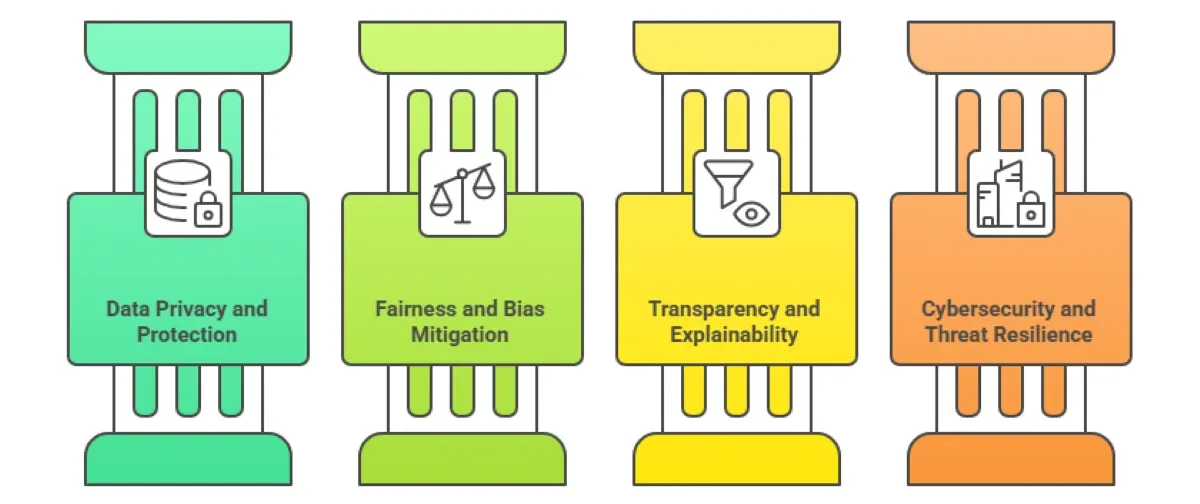
Deploying AI in regulated environments requires addressing risks that extend beyond traditional cybersecurity. These four pillars represent the comprehensive framework that regulators and auditors evaluate when assessing AI compliance and safety.
Your AI systems process sensitive information that must remain confidential and comply with strict data protection regulations. Private LLMs prevent unauthorized access by keeping all data processing within your controlled infrastructure, eliminating third-party exposure risks inherent in public AI services.
AI models can perpetuate discrimination if trained on biased datasets, particularly in lending decisions, hiring processes, and healthcare treatments. Private LLMs allow you to carefully curate training data, implement bias detection mechanisms, and regularly audit outputs for discriminatory patterns that could trigger regulatory enforcement.
Regulators require clear documentation of how AI systems make decisions, especially for high-stakes applications like loan approvals or medical diagnoses. Private LLMs enable you to maintain detailed audit trails, implement explainability tools, and provide regulators with complete visibility into your AI decision-making processes.
AI systems present unique attack surfaces that malicious actors can exploit through prompt injection, model poisoning, or data extraction techniques. Private LLMs deployed with zero-trust architectures, network isolation, and continuous monitoring provide a stronger defense against sophisticated threats targeting your AI infrastructure.
Public LLMs create unacceptable risks for organizations handling sensitive data and operating under strict regulatory oversight. The convenience of cloud-based AI services comes with hidden compliance landmines that can trigger massive penalties.
When you query public LLMs, your prompts may be used to improve the model, potentially exposing proprietary information to competitors or the public. The Samsung incident, where employees accidentally leaked confidential semiconductor code to ChatGPT, demonstrates how easily sensitive data escapes through public AI interfaces.
Public LLM providers process data across global server networks, potentially routing your information through jurisdictions with incompatible privacy laws. You cannot control where your data travels or how long it's retained, creating GDPR, HIPAA, and state-level privacy compliance violations.
Public LLM providers can change model behavior, update algorithms, or modify outputs without notice, affecting your business processes. You're at the mercy of vendor decisions regarding features, pricing, and service availability, creating operational risks when AI becomes mission-critical to your workflows.
Public APIs provide minimal visibility into how your data is processed, making it impossible to satisfy regulatory requirements for comprehensive audit documentation. You cannot track individual requests, monitor for anomalies, or prove compliance when investigators demand detailed system logs.
Public LLM services rely on multiple infrastructure providers and subcontractors, each introducing additional compliance obligations and security vulnerabilities. Every entity in this chain represents a potential breach point, and you're ultimately responsible for their security failures under regulatory frameworks.
Regulatory pressure on AI deployment is intensifying across federal and state levels. Understanding the evolving compliance landscape helps you build AI systems that withstand future regulatory scrutiny while avoiding costly retrofits.
The HHS Office for Civil Rights now explicitly includes AI systems in HIPAA enforcement actions, requiring Business Associate Agreements with any AI service processing protected health information. Private LLMs eliminate third-party BAA complications by keeping all PHI processing within your covered entity boundaries.
Financial institutions using AI must demonstrate comprehensive security controls through SOC 2 Type II audits that examine data handling, access management, and system availability. Public LLMs introduce third-party dependencies that complicate SOC 2 compliance and fail to provide the detailed control evidence auditors demand.
The FDA's Software as a Medical Device framework requires extensive validation, documentation, and change control for AI making clinical decisions. Private LLMs provide the deterministic behavior, version control, and audit documentation necessary for FDA submissions that public cloud services cannot guarantee.
California's CCPA, Virginia's CDPA, and emerging state regulations require explicit consumer consent for automated decision-making and AI processing. Private LLMs give you granular control over data handling, enabling compliance with varying state requirements without depending on vendor policy changes.
Federal agencies and contractors must use FedRAMP-authorized services for systems processing government data. Private LLM deployments in FedRAMP-certified infrastructure provide the only viable path for government AI applications, as most public LLM services lack appropriate authorization levels.
Certain industries face regulatory environments so stringent that public AI services create unacceptable compliance and security risks. These sectors require complete data control to operate legally and protect stakeholder trust.
Patient records, clinical notes, and research data demand HIPAA-compliant AI that never exposes protected health information to external systems. Private LLMs automate clinical documentation, assist with diagnosis, and analyze medical literature while maintaining strict PHI boundaries that public services cannot guarantee.
Banks process confidential financial data, trade secrets, and personally identifiable information under SEC, FINRA, and state banking regulations. Private LLMs enable fraud detection, customer service automation, and risk assessment without exposing sensitive financial information through third-party APIs that could trigger regulatory violations.
Insurance companies analyze claims data, underwriting information, and customer health records that require strict confidentiality protections. Private LLMs automate claims processing, assess risk profiles, and generate policy documents while maintaining the data isolation that insurance regulators and customers demand.
Law firms and government contractors handle confidential case files, classified information, and attorney-client privileged communications. Private LLMs provide contract analysis, legal research, and document review capabilities without the conflict-of-interest and security clearance issues created by shared public AI infrastructure.
Pharma companies must protect drug formulations, clinical trial data, and FDA submission materials from competitors and unauthorized disclosure. Private LLMs accelerate research, analyze regulatory documents, and draft submissions while maintaining the trade secret protection that public cloud services compromise.
While security drives initial interest in private LLMs, the operational and strategic advantages extend far beyond risk mitigation. Private deployment unlocks capabilities that fundamentally transform how your organization leverages AI.
Private LLMs can be fine-tuned on your industry terminology, internal knowledge bases, and proprietary data to deliver contextually accurate responses. Unlike generic public models, your private LLM understands your specific processes, acronyms, and business logic without requiring extensive prompt engineering.
Public LLM APIs charge per token processed, creating unpredictable expenses that spike with usage. Private LLM deployment involves fixed infrastructure costs that provide budget certainty and often achieve lower per-query costs at scale, improving your AI ROI predictability.
You control inference speed, response time, and resource allocation with private LLMs, optimizing performance for your specific use cases. Mission-critical applications receive priority processing without competing for resources on shared public infrastructure that experiences latency during peak demand.
Your prompts, fine-tuning data, and interaction patterns represent valuable intellectual property that public LLMs may absorb during training. Private deployment ensures your competitive intelligence, strategic insights, and proprietary methodologies remain exclusively within your organization, preventing inadvertent knowledge transfer to competitors.
Private LLMs built on open-source foundations eliminate vendor lock-in, allowing you to switch infrastructure providers or deployment models without service disruption. You own your AI capabilities rather than renting them, providing strategic flexibility as AI technology and business requirements evolve.
Building secure private LLMs requires a comprehensive security architecture that addresses AI-specific threats while maintaining operational efficiency. This framework establishes multiple defensive layers protecting your AI systems from sophisticated attacks.
Private LLMs operate within isolated network segments that enforce strict access controls, requiring authentication and authorization for every interaction. No user or system automatically receives trust, reducing lateral movement opportunities if perimeter defenses are compromised.
All data remains encrypted at rest in storage systems and in transit across networks, protecting information even if infrastructure is physically compromised. Private LLMs use customer-managed encryption keys that you control, ensuring provider administrators cannot access your sensitive data.
Granular permission systems restrict who can query the LLM, access training data, or modify model configurations based on job functions. Administrative privileges follow the principle of least access, minimizing insider threats and limiting damage from credential compromises.
Every interaction with the private LLM generates detailed logs capturing user identity, timestamp, query content, and system responses. These audit trails provide the documentation regulators require and enable security teams to detect anomalous behavior indicating potential breaches.
Private LLMs run in containerized environments that prevent interference between different models or workloads. Security vulnerabilities in one application cannot cascade into other systems, and compromised models can be quickly isolated without affecting your broader AI infrastructure.
Regulatory compliance for AI systems demands more than secure deployment; you must demonstrate how your models make decisions and maintain evidence of responsible AI governance. Building compliance into your architecture from inception prevents costly remediation later.
Private LLMs maintain detailed records connecting every output to specific input data, model versions, and configuration parameters used during inference. When regulators question an AI decision, you can reconstruct the exact conditions that produced it, satisfying explainability requirements.
Every model update, fine-tuning session, and configuration change receives version tagging with approval workflows and rollback capabilities. This creates an auditable history demonstrating responsible AI management that compliance teams can present during regulatory examinations.
Private LLMs integrate with SHAP, LIME, and other interpretability frameworks that generate human-understandable explanations for model outputs. These tools convert opaque neural network decisions into logical reasoning that business users and regulators can comprehend and validate.
Automated bias scanning analyzes LLM outputs for discriminatory patterns across protected demographics before deployment to production. Regular bias audits combined with diverse training data curation help you identify and correct fairness issues before they trigger regulatory enforcement.
Private LLM systems automatically generate the technical documentation, risk assessments, and validation reports that regulations require. This documentation proves you've implemented appropriate controls and continuously monitor AI systems, reducing audit preparation time and improving examination outcomes.
Cost comparison between private and public LLMs reveals counterintuitive economics where private deployment often provides superior long-term value, especially at enterprise scale. Understanding the total cost of ownership helps you make informed investment decisions.
Cost ComponentPublic LLMsPrivate LLMsInitial SetupMinimal (API access)Significant (infrastructure, development)Per-Query CostsVariable, usage-basedFixed infrastructure amortized over queriesBreak-even PointLower volumes (<1M queries/month)Higher volumes (>5M queries/month)Data PreparationMinimal preprocessingSubstantial fine-tuning investmentScaling CostsLinear increase with usageMarginal cost decrease at scaleCompliance BurdenHigh (ongoing BAAs, audits)Lower (internal controls)Security IncidentsProvider's insurance + your liabilityYour insurance onlyVendor Lock-in RiskHigh (API dependency)Low (portable open-source)Customization CapabilityLimited (prompt engineering)Extensive (full model access)Long-term ROIDecreases with volumeIncreases with volume
Private LLMs require substantial upfront investment but deliver lower total cost of ownership for enterprises with significant AI usage. The break-even point typically occurs between 1-5 million queries monthly, after which private deployment provides dramatic cost advantages while eliminating compliance complexity.
Several myths prevent organizations from seriously considering private LLM deployment, often based on outdated information or a misunderstanding of modern AI infrastructure. Clarifying these misconceptions helps you make decisions based on current technical reality.
Initial infrastructure costs seem daunting, but modern serverless deployments and open-source models have dramatically reduced barriers. Organizations achieve break-even within months at enterprise query volumes, after which per-query costs drop below public API pricing while eliminating compliance overhead.
Open-source models like LLaMA, Mistral, and Falcon provide enterprise-grade foundations requiring fine-tuning rather than training from scratch. Managed services and AI consulting partners enable mid-market companies to deploy private LLMs without building extensive in-house AI expertise.
Private LLMs fine-tuned on domain-specific data often outperform generic public models for specialized tasks. While general knowledge may be broader in public models, private LLMs excel at your specific use cases because they train exclusively on relevant data.
Modern LLM infrastructure allows pilot deployments in 8-12 weeks using pre-trained models and rapid fine-tuning. Proof-of-concept implementations validate technical feasibility and business value before committing to full-scale deployment, accelerating time-to-value while managing risk.
Commercial distributions of open-source LLMs provide enterprise support, security patches, and managed services comparable to proprietary solutions. Leading cloud providers now offer managed private LLM services combining open-source flexibility with enterprise-grade support and reliability.
Successful private LLM deployment follows a structured approach balancing speed-to-value with risk management. This roadmap provides a proven framework for transitioning from concept to production while maintaining compliance and security standards.
Conduct a comprehensive evaluation of your AI maturity, infrastructure capabilities, and regulatory requirements. Identify high-value use cases where private LLMs deliver measurable business impact while assessing technical prerequisites, data readiness, and organizational change management needs.
Design your private LLM architecture, including model selection, hosting environment, security controls, and integration points with existing systems. Develop detailed compliance mapping showing how your design satisfies regulatory requirements and create a phased implementation plan balancing quick wins with comprehensive capabilities.
Deploy a limited-scope proof-of-concept targeting your highest-priority use case with a small user group. Validate technical performance, gather user feedback, confirm compliance controls function as designed, and establish baseline metrics for measuring ROI and system performance.
Refine the model using production feedback, optimize prompts and parameters, and expand training data to improve accuracy. Implement monitoring dashboards, establish performance benchmarks, and document lessons learned that inform full-scale rollout planning.
Expand deployment across additional use cases, departments, and user populations following a phased approach. Implement comprehensive training programs, establish governance frameworks, and build internal capabilities for ongoing model management, ensuring long-term success beyond initial deployment.
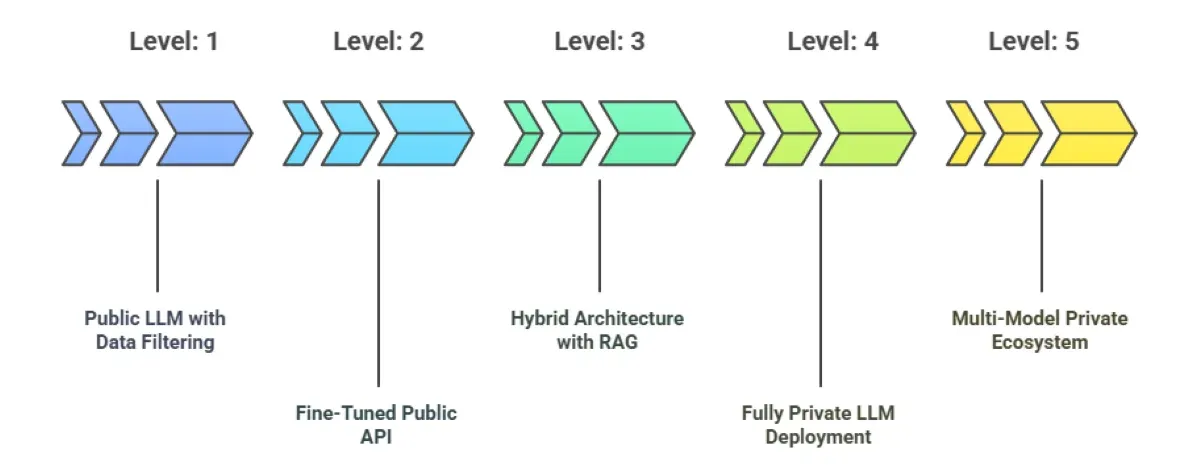
Organizations progress through predictable stages as they develop private LLM capabilities, with each level building on the foundation of the previous stage. Understanding your current maturity helps you plan realistic next steps.
You use public APIs like ChatGPT with strict data governance policies prohibiting sensitive information in prompts. This represents a minimal investment but offers limited protection, as users may inadvertently violate policies, and you lack technical controls to prevent data exposure.
You work with public LLM providers to create custom models trained on your data through their platforms. This improves response quality for your use cases but maintains third-party dependency and requires trusting providers with training data access.
You deploy retrieval-augmented generation combining public LLMs with private knowledge bases queried at inference time. Your proprietary data never leaves your environment, though prompts still traverse external APIs, providing partial security while maintaining public model capabilities.
You operate a complete LLM infrastructure within your controlled environment using open-source models fine-tuned on your data. This provides maximum security and compliance but requires substantial technical expertise and infrastructure investment to maintain performance and reliability.
You deploy specialized private LLMs optimized for different tasks across your organization, with automated routing directing queries to appropriate models. This represents AI-native operations where multiple fine-tuned models work in concert, delivering optimal performance while maintaining complete data sovereignty.
Evaluating private LLM performance requires comprehensive metrics beyond simple accuracy scores. Understanding these technical factors helps you establish realistic expectations and optimize your deployment for specific workloads.
Private LLMs must deliver responses within acceptable timeframes for your applications, typically 1-5 seconds for interactive use cases. Hardware selection, model size, and batching strategies significantly impact throughput capacity, determining how many concurrent users your infrastructure can support.
Benchmark private LLM performance using test sets representing your actual use cases rather than generic evaluation datasets. Domain-specific accuracy often exceeds public models after fine-tuning, even when general knowledge scores are lower, because your model optimizes for relevant tasks.
Different model sizes demand varying GPU memory, compute power, and storage capacity. Understanding your workload patterns helps you right-size infrastructure, balancing performance requirements against cost while maintaining capacity for usage growth and peak demand periods.
Model accuracy depends heavily on training data quality, not just quantity. Curated, properly labeled datasets with diverse examples produce better results than large volumes of noisy data, making data preparation the most critical factor determining private LLM success.
API response times, network latency, and system integration complexity affect end-user experience beyond raw model performance. Optimizing the complete application stack, including caching strategies and asynchronous processing, ensures private LLM deployments deliver an acceptable user experience at scale.
Comprehensive compliance requires addressing multiple regulatory frameworks simultaneously. This checklist provides a practical starting point for assessing your private LLM's compliance posture across key regulations.
Implement technical safeguards, including encryption, access controls, and audit logging. Establish administrative policies for workforce training, risk assessment, and incident response. Ensure physical security measures protect server infrastructure, and maintain Business Associate Agreements covering any third-party infrastructure providers.
Document security policies and procedures governing LLM operations. Implement continuous monitoring, vulnerability management, and change control processes. Conduct annual penetration testing and maintain evidence of control operation effectiveness that auditors examine during SOC 2 examinations.
Segment networks isolating LLM systems processing cardholder data from other environments. Implement strict access controls, encrypt payment information at rest and in transit, and maintain quarterly vulnerability scans plus annual penetration tests demonstrating PCI compliance.
Establish a legal basis for AI processing personal data and implement privacy by design principles. Provide data subject rights, including access, correction, deletion, and portability. Conduct Data Protection Impact Assessments for high-risk processing and maintain records of processing activities.
Map your private LLM architecture against sector-specific requirements like FDA validation for medical devices, SEC rules for financial services, or FedRAMP controls for government applications. Maintain current awareness of regulatory guidance evolution as agencies develop AI-specific enforcement priorities.
Our LLM development journey starts with thoroughly understanding your business needs, industry dynamics, and specific use cases. Leveraging our deep expertise in Natural Language Processing (NLP) and Machine Learning (ML), we collaborate with you to create a custom strategy for developing an LLM that aligns with your organizational goals.
At Folio3 AI, we craft Large Language Models from scratch to help businesses gain a competitive edge. Our process includes a detailed consultation, followed by meticulous data preparation and model training using your data, ensuring a model that aligns perfectly with your business needs.
We fine-tune pre-trained models like GPT, Llama, and PaLM to meet the specific needs of your industry, whether in finance, legal, healthcare, or any other sector. Our fine-tuned LLMs deliver contextually accurate and relevant results, enhancing decision-making processes across your organization.
Harness the power of LLMs with our robust AI solutions. From chatbots and virtual assistants to sentiment analysis and speech recognition systems, we build custom solutions that transform the way your business operates, communicates, and innovates.
Our developers ensure the smooth integration of LLMs into your existing enterprise systems, such as CRM, ERP, and content management systems. We prioritize minimizing downtime during the integration process, ensuring that your operations continue without disruption.
We provide comprehensive support and maintenance services to keep your LLMs and LLM-based solutions running seamlessly over time. Our services include continuous monitoring, adapting to evolving data, implementing necessary updates, and ensuring optimal performance of your AI.

A private LLM is a large language model deployed within your organization's controlled infrastructure, ensuring all data processing occurs within your secure environment. Unlike public LLMs that operate on shared cloud platforms, private LLMs keep your sensitive information, training data, and AI interactions exclusively within your security perimeter.
Public LLMs like ChatGPT operate on external servers managed by third-party providers, processing your data outside your controlled environment. Private LLMs run entirely within your on-premise or private cloud infrastructure, giving you complete control over data security, model behavior, and compliance with regulatory requirements while eliminating third-party data exposure risks.
Private LLMs can be designed and deployed to meet HIPAA technical, administrative, and physical safeguard requirements. When properly implemented with encryption, access controls, audit logging, and security policies, private LLMs process protected health information without violating HIPAA, unlike public LLM services that create Business Associate Agreement complications.
Yes, private LLMs can be deployed entirely on-premise within your data center infrastructure, providing maximum control and security. Alternatively, they can be deployed in private cloud environments or hybrid architectures combining on-premise and cloud resources, depending on your security requirements, scalability needs, and existing infrastructure capabilities.
Private LLMs prevent data leakage by processing all queries and storing all data within your controlled infrastructure, with no external API calls or third-party access. Network isolation, encryption, and access controls ensure information cannot escape your security perimeter, eliminating the risks inherent in public LLMs where your prompts may be used for model training or inadvertently exposed.
Yes, Folio3 AI specializes in building custom private LLMs for regulated industries, including healthcare, finance, insurance, and legal sectors. We handle everything from strategy and architecture design through deployment and ongoing support, creating compliance-ready AI solutions tailored to your specific business requirements and regulatory environment.