

Loading...

You've probably used ChatGPT to draft an email or asked an AI assistant to summarize a document. As these tools become part of our daily workflow, a critical question emerges: are we using them responsibly? Generative AI ethics encompasses the principles and practices that ensure artificial intelligence systems operate fairly, transparently, and without causing harm.
The risks posed by generative AI are bigger and more concerning than those associated with other types of AI, requiring organizations to establish comprehensive ethical frameworks. Understanding these considerations isn't just about compliance; it's about building trust, protecting stakeholders, and ensuring that AI serves humanity's best interests rather than undermining them.
Generative AI ethics refers to the moral principles and guidelines governing how AI systems create content, make decisions, and interact with users. Unlike traditional AI that simply recognizes patterns, generative AI produces new text, images, code, and other outputs based on training data.
This capability raises unique ethical questions: Who owns AI-generated content? How do we prevent bias? What happens when AI creates harmful material? Ethical considerations ensure these powerful tools enhance human capabilities without compromising privacy, perpetuating discrimination, or spreading misinformation. They provide a framework for responsible development and deployment.

Generative AI can affect ethical issues and risks pertaining to data privacy, security, energy usage, political impact, and workforces. The technology also potentially introduces business risks such as misinformation, plagiarism, copyright infringements, and harmful content. Understanding why ethics matters helps organizations surpass these challenges effectively.
Organizations deploying generative AI face reputational risks if systems produce offensive content, leak sensitive information, or violate intellectual property rights. Ethical frameworks safeguard brand integrity and maintain customer confidence.
Governments worldwide are introducing AI regulations addressing data protection, algorithmic transparency, and accountability. Ethical practices help organizations stay ahead of evolving legal requirements and avoid costly penalties.
Unethical AI deployment can result in lawsuits, regulatory fines, business disruptions, and customer churn. Proactive ethical measures reduce exposure to financial losses and operational challenges that threaten organizational stability.
Ethics-first approaches create competitive advantages by building systems that users trust and regulators approve. Responsible AI deployment accelerates adoption while minimizing risks that could derail implementation efforts.
The future of work is changing, and ethical companies are investing in preparing the workforce for new roles created by generative AI applications, fostering positive workplace culture and employee engagement.
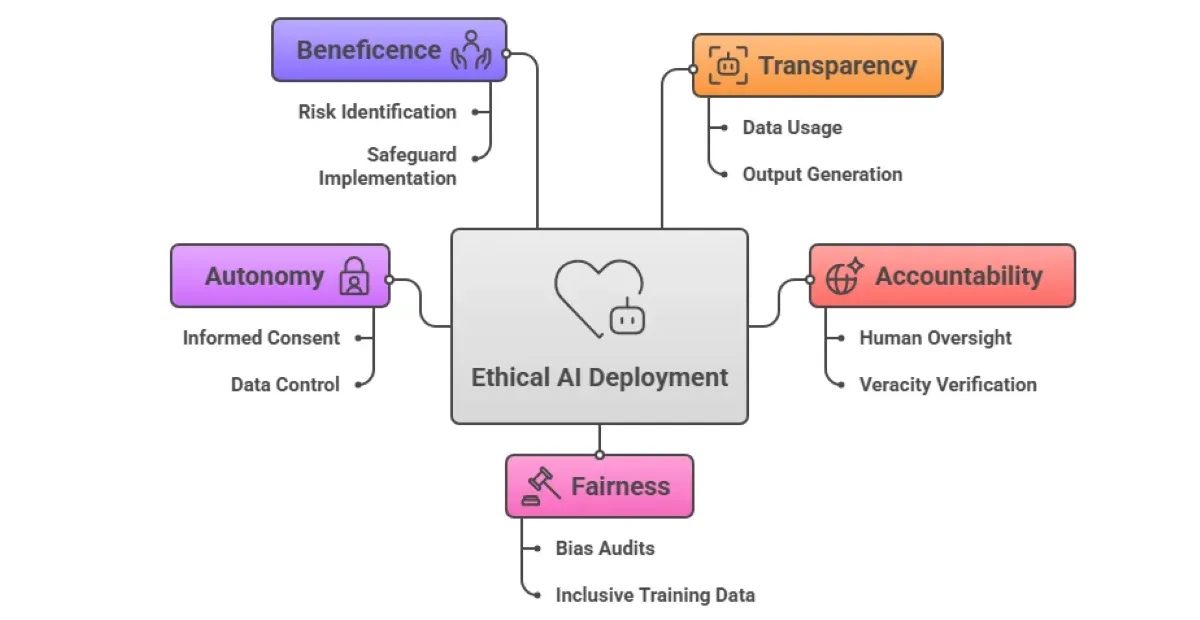
Transparency and accountability in AI systems are essential, requiring clear explanations of how AI generates content and identifying who is responsible for its output. These foundational principles guide ethical implementation.
Organizations must explain how their AI systems work, what data they use, and how outputs are generated. Clear documentation allows stakeholders to understand AI capabilities, limitations, and potential impacts on decisions.
Psychologists must be "the conscious oversight" for controlling and fine-tuning generated output to ensure information does not harm, with ultimate responsibility for verifying the veracity of AI-generated information. Humans remain responsible regardless of automation.
AI systems must treat all users equitably without perpetuating historical biases or creating new forms of discrimination. Regular audits, diverse development teams, and inclusive training data help achieve fairness goals.
Obtaining informed consent and respecting user autonomy is vital, with users having control over how their data is used and understanding the implications of the AI-generated content.
AI systems should benefit society while minimizing potential harm. Organizations must proactively identify risks, implement safeguards, and prioritize human well-being over purely technical or commercial objectives in development decisions.
Generative AI large language models are trained on data sets that include personally identifiable information about individuals, which can sometimes be elicited with a simple text prompt. Protecting sensitive information requires comprehensive security measures.
Training datasets may inadvertently contain names, addresses, financial records, or health information. Organizations must implement data sanitization processes and ensure PII isn't embedded in models or easily extractable through prompts.
Generative AI systems require robust security protocols to prevent malicious actors from extracting sensitive information, manipulating outputs, or compromising system integrity through adversarial attacks targeting model vulnerabilities.
GDPR, CCPA, HIPAA, and other privacy laws impose strict requirements on data handling. Organizations must ensure AI systems allow for data deletion requests, maintain consent records, and provide transparency about information usage.
Democratization and accessibility of GenAI could potentially lead to medical researchers inadvertently disclosing sensitive patient information or consumer brands unwittingly exposing product strategies to third parties.
Organizations should adopt stringent data protection policies, ensure compliance with data privacy regulations, and implement secure data storage and processing practices, while collecting only necessary information.
GenAI systems consume tremendous volumes of data that could be inadequately governed, of questionable origin, used without consent, or biased. The AI systems themselves can amplify additional levels of inaccuracy.
Organizations often lack visibility into where training data originates, how it was collected, and whether proper permissions exist for its use. Unverified internet sources may contain misinformation, outdated information, or unreliable content that compromises model reliability.
Synthetic data produced by generative AI can contaminate future training datasets if not properly segregated. When AI-generated content feeds back into training pipelines, it creates recursive quality degradation and amplifies existing inaccuracies across model generations.
AI models trained on outdated information produce irrelevant outputs. If data is biased, incomplete, or inaccurate, then conclusions drawn may be inappropriate, biased, nonsensical, and/or inaccurate, with data quickly becoming out-of-date without real-time updates.
Incomplete documentation of the data journey, from collection through preprocessing, augmentation, and integration, creates blind spots for quality assurance, compliance verification, and troubleshooting when models produce unexpected or problematic outputs.
Organizations often lack measurable criteria for assessing data completeness, consistency, reliability, and relevance. Without validation processes, quality metrics, and automated checks, substandard data undermines model performance and trustworthiness throughout the AI lifecycle.
Popular generative AI tools are trained on massive image and text databases from multiple sources, including the internet, making the data's source unknown. This creates reputational and financial risks if products are based on another company's intellectual property.
AI-generated content blurs traditional copyright lines. Questions about whether AI can hold copyrights, who owns outputs created from copyrighted training data, and fair use remain legally unsettled across jurisdictions.
Generative AI may generate exact copies of copyrighted materials, presenting them as new material, creating plagiarism risks without proper oversight. Organizations must validate outputs against existing works before publication or commercial use.
Companies need policies defining who owns AI-generated work: the user, the organization, or the AI provider. Attribution guidelines should specify when and how to disclose AI involvement in content creation.
Organizations should prepare for potential infringement allegations by maintaining records of AI system usage, implementing content validation processes, and establishing legal response protocols when copyright holders raise concerns.
Companies must look to validate outputs from models until legal precedents provide clarity around IP and copyright challenges, protecting both their interests and respecting others' rights.
Generative AI techniques sometimes struggle with teasing out important distinctions relevant to human use cases. This creates authoritative-sounding but inaccurate prose or produces realistic-looking imagery with misshapen representations.
AI models predict likely sequences of words or pixels based on training patterns, not truth. They lack comprehension, fact-checking abilities, or awareness when generating plausible-sounding fabrications disconnected from reality.
The ability of generative AI to produce convincing deepfakes and synthetic media threatens the foundations of truth, trust, and democratic values. Detection tools and watermarking technologies help identify manipulated content.
Techniques like retrieval augmented generation and agentic AI frameworks can help reduce hallucination issues. But it's important to keep humans in the loop to verify accuracy and avoid customer backlash or sanctions.
High-profile hallucination incidents have occurred, including chatbots misrepresenting corporate policies and lawyers citing nonexistent court cases. These incidents demonstrate the need for incident response plans, public communication strategies, and corrective action procedures.
AI systems should communicate confidence levels in their outputs, flag uncertain responses, and direct users to authoritative sources. Transparency about limitations helps users make informed decisions about trusting recommendations.
There are potentially a multitude of benefits for harnessing generative AI in practice. These include the generation of scientific hypotheses, identifying complex data patterns, creating course curricula, and speeding up clinical processes.
Psychologists must ensure their use adheres to laws and ethical standards, with considerations for informed consent, maintaining confidentiality, boundaries of competence, and avoiding harm when integrating generative AI into practice.
Students and researchers using AI face questions about authorship, originality, and intellectual contribution. Institutions must develop policies balancing AI's educational benefits against academic honesty requirements and learning outcome preservation.
High-stakes industries like law and finance require explainability for AI-assisted decisions. Professional liability, regulatory compliance, and client confidentiality concerns demand rigorous validation, documentation, and human oversight protocols.
Companies must look to validate outputs from models until legal precedents provide clarity around IP and copyright challenges. Organizations must also institute clear guidelines, governance, and effective communication, emphasizing shared responsibility.
The EU AI Act, China's generative AI regulations, and proposed U.S. legislation create a complex compliance ground. Organizations operating internationally must navigate varying requirements for transparency, testing, and accountability.
Effective governance includes ethics committees, AI review boards, clear decision-making processes, and defined roles for monitoring AI systems. Cross-functional teams ensure technical, legal, and ethical perspectives inform AI deployment.
Written policies should address acceptable use cases, prohibited applications, data handling requirements, human oversight mandates, incident response procedures, and regular auditing protocols tailored to organizational risk profiles.
Organizations need structured approaches for identifying, evaluating, and mitigating AI-related risks. Risk registers, impact assessments, and continuous monitoring help maintain appropriate controls as systems evolve and new threats emerge.
Comprehensive records of model development, training data sources, testing procedures, deployment decisions, and performance monitoring enable regulatory compliance verification, internal audits, and accountability when issues arise.
Ensuring transparency and accountability requires clear explanations of AI system operations, attribution of creators, and robust mechanisms to address and correct errors. Practical implementation strategies mitigate risks.
Organizations should regularly audit AI systems for biases, use diverse and representative training data, and implement measures to mitigate identified biases. Continuous monitoring catches issues before they cause harm.
It's critically important for companies working on AI to have diverse leaders and subject matter experts to help identify bias in data and models. Homogeneous teams miss perspectives necessary for equitable systems.
The most ethical companies are investing in preparing certain parts of the workforce for new roles created by generative AI applications, helping employees develop skills such as prompt engineering.
AI should augment rather than replace human judgment in critical decisions. Define clear touchpoints where human review is mandatory, particularly for high-stakes outputs affecting individual rights, safety, or organizational reputation.
User feedback, employee concerns, and external stakeholder input provide valuable signals about ethical issues. Organizations should establish accessible reporting channels, regular consultations, and transparent processes for addressing concerns.
Generative AI technology evolves rapidly, introducing new ethical dilemmas faster than society can address existing ones. Anticipating future challenges helps organizations stay ahead of emerging risks and opportunities.
AI is being trained to do more daily tasks that knowledge workers do, including writing, coding, content creation, summarization, and analysis, with the pace of worker displacement accelerating due to innovations.
Many AI vendors argue that bigger AI models deliver better results, but this often involves considerably more data center resources for training and inference processes, potentially exacerbating global warming.
Generative AI's political impact is fraught, with technologies potentially making communities better or worse, including social media platforms algorithmically promoting divisive comments to increase engagement over finding common ground.
As AI systems gain greater autonomy in decision-making and task execution, new accountability challenges emerge. Organizations must consider how to maintain meaningful human control while leveraging advanced capabilities.
Rapid AI advancement creates pressure to deploy quickly, sometimes sacrificing thorough ethical review. Organizations need frameworks that enable innovation while maintaining essential safeguards, avoiding shortcuts that create long-term liabilities.
We provide complete generative AI development services from strategy and model creation to integration and optimization, helping enterprises accelerate innovation, streamline operations, and deploy production-grade AI solutions tailored to their unique needs.
We develop custom generative AI models fine-tuned to your data, use cases, and industry workflows. Our models deliver accuracy, scalability, and business-specific impact across text, visuals, and complex datasets.
We integrate generative AI into your existing systems, including CRM, ERP, apps, and proprietary platforms, ensuring seamless adoption, minimal disruption, and maximum efficiency across enterprise workflows and operations.
We design optimized prompts for your business scenarios to ensure consistent and high-quality outputs. Our prompt engineering improves model reliability, contextual accuracy, and overall performance across mission-critical use cases.
Our MLOps experts support deployment, monitoring, scaling, and continuous optimization of your AI systems. We strengthen your internal teams and keep your generative AI infrastructure production-ready at all times.
We automate repetitive coding tasks using AI-powered tools, accelerating development cycles, reducing manual workload, and improving code quality while enabling your teams to focus on innovation and high-value initiatives.

{ "@context": "https://schema.org", "@type": "FAQPage", "mainEntity": [ { "@type": "Question", "name": "What defines ethical generative AI for business use?", "acceptedAnswer": { "@type": "Answer", "text": "Ethical generative AI adheres to principles of transparency, fairness, privacy protection, and accountability. It operates within legal frameworks, respects intellectual property, maintains human oversight, and implements safeguards against bias, misinformation, and harmful outputs while serving legitimate business purposes." } }, { "@type": "Question", "name": "How do you detect and mitigate bias in a generative AI model?", "acceptedAnswer": { "@type": "Answer", "text": "Bias detection involves testing models with diverse datasets, analyzing outputs across demographic groups, and using fairness metrics. Mitigation strategies include diversifying training data, implementing debiasing algorithms, involving diverse development teams, and establishing continuous monitoring processes." } }, { "@type": "Question", "name": "Can generative AI outputs be audited for fairness and transparency?", "acceptedAnswer": { "@type": "Answer", "text": "Yes, generative AI systems can be audited through input-output testing, model explainability tools, bias assessment frameworks, and third-party audits. Documentation of training data, model architecture, and decision-making processes enables comprehensive auditing when systems are designed with transparency." } }, { "@type": "Question", "name": "How long does it take to deploy a governed generative AI solution?", "acceptedAnswer": { "@type": "Answer", "text": "Deployment timelines vary based on use case complexity, regulatory requirements, existing infrastructure, and governance maturity. Simple implementations may take weeks, while enterprise-wide deployments with comprehensive governance frameworks typically require 6–12 months or longer." } }, { "@type": "Question", "name": "What industries benefit most from ethical generative AI frameworks?", "acceptedAnswer": { "@type": "Answer", "text": "Industries such as healthcare, financial services, education, legal services, and government benefit significantly due to strict regulatory requirements, sensitive data handling, and high-stakes decision-making. However, all industries deploying generative AI gain competitive advantages through ethical frameworks." } }, { "@type": "Question", "name": "What happens if an enterprise model produces biased or harmful content?", "acceptedAnswer": { "@type": "Answer", "text": "Organizations face reputational damage, legal liability, regulatory penalties, customer loss, and potential discrimination lawsuits. Response protocols should include immediate content review, affected party notification, root cause analysis, corrective actions, and policy updates to prevent recurrence." } }, { "@type": "Question", "name": "Is it possible to use off-the-shelf generative models ethically?", "acceptedAnswer": { "@type": "Answer", "text": "Yes, but organizations must understand model training data, limitations, biases, and appropriate use cases. Ethical use requires implementing additional safeguards such as output validation, human oversight, clear usage policies, and ensuring the model aligns with organizational values." } }, { "@type": "Question", "name": "What role does human oversight play in generative AI workflows?", "acceptedAnswer": { "@type": "Answer", "text": "Human oversight is essential for verifying accuracy, ensuring ethical compliance, catching hallucinations, providing contextual judgment, maintaining accountability, and making final decisions on sensitive matters. Humans translate AI outputs into responsible actions aligned with organizational values." } }, { "@type": "Question", "name": "How do you monitor and measure bias in production generative systems?", "acceptedAnswer": { "@type": "Answer", "text": "Monitoring involves establishing baseline fairness metrics, implementing automated testing across demographic groups, tracking user feedback, conducting regular audits, analyzing outcome disparities, and using explainability tools to identify bias trends over time." } } ] }
Ethical generative AI adheres to principles of transparency, fairness, privacy protection, and accountability. It operates within legal frameworks, respects intellectual property, maintains human oversight, and implements safeguards against bias, misinformation, and harmful outputs while serving legitimate business purposes.
Bias detection involves testing models with diverse datasets, analyzing outputs across demographic groups, and using fairness metrics. Mitigation strategies include diversifying training data, implementing debiasing algorithms, involving diverse development teams, and establishing continuous monitoring processes.
Yes, through various methods, including input-output testing, model explainability tools, bias assessment frameworks, and third-party audits. Documentation of training data, model architecture, and decision-making processes enables comprehensive auditing when systems are designed with transparency.
Deployment timelines vary significantly based on use case complexity, regulatory requirements, existing infrastructure, and governance maturity. Simple implementations may take weeks, while enterprise-wide deployments with comprehensive governance frameworks typically require 6-12 months or longer.
Healthcare, financial services, education, legal services, and government sectors benefit significantly due to strict regulatory requirements, sensitive data handling, and high-stakes decision-making. However, all industries deploying generative AI gain competitive advantages through ethical frameworks.
Organizations face reputational damage, legal liability, regulatory penalties, customer loss, and potential discrimination lawsuits. Response protocols should include immediate content review, affected party notification, root cause analysis, corrective actions, and policy updates to prevent recurrence.
Yes, but organizations must understand model training data, limitations, biases, and appropriate use cases. Ethical use requires implementing additional safeguards, including output validation, human oversight, clear usage policies, and ensuring the model aligns with organizational values.
Human oversight remains essential for verifying accuracy, ensuring ethical compliance, catching hallucinations, providing contextual judgment, maintaining accountability, and making final decisions on sensitive matters. Humans translate AI outputs into responsible actions aligned with organizational values.
Monitoring involves establishing baseline fairness metrics, implementing automated testing across demographic groups, tracking user feedback and complaints, conducting regular audits, analyzing outcome disparities, and using explainability tools to understand decision-making patterns.
Major costs include diverse training data acquisition, bias testing and mitigation tools, compliance infrastructure, human oversight resources, audit and monitoring systems, legal consultation, ongoing training programs, and potential model retraining to address identified issues.