

Loading...

You've likely heard the conversations around generative AI. Your competitors are exploring it, your leadership team is asking about it, and your customers are starting to expect AI-powered capabilities. But here's where most B2B companies get stuck: figuring out how to actually integrate generative AI into the systems you already have running.
According to McKinsey, 71% of organizations now regularly use generative AI in at least one business function, yet many struggle with the integration challenge. This isn't about replacing everything you've built; it's about strategically embedding AI capabilities into your existing infrastructure without causing operational chaos. This guide walks you through practical integration approaches, readiness assessments, architectural considerations, and a realistic roadmap for B2B companies.
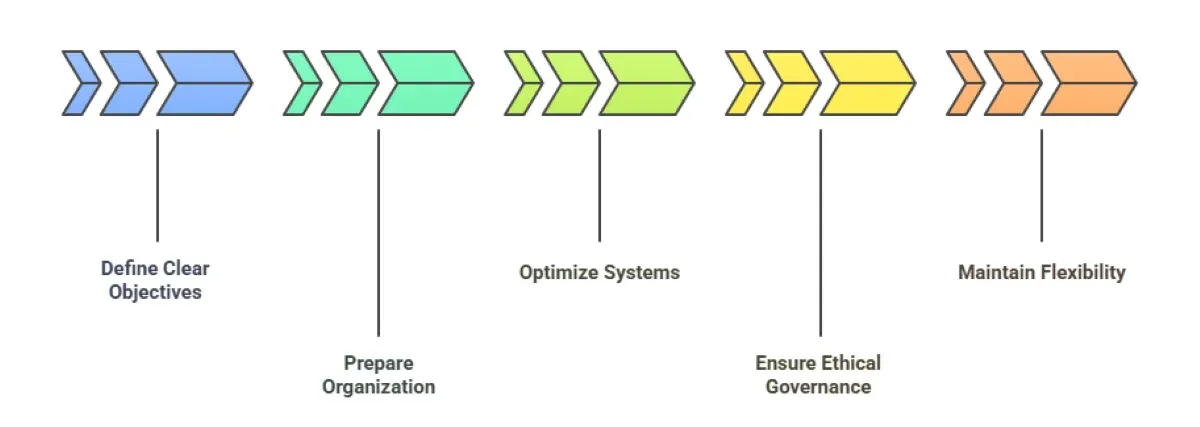
Successful generative AI integration requires methodical planning that balances strategic objectives with practical execution, organizational readiness with technical capability, and short-term wins with long-term sustainability.
Resist rushing into AI adoption despite market hype. Clearly define how generative AI benefits employees and customers, aligns with business goals, and addresses specific operational challenges. Hasty implementation leads to misaligned expectations, wasted resources, and failed projects that damage stakeholder confidence in future AI initiatives.
Acknowledge that the early stages require openness to new processes and patience during skill development. Consider challenges from employees' perspectives, like workflow changes, new responsibilities, and uncertainty about roles. Provide hands-on training, encourage iterative feedback, and allow time for teams to develop proficiency through practice.
Audit existing hardware and software to identify integration requirements without disrupting the entire architecture. Focus on modular integration approaches that enhance current systems incrementally. Prioritize data quality, accessibility, and organization. High-quality data determines AI effectiveness. Consider integration platforms that streamline connections between AI and existing infrastructure.
Develop a responsible AI strategy reflecting organizational values, addressing bias and accountability concerns proactively. Understand current and emerging regulations affecting your industry and geography. Collaborate with established technology partners and consider specialists who bring expertise. Select AI solutions tailored to your specific business needs rather than generic tools.
Build adaptable strategies that accommodate evolving AI technologies and shifting business objectives. Stay current with AI developments through ongoing education for decision-makers who guide integration efforts. Learn from early adopter organizations, research their successes and failures to adapt best practices. Establish a collaborative learning environment with training opportunities and knowledge sharing.
Successful integration requires matching the right approach to your specific operational requirements, existing infrastructure constraints, and business objectives.
Connect pre-built generative AI services through REST APIs to specific applications like CRM or customer portals. This lightweight method requires minimal infrastructure changes, delivers quick time-to-value, and works well for standalone use cases like chatbots or content generation tools.
Embed generative AI as containerized services within your existing microservices architecture using Kubernetes orchestration. This approach provides better scalability, enables version control, allows independent deployment cycles, and maintains clean separation between AI and core business logic.
Deploy generative AI across multiple business functions through a unified data architecture and centralized model management. This comprehensive approach requires significant upfront investment but delivers consistent AI capabilities across sales, operations, and support while maintaining data governance and security standards.
Combine cloud-based generative AI services for scalability with on-premises deployment for sensitive data processing. This balanced approach addresses compliance requirements, reduces latency for critical operations, and provides flexibility as regulatory grounds evolve across different jurisdictions and industries.
Implement Retrieval-Augmented Generation to connect generative models with your existing knowledge bases, documentation, and data warehouses. RAG enables accurate, context-aware responses using your proprietary information while reducing hallucinations and maintaining data freshness without constant model retraining.

B2B organizations recognize that generative AI delivers measurable operational improvements, competitive differentiation, and scalable growth without proportional resource increases.
Generative AI enables rapid development of customer-facing features like intelligent search, automated proposal generation, and conversational interfaces. Development cycles that traditionally took months now complete in weeks, allowing faster response to market demands and competitive pressures.
Automation of repetitive tasks, like technical documentation, support ticket routing, data entry, and report generation, frees skilled employees for strategic work. Companies report 30-50% time savings in content-heavy departments, translating directly to cost reductions and improved resource allocation.
24/7 AI-powered support, personalized product recommendations, and instant access to technical documentation improve customer interactions. Response times drop from hours to seconds, resolution rates increase, and customer satisfaction scores improve measurably across support and sales touchpoints.
Sales teams generate proposals faster, engineers access documentation instantly, and analysts query data using natural language instead of complex SQL. These productivity gains compound across teams, allowing organizations to handle growing workloads without proportional headcount increases.
Early adopters establish market leadership as customers increasingly expect AI-powered capabilities in B2B platforms. Companies without generative AI integration risk appearing outdated, losing deals to competitors offering intelligent automation, and struggling to attract talent expecting modern tools.
Generative AI applications span customer-facing operations, internal workflows, and technical processes, delivering value across departments when integrated with existing systems.
AI chatbots access CRM data, order histories, and product documentation to resolve customer inquiries without human intervention. Complex issues get automatically routed to appropriate specialists with context already gathered, reducing resolution time and improving first-contact resolution rates.
Generate comprehensive product documentation, API references, and troubleshooting guides directly from code repositories and engineering specifications. Documentation stays current automatically, reduces engineer time spent on manual updates, and improves consistency across all technical materials.
Create customized proposals, RFP responses, and competitive analyses by pulling data from CRM systems, past proposals, and product specifications. Sales teams spend less time on document creation, maintain messaging consistency, and respond faster to opportunities with higher-quality materials.
Automatically review vendor agreements, service contracts, and MSAs to identify risks, non-standard terms, and compliance issues. Legal teams process contracts faster, miss fewer critical clauses, and maintain better visibility into contractual obligations across the organization.
Query data warehouses using natural language instead of SQL, generate reports automatically, and receive proactive insights about trends and anomalies. Business users access data independently without waiting for technical teams, accelerating decision-making and reducing bottlenecks in analytics workflows.
Most B2B companies successfully pilot generative AI projects but struggle to scale these initiatives into production-ready, enterprise-grade implementations across their infrastructure.
Older ERP, CRM, and database systems lack modern API interfaces, use outdated authentication methods, and contain data in formats incompatible with generative AI requirements. Integration requires middleware layers, data transformation pipelines, and careful architecture planning to avoid disrupting existing operations.
Business data sits isolated in separate systems. Salesforce holds customer data, ERP contains financial information, and support platforms track issues independently. Generative AI needs unified access to provide accurate, context-aware responses, requiring data integration strategies that respect security boundaries while enabling AI functionality.
Generative AI introduces new attack surfaces, data exposure risks, and regulatory compliance challenges. Organizations must implement proper access controls, audit logging, data encryption, and output validation while meeting industry-specific regulations like GDPR, HIPAA, or SOC 2 requirements.
Integration projects demand skills in machine learning, API development, infrastructure management, and security, capabilities that many IT teams lack. Organizations face competition for AI talent, extended project timelines due to learning curves, and difficult decisions about building internal expertise versus partnering with specialists.
Cross-functional stakeholders, like IT, legal, compliance, and business units, must agree on AI usage policies, data access rules, and success metrics. Without clear governance frameworks, projects stall in committee discussions, pilot programs never scale, and different departments deploy incompatible AI solutions.
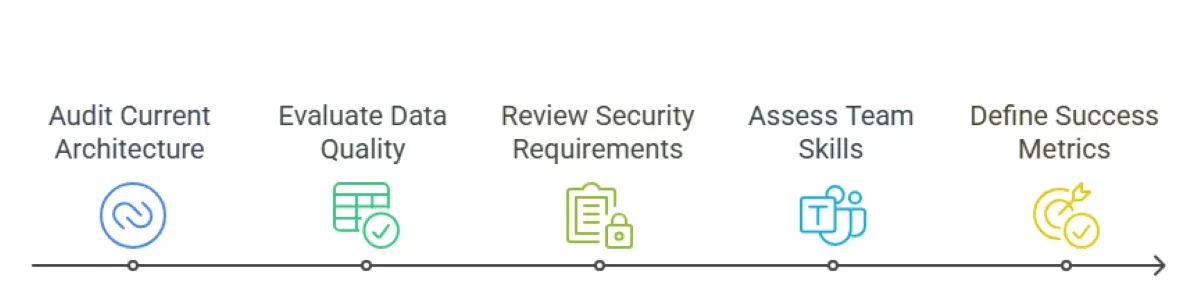
Systematic evaluation of your current infrastructure, data quality, security posture, and team capabilities determines integration feasibility and identifies gaps requiring remediation.
Document existing systems, APIs, data flows, and authentication mechanisms across your infrastructure. Identify which applications need AI capabilities, where data bottlenecks exist, what APIs are available, and which legacy systems require special attention during integration planning.
Assess whether your data is structured appropriately, accessible through APIs, sufficiently clean for AI consumption, and comprehensive enough to support intended use cases. Poor data quality produces poor AI outputs, like address data governance, cleanup requirements, and accessibility issues, before implementing AI.
Identify regulatory constraints (GDPR, CCPA, HIPAA), data residency requirements, access control policies, and audit logging needs. Determine whether your current security infrastructure supports AI workloads or requires upgrades to authentication systems, network segmentation, or monitoring capabilities.
Evaluate whether your team understands prompt engineering, model evaluation, API integration, and AI operations. Identify training needs, determine whether you need external expertise, and plan for ongoing education as AI technologies evolve rapidly and require continuous skill development.
Establish measurable outcomes like cost reduction percentages, time savings, customer satisfaction improvements, or revenue impacts that justify investment. Clear metrics enable objective evaluation of pilots, inform scaling decisions, and help stakeholders understand AI's business impact beyond technical achievements.
Recognizing inherent constraints and failure modes of generative models enables appropriate use case selection, necessary safeguards, and realistic expectation management.
Generative models confidently produce plausible but incorrect information, especially when asked about topics outside training data or when making logical inferences. Enterprise deployments require human review workflows, fact-checking mechanisms, and clear user warnings about accuracy limitations for critical business decisions.
Models have finite context windows limiting conversation length and the information they can process simultaneously. They also lack knowledge of events after their training cutoff dates, requiring Retrieval-Augmented Generation or external data sources for current information and large document processing.
Training data biases manifest in model outputs, potentially affecting hiring decisions, customer interactions, or business recommendations unfairly. Organizations must test for bias across demographic groups, implement fairness monitoring, and maintain human oversight where AI decisions impact individuals or protected classes.
Generative AI identifies patterns and correlations but cannot determine causation or reason through complex logical chains reliably. For strategic decisions requiring causal understanding, like why sales dropped, what changes will improve outcomes. AI provides suggestions requiring human analysis rather than definitive answers.
Not every business process benefits from generative AI. Highly regulated decisions, processes requiring strict accuracy, safety-critical operations, and creative work requiring genuine innovation often need human expertise. Successful implementations match AI capabilities to appropriate tasks while keeping humans in control where necessary.
Folio3 delivers comprehensive generative AI services from strategy through deployment, enabling B2B companies to implement AI capabilities without building specialized teams.
As a trusted Generative AI development partner, we deliver end-to-end solutions designed to help enterprises accelerate innovation, optimize operations, and achieve measurable business impact. From strategy to deployment, our scalable Generative AI consulting and technology services enable organizations to unlock new levels of efficiency and growth.
We design and build custom Generative AI models, fine-tuned to your data, industry, and use cases. Whether it's text, visuals, or complex datasets, our models deliver accuracy, scalability, and business-specific value that generic solutions cannot match for specialized B2B applications.
We seamlessly embed Generative AI solutions into your existing IT ecosystem. From CRM and ERP systems to proprietary platforms, we ensure smooth integration without disrupting workflows, maximizing operational efficiency while respecting your existing infrastructure investments and security requirements.
Our experts craft optimized prompts tailored to your enterprise applications, ensuring consistent, relevant, and high-quality AI outputs. The result: better model performance and reliable results, every time, with reduced need for extensive post-processing or human correction of generated content.
Strengthen your internal teams with our seasoned MLOps specialists. We support your Generative AI infrastructure services by managing model deployment, monitoring, scaling, and ongoing optimization—keeping your AI systems production-ready at all times without requiring you to build full-time internal ML operations teams.
We automate repetitive coding tasks using AI-driven tools, accelerating software development cycles, reducing manual effort, and ensuring higher code quality, all while freeing your teams to focus on high-value initiatives that require human creativity and strategic thinking.

Traditional AI integration deploys specialized models for specific predictive tasks like fraud detection or demand forecasting. Generative AI integration requires handling natural language interfaces, managing larger context windows, implementing prompt engineering, addressing hallucination risks, and connecting to broader knowledge bases for context-aware generation.
API-based integrations for single use cases are complete in 4-8 weeks, while microservices-based implementations spanning multiple functions take 3-6 months. Enterprise-wide platform integration with custom model development, data pipeline creation, and governance framework establishment typically requires 6-12 months from planning through production deployment.
Building in-house makes sense if you have ML expertise, unique requirements, and a long-term commitment to maintaining AI infrastructure, while buying off-the-shelf solutions works for standard use cases. Partnering with specialists like Folio3 balances customization, speed-to-market, and manageable resource requirements for most B2B companies lacking deep AI expertise.
Generative AI requires accessible data through APIs or databases, reasonably clean formatting without excessive inconsistencies, sufficient volume for fine-tuning if using custom models, and proper metadata for retrieval systems. Unlike predictive AI, which requires extensive cleaning and labeling, generative models tolerate some imperfection but perform better with well-structured, comprehensive datasets reflecting actual business contexts.
Track quantitative metrics like time savings (hours saved per week per employee), cost reductions (tickets automated, processes streamlined), revenue impacts (faster deal cycles, increased conversions), and customer satisfaction improvements. Compare baseline performance before AI against post-implementation metrics, as most companies see measurable ROI within 6-12 months for well-scoped implementations.
Key risks include data exposure through model outputs revealing training data, prompt injection attacks manipulating model behavior, excessive access to internal systems through AI integrations, and compliance violations if AI processes regulated data improperly. Mitigate through proper access controls, output filtering, input validation, comprehensive audit logging, and regular security assessments.
Yes, though it requires middleware layers and careful architecture planning, including API wrappers, data transformation pipelines, or modern integration platforms connecting old databases to AI services. RAG architectures work particularly well, allowing AI to query legacy data without requiring system modernization, though performance and maintenance considerations require evaluation.
Implement human-in-the-loop review for high-stakes outputs, use RAG to ground responses in verified data sources, add confidence scoring to flag uncertain responses, and establish output validation against business rules or databases. Maintain clear user warnings about AI limitations, as no method eliminates hallucinations; appropriate use case selection matters most.
GDPR requires transparency about AI usage and data protection safeguards, while CCPA mandates disclosure of automated decision-making, and industry regulations (HIPAA for healthcare, SOC 2 for service providers) impose data handling requirements. Some jurisdictions require human review of AI decisions affecting individuals, so engage legal counsel to assess specific requirements for your industry and geography.
Start with basic AI literacy explaining capabilities and limitations, provide hands-on training with actual tools employees will use, teach prompt engineering skills, and address concerns about job displacement through honest discussion of augmentation versus replacement. Establish clear policies about appropriate usage, data handling, and when human judgment supersedes AI suggestions.