
Loading...

Enterprises are racing to deploy AI agents, but here's the uncomfortable reality: 87% of AI projects never make it to production. Why? Because automation without human oversight doesn't just underperform, it fails spectacularly.
According to Accenture research, only 35% of consumers trust how organizations are implementing AI. That trust gap? It's costing businesses millions in abandoned initiatives and damaged reputations.
But what if the answer isn't choosing between human expertise and AI speed? That's exactly what human-in-the-loop AI delivers. It combines human judgment with machine intelligence to ensure accuracy, fairness, and trust in high-stakes workflows. As a result, AI transforms from a risky black box into a reliable teammate that scales your operations while maintaining the control, compliance, and accountability your business actually needs.

Human-AI collaboration exists across a spectrum, from continuous human involvement to full automation. Understanding where your workflows fall determines the right balance between efficiency and control, with most enterprise applications requiring varying degrees of human participation based on risk and complexity.
In HITL systems, humans participate at various stages of the AI lifecycle, including training, validation, and real-time operation. Every decision requires explicit human approval before execution, making this approach ideal for high-stakes scenarios like medical diagnoses or financial approvals.
Humans oversee AI operations without participating in every decision. The system operates autonomously but alerts humans when confidence drops, anomalies appear, or outcomes require verification, balancing efficiency with oversight.
AI operates independently without human intervention. While maximizing efficiency, this approach introduces risks, including undetected errors, compliance failures, bias amplification, and the inability to handle novel situations requiring contextual judgment or ethical reasoning.
Fully autonomous AI systems promise efficiency but deliver risk. While 95% of companies now use generative AI, with 79% implementing AI agents, only 1% consider those implementations "mature", exposing the gap between deployment and reliable performance.
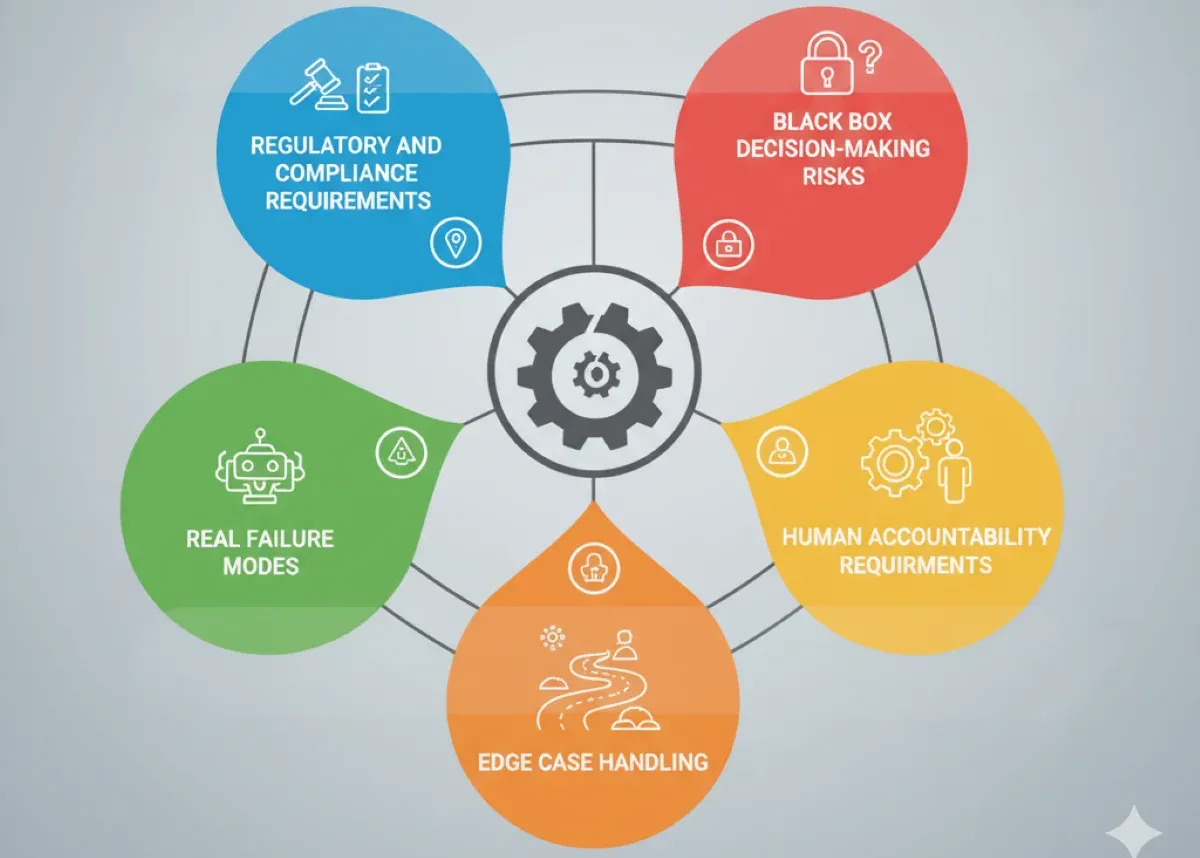
Industries like finance, healthcare, and logistics operate under strict regulatory requirements that necessitate human review for compliance purposes. Autonomous agents cannot ensure adherence to GDPR, HIPAA, or SOC2 standards without human validation checkpoints at critical junctures.
AI models often operate as opaque systems where decision paths remain unclear. Without explainability and oversight, enterprises cannot justify choices to auditors, customers, or regulators, creating legal and reputational exposure.
Agent systems can hallucinate actions, misinterpret prompts, loop through tool calls unnecessarily, or burn excessive tokens to complete simple tasks. These failures translate directly into operational costs, customer dissatisfaction, and compliance violations.
High-stakes decisions involving financial transactions, healthcare diagnoses, or safety-critical operations require human accountability. Autonomous systems cannot accept legal responsibility or apply ethical reasoning when outcomes affect human welfare.
AI systems struggle with edge cases and scenarios not well-represented in training data. Human oversight catches these failures, providing corrections that prevent immediate issues and contribute to long-term system improvement through feedback.
Effective hybrid AI systems balance automation with oversight through foundational principles that govern when agents act independently and when humans must intervene. These principles create predictable, auditable workflows that combine machine speed with human judgment for optimal outcomes.
AI agents must articulate why they made specific recommendations. This includes showing data sources, confidence scores, decision factors, and alternative options considered, enabling humans to evaluate proposals intelligently rather than accepting outputs blindly.
Systems define specific confidence ranges that trigger escalation, such as toxicity scores between 0.4 and 0.6, requiring human review. Clear numerical thresholds eliminate ambiguity about when agents proceed independently versus when they must pause for human judgment.
Workflows include deliberate pause points at critical junctures where humans review agent proposals and can approve, modify, or reject recommendations. These checkpoints protect against automated errors while maintaining operational flow.
Human reviewers receive sufficient context and background information to make informed decisions quickly without cognitive overload. This includes relevant data, agent reasoning, historical patterns, and business rules that influenced the AI's recommendation.
Predetermined rules define scenarios requiring escalation: low confidence, high financial impact, regulatory triggers, safety concerns, or novel situations. Agents automatically transfer control to appropriate human reviewers based on these criteria.
HITL systems create feedback loops where human decisions and corrections help improve the underlying AI models, creating systems that become more accurate and reliable over time. Every human intervention trains the agent to handle similar situations better.
Complete audit trails capture every agent action, human decision, override rationale, and outcome. These logs satisfy regulatory requirements, enable performance analysis, and provide accountability when reviewing past decisions or investigating issues.
When agents encounter errors or excessive costs, systems fall back to default workflow branches rather than failing. This ensures business continuity even when AI components experience issues or behave unexpectedly.

Trust in AI agents emerges through consistent, predictable performance backed by transparency and human oversight. Implementing these practices transforms AI from a suspicious black box into a reliable business tool that employees and stakeholders confidently depend on.
Establish specific, measurable conditions that trigger human review. These include confidence thresholds, risk levels, complexity indicators, and edge case detection triggers. Document these criteria clearly so both humans and agents understand exactly when escalation occurs.
Successful HITL implementation requires an intuitive UI design where reviewers can quickly understand agent recommendations and take action. Include one-click approve/reject options, clear confidence scores, highlighted decision factors, and relevant context without overwhelming users with unnecessary data.
Use observability tools like LangFuse, AgentOps, and Arize Phoenix to track reasoning chains, tool call loops, token usage, and decision quality. Real-time dashboards expose what agents are doing, how often they retry operations, and where costs accumulate before budgets explode.
Generic models lack context about your business rules, terminology, and edge cases. Agents need clean, labeled, diverse data that represents actual workflows, including uncommon scenarios. Continuously refine training sets based on human corrections and new situations.
Deploy dashboards showing agent reasoning chains, confidence scores with explanations, and highlighted factors influencing each decision. Transparency builds trust by demonstrating that agents consider appropriate information and follow logical decision paths.
Begin by automating a single process where AI can make an immediate impact, such as task prioritization or automated routing, to build confidence before broader implementation. Start with pilot teams, measure success metrics, adjust based on feedback, then scale gradually.
Successful AI implementations combine predictable workflows with dynamic agent decision-making. Understanding when to use structured orchestration versus autonomous agents, and how to blend both, determines whether your system delivers reliable business value or expensive chaos.
Workflows handle 80% of predictable work through deterministic processes with defined steps. Use workflows for data retrieval sequences, approval chains, notification patterns, and standard operating procedures where paths are known in advance.
Deploy agents when situations require reasoning, planning, or creative problem-solving. Agents excel at interpreting ambiguous inputs, selecting appropriate tools, adapting strategies based on intermediate results, and handling scenarios without predefined solutions.
The strongest systems map predictable tasks in workflows, then identify decision points where agents provide creative reasoning before returning control to the workflow. This combines reliability with flexibility, using each approach where it excels.
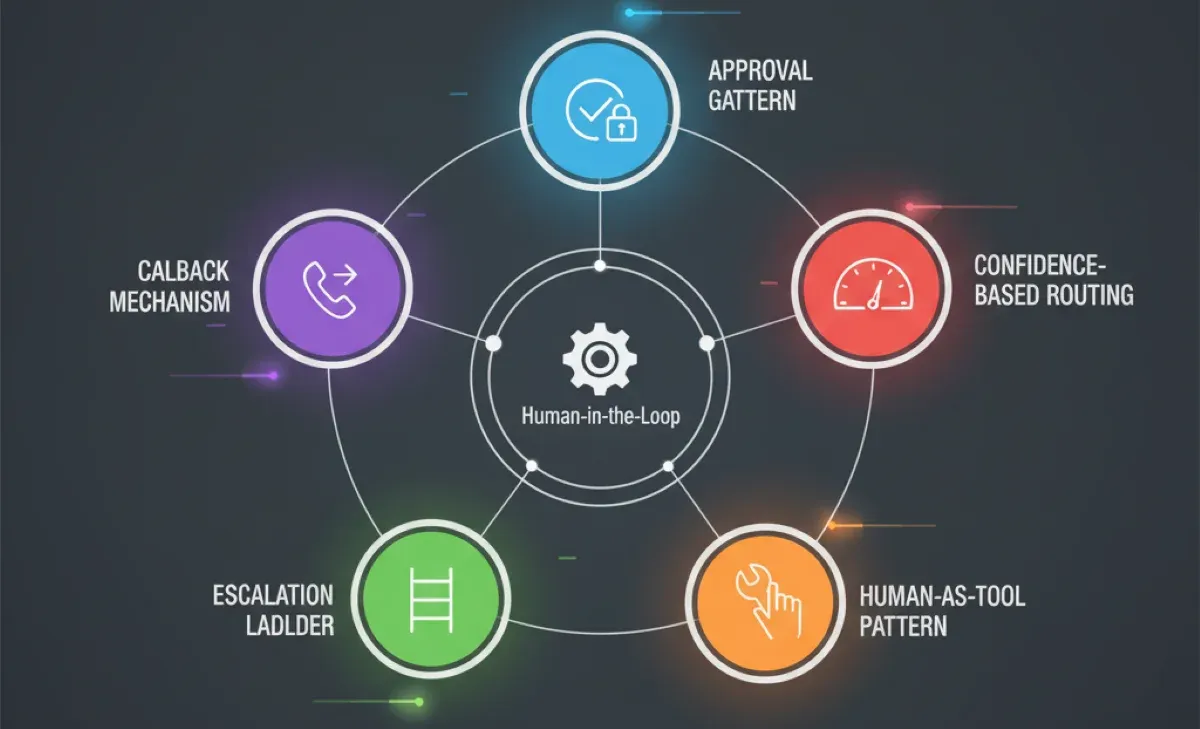
Modern HITL implementations follow proven architectural patterns that balance automation efficiency with human oversight. These design patterns address specific collaboration scenarios, enabling teams to build reliable hybrid systems without reinventing foundational approaches.
Workflows pause mid-execution using interrupt functions, wait for human input through familiar tools like Slack or email, then resume cleanly after approval. This pattern maintains flow while ensuring human oversight at critical junctures.
Systems automatically route high-confidence decisions through automated processing while flagging uncertain cases for human review based on predefined score thresholds. This optimizes human attention on cases truly requiring judgment.
Agents treat human expertise as callable tools, requesting input through standardized interfaces when encountering situations requiring human knowledge or judgment. This inverts traditional oversight, making humans available resources rather than bottlenecks.
Complex or high-stakes decisions follow tiered escalation paths. Agents handle routine cases, team leads review moderate complexity, and managers address strategic or high-value decisions, distributing cognitive load appropriately.
When agents need information they cannot obtain independently, they pause execution, issue callbacks to humans or external systems, wait for responses, then continue processing. This enables asynchronous workflows without blocking entire processes.
Effective override systems balance automation efficiency with human control. Well-designed escalation mechanisms ensure agents handle appropriate decisions autonomously while routing complex, high-risk, or ambiguous situations to qualified human reviewers through predictable, transparent pathways.
Knowing when to shift control from AI agents to human reviewers prevents costly errors while maintaining operational efficiency. Clear escalation triggers eliminate ambiguity, ensuring appropriate decisions receive human judgment without creating unnecessary bottlenecks for routine operations.
When agent confidence falls below defined thresholds, automatic escalation ensures uncertain decisions receive human validation.
Financial transactions exceeding specified amounts, decisions affecting customer relationships, or actions with significant business impact.
Agents encountering scenarios different from training examples should escalate rather than extrapolate unreliably.
Certain industries have regulatory requirements necessitating human review for compliance purposes, while maintaining the benefits of automation.
User concerns, even if unexplained, warrant human attention as they may indicate issues the agent cannot perceive.
Different business scenarios require different control mechanisms. Understanding these override types enables architects to design systems that match organizational risk tolerance, operational tempo, and regulatory requirements while maintaining appropriate human authority over AI decisions.
Agents present proposed actions and wait for explicit human approval before executing. This prevents unintended consequences but introduces latency, making it suitable for high-risk decisions.
Agents execute decisions immediately but flag them for human review afterward. This maintains speed while enabling humans to catch errors before downstream impacts occur.
Humans observe agent operations as they occur, ready to intervene immediately if problems arise. This approach works for critical operations requiring continuous oversight without blocking every action.
When agents need input they cannot obtain independently, they suspend execution, request human response through defined channels, then continue once they receive guidance.

Real-world HITL implementations vary dramatically across industries, each with unique risk profiles and regulatory constraints. These examples demonstrate how different sectors apply escalation mechanisms to balance automation benefits with sector-specific oversight requirements.
Automated quoting handles standard deals, but proposals exceeding value thresholds or including non-standard terms require sales manager approval to prevent revenue leakage or commitments the company cannot fulfill.
AI diagnostic assistants escalate uncertain cases to physicians rather than suggesting potentially incorrect treatments. This combines AI pattern recognition with medical expertise for patient safety.
Autonomous fleet management systems alert supervisors when vehicle safety metrics decline, enabling preventive intervention before mechanical failures or accidents occur.
In invoice parsing workflows, high-confidence extractions proceed directly to ERP systems while edge cases are flagged for human review. This achieves speed with accuracy on critical financial data.
Transactions with fraud scores below 0.4 process automatically, above 0.7 block automatically, but ambiguous scores between 0.4 and 0.7 route to fraud analysts who apply contextual judgment.
Even well-intentioned AI implementations fail when organizations overlook practical challenges. These pitfalls undermine system reliability, slow adoption, and waste resources.
Without clear guidance, human reviewers either rubber-stamp AI recommendations without actual review or apply inconsistent standards that undermine system reliability. Ambiguity about decision authority creates friction, slows workflows, and diminishes trust in the entire system.
Successful HITL implementation requires intuitive, low-code human-AI collaboration platforms. When interfaces require excessive clicks, bury relevant information, or lack mobile support, reviewers avoid the system or make hasty decisions to escape a poor user experience.
The most successful companies treat AI as a new paradigm, leading to an experimental mindset and iterative approach that gets to value faster with greater buy-in. Rushing to full automation before validating accuracy, identifying edge cases, or securing user trust creates expensive failures.
Without metrics, organizations cannot determine whether hybrid workflows deliver value, identify areas needing improvement, or justify continued investment. Flying blind prevents optimization and obscures both successes and failures throughout the implementation lifecycle.
According to Big Data Wire, 55% of organizations cite a lack of skilled personnel as a major barrier to scaling generative AI. Teams unfamiliar with AI capabilities, limitations, and proper oversight methods either misuse systems or resist adoption entirely.
A feedback loop is essential for long-term accuracy gains, allowing AI to learn from past corrections and gradually reduce the need for human intervention. Without systematic capture of human decisions and model retraining, agents repeat the same mistakes indefinitely.
Addressing HITL challenges requires deliberate planning and proven strategies that transform common failure points into success factors.
Provide checklists to help reviewers stay consistent, ensuring they understand both the tools and expectations. Document specific review criteria, approval authority levels, and escalation paths so every reviewer knows their responsibilities.
Present all relevant context on a single screen. Provide clear approve/reject/modify buttons. Show confidence scores and reasoning prominently. Enable mobile review for on-the-go decisions. Test interfaces with actual users before full deployment.
Adopt a crawl-walk-run strategy: start small, monitor closely, and scale with purpose. Begin with non-critical processes, measure outcomes rigorously, incorporate learnings, then expand gradually as confidence builds.
Track key performance indicators, including automation rates, override frequency, and reviewer efficiency, to evaluate model performance and overall workflow effectiveness. Monitor trends over time to validate that systems improve through continuous learning.
Provide training and support to enhance confidence in using new technologies, while actively seeking employee input and highlighting AI tool benefits. Cover AI fundamentals, system-specific workflows, review best practices, and escalation procedures.
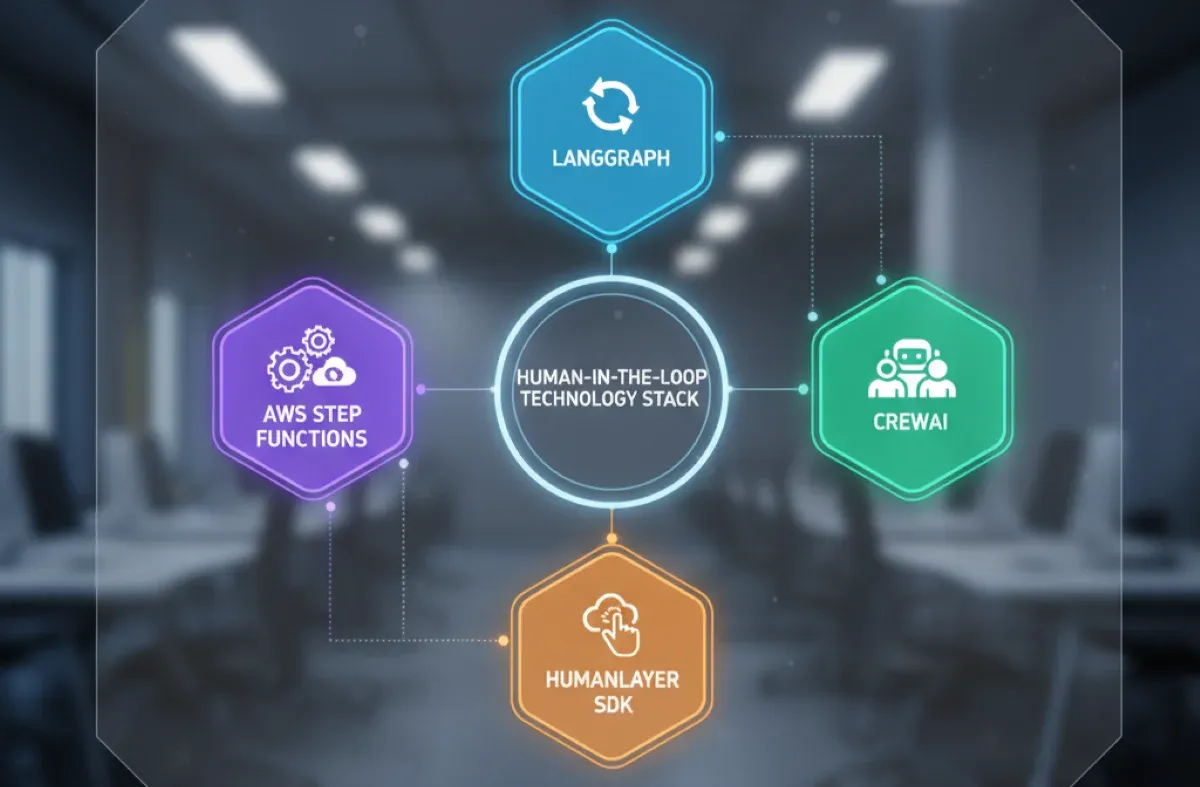
Leading HITL frameworks offer specialized capabilities for integrating human oversight into AI workflows. Each framework addresses different architectural needs, from structured orchestration to multi-agent collaboration, enabling teams to select tools matching their specific use cases and technical constraints.
LangGraph is ideal for building structured workflows where you need full control over how an agent reasons, routes, and pauses, with interrupt functions that pause graphs mid-execution, wait for human input, and resume cleanly.
CrewAI focuses on collaborative, role-based agent teams, great for decomposing tasks among agents with different goals, with HITL coming via human_input or by defining a HumanTool the agent can call for guidance.
HumanLayer SDK enables agents to communicate with humans via familiar tools like Slack, Email, and Discord, with decorators that wrap functions to make approval logic seamless for asynchronous human decisions.
Step Functions workflow orchestration runs through a series of steps, including generating content using LLMs and involving human decision-making at defined checkpoints. Ideal for complex multi-step processes requiring durable execution.
Modern HITL systems require seamless connections between AI components, enterprise applications, and communication channels. These integration patterns enable data flow across systems, support both cloud and on-premise deployments, and leverage pre-built connectors to accelerate implementation.
APIs are key components of AI workflows, driving the ability to connect services and enable software applications to communicate and exchange data, features, and functions.
Modern platforms include ready-made connections for CRM, ERP, ticketing systems, and collaboration tools. These accelerate implementation by eliminating custom integration development for common enterprise applications.
Hybrid cloud environments combine on-premise and cloud resources to provide flexibility and scalability, with AI and ML models helping teams make better decisions and optimize resources.
Deploying production-ready HITL systems requires more than technical capability; it demands a deep understanding of AI frameworks, industry requirements, and practical implementation challenges. Folio3 combines all three to deliver hybrid AI workflows that balance automation with oversight.
We build AI agents using advanced platforms like AutoGen, LangChain, and CrewAI, powered by GPT-4, Claude, and other leading LLMs that are tailored to fit your business needs, delivering solutions optimized for your specific workflows.
Unlock new efficiencies with a clear AI adoption strategy. We assess your business processes, recommend the right agents for maximum impact, and define a roadmap for scalable implementation that aligns with your strategic objectives.
Build intelligent agents that adapt to your workflows, designed with flexibility, performance, and real-time decision-making in mind. Our custom development ensures agents integrate seamlessly with existing systems while meeting your unique business requirements.
Seamlessly plug AI agents into your tech stack. We ensure smooth data exchange, compatibility across platforms, and security throughout integration, connecting agents with your CRM, ERP, databases, and collaboration tools.
From updates to continuous tuning, we ensure your agents remain high-performing and aligned with your evolving needs. Our ongoing optimization incorporates human feedback, refines confidence thresholds, and improves accuracy through regular model retraining.
Craft natural, intuitive user experiences with multimodal interfaces that foster trust and adoption. We design review interfaces that make human oversight efficient rather than burdensome, encouraging engagement rather than resistance.

Autonomous agents lack accountability, cannot handle regulatory requirements, struggle with edge cases, and risk expensive errors without oversight. Enterprises need human judgment for high-stakes decisions, ethical reasoning, and compliance validation that AI cannot reliably provide alone.
Human-in-the-loop is a collaborative approach integrating human judgment and expertise into AI development and decision-making processes, where humans actively participate in training, validation, and operation of AI models.
Override mechanisms include pre-approval, where humans authorize actions before execution, post-approval, where agents act but humans review afterward, concurrent monitoring, where humans observe real-time, and callback patterns where agents pause and request human input when needed.
Healthcare benefits from diagnostic assistance with physician oversight. Finance uses AI for fraud detection with analyst validation. Legal services employ document review with attorney verification. Manufacturing leverages predictive maintenance with engineer approval. Any regulated industry requiring accountability gains significantly.
Build trust through transparency, showing agent reasoning, confidence scores indicating certainty levels, explainable AI dashboards visualizing decision factors, consistent accuracy over time, complete audit trails, and phased rollouts that prove reliability before full deployment.
Without transparency into how AI models process data and generate insights, it's difficult to know if results are built on solid data or if hidden biases and errors are creeping in. Explainability builds trust by revealing decision logic and enabling meaningful human oversight.
AI handles high-volume routine cases quickly while humans focus only on low-confidence or exception cases, combining speed with quality control and reducing total workload without sacrificing accuracy. Confidence-based routing ensures humans only review cases truly requiring judgment.
Complete audit trails capture every decision, human override, and rationale. Role-based access controls enforce separation of duties. Timestamp logs prove review timing. Retention policies maintain records per regulatory requirements. Explainability features demonstrate decision appropriateness during audits.
Typical timelines: 4-6 weeks for pilot implementation on a single workflow, 2-3 months for production deployment across one business unit, 6-12 months for enterprise-wide rollout, depending on complexity. Phased approach validates value before major investment.
Folio3 combines framework expertise across LangGraph, CrewAI, and custom solutions with deep industry knowledge in healthcare, finance, and logistics. We provide pre-built HITL patterns, compliance-first design, integration capabilities with existing systems, and ongoing optimization, ensuring sustained performance.