
Loading...

Test automation is changing fast. According to a recent study by Gartner, organizations using AI-augmented testing report 40% faster release cycles and 35% fewer defects. Large language models are driving this shift, enabling the automation of manual test creation.
If you're still writing test scripts line by line, you're missing out. LLMs in test automation aren't hype; they're changing how software teams build, test, and ship products. This guide covers everything you need to know to get started.
Large language models are AI systems trained on massive datasets to understand and generate text that resembles human language. They use transformer architectures and neural networks to process context, predict patterns, and create responses.
Models like GPT-4, Claude, and Llama can write code, analyze requirements, and generate test cases because they've learned from billions of code samples and documentation. Unlike traditional rule-based tools, LLMs adapt to context and handle ambiguity, which makes them useful for complex testing scenarios.

LLMs are changing test automation by removing bottlenecks that have slowed down QA teams for years. They generate tests from plain language, adapt to code changes, and spot edge cases humans miss, which changes how software teams think about quality assurance.
LLMs generate complete test scripts from plain English descriptions. You describe what needs testing, and the model writes executable code in your preferred framework. No more spending hours translating requirements into Selenium or Cypress commands by hand.
Traditional automation misses edge cases because humans can't think of everything. LLMs analyze code and requirements to identify boundary conditions, null scenarios, and unusual input combinations that would take days to think through manually.
When your application changes, LLMs update tests automatically. They read code diffs, understand modifications, and regenerate affected test cases without manual work. Self-healing tests mean less maintenance and fewer broken CI/CD pipelines to fix.
Feed user stories or feature descriptions directly to LLMs without technical specifications. They parse natural language, extract test scenarios, and create comprehensive test suites from Jira tickets, product docs, or casual descriptions, with no detailed specs needed.
LLMs prioritize which tests to run based on code changes rather than executing everything. They analyze commit history, identify affected areas, and select relevant test cases intelligently. This cuts the regression suite runtime from hours to focused minutes.
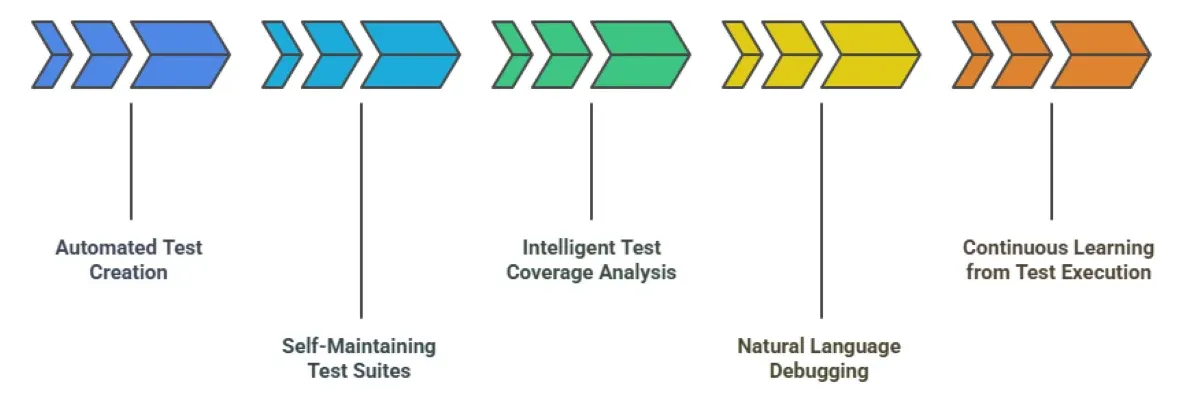
Traditional testing relies on manual scripting, rigid frameworks, and reactive debugging. LLMs add intelligence and adaptability to every phase, shifting teams from writing tests to managing automated quality assurance that learns and improves over time.
Instead of writing test functions line by line, you describe test scenarios conversationally to LLMs. The model generates complete test suites with proper setup, assertions, and teardown blocks. One well-crafted prompt creates dozens of production-ready test cases in seconds.
LLMs monitor code repositories and automatically update tests when applications change without human help. Broken selectors get fixed, outdated logic gets refreshed, and deprecated methods get replaced as code changes, removing the test maintenance burden most teams deal with.
LLMs scan entire codebases to identify untested code paths and missing test scenarios automatically. They suggest new test cases for uncovered functions, recommend boundary tests, and highlight risky areas based on code complexity and how often code changes.
When tests fail, LLMs analyze stack traces, compare expected versus actual results, and explain failures in plain English instead of cryptic error messages. They suggest fixes, identify root causes, and even generate code patches automatically for common failure patterns.
LLMs learn from test execution patterns over time rather than staying static. They identify flaky tests, recognize patterns in failures, optimize test sequences for speed, and improve prediction accuracy. Each test run makes the system smarter and more reliable.
LLMs bring specific features to test automation that traditional tools can't match. These capabilities fix the biggest pain points QA teams face daily, from test creation through maintenance and optimization.
Paste user stories, API documentation, or feature specifications into an LLM and watch it work. It extracts test scenarios, creates positive and negative test cases, and structures them in BDD, TDD, or standard unit test format automatically.
LLMs write tests in Python, JavaScript, Java, TypeScript, Go, or any language your stack requires. They adapt syntax automatically, use correct testing frameworks, and follow language-specific best practices. Language barriers don't limit your automation coverage anymore.
LLMs generate complete API test suites by analyzing OpenAPI specs, Swagger docs, or Postman collections automatically. They create request payloads, validate response schemas, test authentication flows, and handle error scenarios with comprehensive edge case coverage instantly.
LLMs understand application structure and generate UI tests that interact intelligently with interfaces beyond brittle selectors. They locate elements semantically using context, handle dynamic content gracefully, and adapt to layout changes without fragile XPath dependencies constantly breaking.
LLMs create realistic test data that matches your specific domain requirements. Need 1000 customer records with valid emails, addresses, and purchase histories? LLMs generate contextually accurate datasets respecting data types, constraints, and business rules in seconds.
Not all LLMs perform the same in testing scenarios. Picking the right model and implementation approach directly affects test quality, generation speed, maintenance costs, and long-term team productivity. Think through these factors carefully.
Commercial models like GPT-4 and Claude offer better code understanding and context handling, but come with per-token API costs. Open-source alternatives like Llama and CodeLlama run locally, keeping your code private and eliminating usage charges at the cost of slightly lower accuracy.
Large codebases need models with big context windows to understand how different parts connect. GPT-4 Turbo handles 128K tokens, and Claude supports 200K tokens. Smaller contexts force chunking strategies that make test generation harder for complex applications with deep call hierarchies.
Simple unit tests work fine with lightweight models like GPT-3.5-turbo or smaller Llama variants. Complex integration tests requiring deep code analysis need GPT-4 or Claude Sonnet's better reasoning. Match model capability to test complexity for the best cost and performance balance.
Generic LLMs sometimes generate incorrect tests for specialized domains like fintech, healthcare, or industrial systems. Fine-tuning on your codebase, past tests, and domain-specific patterns dramatically improves output quality while reducing false positives and maintenance work substantially.
Cloud APIs offer easy integration and zero infrastructure, but raise data privacy concerns for proprietary code. On-premise deployments using open-source models keep sensitive code internal but require significant infrastructure investment, ML expertise, and ongoing maintenance costs.
How you communicate with LLMs determines output quality. Good prompt engineering and retrieval-augmented generation transform mediocre results into production-ready tests. Master these techniques to get the most value from LLM testing and reduce iteration cycles.
Specific prompts consistently beat vague requests in quality and accuracy. Include test type, framework, programming language, edge cases, and expected output format explicitly. "Write pytest unit tests for UserAuthentication covering valid/invalid credentials and token expiration" works much better than "write some tests."
Show LLMs 2-3 examples of your preferred test style and structure before requesting new tests. Provide samples showing naming conventions, assertion patterns, and organization structure. LLMs copy the demonstrated style across all generated tests, keeping everything consistent automatically.
Retrieval-augmented generation connects LLMs to your test documentation, API specs, and past test cases. When generating new tests, models pull relevant examples and patterns from your knowledge base automatically, keeping everything consistent, accurate, and following established patterns.
Break large testing tasks into focused, manageable prompts instead of requesting entire test suites at once. Generate tests file-by-file or class-by-class with clear context boundaries. Smaller, focused contexts produce significantly more accurate and maintainable tests every time.
Initial LLM outputs rarely meet production standards on the first try. Use iterative prompting: generate tests, review results thoroughly, provide specific feedback, and regenerate. This conversation-style approach gets you to production quality through progressive refinement and learning.
LLMs don't replace your testing infrastructure; they make it better. Good integration connects AI capabilities with proven frameworks and automation pipelines, creating hybrid systems that combine human expertise with machine efficiency without disruption.
LLMs generate browser automation code fully compatible with existing Selenium or Playwright configurations. They create proper page objects, write test methods following conventions, and handle waits using your current framework patterns. Integration requires no migration costs or framework changes.
LLMs understand testing framework conventions and generate natural code automatically. They create pytest fixtures, Jest describe blocks, proper assertions, and mock configurations that execute immediately in your existing test runners without modifications or compatibility issues.
Integrate LLMs into GitHub Actions, Jenkins, or GitLab CI for automated test generation on every commit. LLMs analyze code changes, generate new tests for modified functionality, update affected existing tests, and execute the full suite automatically within your standard pipeline.
Store LLM-generated tests in Git alongside hand-written tests with no distinction. Track prompt templates, model versions, and generation parameters in version control. This creates comprehensive audit trails and lets anyone reproduce test generation across all team members.
LLMs don't just generate tests; they interpret execution results. Connect them to test runners for failure analysis, error categorization, fix suggestions, and readable reports explaining what broke, why it failed, and potential solutions clearly.
Different industries face unique testing challenges, compliance requirements, and domain-specific scenarios. LLMs adapt to specialized needs across sectors, generating tests that understand industry context, regulatory constraints, and business-critical workflows.
LLMs generate compliance-focused tests for payment processing, transaction validation, and fraud detection systems automatically. They create test cases covering regulatory requirements like PCI-DSS and SOC 2, making sure financial calculations match specifications precisely while validating security controls.
Medical applications demand rigorous testing for patient safety and regulatory compliance. LLMs generate HIPAA-compliant test data, validate EHR workflows, create tests for medical device software following FDA guidelines, and make sure patient safety features work correctly under all operating conditions.
LLMs automate testing for checkout flows, payment gateway integrations, inventory management, and recommendation engines across platforms. They generate test scenarios covering multiple currencies, shipping methods, promotion combinations, and abandoned cart recovery that human testers often miss.
Multi-tenant SaaS platforms need extensive testing across configurations, user roles, and permission levels at once. LLMs generate tests for each tenant scenario, API endpoint, webhook integration, and data isolation requirement automatically, making sure tenant data never leaks between accounts.
LLMs create tests for mobile apps across Android and iOS platforms, generating device-specific scenarios for different screen sizes, OS versions, network conditions, and hardware capabilities. For IoT systems, they test device communication protocols and handle edge cases well.
The tools available for LLM testing keep growing. These solutions make implementing AI-powered test automation accessible to teams regardless of size, budget, or technical expertise levels.
Copilot suggests test code as you type in your IDE, completing test functions, generating assertions, and creating mock data based on your codebase context. It's free for open-source projects and available via subscription for commercial use with enterprise licensing options.
Open-source tool inspired by Meta's TestGen-LLM research. Analyzes existing code and test suites, identifies coverage gaps systematically, generates additional tests automatically, and validates that they actually increase coverage before adding them to your repository for permanent use.
A commercial platform that generates comprehensive test suites from code analysis automatically. Provides test suggestions directly in your IDE, creates thorough test coverage, and integrates with major testing frameworks. Offers individual developer and team plans with enterprise support.
Framework for building LLM-powered applications with flexible architecture. Create custom test generation pipelines, implement RAG for test documentation retrieval, chain multiple models together, and build specialized testing agents tailored to your unique requirements and constraints.
Open-source framework specifically designed for testing LLM outputs and validation. Validates that generated tests are correct, measures quality metrics, runs regression tests on test generators themselves, and makes sure output quality stays consistent across different model versions.
Generated tests need rigorous validation before production deployment. These metrics and techniques make sure LLM-produced tests actually improve quality rather than creating maintenance headaches, technical debt, or false confidence in test coverage.
Measure whether LLM tests actually execute all code paths. Track line coverage, branch coverage, and mutation testing scores. Compare coverage before and after LLM integration to quantify improvement and identify gaps requiring manual test creation.
Count real bugs caught by LLM-generated tests versus hand-written tests for comparison. Good tests find actual issues during development and prevent production incidents. Track defects discovered during development and escaped defects to validate genuine test quality improvements.
LLMs sometimes generate tests that fail incorrectly when the code is actually correct. Monitor false positive rates; tests failing when code works correctly indicate poor test quality. Aim for under 5% false positives to maintain developer trust and productivity.
Measure time spent fixing broken tests after code changes in hours. LLM-generated tests should reduce maintenance burden significantly, not increase it compared to manually written tests. Track hours spent on test updates before and after LLM adoption for ROI calculation.
When developers review LLM-generated tests, what percentage gets merged without requiring changes or corrections? High acceptance rates indicate quality generation and good prompts. Low rates signal prompt engineering problems or model selection issues requiring adjustment.
LLMs aren't perfect and come with limitations you'll need to work around. Understanding common problems and proven solutions prevents disappointment and helps you implement test automation that delivers lasting value rather than creating new problems.
LLMs sometimes generate plausible-looking tests that don't actually work or validate wrong behaviors. Always execute generated tests in isolated environments, validate they pass with correct code and fail with bugs, and implement mandatory human review for critical paths.
LLMs can't process infinite code at once due to token limits. For large applications, split test generation into manageable chunks, use RAG to provide relevant context, and implement hierarchical generation—high-level tests first, detailed implementation tests second.
LLMs can produce different outputs for identical prompts due to randomness. Use low temperature settings (0.0-0.2) for consistent results, store successful prompts and outputs in version control, and implement retry logic with validation to catch non-deterministic issues early.
Sending proprietary code to commercial LLM APIs risks intellectual property exposure and compliance violations. Use on-premise models for sensitive code, sanitize inputs by removing secrets before API calls, and implement strict access controls on LLM-generated artifacts.
Full automation without review creates technical debt and quality problems over time. Set up review processes where experienced testers validate critical test paths manually, use automation for repetitive tests, while humans handle complex scenarios requiring judgment.
LLM testing keeps getting better with new capabilities appearing regularly. These upcoming trends and proven practices help you stay ahead as AI-powered testing becomes the standard approach.
Next-generation systems use multiple specialized LLM agents working together on testing tasks. One agent analyzes requirements, another generates tests, a third validates outputs, and a fourth manages execution, creating fully autonomous QA pipelines requiring minimal human work.
Future LLMs will process visual interfaces directly using computer vision. Instead of generating code to click buttons blindly, they'll observe screenshots, understand UI layouts, and generate tests by watching applications exactly like human testers do with visual context.
LLMs will monitor production systems, detect problems automatically, and generate tests reproducing issues immediately. When users report bugs, systems will create failing tests instantly, speeding up debugging cycles and making sure fixes actually work correctly before deployment.
Current LLMs are generalists trained on everything. Expect domain-specific models trained exclusively on testing tasks, models that understand test patterns better, generate higher-quality outputs consistently, and require significantly less prompt engineering and iteration for production quality.
LLMs will generate tests during development in real-time, not after code completion. As developers write code, AI will suggest tests immediately, making sure test coverage grows alongside features rather than lagging, catching bugs before they're committed.
Implementing LLM-powered test automation requires the right technical approach and domain expertise. At Folio3 AI, we help organizations explore and implement LLM testing solutions that align with their specific testing needs and technical infrastructure.
We work with your team to assess where LLM automation makes sense in your testing workflow. Our consultation covers your current testing setup, identifies suitable use cases for LLM integration, and helps you understand the technical requirements, costs, and expected outcomes before implementation begins.
We help integrate LLM capabilities into your existing test automation frameworks. This includes selecting appropriate models for your use case, developing prompt templates that work with your application domain, and connecting LLMs with your current testing tools like Selenium, Cypress, or pytest.
When generic LLMs don't produce accurate enough results for your domain, we can fine-tune models using your existing test data and codebase. This improves test generation quality for specialized applications in fintech, healthcare, or other industries with unique testing requirements.
We build custom solutions that leverage LLMs for specific testing tasks; whether that's automated test case generation, test data creation, or failure analysis. These solutions integrate with your development workflow and work alongside your existing QA processes.
We provide technical support during LLM testing implementation, helping your team set up infrastructure, optimize prompts for better results, and troubleshoot issues as they arise. Our goal is to help you get LLM testing working effectively within your environment.
Not entirely. LLMs excel at generating standard test cases but struggle with complex business logic and specialized domain knowledge. They work best for speeding up test creation while human testers focus on critical paths and edge cases requiring deep domain expertise.
GPT-4 and Claude Sonnet lead for code understanding and test quality. For cost-conscious teams, GPT-3.5-turbo handles simpler tests adequately. Open-source options like Llama 3 work well for on-premise deployments despite slightly lower accuracy.
Commercial API costs range from $0.03-$0.06 per 1K tokens. Generating a comprehensive test suite might cost $5-$20, depending on complexity. Open-source models have zero API costs but require infrastructure investment for hosting.
Yes, always. LLMs produce working code most of the time, but occasionally generate incorrect assertions or miss edge cases. Set up code review processes where experienced testers validate generated tests before merging.
Yes. LLMs analyze existing code regardless of age and generate compatible tests. However, poorly documented legacy systems may produce lower-quality results. Providing context through RAG or documentation improves generation accuracy.
Use on-premise open-source models, implement API request sanitization, removing sensitive information, or negotiate enterprise contracts with commercial providers offering private instances and data residency guarantees.
No testing approach catches everything. LLMs generate comprehensive test coverage but can't anticipate every scenario. Combine LLM testing with manual exploratory testing, security audits, and performance testing for complete quality assurance.
Basic integration takes 1-2 weeks. Proof-of-concept setups work in days. Production-ready implementations with RAG, fine-tuning, and CI/CD integration typically require 1-3 months, depending on codebase complexity and team experience.
Yes, with proper setup. Connect LLMs to your CI/CD pipeline to analyze code diffs on each commit. They identify affected tests, regenerate outdated ones, and create new tests for added functionality automatically.
Teams report 40-60% reduction in test creation time, 30-50% decrease in maintenance overhead, and 20-35% improvement in defect detection. Most organizations see positive ROI within 3-6 months of implementation.